Schefflera Soil: Mix, Drainage & Repotting
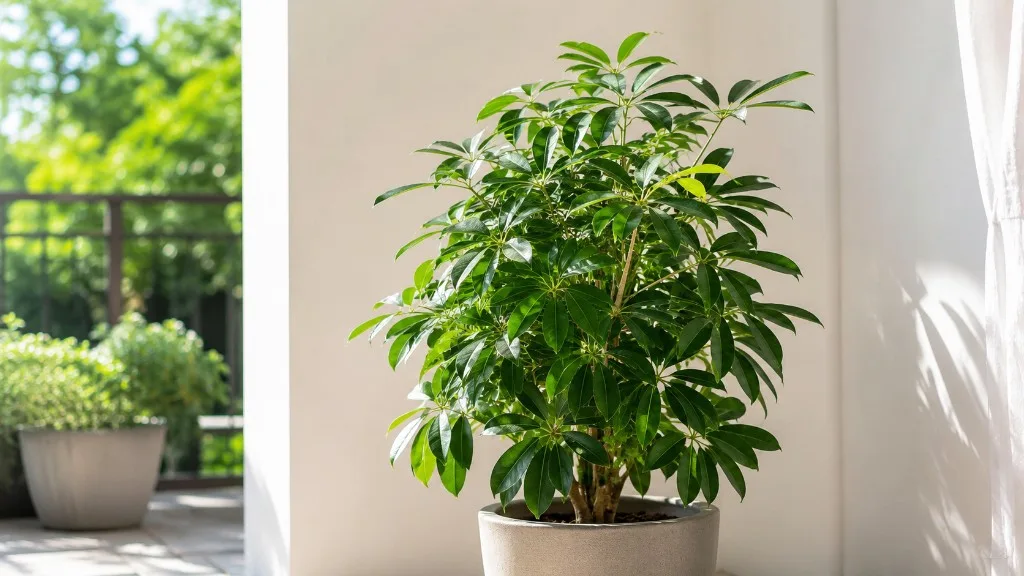
Schefflera Soil: Mix, Drainage & Repotting
Schefflera Soil: Mix, Drainage & Repotting
Schefflera - the umbrella tree or dwarf umbrella tree on your shelf - is not failing because you skipped a secret ingredient. It is failing because the soil system around its roots is either too wet, too compacted, or too large for the root ball to manage. Schefflera arboricola and the larger Schefflera actinophylla evolved in rainforest margins where moisture is available but oxygen still moves freely through the root zone. Indoors, that translates to one practical target: a well-draining, airy potting mix in a right-sized pot with a real drainage hole, refreshed before it compacts into a swamp. Nail the substrate and your Schefflera watering guide becomes predictable. Miss it, and you will chase yellow leaves, sudden leaf drop, and mushy roots while the mix quietly suffocates the plant below the surface.
This guide covers what Schefflera needs from soil, why saturated mix causes root rot on Schefflera, the exact DIY recipes that work indoors, whether bagged potting soil is enough on its own, how pot material changes drainage speed, when pH and salt buildup matter, how to repot without shock, species differences between arboricola and actinophylla, the mistakes that weaken umbrella trees over months, and quick checks that tell you whether the mix - not light or fertilizer - is the real problem.
What Schefflera actually needs from its soil
Schefflera is a woody-stemmed member of the Araliaceae family - the same broad group that includes fatsia and ivy - built for upright growth with a branching crown of palmate leaves. The roots are fibrous and capable of producing aerial roots on lower stems in humid conditions, which is a clue that they expect air as much as moisture. Indoors, your job is not to recreate a permanently damp forest floor. Your job is to build a mix that holds enough moisture for steady uptake while draining excess water within hours and staying open enough for oxygen between waterings.
The useful mental model is a two-speed root zone: the upper profile should dry noticeably within a few days in a typical bright room, while the lower profile should never stay cold, dark, and saturated for a week after a single thorough watering. If the entire pot feels heavy and cool five days after you watered, the mix is too retentive, the pot is too large, or both - regardless of how healthy the leaves looked when you bought the plant.
Rainforest understory origins and what they mean indoors
Schefflera arboricola, the dwarf umbrella tree most commonly sold as a houseplant, is native to Taiwan and Hainan Province in southern China. In the wild it grows along stream banks and in wet forests, sometimes as an epiphyte on tree branches, according to Missouri Botanical Garden data. Schefflera actinophylla, the larger umbrella tree, comes from northern Queensland, Australia, and nearby Pacific regions, where it also occupies rainforest and coastal forest margins.
Those habitats sound wet, but epiphytic and stream-bank growth tells you something important: roots are often exposed to fast drainage and moving air, not a sealed tub of mud. NC State Extension describes the dwarf form as preferring a well-drained potting medium rich in organic matter indoors, with soil allowed to dry between soakings. That combination - organic matter for moisture and nutrients, drainage for oxygen - is the indoor translation of rainforest edge conditions.
The moisture-air balance woody roots depend on
Schefflera roots need three things from soil: water films thin enough to absorb, air spaces large enough to breathe, and stable structure that does not collapse after six months of watering. Peat-heavy mixes without coarse amendments satisfy the first requirement and fail the second. Pure bark or gravel-heavy mixes satisfy drainage and fail retention, forcing you into daily watering in dry apartments.
The balance point for most indoor growers sits around evenly moist, never soggy. Water should move through the pot freely when you soak it, the top 1–2 inches (2.5–5 cm) should dry before the next watering during active growth, and the mix should not smell sour or feel like wet concrete when you press a finger into the side drainage hole zone. Schefflera tolerates brief drought better than prolonged saturation - Missouri Botanical Garden notes that leaves drop if soils become too moist or too dry - but chronic dryness causes leaf drop and stunted new growth. Soil is the lever that keeps you in the middle.
Why waterlogged mix leads to root rot faster than you think
Root rot is the headline fear for Schefflera owners, and for good reason. It is the most common fatal outcome when soil and watering work against each other. The rot itself is caused by fungal and bacterial pathogens that multiply when roots lose oxygen in saturated, warming mix. overwatering on Schefflera is the trigger people name, but poor soil structure and oversized pots are often the hidden co-conspirators - you can water with reasonable caution and still rot roots if the lower third of the pot never dries.
What saturated soil does to Schefflera roots
Healthy Schefflera roots are firm, pale tan to white, and spread evenly through the mix. When soil stays saturated, oxygen diffuses out of water-filled pores faster than roots consume it. Fine root tips die first. The plant responds above ground with yellowing leaves, wilting in wet soil, and eventual leaf drop - a confusing picture because wilting looks like thirst when the real problem is drowning.
As dead root tissue decays, pathogens spread into the crown. At that point, Schefflera repotting guide into fresh mix helps only if enough living root remains to support the canopy. Prevention is cheaper than surgery. That is why drainage speed matters more than any single organic amendment in the recipe.
Early warning signs your mix holds too much water
Catch a failing soil system early and you can often correct it with a repot rather than a funeral. Watch for these patterns:
The pot still feels heavy and cool four to five days after a normal watering in spring or summer. Water pools on the surface for more than a few seconds instead of infiltrating. A sour, swampy, or stagnant smell rises when you lift the plant or slide it from the cachepot. New growth stalls while older leaves yellow from the bottom up. Fungus gnats appear in steady numbers because their larvae thrive in perpetually moist organic mix. Leaf drop happens after you were careful with water, which usually means the lower profile stayed wet even when the surface looked dry.
If two or more signs show up together, inspect the root ball before you tweak light or fertilizer. The mix is telling you it is no longer a safe home.
The best DIY potting mix recipes for indoor Schefflera
The best soil for Schefflera is a light, chunky, well-draining blend built from ingredients that each do one job clearly. You do not need exotic components. You need the right proportions and fresh structure at repot time.
Standard blend: potting soil, perlite, and bark chips
This is the recipe I recommend as a default for most indoor Schefflera arboricola plants in plastic or glazed ceramic pots:
60% high-quality all-purpose potting soil as the base - peat-based or peat-free houseplant mix with no added moisture-control gel crystals. 20% perlite or pumice for aeration and fast drainage. 20% fine orchid bark or pine bark fines for structure, slow moisture release, and long-term pore space.
Measure by volume, not weight. Mix dry in a tub or on a tarp until the perlite and bark are evenly distributed. The finished blend should feel loose in your hand, not sticky.
A simpler ratio that works equally well: 3 parts potting soil, 1 part perlite, 1 part fine bark. That is easy to scale for a single 8-inch pot or a batch for several plants.
If you prefer a peat-forward recipe aligned with slightly acidic preferences, blend 2 parts peat moss or coco coir, 1 part quality potting soil, 1 part perlite, and a small handful of compost per gallon of mix. Keep perlite at at least 25% of total volume so the peat does not dominate drainage.
Recipe adjustments for different home conditions
Soil is not one-size-fits-all because rooms differ. Adjust the base recipe with these rules:
Humid homes or heavy-handed waterers: Increase perlite or pumice to 30% and bark to 25%, dropping potting base to 45%. You are buying forgiveness against overwatering.
Dry apartments with forced-air heat: Hold potting base at 60–65% and do not push perlite below 20%. Consider 10% coco coir instead of extra peat if you need slightly better rewetting when the mix goes dry.
Terracotta pots: Terracotta pulls moisture through the walls, so you can run 55% base, 25% perlite, 20% bark without the plant drying unnaturally fast in moderate humidity.
Schefflera actinophylla in large floor containers: Larger plants in bright light drink steadily. Use the standard 60/20/20 blend but never skip bark - big pots compress over time, and bark slows that collapse.
Propagation or fresh cuttings: Rooting stems want the same drainage principles with slightly finer texture. Use 50% potting base, 30% perlite, 20% fine bark in small pots so the limited root mass does not swim in a large wet reservoir.
Can you use store-bought potting soil straight from the bag?
Sometimes, but rarely without amendment. Modern all-purpose indoor potting mixes are designed for a wide range of plants, which means they lean more moisture-retentive than Schefflera prefers long term. A fresh bag in a small pot with a drainage hole can carry a new plant through its first season if you water only when the top 2 inches dry and you empty the saucer.
Problems appear when the same mix compacts, when the plant moves into a larger pot, or when the bag was formulated with moisture-control crystals that keep the lower profile damp. Straight bagged soil also fails in cachepots without drainage, because no mix can overcome standing water at the bottom.
The practical rule: treat unamended potting soil as a base ingredient, not a finished Schefflera soil mix. Stir in 25–30% perlite at minimum before repotting an established plant. If you are buying pre-mixed soil labeled for houseplants or tropicals, check the label for added wetting agents or water-holding polymers and avoid those for Schefflera.
Cactus or succulent mix alone is usually too lean for Schefflera unless you blend it back toward retention. A workable compromise is equal parts cactus mix and quality potting soil plus 10% bark - but the 60/20/20 recipe above is simpler and more predictable.
Garden soil or topsoil is never appropriate indoors. It compacts, carries pests and pathogens, and does not drain fast enough in a container profile.
Pot choice, drainage holes, and perched water tables
Soil cannot do its job in a container that traps water. A drainage hole is non-negotiable for long-term Schefflera health. Water must leave the pot after each soak so the lower root zone can exchange air before the next watering.
Pot size matters as much as mix recipe. Choose a container only 1–2 inches (2.5–5 cm) wider in diameter than the current root ball for most repots. Oversized pots hold a large volume of mix the roots do not reach, and that unused mix stays wet for weeks - the classic setup for root rot in an otherwise careful home.
Depth should match Schefflera’s relatively shallow-to-moderate root habit. Extremely deep pots without proportional root mass recreate the oversized-pot problem vertically.
Terracotta is an excellent partner for Schefflera because it increases evaporative loss through the walls, sharpening the dry-down signal you feel when lifting the pot. Glazed ceramic and plastic retain moisture longer, which is fine if you adjust perlite upward or water more cautiously.
The gravel or pottery shard layer at the bottom of pots is a persistent myth. It does not improve drainage in the way most people imagine; it can instead create a perched water table where the fine mix above the coarse layer holds water higher in the root zone. Skip the gravel. Use a hole, a saucer you empty, and a well-mixed perlite-bark profile.
Cachepots are fine for display if the grow pot inside has holes and you never let runoff sit. Schefflera should not live permanently in a sealed decorative pot.
pH, fertilizer salts, and when soil chemistry matters
Drainage and aeration solve most Schefflera soil problems. Chemistry matters when you are doing everything else right and still seeing burned leaf tips, pale new growth, or crusty white deposits on the mix surface.
Ideal pH range and salt buildup signs
Schefflera grows well in slightly acidic to neutral soil, roughly pH 6.0 to 7.0. Most quality peat-based or peat-free potting mixes already land in that range without adjustment. NC State Extension lists acid to neutral soil pH among acceptable cultural conditions for Heptapleurum arboricola outdoors, which aligns with typical indoor blends.
You usually do not need to test pH unless you are mixing from raw components or reusing problematic soil. If you do test, a simple meter or send-out kit is enough; chasing perfect 6.3 is less useful than fixing drainage.
Salt buildup from hard tap water or heavy fertilizer is a more common indoor issue. Signs include brown or black leaf tips, crispy margins on older leaves, and white mineral crust on the pot rim or mix surface. Flush the pot occasionally by watering deeply until water runs clear from the hole, or refresh the mix at repot. Hold fertilizer for a few weeks after a flush so you do not stack salts on stressed roots.
Fluoride sensitivity appears in some Schefflera; chronic tip burn on a well-drained plant in appropriate light sometimes traces to water quality rather than mix pH. That is not a soil recipe fix, but refreshing mix and flushing reduces the background salt load while you address water.
When to repot Schefflera and how to refresh the mix safely
Repotting is the right move when the soil system - not just the plant size - stops supporting healthy roots. Schefflera does not need annual repotting by calendar alone.
Signs the soil system needs replacement
Repot when you see roots circling the bottom or emerging from drainage holes, when the plant dries out unusually fast because roots displaced mix, when the mix has compacted and water channels down the sides, when you detect a sour smell even after careful watering, or when growth stalled last season despite good light and sensible water.
Spring through early summer is the safest window, as new growth accelerates and roots repair quickly. Avoid repotting a stressed, dropping plant in deep winter unless the roots are clearly rotting in wet mix - in that emergency, trim mush, repot into dry-ish fresh mix, and keep humidity moderate without soaking.
Steps that reduce shock: Water lightly the day before so the root ball holds together. Choose a pot one size up with a hole. Tease circling roots gently and trim black mush with clean scissors. Set the plant at the same depth as before - burying the crown deeper invites stem rot. Backfill with fresh 60/20/20 mix, tap the pot to settle, water once lightly, and place back in the same light for a week before resuming normal care. Skip fertilizer for three to four weeks while roots establish.
Schefflera arboricola vs actinophylla soil differences
Both species want well-draining, organic-rich mix, but scale and growth rate change how errors show up.
Schefflera arboricola - the dwarf umbrella tree - usually lives in 6- to 10-inch pots indoors and reaches roughly 4–6 feet in a container. Its root mass is moderate, so overpotting is the most common soil-related mistake. The standard 60/20/20 recipe with conservative watering fits most homes.
Schefflera actinophylla grows larger indoors - potentially 10–15 feet in bright atriums - and drinks more steadily in active growth. It still rots in wet mix; do not interpret size as permission for heavy garden soil. Use the same chunky blend, but in a stable floor pot with excellent drainage, and refresh mix every two to three years because large volumes compact under their own weight.
If you grow both, keep separate saucers and labels at repot time. The recipes overlap; the pot volume and watering cadence diverge.
Common soil mistakes that kill umbrella trees slowly
Most Schefflera decline is gradual - a wet lower profile weeks before the canopy collapses. These are the mistakes I see most often:
Using unamended moisture-retentive mix in a large pot is the top error. The surface dries, you water, the bottom stays saturated.
No drainage hole or permanent standing water in a cachepot nullifies even a perfect DIY blend.
Oversized pots after repot “to give room to grow” create a permanent wet zone.
Gravel drainage layers that raise the perched water table into the root zone.
Reusing old, compacted mix from another plant imports pests, pathogens, and poor structure.
Bottom watering exclusively without occasional top watering can leave salts concentrated in the upper profile while the lower third stays too wet in deep pots.
Adding sand alone to heavy peat often makes concrete-like texture indoors. Perlite or pumice works better for aeration.
Repotting into dry desert mix meant for cacti forces chronic drought stress and leaf drop in a plant that expects moderate, even moisture.
Ignoring aerial roots on lower stems in very humid rooms - if they reach for open air, the mix may be too wet or the pot too deep for that stem section.
Quick diagnostic checks before you change the mix
Before you repot on impulse, run three checks that take less than five minutes and often isolate soil problems from light or pest issues.
The infiltration check: Water slowly from the top. If water races down the inside wall and out the hole while the center stays dry, you have channeling from compacted or shrunken peat - refresh is due. If water pools on top for more than a few seconds, the surface has crusted or the mix is too fine without enough bark.
The weight-and-dry-down check: Lift the pot right after watering, then again three days later during active growth. If it is still noticeably heavy and the top 2 inches feel cool and moist while growth has stalled, your mix or pot size is too retentive.
The root-zone smell test: Slide the plant partly out of the pot. Fresh mix smells earthy. Sour, eggy, or swampy odor means anaerobic conditions - roots may already be declining even if only a few leaves have yellowed.
If two or more checks fail, repot into fresh 60/20/20 perlite-bark mix, right-size the pot, and confirm a clear drainage path. If checks pass but foliage still looks wrong, move next to light exposure and pest inspection - but always rule out the soil system first, because that is where Schefflera lives every hour of the day.
Conclusion
Schefflera soil success comes down to three linked decisions: a well-draining, airy potting mix with perlite and bark that moves water through within hours, a right-sized pot with a real drainage hole that prevents a permanent wet zone, and timely mix refresh before compaction turns your careful watering into root rot. The rainforest and epiphytic native habit explains why umbrella trees want moisture and oxygen at the same time - not a sealed bog in a decorative pot.
Blend 60% quality potting base with 20% perlite and 20% fine bark (or the simpler 3:1:1 ratio), water when the top 1–2 inches dry during active growth, empty the saucer after every soak, and repot when roots crowd or the mix smells sour. Get those habits in place and Schefflera rewards you with steady palmate foliage, manageable dry-down rhythm, and the kind of boring root-zone health that makes the rest of umbrella tree care feel straightforward.
When to use this page vs other Schefflera guides
- Schefflera overview - Start here for whole-plant context before deep-diving this topic.
- Schefflera problems hub - Jump to symptom-specific fix guides when this care topic does not resolve the issue.
- Root Rot on Schefflera - Escalate here when soil adjustments are not enough.
- Mold on Soil on Schefflera - Escalate here when soil adjustments are not enough.
Related Schefflera guides
- Schefflera overview
- Schefflera watering
- Schefflera light
- Schefflera propagation
- Schefflera fertilizer
- Schefflera repotting
- Root Rot on Schefflera
- Mold on Soil on Schefflera
- Schefflera problems
Related tool
Try the Soil Mix Calculator with schefflera pre-selected to estimate needs for your setup.