Schefflera Fertilizer: When, How, and Mistakes
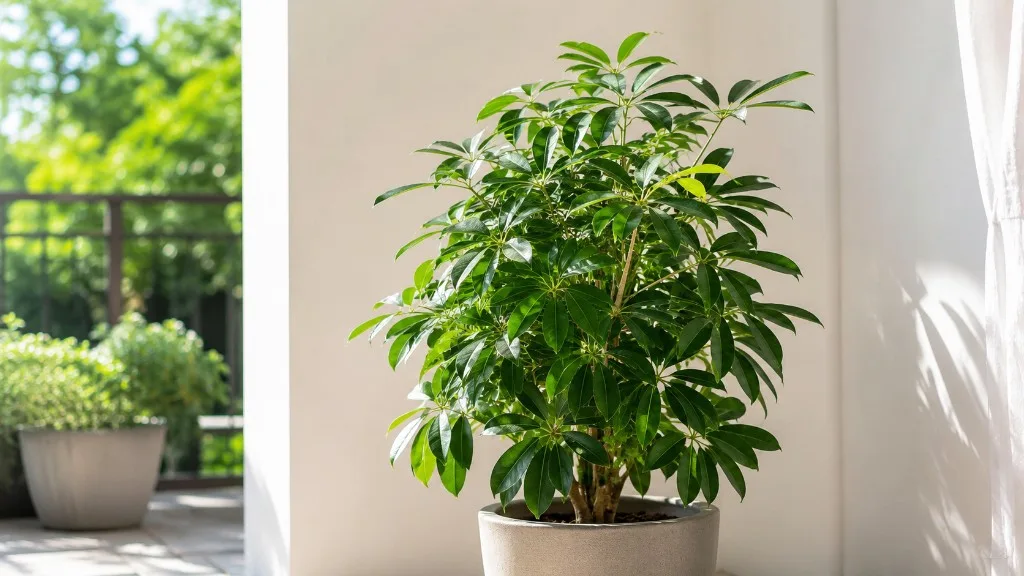
Schefflera Fertilizer: When, How, and Mistakes
Schefflera Fertilizer: When, How, and Mistakes
Schefflera fertilizer decisions are simpler than most houseplant forums suggest - and more consequential than many growers realize. Schefflera arboricola (dwarf schefflera, the compact umbrella plant most people buy at garden centers) and Schefflera actinophylla (the larger umbrella tree) are rainforest understory trees from Asia and Australia that push out whorls of glossy leaflets when light, water, and root conditions align. Fertilizer does not replace good light or proper watering, but steady, appropriate feeding during active growth helps the plant build sturdy stems, deep green foliage, and the dense canopy shape that makes schefflera worth keeping indoors. Feed too much, too often, or onto dry roots, and you get the opposite: brown leaf tips, a white salt crust on the soil surface, sudden leaf drop, and a root zone stressed by soluble salts it cannot process.
The practical goal for most home growers is straightforward: use a balanced water-soluble fertilizer at half the label strength, apply it every two to four weeks from spring through early fall while the plant is actively growing, and pause entirely in late fall and winter. Pour the solution onto moist soil, never onto dry roots. Adjust frequency based on light - a schefflera in Schefflera light guide uses nutrients faster than one in a dim corner. Skip feeding entirely for at least four to six weeks after Schefflera repotting guide, during drought stress, or when the plant is dropping leaves for unrelated reasons until you identify the cause.
This guide covers when to fertilize, how much to use, which products work best for both common species, how to read deficiency versus burn, and the mistakes that cause more damage than skipping a month ever would.
Why Fertilizer Matters for Schefflera
Schefflera is not a heavy feeder compared to fast-growing tropical foliage plants like coleus or pothos, but it is also not a set-and-forget species in a container. A potted schefflera depends entirely on the finite volume of potting mix in its pot for nitrogen, phosphorus, potassium, and trace elements. Every watering session leaches some of those nutrients through the drainage holes. Root growth and microbial activity consume others. Over months and years, even a premium peat-based mix loses the fertility it shipped with, and the plant’s growth slows - not always dramatically, but enough that new leaflets emerge smaller, internodes stretch slightly, and the overall canopy looks thinner than it should.
Clemson University’s Home & Garden Information Center notes that scheffleras benefit from regular fertilization with either water-soluble or time-release houseplant fertilizer, fed according to label directions, with plants in reduced light needing less frequent feeding than those in bright light (Clemson HGIC - Schefflera). That light coupling is the detail most generic articles skip. A schefflera sitting three feet from a south-facing window with sheer curtains processes nutrients at a different rate than the same cultivar on a north-facing desk under 200 foot-candles. Fertilizer replaces what the plant uses - but only up to the point its roots can absorb without salt damage.
Think of feeding as maintenance for a healthy, actively growing plant - not a rescue tool for a schefflera that is pale because it sits in too little light, dries out repeatedly between waterings, or struggles in waterlogged mix. Fix light and water first, then add nutrients on a conservative schedule. A schefflera can look fine its first year on fresh potting mix, then gradually thin out unless you repot on schedule or feed lightly during active growth - though a root-bound plant in depleted soil needs repotting, not just more fertilizer.
When to Fertilize Schefflera: Active Growth vs Rest
Timing is the first decision, and it follows the plant’s metabolism more than the calendar on your wall. Feed when schefflera is actively producing new leaf whorls and extending stems, and stop when growth slows sharply. Indoors, that rhythm tracks day length, room temperature, and light intensity more than outdoor weather. Most scheffleras push their strongest growth from mid-spring through late summer, taper in fall, and rest through winter - even in heated apartments where the plant never experiences true cold.
A schefflera brought indoors from a bright patio often keeps its leaves through winter and looks “alive,” which tricks growers into feeding on a summer schedule through December. In practice, lower light and shorter days reduce new shoot production even when old foliage stays upright. Unused nutrients then accumulate as soluble salts while roots absorb water more slowly - a common path to brown tips and stunted spring growth. The plant is not using what you are giving it, and the salts have nowhere to go in a small pot.
Spring and Summer Feeding Window
Start feeding when you see fresh growth at stem tips - new leaflets unfurling in their characteristic umbrella whorl, side shoots filling in after pruning, and roots visibly active if you gently slip the plant from its pot. In most temperate-climate homes, that usually means mid-spring through early fall, roughly April through September depending on your latitude, window exposure, and whether you use supplemental grow lights.
During this active window, a half-strength balanced liquid feed every two to four weeks works for most container plants. A schefflera in bright indirect light with steady new growth can sit at the two-to-three-week end. An established plant in moderate light that grows more slowly may need only monthly feeding. Both are reasonable if leaflets stay deep green (or maintain their natural variegation), internodes stay reasonably short, and the soil surface stays free of heavy salt crust.
| Month (temperate climate) | Growth phase | Feeding guidance |
|---|---|---|
| March–April | Waking up, new whorls | Start half-strength liquid if active growth visible |
| May–August | Peak foliage production | Every 2–4 weeks; bright light on shorter end |
| September | Slowing slightly | Reduce to every 4–6 weeks or taper off |
| October | Wind-down | Final light feed if still growing, then pause |
| November–February | Low growth indoors | No fertilizer for typical setups |
The table is a framework, not a law. Watch the plant: if it is building new whorls steadily and leaf color matches the cultivar’s norm, the timing is right. If it is static for weeks, solve light and water before adding food. Start conservative at four-week intervals with half-strength dilution, then tighten only if the plant clearly wants more and shows no salt signs.
Fall Taper and Winter Pause
Taper feeding in early to mid-fall as day length drops and indoor growth slows. One practical approach: give a final half-strength feed in early fall if you still see new whorls forming, then stop entirely from late fall through winter. Most indoor scheffleras do fine with no fertilizer from November through February, especially in cooler rooms or north-facing windows where metabolic demand is lowest.
Winter rest is not full dormancy, but nutrient demand drops sharply. University of Maryland Extension notes that excessive fertilizer use is a primary cause of high soluble salts in indoor plants, with symptoms including brown leaf tips and marginal necrosis (University of Maryland Extension - Fertilizer Toxicity). If you grow under strong grow lights and the plant keeps producing new shoots all winter, feed lightly at half strength every six to eight weeks - otherwise skip winter feeds entirely.
Best Fertilizer Type for Schefflera
The best schefflera fertilizer for most homes is a complete, water-soluble, balanced houseplant formula with nitrogen adequate for leafy growth, phosphorus at moderate levels, and potassium for overall vigor. You want nitrogen for green tissue and new leaflet production, phosphorus for root function at modest levels, and potassium for stress tolerance and water regulation within plant cells. Micronutrients on the label - iron, magnesium, manganese, zinc - matter because pale new growth on otherwise well-watered plants sometimes traces to trace-element gaps rather than macronutrient hunger alone.
Avoid shopping by the word “schefflera” or “umbrella tree” on the bottle unless you already trust the brand’s dosing guidance. A standard balanced indoor formula used conservatively outperforms most specialty products applied at full label strength. The plant does not need exotic micronutrient cocktails - it needs consistent, dilute, complete nutrition during the months it is actually growing.
Balanced Liquid Formulas and NPK Ratios
A 10-10-10 or 20-20-20 water-soluble fertilizer diluted to half strength is the default recommendation across horticultural sources for schefflera. Equal ratios keep feeding simple when your main goal is steady foliage and balanced root-shoot development, not flowers or fruit. Indoor scheffleras rarely bloom in pots anyway, so bloom-booster formulas with high phosphorus are unnecessary and can push the plant toward weak, stretched growth without improving the canopy you actually care about.
Production guides sometimes recommend a 3-1-2 ratio such as 9-3-6 for foliage growth under greenhouse light. For most homes, Clemson HGIC notes that scheffleras benefit from regular fertilization with water-soluble or time-release houseplant fertilizer - 10-10-10 at half strength is fine. Mix at half the label strength, apply until a little water drains, discard saucer runoff, and skip high-analysis formulas like 30-30-30 or bloom boosters marketed for flowering crops.
Organic, Slow-Release, and What to Skip
Organic options - diluted fish emulsion, liquid seaweed, worm castings - work when applied lightly but release nutrients slowly and unpredictably. Slow-release granules like Osmocote can be applied once at the start of the growing season at half the indoor rate, but never combine them with regular liquid feeds. Skip fertilizer-pesticide combos, lawn fertilizers, full-strength application, and slow-release pellets in pots under 6 inches.
How Much Fertilizer to Use on Schefflera
The single most reliable rule for container schefflera is half the label strength, every time. If the bottle says one teaspoon per gallon for houseplants, use half a teaspoon per gallon. If it says one capful per two liters, use half a capful. This is not timidity - it is appropriate dosing for a plant in a finite soil volume where salts cannot disperse the way they do in a garden bed.
For a 6-inch pot, use enough half-strength solution to moisten the entire root ball - often a cup to a pint - applied slowly until a small amount drains. University of Maryland Extension notes that excessive fertilizer use is a primary cause of high soluble salts in indoor plants; half-strength dosing is a practical safety margin. If uncertain, err toward less - under-fed schefflera looks slow; over-fed schefflera looks damaged, and burned leaf tissue does not recover.
How Often to Fertilize Schefflera
Frequency depends on three variables: light intensity, container size relative to plant size, and observed growth rate. There is no single calendar that fits every schefflera in every home, but these starting points cover most situations:
- Bright indirect light, active new whorls every few weeks: every 2–3 weeks at half strength
- Moderate light, steady but slower growth: every 4 weeks at half strength
- Low light, minimal new growth: every 6–8 weeks at half strength, or skip and repot with fresh mix instead
- Recently repotted (within 6 weeks): no fertilizer - fresh mix usually contains starter nutrients
- Winter (November–February) in typical indoor conditions: no fertilizer
Feed every two to four weeks during the growing season at half the label dose, with plants in reduced light needing less frequent feeding than those in bright light - Clemson HGIC explicitly states that plants in reduced light need less frequent fertilization than plants in bright light. That two-to-four-week range is the sweet spot for most homes. If your plant is a young dwarf schefflera in a 4-inch pot under grow lights, lean toward every two weeks. If it is a mature floor specimen in a 12-inch pot in moderate light and you are happy with its size, every four weeks - or even tapering to every six weeks - keeps foliage lush without forcing unwanted height.
Clemson HGIC explicitly states that plants in reduced light need less frequent fertilization than plants in bright light. Adjust within two weeks of any major light change or room rearrangement.
Step-by-Step: How to Feed Schefflera Safely
Feeding schefflera is a short process, but the order of operations matters. Rushing or skipping the pre-checks is how most fertilizer damage happens - not from choosing the wrong NPK ratio, but from applying nutrients when the plant cannot use them or when the soil is too dry to buffer the salts.
Step 1 - Check the calendar and the plant. Confirm you are inside the active feeding window and the plant is showing new growth. If it is winter, recently repotted, drought-stressed, or dropping leaves, stop here.
Step 2 - Check soil moisture. The top inch should feel dry or approaching dry, but the root zone should not be bone-dry. If the pot is completely dry and the plant is wilting, water with plain water first and wait 24 hours before feeding.
Step 3 - Mix fertilizer at half strength. Use room-temperature water. Stir well. If your tap water is very hard (high calcium), consider filtered or distilled water for feeding sessions to avoid adding mineral load on top of fertilizer salts.
Step 4 - Apply slowly to the soil surface. Pour the solution evenly around the base, not directly onto the leaf whorls. Avoid splashing concentrated drops on stems or leaflets. Continue until a small amount drains from the bottom, then discard drainage from the saucer.
Step 5 - Log the date. A note on your phone or a pencil mark on a plant tag prevents accidental double-feeding two weeks later because you forgot.
Step 6 - Observe over the next two weeks. Watch for new whorls, stable leaf color, and absence of salt crust. Adjust the next interval based on what you see, not on a rigid calendar alone.
Pre-Feed Checks and the Moist-Soil Rule
Before every feeding, confirm: (1) active new growth at stem tips, (2) overall plant health - no mass leaf drop or pest stress, (3) not recently repotted, (4) soil moist but not soggy, (5) no white salt crust on the surface. The moist-soil rule is non-negotiable: fertilizer on dry roots burns fine root hairs. Water the day before if needed, and do not feed when roots are cold - wait until room temperatures stay above 60°F (15°C).
Signs Your Schefflera Needs More Nutrition
Under-fertilizing is less common than over-fertilizing, but it happens in plants that have lived three or more years in the same pot without repotting or feeding. Pale or yellowing leaflets on both old and new growth, smaller new whorls than earlier in the season, and very slow growth for eight or more weeks in bright light with proper watering can indicate depleted soil - though check for root-binding first, since a cramped plant needs repotting more urgently than fertilizer.
Important caveat: pale leaves with brown tips or salt crust signal over-fertilization, not deficiency. Leggy stretched stems in dim light are a light problem - feeding more in low light makes salt buildup worse. Rule out light and water before reaching for the fertilizer bottle.
Signs of Over-Fertilizing and Salt Buildup
Over-fertilizing is the most common schefflera fertilizer mistake, and symptoms often mimic other care failures - which is why growers sometimes feed more and make things worse. Watch for brown or crispy leaf tips, white salt crust on the soil surface, sudden leaf drop within days of feeding, wilting despite moist soil, and blackened root tips if you inspect the root ball. University of Maryland Extension lists brown tips, marginal necrosis, and reduced growth as primary salt-toxicity symptoms. The fix is always: stop feeding, flush, and wait.
How to Flush Schefflera After Over-Feeding
If you suspect over-fertilization - or you see salt crust even without obvious leaf damage - flush the pot before the next scheduled feed. Flushing means passing enough plain water through the soil to dissolve and carry excess salts out the drainage holes.
Stop all fertilizer immediately. Water slowly with plain room-temperature water - roughly four times the pot’s volume in stages - until drainage runs clear and crust dissolves. Discard all runoff, let the soil dry to its normal depth, and resume half-strength feeding only after healthy new whorls appear, typically four to six weeks later. For severe cases with mass leaf drop or blackened roots, repot into fresh well-draining mix, trim damaged roots, and hold off on fertilizer for six to eight weeks. Burned leaflets will not turn green again - new growth is your recovery signal.
Schefflera Species, Light, and Feeding Adjustments
Not every schefflera in every home needs the same schedule. Two species dominate the indoor trade, and they differ in size, growth rate, and typical light exposure - all of which change how quickly they use nutrients.
Arboricola vs Actinophylla and Container Size
Schefflera arboricola (dwarf schefflera) is the compact species most often sold indoors, with seven to eleven leaflets per whorl reaching 4 to 6 feet with pruning. Schefflera actinophylla (umbrella tree) grows larger - up to 8 to 10 feet indoors with leaflets up to 12 inches long - and may use nutrients faster in bright light. Variegated cultivars like ‘Gold Capella’ photosynthesize less per leaf and often need less fertilizer, not more. Adjust feeding within two weeks whenever you move a plant to a noticeably brighter or dimmer spot.
Fertilizer and Other Schefflera Care
Fertilizer only works when light and water are in range. Schefflera in bright indirect light uses nutrients efficiently; the same plant in a dim corner metabolizes slowly and builds up salts if fed on a bright-light schedule. Get the dry-down Schefflera watering guide right first - overwatering on Schefflera drowns roots; underwatering on Schefflera followed by feeding on dry soil burns them. Fresh potting mix after repotting includes starter nutrients for four to eight weeks, so wait at least six weeks before feeding. Pause feeding during pest outbreaks or relocation stress.
Schefflera contains calcium oxalate crystals toxic to cats and dogs if chewed (ASPCA - Schefflera). Store fertilizer bottles out of pet reach and rinse spills promptly.
Common Schefflera Fertilizer Mistakes
The repeatable errors: feeding on a calendar without watching growth, using full label strength, feeding dry soil, feeding after repotting or during stress, combining slow-release with liquid feeds, ignoring salt crust, using bloom boosters on a foliage plant, feeding in winter because leaves remain, and trying to fix yellow leaves with fertilizer when light or water is the real problem. Half strength on moist soil during active growth beats every shortcut on this list.
Conclusion
Schefflera fertilizer is not complicated once you align feeding with the plant’s actual growth rhythm rather than a fixed calendar. Use a balanced water-soluble formula - 10-10-10 or 20-20-20 is fine for most homes - diluted to half the label strength, applied to moist soil every two to four weeks from spring through early fall, and paused entirely in late fall and winter. Reduce frequency in low light; increase slightly only when bright light and steady new whorls justify it. Flush with plain water when you see salt crust, and hold off feeding for at least six weeks after repotting or any sign of over-fertilization.
The umbrella tree rewards consistency over intensity. A schefflera that receives light, appropriate watering, and conservative feeding during active months will keep its glossy whorls and sturdy stems for years. One that is pushed with full-strength feeds on dry soil through every season will drop leaves, brown at the tips, and need repotting or flushing to recover. When in doubt, skip a feed - your schefflera tolerates a slower routine far better than it tolerates salt-damaged roots.
When to use this page vs other Schefflera guides
- Schefflera overview - Start here for whole-plant context before deep-diving this topic.
- Schefflera problems hub - Jump to symptom-specific fix guides when this care topic does not resolve the issue.