Schefflera Light Needs: Best Window, Sun & Warning Signs
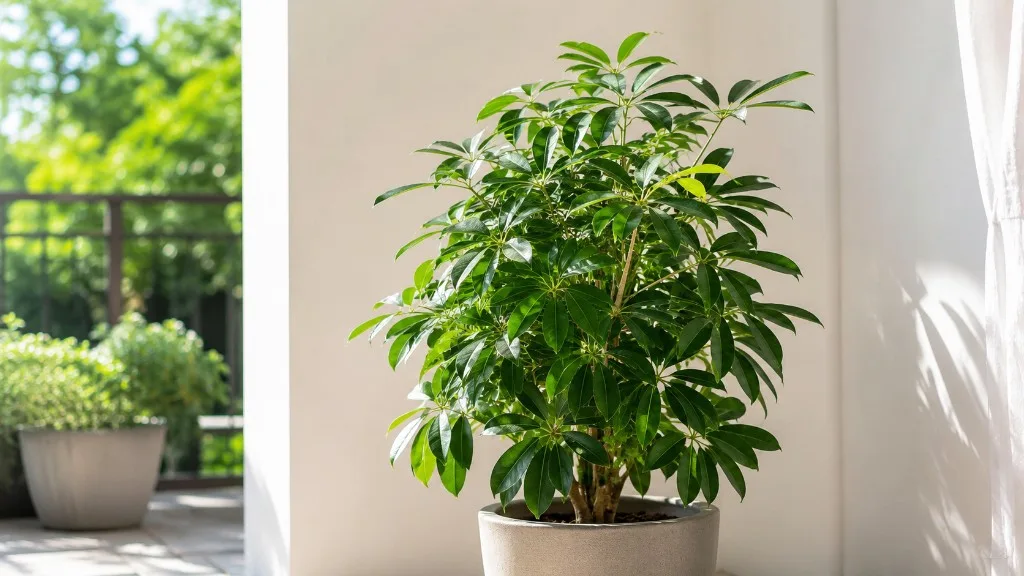
Schefflera Light Needs: Best Window, Sun & Warning Signs
Schefflera Light Needs: Best Window, Sun & Warning Signs
Schefflera - the umbrella tree most people know from offices, hotel lobbies, and living-room corners - is often sold as a low-light plant. That label is half true and half misleading. Schefflera species evolved as understory shrubs in tropical forests, which means they tolerate less sun than a cactus or a fiddle-leaf fig. But understory does not mean dark. In the wild, these plants still receive filtered, bright daylight for much of the day beneath a shifting canopy. Indoors, that translates to bright indirect light as the default target, with enough intensity to keep new leaves compact, glossy, and well spaced.
The practical goal is not to find the dimmest corner where Schefflera merely survives. It is to place the plant where new growth looks firm and proportional - short internodes, normal leaf size, stable color - without scorching foliage or baking the pot against hot glass. Get that right and Schefflera becomes one of the most forgiving tropical houseplants you can own. Miss it by a wide margin and you get the classic leggy umbrella plant: tall, sparse, leaning toward the window, dropping leaves every time you move it.
This guide focuses on decisions you can make today: how much light Schefflera actually needs, which window works best, whether direct sun is ever safe, when to add a grow light, and how to read the plant’s own warning signs before vigor collapses.
How Much Light Schefflera Actually Needs
The standard recommendation across extension and botanical references is consistent: Schefflera grows best in bright to medium indirect light. Clemson HGIC notes that scheffleras prefer medium to bright light, and that low light causes leaf yellowing with spindly, weak stems. Missouri Botanical Garden recommends placing indoor schefflera in bright light at east, west, or southern windows in curtain-filtered sun, and to avoid direct sun.
Translated into daily experience, most healthy indoor Schefflera setups deliver roughly 6 to 8 hours of bright ambient light each day. That does not mean six hours of sunbeams hitting the leaves. It means the plant sits in a genuinely bright zone - close enough to a good window that the foliage is clearly illuminated, but shielded from harsh direct rays for most of the day. A room that looks bright to your eyes at noon can still be weak in winter or on the side of the pot farthest from the glass, which is why placement distance matters as much as compass direction.
Schefflera is more forgiving than many ficus species, but it is not a shade plant in the philodendron sense. Medium indirect light can work, especially for compact Schefflera arboricola, yet growth will be slower and stems may stretch. Deep shade - the far side of a room with one small window, a hallway with no plant-facing light, or a north exposure in a dense urban building - usually produces weak structure over time even if the plant holds on for months.
The Short Answer for Busy Growers
If you want the compressed version, use these three rules. Best default: place Schefflera within a few feet of an east-facing window, or several feet back from a south- or west-facing window with sheer curtains if afternoon sun is strong. Minimum acceptable for dwarf forms: a bright spot with 4 to 5 hours of clear indirect light daily, supplemented in winter if new growth looks stretched. Avoid: unfiltered hot afternoon sun on unacclimated leaves, and dark corners where the plant cannot see the sky.
Judge success by new growth, not old damage. Within two to four weeks of better light, fresh leaves should emerge closer together, feel firmer, and match the color of healthy mature foliage. If only the stem tips improve while lower leaves yellow and drop, you may have moved too abruptly or changed watering at the same time - fix light first, then reassess.
Why Schefflera’s Understory Biology Changes the Rules
Schefflera did not evolve on open tropical beaches or desert margins. Schefflera arboricola is native to Taiwan and Hainan, while the larger Schefflera actinophylla comes from Australia and New Guinea. In those habitats, plants grow beneath taller forest trees where light arrives as dappled patches rather than sustained direct beams. Leaves are broad and compound - nature’s way of capturing diffuse photons efficiently without exposing a single fragile surface to midday intensity.
That ecology explains two behaviors indoor growers see constantly. First, Schefflera accepts bright indirect light eagerly because it is still high-quality energy compared with deep shade. Second, it reacts badly to sudden full sun because leaf tissue built in softer conditions lacks the protective adaptations that sun-trained leaves develop. This is not fussiness. It is physiology.
It also explains why Schefflera stretches in dim rooms. When photon supply drops, the plant allocates energy toward stem elongation to reach a brighter zone - etiolation, the same mechanism that makes seedlings lean toward a window. Unlike some slow-growing succulents that simply pause, Schefflera keeps moving, which is why a leggy umbrella plant is almost always a light problem first and a pruning problem second.
Schefflera arboricola vs. Schefflera actinophylla Light Differences
Not every Schefflera at the nursery has the same appetite for brightness. The two species most houseplant owners encounter behave differently enough that a single “bright indirect” line deserves nuance.
Schefflera arboricola, the dwarf umbrella tree, is the compact form with smaller leaflets - often seen in variegated cultivars like ‘Gold Capella’ or ‘Trinette’. It generally tolerates medium bright indirect light better than its larger cousin and is the safer choice for offices and rooms with only moderately bright windows. It will still stretch in genuinely low light, but it can maintain reasonable form several feet from an east window or in filtered south light.
Schefflera actinophylla, the full-size umbrella tree, grows bigger leaves on longer petioles and builds height faster when conditions are good. It is more light-hungry and less patient with dim corners. In marginal light, actinophylla shows legginess and small new leaves within weeks, whereas arboricola may coast longer before decline becomes obvious. If you own a tall specimen with hand-sized leaflets, assume it wants the brightest indirect spot you can offer without direct scorch.
Variegated forms of either species often need slightly more light than all-green plants because the pale sectors photosynthesize less efficiently. A variegated Schefflera in medium light may fade toward green or lose contrast - not always fatal, but a signal to inch closer to the window or add supplemental lighting.
Dwarf Umbrella Tree Tolerance
For S. arboricola, think “bright room plant,” not “windowless office survivor.” It handles 4 to 5 hours of solid indirect light and can look excellent on a plant stand 3 to 5 feet (0.9 to 1.5 m) from an east window in many homes. It is the species most likely to work on a desk near a window if the desk actually receives reflected brightness, not just overhead room lighting.
That tolerance has limits. Chronic dim conditions produce long bare stems, small pale leaflets, and weak petioles that flop when brushed. If your dwarf Schefflera looks like a lollipop on a stick, brightness - not fertilizer - is the first fix.
Larger Umbrella Tree Appetite
For S. actinophylla, aim closer to the upper end of bright indirect - the kind of spot where you could comfortably read a book all afternoon without turning on a lamp. Large plants on the floor often fail because they sit in the lower, darker zone of a room while only the top branches see window light. Raising the plant on a low stand or moving it closer to the glass frequently improves the whole canopy more than rotating alone.
If you are choosing between species for a specific room, match the plant to the architecture. Tight apartment with one good east window? Arboricola. Bright sunroom with filtered south exposure? Actinophylla can shine. North-facing living room with heavy tree shade outside? Plan on a grow light regardless of species.
Best Window Placement for Indoor Schefflera
Indoor Schefflera fails most often because the pot sits where the room feels bright rather than where the plant receives sustained indirect light. Window direction matters, but distance, outdoor obstructions, glass type, and season matter just as much.
Place Schefflera where it can see a substantial portion of sky from the leaf canopy’s perspective. A spot beside a window, not across the room from one, is the usual upgrade that separates thriving plants from survivors. Keep the pot close enough to benefit - often within 1 to 4 feet (30 to 120 cm) of the glass depending on exposure - without pressing leaves against freezing winter panes or scorching summer glass.
Rotate the container every week or two so all sides receive similar light. Schefflera leans toward brightness quickly, and uneven exposure produces asymmetric canopies that are hard to correct without pruning.
East, South, West, and North Windows Compared
An east-facing window is the most reliable default for Schefflera in many homes. Morning sun tends to be bright but gentle, delivering direct rays when temperatures are cooler and intensity is moderate. A plant directly beside an east window often gets the highlight reel of good Schefflera lighting: strong illumination without the punishment of late-day heat.
A south-facing window can work beautifully in winter and in cooler climates where the plant sits back from the glass or behind sheer curtains. Unfiltered south sun through clear glass in summer - especially on S. actinophylla - is where scorch appears fast. If afternoon sunbeams hit leaves directly for more than a brief period, diffuse or increase distance.
A west-facing window is usable with caution. Late-afternoon sun is hot and low-angled, which can bleach leaflets in minutes on a heat-wave day. West works when filtered, when the plant is set several feet inward, or when outdoor awnings and trees knock down peak intensity.
A north-facing window is the hardest orientation in the northern hemisphere unless the view is open and unobstructed. Schefflera may persist there, especially S. arboricola, but compact growth usually requires a grow light for at least part of the year. Do not confuse “surviving on a north window” with “thriving on a north window.”
Distance From the Glass and Sheer Curtains
Light intensity drops sharply as you move away from a window. A Schefflera on a coffee table 6 feet (1.8 m) from a south window is not getting south-window light - it is getting whatever ambient bounce remains. If you cannot move the pot closer because of furniture or pets, supplement with a grow light rather than hoping the plant will adapt.
Sheer curtains are one of the most useful tools for Schefflera care. They convert harsh direct sun into the diffuse bright light the plant evolved under. White or light-colored sheers on south and west windows often let plenty of brightness through while cutting UV and heat spikes that cause bleaching. If your plant is scorching despite distance, add sheers before moving it to a dimmer room.
Watch seasonal angle changes. Winter sun sits lower and may reach deeper into a room; summer sun climbs higher and can miss floor-level plants entirely. A placement that works in June may fail in December, which is when grow-light supplementation pays off most.
Direct Sun Exposure and Safe Acclimation
Schefflera is not a full-sun plant indoors. Missouri Botanical Garden instructs growers to avoid direct sun on indoor schefflera, and NC State Extension warns that bright, direct light will burn the leaves when grown as a houseplant.
That said, “avoid full sun” does not mean “fear every sunbeam.” Many established Schefflera tolerate a short period of gentle direct morning light - especially if leaves developed in reasonably bright conditions and temperatures stay moderate. The danger zone is hot midday and afternoon sun through clear glass, which raises leaf temperature faster than the photosynthetic system can use the energy, leading to bleached patches and crisp brown margins.
Outdoor summer placement follows the same logic. Schefflera enjoys a covered porch, shaded patio, or dappled spot under trees where brightness is high but direct rays are broken. Moving straight from a dim living room to an open deck in July is a recipe for sunburn even if the outdoor air temperature feels pleasant.
When a Little Morning Sun Helps
Early morning sun can strengthen color and tighten growth on plants that were slightly under-lit. A few east-window setups deliver 30 to 90 minutes of direct morning rays on the nearest leaves without damage. Watch the plant, not the clock. If leaflets facing the glass stay glossy and new growth remains normal, the exposure is acceptable. If you see yellowing on the sun-facing side or dry crisp edges by afternoon, pull the plant back or add sheers.
Variegated cultivars are less forgiving of direct sun than solid-green plants because pale tissue burns first. Actinophylla is less forgiving than arboricola for the same reason size matters - larger leaf area catches more heat.
How to Move Schefflera Without Leaf Drop
Schefflera reacts to sudden environmental shifts with leaf drop, curling, or stalled growth. Light changes are a common trigger. When upgrading brightness, acclimate gradually over 7 to 14 days rather than jumping from a hallway to a south windowsill in one afternoon.
A simple protocol: move the plant closer to the target window by a few inches or one foot per day, or introduce morning sun 30 minutes at a time if direct exposure is part of the plan. Hold at each step until the newest leaves look normal. If older leaves drop but new ones hold firm, acclimation is usually working - old foliage often sheds during stress while the plant reallocates resources.
When downshifting light - for example, moving away from a window for a renovation - expect slower growth and possibly some yellowing on lower leaves. Reduce watering slightly to match reduced photosynthetic demand, and avoid fertilizing until the plant stabilizes.
Change one variable at a time. Do not simultaneously repot, fertilize heavily, and move to a brighter window. Schefflera is resilient, but simultaneous shocks make diagnosis impossible.
Low-Light Limits and Leggy Growth
Schefflera’s reputation for tolerating low light comes from its ability to survive mediocre conditions, not from preferring them. In dim settings, growth slows, internodes lengthen, and the canopy thins. Clemson HGIC notes that low light causes leaf yellowing with spindly, weak stems, and that moving to brighter light fixes the issue.
Low light also changes how the rest of your care routine behaves. A dim Schefflera uses less water because transpiration drops. Growers who keep watering on a bright-window schedule in a dark corner invite root stress while blaming the plant for yellow leaves. Light is the throttle; water follows.
There is a difference between temporary low light and chronic deprivation. A plant parked in a dim guest room for two weeks during a move may shed a few leaves and recover. A plant spending a year on a shelf with no plant-facing window will not develop the dense umbrella silhouette you see in photos.
Reading Schefflera’s Stretch Signals
Leggy Schefflera shows predictable patterns if you know what to look for. Internodes stretch - the gaps between leaf clusters lengthen and stems look like bare green sticks with foliage only at the tips. New leaflets emerge smaller than older ones, sometimes paler or thinner. The whole plant leans toward the brightest source, and lower leaves may yellow and drop as the plant sheds foliage it can no longer support.
If you see stretch beginning, act before the silhouette becomes irreversible without hard pruning. Move the plant closer to the window, add a grow light, or both. Pruning alone without fixing light produces a bushier but still weak plant that re-stretches within weeks.
Variegated plants in low light may revert toward green as the plant produces more chlorophyll to compensate. That is a useful early warning before full legginess appears.
Grow Lights When Natural Light Falls Short
When architecture, season, or furniture layout prevents bright indirect window light, a full-spectrum LED grow light is the most reliable fix. Grow lights are not a last resort for failing plants - they are a normal tool for keeping Schefflera compact in apartments, offices, and north rooms.
Position a full-spectrum fixture 12 to 18 inches (30 to 45 cm) above the canopy, adjusting height as the plant grows. Run the light 12 to 16 hours daily on a timer to mimic a long tropical day; many growers find 14 hours is a practical starting point. Plant retailers and care guides commonly cite 12 to 16 hours for supplemental Schefflera lighting when natural brightness is inadequate.
Choose white full-spectrum LEDs rather than purely decorative purple panels unless you already own horticultural hardware. The goal is even canopy coverage, not spotlighting one side. If only half the plant sits under the fixture, rotate the pot weekly or use a wider lamp.
Fixture Choice, Height, and Timer Schedule
A 20 to 40 watt LED grow panel or a quality screw-in grow bulb in a desk lamp can support a single dwarf Schefflera. Larger actinophylla specimens may need a bigger panel or multiple sources so lower branches receive usable light. Keep fixtures high enough that leaves do not heat - if the canopy feels warm to the touch after an hour, raise the light.
Start with 12 hours on and increase toward 14 to 16 if growth remains slow and the plant shows no bleaching. Bleaching under LEDs is rare but possible if the fixture is too close; back the light up if new leaves look washed out.
Combine grow lights with whatever natural light exists. A Schefflera beside an east window with a supplemental afternoon LED often outperforms either source alone, especially in winter.
Outdoor Summer Placement and Seasonal Adjustments
Many Schefflera benefit from a summer outdoors in bright shade - a covered porch, a patio with a pergola, or a spot under open-branched trees. Missouri Botanical Garden notes that container scheffleras may be taken outdoors to sheltered locations in summer, and NC State Extension describes filtered light exposure for outdoor specimens.
Outdoor air circulation and higher ambient light often produce the best annual growth spurt. The risk is exposure shock. Transition gradually: start in deep shade for a few days, then move to brighter dappled light over 7 to 14 days, watching for bleaching after each step. Never place an indoor-grown Schefflera in open afternoon sun on day one.
As days shorten in fall, bring the plant inside before nighttime temperatures drop below what your species tolerates - Schefflera generally wants temperatures above 60°F (15°C). The combined stress of cold and sudden lower light can trigger major leaf drop. When you bring it in, put it in the brightest indoor spot immediately rather than staging it in a hallway while you find space.
Winter indoors is the season when Schefflera light problems peak. Lower sun angle, shorter days, and heavier curtains reduce effective brightness even beside a good window. If new growth slows or stems stretch between November and February, assume light has fallen below the plant’s needs and add a grow light rather than increasing fertilizer.
Warning Signs Your Schefflera Is Getting the Wrong Light
Schefflera communicates light stress through foliage and growth habit before the roots fail. Learning to separate too little from too much light saves you from counterproductive moves - like pulling a leggy plant away from the window because a few lower leaves yellowed.
Too little light shows up as elongated stems, small new leaflets, pale or dull green color, leaning toward the window, slow spring growth despite warm temperatures, and progressive lower leaf drop as the plant sheds foliage it cannot support. Variegation may fade or revert. The soil stays wet longer than expected because the plant is not using water actively.
Too much light or heat stress shows up as bleached white or tan patches on sun-facing leaflets, crisp brown edges, curling leaves during peak brightness, and sudden damage after a move to a harsher window. Lower leaves may still drop, but new leaves at the tips often look washed out or scorched rather than small and stretched. Hot glass contact can burn leaves even when the room air feels fine.
Use the new-growth test after any placement change: healthy light produces firm, glossy new leaflets at a spacing similar to or slightly tighter than mature growth. Old blemishes do not heal, so judge by the freshest leaves over two to four weeks, not yesterday’s damage.
Remember that light and watering are linked. A Schefflera moved to a brighter spot will dry its pot faster - check moisture more often. One moved to a dim corner needs less frequent watering. Changing light without adjusting water is a common secondary failure after a good placement fix.
Conclusion
Schefflera light care is less about finding a magic window direction and more about matching forest-floor brightness to your actual room. Bright indirect light for roughly 6 to 8 hours daily is the target for most plants, with Schefflera arboricola tolerating slightly less and Schefflera actinophylla preferring more. East windows and filtered south or west exposures usually outperform dark corners and unshaded hot glass.
Place the pot where the canopy receives real brightness, not where it looks decorative. Acclimate gradually when increasing exposure, rotate for even growth, and add a full-spectrum grow light when winter or layout limits natural light. Read new growth to judge success - compact leaflets and short internodes mean you got it right; stretch, pale foliage, and scorch mean adjust before rewriting the rest of your care routine.
Get light reasonably correct and Schefflera rewards you with one of the easiest long-term houseplant relationships you can build - a plant that forgives an occasional missed watering but never forgives a permanently dim shelf.
When to use this page vs other Schefflera guides
- Schefflera overview - Start here for whole-plant context before deep-diving this topic.
- Schefflera problems hub - Jump to symptom-specific fix guides when this care topic does not resolve the issue.
- Not Enough Light on Schefflera - Escalate here when light adjustments are not enough.
- Leggy Growth on Schefflera - Escalate here when light adjustments are not enough.
- Leaf Drop on Schefflera - Escalate here when light adjustments are not enough.
Related Schefflera guides
- Schefflera overview
- Schefflera watering
- Schefflera soil
- Schefflera propagation
- Schefflera fertilizer
- Schefflera repotting
- Not Enough Light on Schefflera
- Leggy Growth on Schefflera
- Leaf Drop on Schefflera
- Schefflera problems
Related tool
Try the Plant Problem Diagnosis Tool with schefflera pre-selected to estimate needs for your setup.