Leaf Drop on Schefflera: Causes, Checks & Fixes
Quick answer
Schefflera sheds whole compound whorls when conditions change-drafts, relocation, or wet roots are the usual triggers. First step: stop moving the pot, check soil moisture at 2 inches depth, and stabilize bright filtered light before you repot, prune, or fertilize.
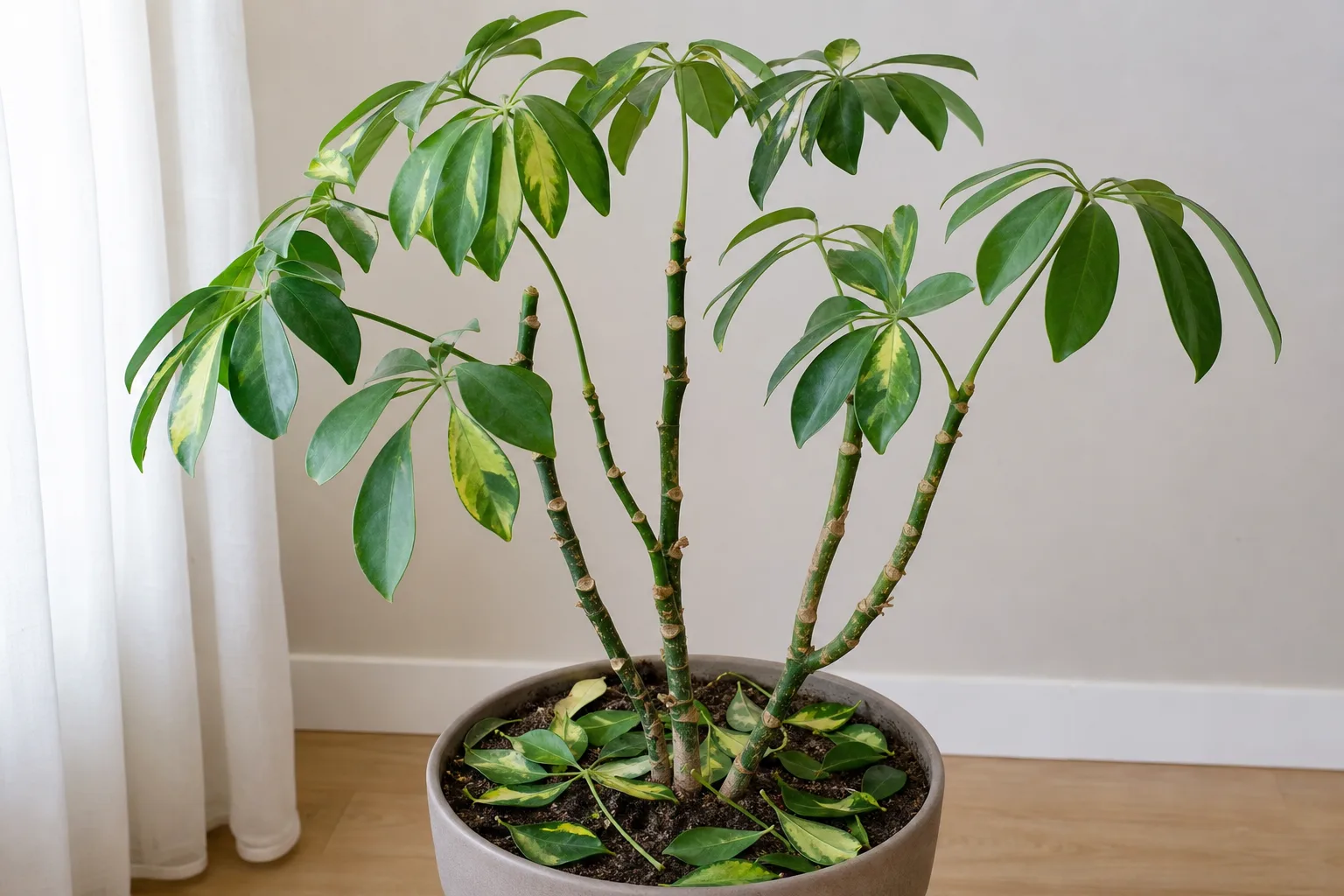
Leaf Drop on Schefflera: Causes, Checks & Fixes
This guide covers leaf drop on Schefflera. See also the general Leaf Drop guide, watering, and light pages for this plant.
Leaf Drop on Schefflera: Causes, Checks & Fixes
Quick answer
Schefflera is famous for dramatic leaf drop. Whole compound whorls-groups of glossy leaflets arranged like umbrella spokes-can fall within days after a cold night, a move across the room, or a week of soggy soil. The umbrella plant (Schefflera arboricola, dwarf schefflera) evolved in stable tropical understory conditions; indoor heating, AC blasts, and watering swings trigger defoliation faster than on many houseplants.
First step: stop moving the pot, check soil moisture at 2 inches depth, and place the plant in stable bright filtered light. Do not repot, prune heavily, and fertilize in the same week-that stacks stress on a plant already shedding foliage. Most mild cases recover once the primary trigger is removed and care stays consistent.
This page is the leaf-drop triage hub. For wet-soil rescue depth, see overwatering on Schefflera. For the dry-down rhythm that prevents recurrence, see the Schefflera watering guide.
Why Schefflera drops leaves so dramatically
Leaf drop is Schefflera’s primary stress response. When roots cannot supply water, when cold air damages tissue, or when light and temperature shift suddenly, the plant sheds foliage to reduce water demand and rebalance itself.
Tropical understory biology and draft sensitivity
Schefflera tolerates average indoor humidity but reacts badly to temperature instability. Clemson Extension notes that leaf drop can be caused by excessive watering, by low humidity, or by chilling on scheffleras, and that dead areas form on leaves several days after exposure to excessive cold. Missouri Botanical Garden recommends indoor temperatures should not dip below 60 degrees F. in winter for S. arboricola. Drafts from doors, single-pane winter windows, heat vents, and AC units are common indoor triggers.
Whorled leaf architecture and whole-whorl shedding
Unlike plants that lose individual leaves one at a time, Schefflera sheds entire compound leaf sets at once. Each whorl connects through a single petiole to the stem-when that petiole abscises, every leaflet in the cluster falls together. That makes a moderate stress event look catastrophic even when stems are still firm and the plant will recover.
Schefflera also “remembers” recent stress. During recovery, minor changes-a slightly brighter window, a new watering day, or bumping the pot-can trigger a second wave of drop. Stability matters more than aggressive intervention.
What leaf drop looks like on Schefflera
The visual pattern helps you rank causes before you act.
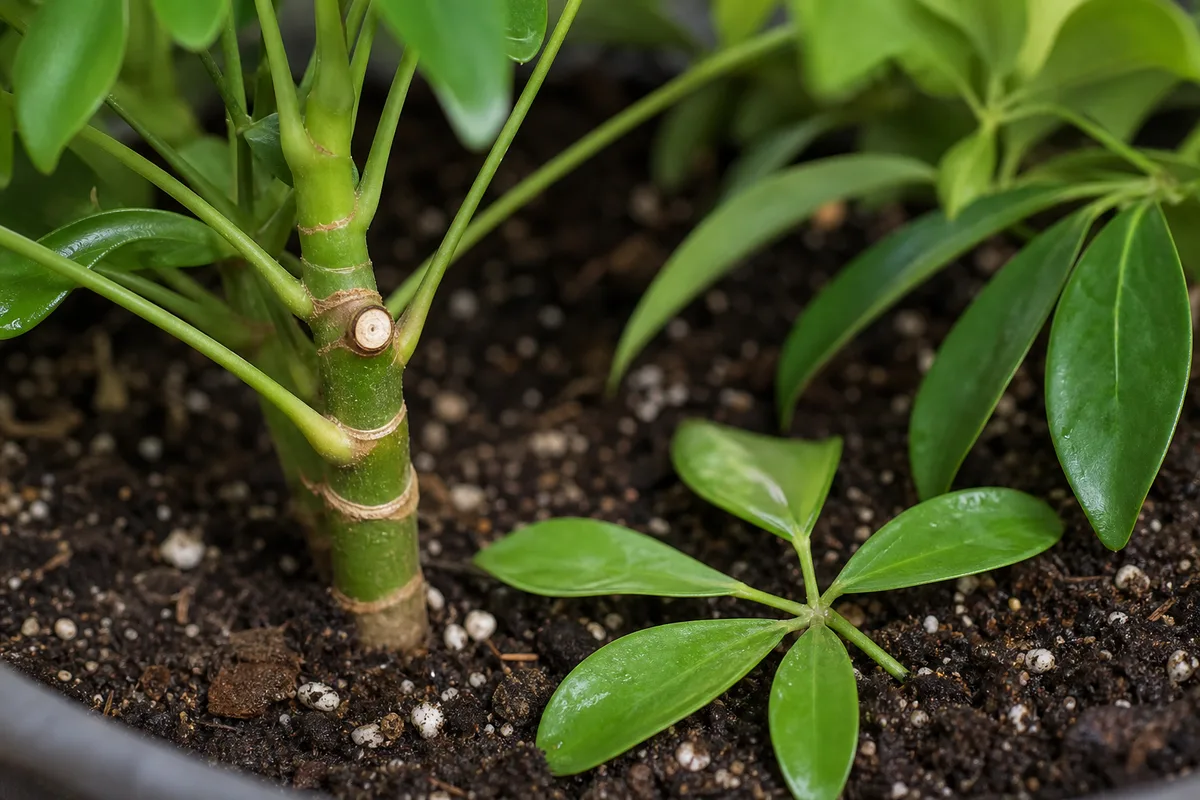
Leaf Drop symptoms on Schefflera - compare with healthy tissue on the same plant.
Shock drop after move, repot, or cold night
- Whole whorls fall within days of relocation, Schefflera repotting guide, or opening a winter window
- Petioles may stay attached briefly, then drop cleanly
- Leaf color often stays green until the whorl detaches
- Newest top whorl may stay firmer than older sets if you catch the problem early
- Soil moisture is usually normal-pot weight feels typical, not heavy or bone dry
- Stems above the soil line remain firm
Iowa State Extension explains that leaf drop occurs in response to stress when houseplants move from greenhouse to home conditions, and adjustment can take two to three months with consistent care.
Overwatering drop: yellow lower whorls on wet soil
- Lower whorls yellow first, then detach while upper leaflets may wilt on saturated mix
- Pot stays heavy days after watering
- Faint sour smell from drainage holes or fungus gnats near the surface
- Wilting despite wet soil-the classic mismatch that sends growers to add more water
- Stem base may soften if root decay is advancing
Clemson Extension links leaf drop to excessive watering and notes root rot usually results from overly frequent watering or slow-draining mix. For step-by-step wet-soil rescue, see overwatering on Schefflera.
underwatering on Schefflera and crispy edges on light pots
- Pot feels light; soil pulls away from container sides
- Leaf edges turn crispy brown before whorls drop
- Drooping may precede drop-see drooping leaves on Schefflera for the wet-vs-dry wilt split
- Stems stay firm; no sour smell from the mix
Missouri Botanical Garden states leaves will drop if soils become too moist or too dry on S. arboricola-both extremes trigger shedding.
How to confirm the cause
Work through timing and physical checks before you repot or prune.
Timing and context checklist
Ask what changed in the last seven days:
- Did you move, repot, or rotate the plant toward a brighter window?
- Did a cold snap hit near an exterior door or window?
- Did watering frequency increase-or did you panic-water after seeing droop?
- Did you reduce light in fall without reducing water?
Context often confirms the cause faster than any single fallen whorl.
Soil depth, pot weight, smell, and temperature at pot level
- Depth moisture test - Insert a finger or bamboo skewer 2 inches into the mix in two spots. Cool, clinging soil days after watering points to excess moisture. Dust-dry soil at depth suggests drought.
- Pot weight - Lift the container. Heavy long after watering confirms retained moisture; a light pot suggests underwatering.
- Smell - Sour or rotten odor from the drainage hole indicates anaerobic, waterlogged soil. Normal smell with appropriate moisture favors shock or draft.
- Temperature - Hold a hand near the pot at night. Cold air below 50°F at leaf level matches Clemson Extension’s chilling injury pattern.
- Stem firmness - Pinch stems at the soil line. Firm tissue with normal or dry soil favors shock or drought. Mushy base on wet soil suggests root rot-see root rot on Schefflera.
Cause-ranking decision table
| Pattern | Soil / pot | Stems | Most likely cause | First action |
|---|---|---|---|---|
| Drop after move, repot, or draft | Normal moisture; typical weight | Firm | Environmental shock | Stabilize placement and watering; wait |
| Yellow lower whorls, heavy pot, sour smell | Wet for days | Firm to soft | Overwatering / early root stress | Stop watering; dry-down-see overwatering |
| Crispy edges, light pot, droop before drop | Dry at 2 inches | Firm | Underwatering | Deep soak; resume dry-down rhythm |
| Pale stretched growth, wet soil in dim corner | Wet but low light | Firm | Low light + overwatering overlap | Improve light gradually; check moisture-see not enough light |
| Stippling, webbing, bumps on stems | Either | Firm | Pests (mites, scale) | Isolate; confirm pests before spraying |
| Mushy stem base, mass drop on wet soil | Saturated | Soft | Advanced root rot | Unpot and trim-see root rot |
First fix for Schefflera
Stop moving the plant. Check soil at 2 inches depth. Place it in bright filtered light-not direct hot sun-and correct watering only after you know whether the mix is too wet or too dry.
That single stabilization pass addresses the majority of Schefflera leaf-drop cases without stacking repotting, pruning, and fertilizer on an already stressed plant.
Mild shock: stabilize placement and watering
If drop followed a move or draft and soil moisture is normal:
- Choose a bright east, west, or filtered south window and leave the pot there for at least two weeks.
- Water when the top 2 inches of mix are dry-NC State Extension advises you allow the soil to dry out and then thoroughly soak dwarf umbrella tree.
- Keep temperatures above 60°F and away from vents and drafty doors.
- Do not rotate the pot daily or chase “better” spots around the house.
Moisture stress: dry-down or deep soak per diagnosis
If soil is wet and stems are still firm: Stop watering, empty the saucer, and wait until the top 2 inches dry before the next drink. Bright filtered light helps the mix lose moisture at a predictable rate.
If soil is dry and the pot is light: Water deeply until runoff exits drainage holes, then discard saucer water within 30 minutes. Missouri Botanical Garden recommends you deeply water and then allow soils to nearly dry before applying an additional deep watering for S. arboricola.
Do not mist, fertilize, or repot on day one unless stems are mushy or the mix smells rotten.
Recovery timeline
Mild environmental shock often stabilizes within two to four weeks once placement and watering stay consistent. Some additional whorls may fall in week one even as the plant recovers-judge progress by firm stems and fresh terminal leaf sets, not by how many old leaflets remain.
Moderate overwatering with intact firm stems may take six to twelve weeks before reliable new whorled growth at tips. Yellowed leaflets that already dropped will not re-green.
Severe root damage can require a full spring-to-summer growing season. If no new terminal growth appears after eight to twelve weeks in corrected care and stems soften progressively, recovery is unlikely-see root rot on Schefflera for the rescue path.
During recovery, Schefflera may drop again after minor care changes. That is normal-avoid “fixing” a stabilizing plant with repotting, heavy pruning, or fertilizer.
Lookalike symptoms to rule out
Drooping without drop yet - Sagging whorls often precede mass shedding. Read pot weight and soil moisture before leaves detach. See drooping leaves on Schefflera.
Yellow leaves without mass drop - Bottom-up yellowing on wet soil may be early overwatering before the canopy collapses. See yellow leaves on Schefflera.
Low light alone - Pale, stretched stems with small new leaflets in a dark corner can yellow slowly without a heavy wet pot. Clemson Extension links low light to leaf yellowing with spindly, weak stems. Improve light and check moisture-both issues often overlap.
Spider mites - Fine stippling and webbing on leaf undersides in dry heated rooms. Mites prefer drought stress, not wet soil-confirm with a white paper tap test under stems.
Normal senescence - One or two old lower leaflets yellow and drop on an otherwise healthy plant with appropriate dry-down. That is not a crisis unless the pattern accelerates or soil stays wet.
What not to do
Do not repot, prune heavily, and fertilize in the same week while the plant is actively dropping whorls-that triples stress.
Do not panic-water when soil is already wet. Wilting on saturated mix often means damaged roots, not drought.
Do not move the plant repeatedly hunting for the “perfect” spot. Each relocation can restart the drop cycle.
Do not place a recovering Schefflera in direct hot sun to “help it recover.” Sudden bright exposure can trigger a second shock drop. Increase light gradually over one to two weeks.
Do not assume every fallen whorl means root rot. Firm stems with normal or dry soil after a move point to shock, not decay.
How to prevent leaf drop next time
Build stability into routine care:
- Water on soil depth, not calendar days. Touch the mix at 2 inches; lift the pot. Only then decide whether to pour.
- Reduce frequency from fall through late winter when growth slows. Missouri Botanical Garden recommends you reduce watering somewhat from fall to late winter.
- Keep bright filtered light so transpiration matches your watering rhythm. Bright light at east, west or southern windows in curtain filtered sun supports healthy S. arboricola growth indoors.
- Avoid draft zones near doors, single-pane winter windows, and HVAC vents. Clemson Extension advises maintaining temperatures above 50 °F and not placing plants near air conditioning vents.
- Change one variable at a time. If you repot, keep the same light and water rhythm for two weeks before adjusting anything else.
- Scout leaf undersides weekly during winter heating when spider mites stress already-weak foliage.
When to worry
Treat as urgent when:
- Stems feel mushy at the soil line
- The mix smells rotten or sour
- Wilting persists on wet soil past 48 hours
- Most of the canopy drops within a week on a heavy, wet pot
- Pests coat multiple stems with scale, mealybugs, or heavy mite webbing
Those patterns suggest advancing root rot or infestation-not simple draft shock. Follow root rot on Schefflera if the stem base is soft.
Schefflera is toxic to cats and dogs if chewed-keep recovering plants out of reach while soil is exposed during inspection or repotting.
Conclusion
Leaf drop on Schefflera is usually a stress signal, not a death sentence. Whole whorls fall when drafts, relocation, or moisture extremes overwhelm a plant built for stable tropical conditions. Stop moving the pot, read soil at 2 inches depth, stabilize bright filtered light, and fix wet or dry soil before you repot or fertilize. Firm stems and fresh whorled growth at the tips are the recovery signals worth watching for. When wet soil, sour smell, and soft stems overlap, escalate to the overwatering and root rot guides rather than waiting out simple shock.
This page was reviewed by the LeafyPixels Review Board against Clemson HGIC, Missouri Botanical Garden, Iowa State Extension, and NC State schefflera references, and our watering, overwatering, and drooping leaves guides before publication. Author: sai-ananth. Reviewed: 2026-06-16.
Related guides:
- Overview - full indoor care hub
- Watering - top 2-inch dry-down protocol
- Overwatering - wet-soil rescue before confirmed rot
- Root rot - advanced rescue when stems soften
- Drooping leaves - wet-soil vs. dry-soil wilt split
- Not enough light - low-light yellowing overlap
When to use this page vs other Schefflera guides
- Schefflera watering guide - Use for routine moisture checks before assuming leaf drop is the main issue.
- Schefflera problems hub - Browse all 18 common issues on this species.
- Yellow Leaves on Schefflera - Different entry point when symptoms overlap with leaf drop.
- Drooping Leaves on Schefflera - Different entry point when symptoms overlap with leaf drop.
- Root Rot on Schefflera - Different entry point when symptoms overlap with leaf drop.