Underwatering on Rosemary: Causes, Checks & Fixes
Quick answer
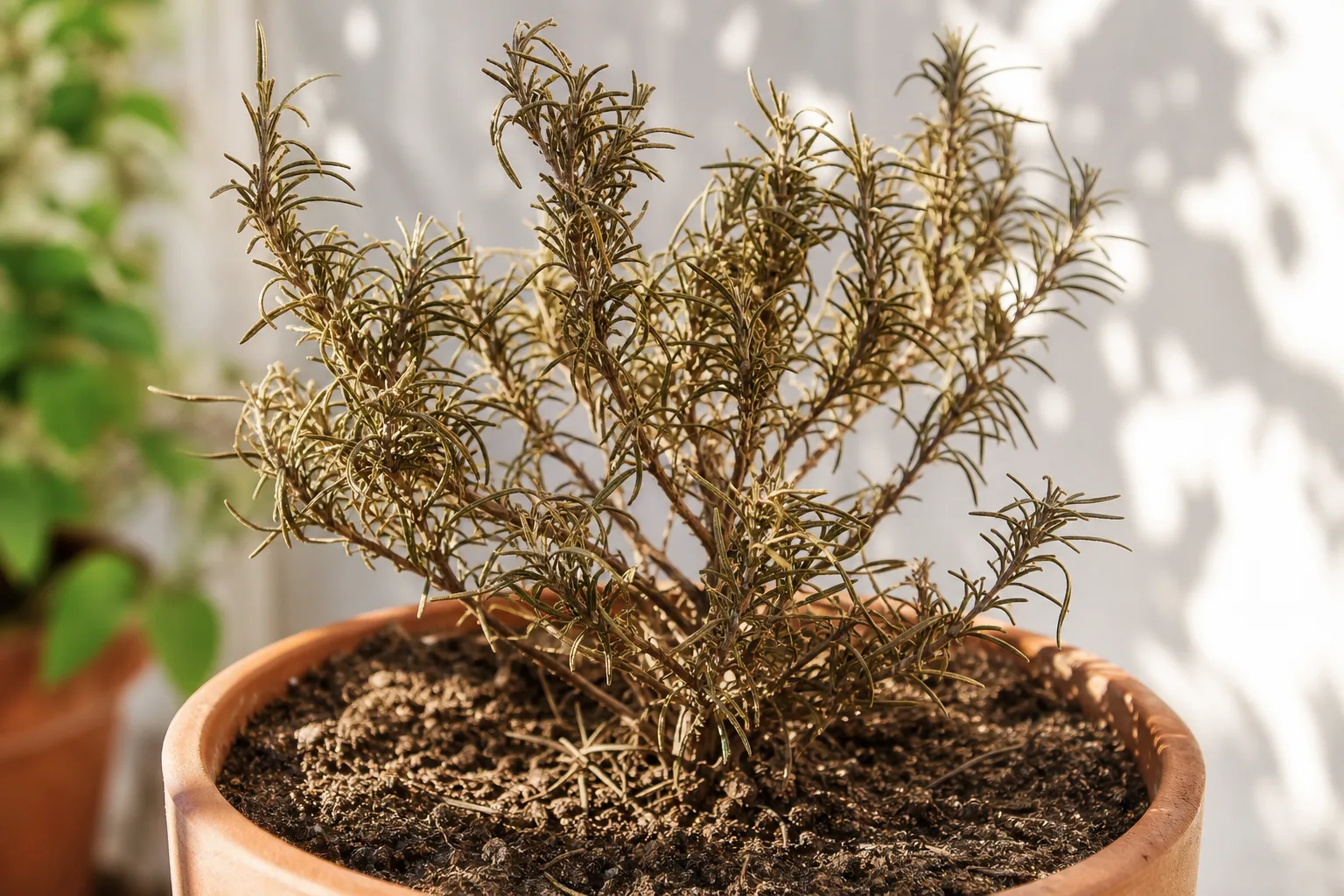
Underwatered rosemary curls its needles inward, browns tips, and wilts dramatically in light pots on hot balconies. First step: soak the root ball until water runs from drainage holes, then resume watering only when the top 5 cm of mix is completely dry.
Underwatering on Rosemary: Causes, Checks & Fixes
This guide covers underwatering on Rosemary. See also the general Underwatering guide, watering, and light pages for this plant.
Underwatering on Rosemary: Causes, Checks & Fixes
Quick answer
Underwatered rosemary (Salvia rosmarinus) curls its needle-like leaves inward, develops dry brown tips, and can collapse sharply in a light terracotta pot on a hot balcony-even though the species is famous for drought tolerance once established in the ground.
Rosemary needles do not wilt the way broad leaves do, which makes drought easy to miss until needles curl and tips crisp. Many growers also keep pots too dry after an overwatering scare-fear of root rot is a common trap on this Mediterranean herb.
First step: soak the root ball until water runs freely from drainage holes. Let excess drain off, then wait until the top 5 cm of mix is completely dry before watering again. Do not give shallow sips-they often fail to rewet a dry root zone.
This URL is the drought and dry-mix rescue hub for the rosemary cluster. For year-round dry-down rhythm and seasonal intervals, see the rosemary watering guide. For wet-soil wilt that does not improve after soaking, see wilting on rosemary and root rot on rosemary.
Drought vs. rot vs. hydrophobic mix on Rosemary
Underwatering means the root zone dried too far between drinks. Wilting is the symptom-rosemary also wilts from uptake failure on wet soil when roots are damaged. Hydrophobic mix looks like you watered, but water races through while the core stays dry.
| What you notice | Likely cause | Urgency | First move |
|---|---|---|---|
| Light pot, bone-dry at 5 cm, needles curl inward, firm woody stems | Underwatering | Same day if collapse is widespread | Deep soak until water runs from holes; empty saucer |
| Light pot, water runs through in seconds, dry core after “watering” | Hydrophobic dry core | Same day - center stays dry | Bottom-soak 20–30 minutes until top 5 cm moistens, then drain |
| Heavy pot, wet at 5 cm, mushy stem base, wilt persists after soak | Overwatering / rot | Same day if stems soften | Stop watering; inspect roots if decline continues |
| Sun-side tip browning only, adequate moisture at 5 cm, firm stems | Heat scorch | Within a few days | Afternoon shade during heat wave; do not flood roots |
| Fine stippling, webbing on needle undersides in hot dry air | Spider mites | Within a week if spreading | White-paper tap test; treat pests-drought stress can overlap |
When drought and rot both seem possible, the wilting guide walks through the full branch-by-branch diagnosis.
What underwatering looks like on Rosemary
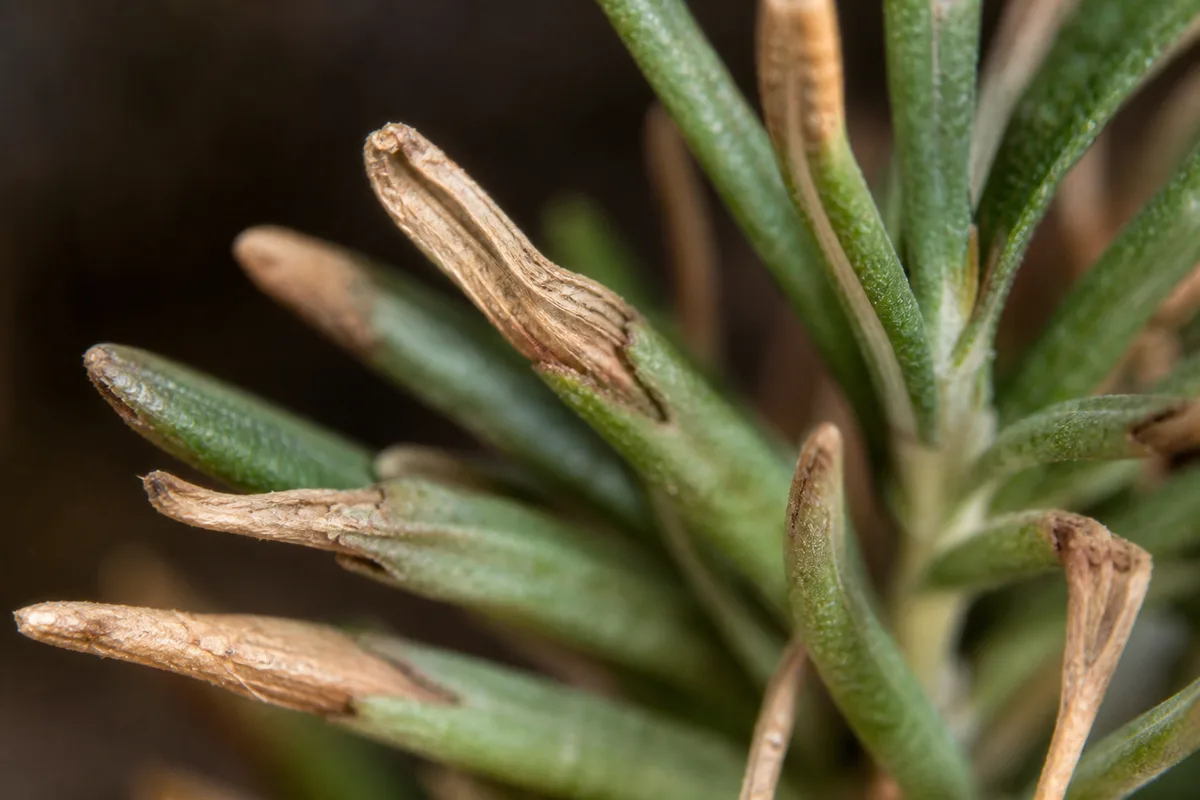
Rosemary expresses drought through its needles and stems rather than soft limp foliage. The needle-like leaves have revolute margins that roll slightly downward-a Mediterranean adaptation that reduces visible wilt until dehydration is advanced. By the time needles curl inward and feel brittle, the root zone has often been dry longer than a basil or mint would tolerate in the same pot.
Underwatering symptoms on Rosemary - compare with healthy tissue on the same plant.
Typical underwatering signs:
- Needles curl inward along the stem, losing their usual firm, upright posture
- Tips turn dry brown or gray-green before color spreads inward
- Foliage feels brittle and may crumble when rubbed
- Severe collapse-the whole plant looks wilted, though needles stay narrow rather than floppy
- Pot feels unusually light; dry mix may shrink and pull away from the pot wall
- Growth stalls; new shoots abort or stay very short
- Older interior needles yellow and drop after repeated dry cycles
What drought usually does not look like:
- Soft, mushy stems at the soil line-that pattern points to overwatering and root failure
- Uniform pale yellowing on wet, heavy soil
- White powdery coating on leaves-that is powdery mildew, not thirst
- Widespread stickiness with insects-check for aphids or scale separately
The wilt-recovery test is the most reliable field clue. Underwatered rosemary often bounces back within hours once the root zone is fully saturated. If soaking does not restore turgor, look for root rot, severe heat scorch, or pest stress instead.
In-ground vs. container drought tolerance
Established rosemary planted in the ground has excellent drought tolerance and rarely needs supplemental water once roots spread beyond the planting hole. The RHS advises that established in-ground rosemary should not need additional watering-rainfall usually suffices.
Container rosemary is a different contract. Limited soil volume, porous terracotta walls, and full-sun transpiration can move a 15 cm pot from adequately moist to critically dry within days during summer heat. Container plants need supplemental water during dry spells-but never confuse drought tolerance in garden beds with neglect on a west-facing balcony railing.
Original symptom photos (curled inward needles on light dry terracotta vs. healthy upright aromatic foliage; finger-depth check at 5 cm) pending for a future update.
Why Rosemary gets underwatered
Rosemary is a Mediterranean shrub native to dry scrub and rocky slopes. Established plants have excellent drought tolerance, and gardeners often hear that rosemary hates wet feet-which is true. Fear of root rot from overwatering pushes many growers to keep pots too dry for too long, especially indoors or on sheltered patios where evaporation is slower than expected.
Drought-tolerant reputation vs. container limits
The same species that survives dry Mediterranean summers can collapse in a small starter pot on a metal railing in July. Calendar watering fails here. Rosemary in full sun on a west-facing balcony uses water far faster than the same cultivar in a cool east window. Travel gaps, heat waves, and windy exposed sites all compress the interval between necessary soaks.
Terracotta, travel gaps, and shallow watering
Terracotta wicks moisture through porous walls faster than glazed ceramic-clay pots permit rapid drying, a benefit for preventing chronic wetness, but a liability when you forget to check for three hot days. Shallow watering creates a second trap: a quick pour that only dampens the surface leaves the core of the root ball dry while the top looks briefly moist. The plant keeps losing water through aromatic foliage, but roots cannot absorb what never reached them.
Young or recently repotted rosemary is more vulnerable than mature in-ground shrubs. Until roots explore fresh mix and stems lignify, even brief dry spells can stall growth and crisp tender tips. Upright cultivars in narrow pots often show collapse before prostrate trailing types in wider bowls-but pot weight and the 5 cm probe confirm drought on any form.
How to confirm the cause
Work through these checks before you change your whole care routine:
- Soil moisture at depth - Push your finger 5 cm into the mix. Bone-dry soil at that depth strongly supports drought. Cold, clumpy, wet soil days after watering suggests the opposite problem.
- Pot weight - Lift the container. A very light pot on a large plant usually means the root ball has little available moisture.
- Edge gap - Dry mix shrinking away from the pot wall is a classic sign the root zone has been dry too long.
- Stem firmness - Woody stems should feel rigid. Soft brown tissue at the base on damp soil is not underwatering.
- Soak response - Water deeply once. Needles that rehydrate and stand up within several hours confirm drought was the main issue.
- Light and heat context - Rosemary needs at least six hours of direct sun daily when possible; plants in six or more hours of direct sun dry faster. A plant moved recently to a hotter spot may need water sooner than your old schedule allowed.
- Hydrophobic mix check - If water runs straight through and out the bottom in seconds, the peat may have dried out and repelled moisture. The surface can look briefly damp while the center stays dry.
If soil is wet, stems are mushy, or the plant does not revive after soaking, stop treating this as underwatering and inspect roots for rot per the root rot guide.
First fix for Rosemary
Soak the container until water runs steadily from drainage holes, then empty the saucer.
Set the pot in a sink or outdoors, water slowly until the entire root zone saturates, and repeat once if the first pass ran through too fast on hydrophobic mix. For severely dry pots, bottom-water by standing the container in a tray of water for 20–30 minutes, then let it drain fully before returning it to its saucer.
That single deep soak is the correct first response. Do not fertilize, repot, or prune heavily on day one unless you have confirmed mushy roots that require emergency surgery.
After the soak, wait until the top 5 cm of mix is completely dry before the next watering. Rosemary wants dry-down cycles between soaks-not constant moisture and not months of neglect. Full interval guidance lives on the watering guide.
Step-by-step recovery
Once the initial soak is done, follow this sequence based on severity:
Mild - missed one watering, firm stems, light curl only
- One deep soak - Saturate the root ball once; empty the saucer within thirty minutes.
- Resume dry-down rhythm - Check the top 5 cm every two to three days in summer; water only when completely dry at depth.
- Trim only dead tissue - Snip brittle brown stems that snap cleanly with no green inside. Leave wilted but flexible stems; they may refill after hydration.
Expect needles to uncurl within hours. Crispy tips will not green up-that is cosmetic, not a failure signal.
Moderate - widespread tip browning, edge gap, stalled growth
- Rewet hydrophobic mix - Bottom-water twice in one week or poke a few shallow holes in the dry surface before soaking to break the crust.
- Reset the schedule - In summer, check small pots every two to three days. Larger containers may go five to seven days between soaks depending on sun and wind. Use depth checks, not calendar dates.
- Hold fertilizer - Do not feed drought-stressed rosemary until new growth looks firm and aromatic again. Salts on dry roots cause additional stress.
- Move if placement amplifies drying - A small pot on a metal railing in all-day sun may need a slightly larger container or afternoon shade during heat waves-not because rosemary dislikes sun, but because the root volume cannot keep up with transpiration.
Judge success by new silvery-green shoots at branch tips within one to two weeks-not by old needle color.
Severe - gray-brown brittle branches, no perk-up after soak
- Re-soak once - If the first soak ran through too fast, bottom-water until the top 5 cm is moist.
- Inspect roots if still collapsed after twenty-four hours - Pale firm roots support continued rescue; brown mushy roots mean root dieback from prior wet stress or prolonged desiccation beyond what foliage can support.
- Repot only when root volume is the bottleneck - If the plant dries out every day despite deep soaks, it may be root-bound in too small a pot. Repot in spring into gritty fast-draining mix per the soil guide, but only after hydration stabilizes.
- Start backup cuttings - Take healthy semi-hardwood cuttings from firm upper growth if lower wood is snapping dry-see the propagation guide.
Isolate the plant from other changes while you monitor. Adjust watering first; do not simultaneously move pots, change soil, and prune hard.
Recovery timeline
| Severity | What you see | Realistic timeline | Success signal |
|---|---|---|---|
| Mild | Light pot, inward curl, firm stems | Hours to same day after soak | Needles uncurl; stems regain stiffness |
| Moderate | Widespread tip browning, edge gap | One to two weeks | New shoots at branch tips; wilt stops spreading |
| Severe | Gray-brown brittle branches, failed first soak | Three to four weeks or unlikely | Fresh aromatic growth from nodes; firm roots on inspection |
Crispy brown needle tissue does not revert to green. Judge success by stopped wilting, firm woody stems, and fresh silvery-green shoots emerging from nodes.
If no new growth appears after three to four weeks of corrected watering, roots may have died back beyond what foliage can support. Inspect the root ball before investing more time on a declining specimen-or shift focus to propagation from firm upper growth.
Lookalike symptoms to rule out
Overwatering and root rot - Leaves may yellow and stems soften at the base while soil stays wet. The pot feels heavy. Soaking makes wilt worse, not better. See overwatering on rosemary.
Heat scorch on recently moved plants - Needle tips brown on the sunniest side after a sudden exposure increase, but soil moisture is adequate and stems stay firm throughout. Cosmetic brown tips may overlap-confirm moisture at 5 cm before soaking.
Low light stress - Leggy pale growth in weak indoor light can look unhealthy without the brittle curl-and-crisp pattern of true drought. Soil may stay wet too long in dim cool rooms.
Spider mites - Fine stippling and webbing on needle undersides in hot dry air; confirm with a white paper tap test. Mites thrive when rosemary is stressed, but drought and mites can overlap-see spider mites on rosemary.
Winter cold damage - Brown needles after frost exposure differ from summer drought; soil was not necessarily dry and damage often hits outer foliage first.
Mistakes to avoid
Do not assume rosemary never needs water because it is drought tolerant once established. Established in-ground plants may survive dry spells; container rosemary needs supplemental water during dry spells.
Do not respond to wilt by soaking daily without checking soil first-you may flip a dry plant into rot if drainage is poor and the mix stays soggy.
Do not mist needles instead of soaking roots. Surface humidity does not replace soil moisture.
Do not give shallow sips that wet only the top inch. Saturate the root ball or use bottom-watering.
Do not fertilize before rehydration. Feed only after the plant is drinking normally again.
Do not confuse brittle drought browning with mushy rot browning-the fix for each is opposite.
Do not withhold water from a wilting rosemary when soil is wet at 5 cm-that is rot or uptake failure, not drought.
Rosemary care cross-check
Rosemary performs best with at least six hours of direct sun, gritty alkaline mix with exceptional drainage per the soil guide, and watering only when the root zone has dried down. Low humidity is normal and not a reason to overwater.
If your pot stays wet for many days after a soak, the problem is likely mix, drainage, or insufficient light-not underwatering. Fix those conditions before increasing water frequency. Background on Mediterranean biology and cultivar choice lives on the rosemary overview.
How to prevent underwatering next time
Check soil at 5 cm depth before every major watering decision. In summer, small containers on sunny balconies may need attention every few days; winter indoor rosemary may go ten to fourteen days between soaks-full seasonal tables on the watering guide.
Water deeply each time so the whole root ball moistens, then let excess drain away. Never leave rosemary sitting in a full saucer.
Size pots realistically. A root-bound plant in a too-small container will cycle through drought stress repeatedly no matter how careful you are.
Refresh peat-heavy mix that has gone hydrophobic after long dry spells. Gritty rosemary blends with perlite, coarse sand, and fine gravel drain fast but still need occasional full rewetting.
Track how your specific pot dries across seasons. Heat waves, travel, and new sun exposure all shorten the interval-adjust before needles curl, not after.
When to worry
Treat as urgent when whole branches turn gray-brown and snap dry, soil has separated from the pot wall for days, or the plant remains collapsed twenty-four hours after a thorough soak. Those signs suggest severe root dieback or a misdiagnosis-escalate to root rot triage if stems soften on wet soil.
| Urgency | Signs | Action |
|---|---|---|
| Monitor | Mild tip browning, one missed watering, firm stems | One deep soak; reset dry-down rhythm |
| Act today | Widespread curl, light pot, edge gap, no mushy base | Deep soak or bottom-water; hold fertilizer |
| Escalate | No perk-up after 24 h soak; soft base on wet soil; gray brittle wood | Inspect roots; stop watering if rot confirmed |
Also escalate if stem bases soften while soil is wet-that is rot, not drought. Stop watering and inspect roots immediately.
Mild tip browning on an otherwise firm plant after one missed watering is not an emergency. One deep soak and a schedule reset usually suffice.
Related rosemary guides
- Rosemary watering - Dry-down rhythm, seasonal intervals, and winter indoor care
- Overwatering on rosemary - Wet-soil triage before roots decay
- Wilting on rosemary - Drought wilt vs. uptake failure on wet mix
- Root rot on rosemary - Failed soak-response escalation
- Brown tips on rosemary - Cosmetic vs. drought browning
- Spider mites on rosemary - Post-drought pest overlap
- Rosemary overview - Mediterranean biology and cultivar context
Conclusion
Rosemary hides thirst well until needles curl and tips crisp, especially in containers. Confirm drought with a depth check and a soak-response test, then rehydrate the full root ball once before rebuilding a dry-down rhythm on the watering guide. Browned needle tissue will not heal, but firm stems and fresh aromatic growth tell you the plant is back on track. When a thorough soak fails to restore turgor within twenty-four hours-or stems soften on wet soil-open root rot triage instead of repeating drought rescue.
FAQs
Why does my rosemary look dry but water runs straight through?
Dry peat-heavy or gritty mix can turn hydrophobic-water channels down the pot sides while the root core stays bone dry. Bottom-soak the container for twenty to thirty minutes until the top 5 cm moistens, then drain fully. If repelling returns within two weeks, refresh mix per the soil guide rather than repeating shallow top pours alone.
How often should I water rosemary in a small terracotta pot in summer?
Check every two to three days in full sun-many 15 cm terracotta pots need a deep soak every five to seven days in summer, but only when the top 5 cm is completely dry. Pot weight and finger depth beat any calendar. Established in-ground rosemary rarely needs supplemental water unless rainfall fails for several weeks.
Will crispy rosemary tips turn green again after drought?
No-fully desiccated brown needle tissue does not revert to green. Judge recovery by stopped wilting, firm woody stems, and fresh silvery-green shoots emerging from nodes within two to four weeks-not by cosmetic repair on old tips.
Is rosemary underwatering the same as wilting?
Wilting is the visible symptom; underwatering is one cause among several. Rosemary also wilts from root rot on wet soil, heat scorch, and pest stress. This page is the drought rescue hub-start here when the pot is light and mix is dry at 5 cm. Route to wilting or overwatering when pot weight and stem firmness disagree.
When is underwatering urgent on rosemary?
Act quickly when whole branches go gray-brown and brittle, soil has pulled away from the pot wall for days, or the plant fails to revive within twenty-four hours after a thorough soak. If stem bases are soft on wet soil, stop watering and inspect roots for rot instead of soaking again.