Brown Leaves on Janet Craig Dracaena: Causes, Checks & Fixes
Quick answer
Brown leaves on Janet Craig Dracaena usually trace to one of six patterns: tan crispy margins from fluoride in tap water, soft yellow-brown whole leaves on wet mix in low light, crisp edges on a light dry pot in bright rooms, cold-draft damage below about 55°F, normal aging of a single lower leaf on a firm cane, or sun scorch after a sudden move to harsh sun. First step: check pot weight and half-depth moisture, then your water source-fluoride margins and overwatering rot need opposite fixes.
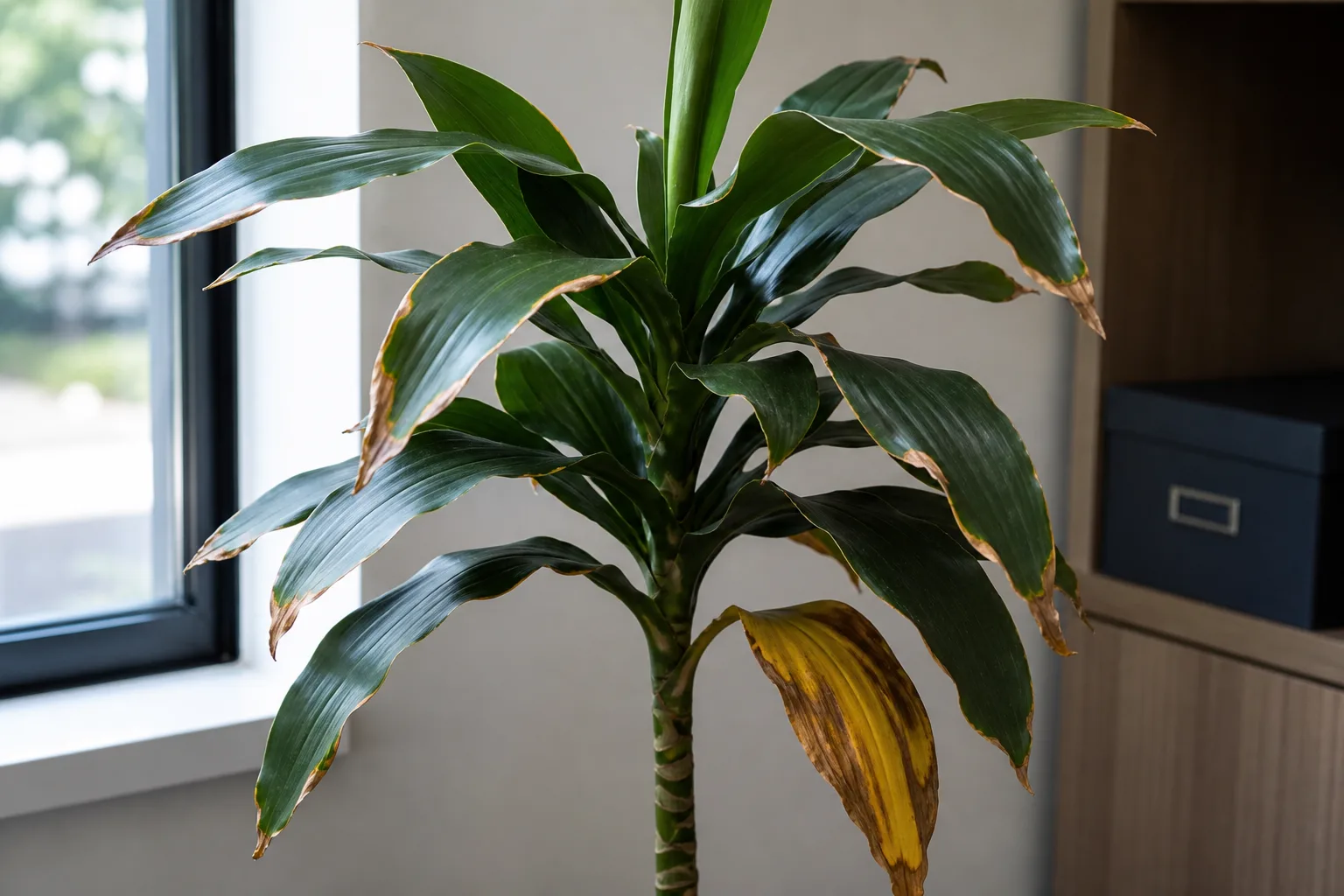
Brown Leaves on Janet Craig Dracaena: Causes, Checks & Fixes
This guide covers brown leaves on Janet Craig Dracaena. See also the general Brown Leaves guide, watering, and light pages for this plant.
Brown Leaves on Janet Craig Dracaena: Causes, Checks & Fixes
Quick answer
Brown leaves on Janet Craig Dracaena (Dracaena deremensis ‘Janet Craig’) are not one problem with one fix. The broad strap foliage on this low-light office staple browns in predictable patterns-and matching the pattern matters because fluoride margins and chronic overwatering need opposite responses.
The six causes that cover most indoor Janet Craigs:
- Fluoride and salt margin necrosis - Tan-to-brown crispy edges and margins on otherwise firm deep-green leaves after months of tap water.
- Overwatering and root stress in low light - Soft yellow-brown whole leaves, heavy wet pot, stalled crown growth, sometimes sour soil.
- Drought crisping in brighter placements - Light pot weight, dry mix halfway down, crisp brown edges on slightly drooping leaves.
- Cold-draft damage - Brown or yellow-brown leaves on the side facing a winter window, AC vent, or frequently opened door below about 55°F (13°C).
- Normal lower-leaf senescence - One mature strap leaf browning slowly at the lowest node on a firm upright cane as the trunk elongates.
- Sun scorch - Bleached or tan patches on leaves moved suddenly to harsh afternoon sun.
First step: check pot weight and push a finger or skewer halfway into the mix. A heavy wet pot with soft yellow-brown lower leaves points to overwatering-do not add water. A very light pot with crisp brown edges points to drought. Firm leaves with only margin necrosis and a history of tap watering point to fluoride-switch water before changing your watering interval.
For damage limited to tips and narrow margins only, start with brown tips on Janet Craig. Full species context: Janet Craig overview.
Brown leaves vs. brown tips on Janet Craig
Janet Craig owners often search both terms because fluoride injury starts at tips and margins-but the diagnostic scope differs.
Brown tips (tip-only or narrow margin band) usually mean fluoride or salt buildup from municipal tap water, over-fertilizing, or superphosphate products. The rest of the leaf stays deep green and firm. Crown new leaves may show minor tip burn early. This is cosmetic stress on an otherwise healthy plant when cane tissue stays firm and soil moisture is appropriate.
Brown leaves (this page) covers wider tissue failure: whole strap leaves turning yellow-brown on wet mix, multiple leaves crisping from drought, single lower leaves browning as the cane develops, cold-draft necrosis across exposed foliage, or tan scorch patches from direct sun.
| Symptom scope | Leaf texture | Pot / soil | Likely cause | Read next |
|---|---|---|---|---|
| Tips and margins only; blade stays green | Firm | Normal dry-down for light | Fluoride / salts | Brown tips |
| Whole lower leaves yellow-brown | Soft, may droop | Heavy, wet at depth | Overwatering / rot | Root rot, overwatering |
| Crisp edges, slight droop | Firm to slightly limp | Light, dry halfway down | Drought | Watering guide |
| One lowest leaf browning slowly | Firm | Normal | Normal aging | Monitor; overview |
| Tan patches after bright move | Firm then necrotic | Variable | Sun scorch | Sunburn guide |
| Brown on draft-facing side | Variable | Variable | Cold below ~55°F | Yellow leaves |
If leaves are yellow without brown necrosis, route to yellow leaves first-yellowing often precedes brown tissue on Janet Craig.
What brown leaves look like on Janet Craig
Janet Craig carries broad, glossy, dark-green strap leaves on thick cane-like stems. Brown damage shows distinct patterns depending on cause.
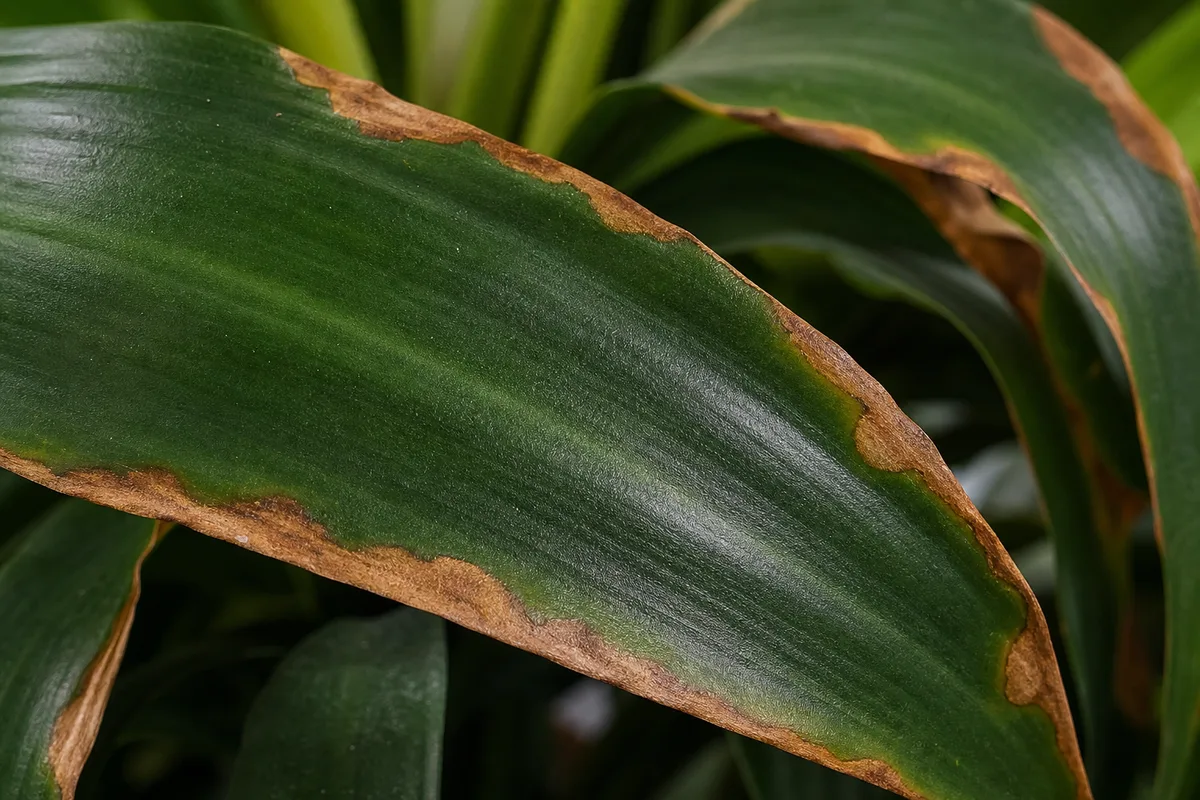
Brown Leaves symptoms on Janet Craig Dracaena - compare with healthy tissue on the same plant.
Fluoride and salt margin necrosis
- Tan-to-brown crispy tissue at leaf margins and tips while the central blade stays deep green
- Damage may creep inward along edges over months of tap watering
- Leaves feel firm, not soft; pot weight matches your normal dry-down rhythm
- White crust on soil surface may accompany salt buildup from fertilizer or hard water
- New crown leaves may show early margin burn if fluoride is already high in the root zone
- Often worsens in low-light offices where transpiration is slow but fluoride still accumulates with every watering
For tip-focused fluoride protocols, see brown tips.
Overwatering and root stress (whole-leaf browning)
- Lower and inner leaves turn soft yellow-brown; some drop while still partially green-yellow
- Pot stays heavy days or weeks after the last watering
- Crown growth stalls-no new rolled leaves emerging for weeks
- Cane may soften at the soil line in advanced cases; mix may smell sour when lifted
- Common in dim offices watered on a bright-room weekly schedule
- Fungus gnats sometimes appear as a secondary moisture signal
This pattern overlaps yellow leaves early-yellow often comes before brown necrosis on wet mix.
Drought crisping
- Brown crisp edges on leaves that may also show slight droop
- Pot feels very light; mix is dry well below the surface
- More common when Janet Craig sits in a brighter window or warm room where dry-down runs faster than the owner expects
- Cane usually stays firm; damage concentrates on oldest outer leaves first
- Distinct from fluoride when pot weight is light and you have skipped waterings
Cold-draft damage
- Brown or yellow-brown patches on leaves facing a winter window, AC register, or exterior door
- May follow sustained exposure below about 55°F (13°C)
- Can affect multiple leaves on one side of the canopy while the sheltered side stays green
- Cane often remains firm unless overwatering is also present
- Often confused with disease-check placement before spraying anything
Normal lower-leaf aging
- One mature strap leaf at the lowest node browns slowly from the tip or margin inward
- Cane is firm and upright; crown leaves stay deep green and healthy
- Happens as Janet Craig elongates its trunk and sheds older foliage
- No sour soil, no heavy wet pot, no rapid spread up the cane
- Missouri Botanical Garden notes lower leaf loss on Dracaena as plants develop height indoors
Sun scorch
- Bleached, tan, or brown patches on leaves exposed to direct afternoon sun through glass
- Often follows a sudden move from a dim shop or office to a bright south- or west-facing window without acclimation
- Damage is localized to sun-facing tissue; shaded portions of the same leaf may stay green
- See sunburn and scorched leaves for relocation and acclimation detail
Why Janet Craig gets brown leaves
Low-light office biology and slow transpiration
Janet Craig is marketed for exceptional shade tolerance-it can maintain foliage in office fluorescent light where faster growers fail. That survival comes with a metabolic tradeoff: in deep shade the plant transpires slowly, so water exits leaves slowly and mix stays wet far longer than owners expect.
A watering rhythm that keeps a bright-window pothos happy will waterlog Janet Craig roots within weeks in a dim hallway. Wet, airless mix damages roots; the plant cannot supply crown leaves even though soil feels “normal” to a calendar-based waterer. Lower leaves yellow-brown and drop while the pot stays heavy-a pattern detailed in overwatering and root rot.
At the same time, fluoride from tap water still enters the root zone with every watering even when transpiration is slow. Fluoride accumulates at leaf margins because the plant cannot flush it out as fast as it arrives-a double stress unique to fluoride-sensitive dracaenas in low-light placements.
Fluoride sensitivity and salt buildup
Janet Craig is among the most fluoride-sensitive houseplants in commercial interiors. Municipal water commonly contains fluorine at about 1 ppm; unlike chlorine, it does not evaporate when water sits overnight. Clemson HGIC lists fluoride sensitivity as a primary dracaena complaint. PNW Handbooks fluorine toxicity guidance documents margin necrosis on dracaena from fluoridated water and fertilizers containing superphosphate.
Salt from over-fertilizing or hard water produces similar margin browning. White crust on the soil surface is a visual clue. Margin necrosis is cosmetic on firm cane when moisture is correct-but it will not stop until water quality changes.
Watering mismatch across light levels
Janet Craig in bright indirect light may need the top half of mix dry before the next soak. The same plant in deep shade often needs most of the pot dry-sometimes every 21 to 28 days or longer between thorough waterings per NC State Janet Craig guidance. Owners who do not adjust after moving a plant from a window to an office cube cause either chronic overwatering (soft yellow-brown leaves) or, if they under-correct, drought crisping in the brighter original spot.
Match rhythm to placement using the watering guide and light guide.
How to confirm the cause
Work through these checks in order. Pot weight and half-depth moisture beat guessing from leaf color alone.
- Pot weight - Lift the pot. Heavy days after watering with soft yellow-brown lower leaves → overwatering track. Very light with crisp brown edges → drought track. Normal weight with firm leaves and margin necrosis only → fluoride track.
- Half-depth moisture - Push a finger or wooden skewer to the middle of the pot. Wet cling on a heavy pot confirms overwatering suspicion. Dry throughout on a light pot confirms drought.
- Water source history - Months of municipal tap with progressive margin browning on firm leaves strongly implicates fluoride. NC Extension recommends filtered or rain water for Dracaena when tap causes browning.
- Cane firmness - Firm throughout: environmental or water-quality stress. Soft at soil line with sour smell: escalate to root inspection-see root rot.
- Crown new growth - Clean emerging leaves mean the current fix direction is working. Stalled crown with wet mix means roots-not fluoride-are the bottleneck.
- Which leaves failed - Single lowest leaf on firm cane: aging. Cluster of lower yellow-brown on wet mix: rot. Margins only on many leaves: fluoride. Draft-side patchiness: cold. Tan patches after bright move: scorch.
- Recent placement changes - Move, repot, or light shift in the last two weeks narrows sun scorch vs. chronic fluoride.
Confirmation decision table
| Pattern | Leaf tissue | Pot / mix | Cane | Likely cause | First direction |
|---|---|---|---|---|---|
| Tan crispy margins, green blade center | Firm | Normal dry-down | Firm | Fluoride / salts | Switch water; flush mix |
| Whole leaves yellow-brown, lower first | Soft, droopy | Heavy, wet at depth | Firm to soft | Overwatering / rot | Stop water; inspect roots if soft |
| Crisp brown edges, slight droop | Firm | Light, dry halfway | Firm | Drought | One thorough soak; fix rhythm |
| One lowest leaf browning slowly | Firm | Normal | Firm | Normal aging | Monitor; trim if desired |
| Draft-side brown patches | Variable | Variable | Firm | Cold below ~55°F | Relocate off vent/window |
| Tan patches after bright move | Necrotic patches | Variable | Firm | Sun scorch | Filter light; acclimate |
You have confirmed fluoride margin necrosis when margins and tips crisp on firm leaves, tap water has been the primary source for months, pot moisture matches light level, and cane stays solid.
You have confirmed overwatering browning when lower leaves yellow-brown on a heavy wet pot, crown growth has stalled, and half-depth moisture stays wet days after the last watering.
You have confirmed normal aging when exactly one lower mature leaf browns on an otherwise healthy firm cane with appropriate dry-down and no sour soil.
First fix for Janet Craig (by likely cause)
Apply one change at a time on fluoride-sensitive Janet Craig. Do not stack Janet Craig Dracaena repotting guide, heavy pruning, and fertilizer on the same day.
Fluoride and salt margins (firm leaves, margin necrosis): Switch to rainwater, distilled, or reverse-osmosis water immediately. Water thoroughly once with the new source, then let the top half of mix dry before the next drink. Flush the pot with plain low-fluoride water at two to three times pot volume to leach accumulated salts. Trim dead margins for appearance only. Avoid superphosphate fertilizers. Full tip-focused protocol: brown tips.
Overwatering and root stress (heavy wet pot, soft yellow-brown leaves): Stop watering and let mix dry deeper than usual-potentially an extra week in low light. Empty saucers after every future watering. If cane softens or mix smells sour, unpot and inspect roots per root rot. Do not increase watering because leaves look brown-wet soil in dim rooms worsens rot.
Drought crisping (light pot, dry mix): Water thoroughly once with filtered low-fluoride water until a modest amount runs from the drainage hole, then empty the saucer. Resume dry-down checks matched to light-see watering guide. Do not water on a fixed calendar.
Cold-draft damage: Move Janet Craig off the draft path-away from AC vents, winter window sills, and frequently opened exterior doors. Hold placement steady for two weeks. Remove severely necrotic leaves for appearance. Do not mist; it does not fix cold injury.
Normal lower-leaf aging: No emergency treatment. Trim the spent leaf at the node if it bothers you visually. Monitor that only one leaf at a time browns on a firm cane. Progressive multi-leaf loss routes to yellow leaves.
Sun scorch: Relocate to bright indirect light without direct afternoon sun on the leaves. Acclimate gradually over one to two weeks if you need brighter placement long term. Remove scorched tissue; it will not re-green. Details: sunburn guide.
Recovery timeline
Fluoride margin necrosis - Existing brown tissue does not re-green. Margin spread should stop within two to four weeks after switching to low-fluoride water and flushing salts. Judge success by clean new crown leaves without fresh tip burn.
Overwatering / mild root stress - Lower damaged leaves may drop. Crown growth may stay stalled two to six weeks after you correct dry-down. Firm cane with new rolled leaves emerging means recovery is underway. Advanced rot with mushy roots needs repotting-timeline extends several months.
Drought crisping - Leaves perk within days after a thorough soak. Crisp edge tissue remains brown permanently; new growth should emerge clean within two to four weeks if rhythm stays matched to light.
Cold-draft damage - Damaged tissue is permanent. New crown leaves after relocation may take two to four weeks in warm months; slower in winter low light.
Normal aging - The single browned leaf is replaced by trunk elongation over time-not by that same leaf re-greening.
Sun scorch - Scorched patches are permanent on affected tissue. New leaves formed after acclimated placement should be full deep green within one to two growth cycles.
What not to do
Do not increase watering when margins brown from fluoride alone-wet mix in low light causes separate rot problems.
Do not use untreated tap water if margin necrosis persists after you have “fixed” watering rhythm.
Do not mist leaves to fix fluoride burn or cold damage-it does not leach fluoride from tissue and can encourage fungal spotting when air circulation is poor.
Do not water on a weekly calendar in a dark office-allow soil to dry between waterings is essential, and Janet Craig in deep shade needs far longer intervals than faster growers.
Do not assume every lower brown leaf means rot-single-leaf aging on a firm cane is normal as the trunk develops.
Do not stack repotting, pruning, and fertilizer on the same day while the plant is stressed.
Do not use water from a home softener-sodium damages Dracaena roots.
Dracaena is toxic to cats and dogs-dispose of trimmed brown leaves safely and keep plants out of reach of chewing pets.
How to prevent brown leaves next time
Default to low-fluoride water for every Janet Craig watering-filtered, distilled, rainwater, or reverse osmosis. This single habit prevents most margin necrosis in offices that would otherwise blame humidity or fertilizer.
Match dry-down to light level - Top half dry in bright indirect placements; most of the pot dry in deep shade, often every three to four weeks or longer. Use pot weight and a half-depth skewer, not a calendar. Full rhythm detail: watering and light.
Flush salts seasonally - Run plain low-fluoride water through the pot at two to three times volume every few months if you fertilize lightly or use harder water.
Shield from drafts - Keep Janet Craig away from heating and cooling vents and winter window sills where air drops below 55°F (13°C).
Acclimate before bright moves - Shift gradually over one to two weeks when relocating from dim shops to sunny windows to avoid scorch.
Inspect weekly during routine dusting or watering checks-crown new growth, pot weight, and lowest leaf nodes tell you problems are building before half the canopy browns.
Practical checks
Urgency check
Same-day attention when cane tissue softens at the base, soil smells sour, yellow-brown leaves cluster on a heavy wet pot, or crown growth has stalled for weeks in warm indoor temperatures-that is root rot risk, not cosmetic fluoride margins.
This week when multiple leaves brown after a cold event, sun scorch covers most of the canopy after a sudden bright move, or margin necrosis spreads rapidly despite normal moisture-identify cause and apply one fix.
Monitor when one lower leaf browns on a firm cane with clean crown growth-likely normal aging.
Lower urgency when firm leaves show only margin necrosis and you have not yet switched off tap water-start with water quality before repotting.
Best inspection order
Crown new growth → pot weight → half-depth moisture → water source (fluoride history) → which leaves failed (lowest vs. many vs. margins only) → draft and sun placement → cane firmness at soil line → roots only if wet decline persists
Related Janet Craig problems
- Janet Craig overview - Fluoride, low-light watering, troubleshooting hub
- Watering - Dry-down rhythm matched to office low light
- Light - Survive vs. thrive light levels
- Brown tips - Tip-only fluoride burn and flush protocol
- Yellow leaves - Yellowing before brown necrosis on wet mix
- Root rot - Soft cane when wet mix persists
- Overwatering - Heavy pot in dim placements
- Sunburn and scorched leaves - Tan patches after harsh sun
When to use this page vs other Janet Craig Dracaena guides
- Janet Craig Dracaena watering guide - Use for routine moisture checks before assuming brown leaves is the main issue.
- Janet Craig Dracaena problems hub - Browse all 50 common issues on this species.
- Brown Tips on Janet Craig Dracaena - Different entry point when symptoms overlap with brown leaves.
- Yellow Leaves on Janet Craig Dracaena - Different entry point when symptoms overlap with brown leaves.
- Overwatering on Janet Craig Dracaena - Different entry point when symptoms overlap with brown leaves.