Spider Mites on Fishbone Cactus: Causes, Checks & Fixes
Quick answer
Spider mites on Fishbone Cactus show as fine yellow stippling and webbing on flat zigzag segments in dry heated rooms. First step: isolate the hanging plant and rinse every stem from top to bottom with lukewarm water until the paper-tap test confirms live mites.
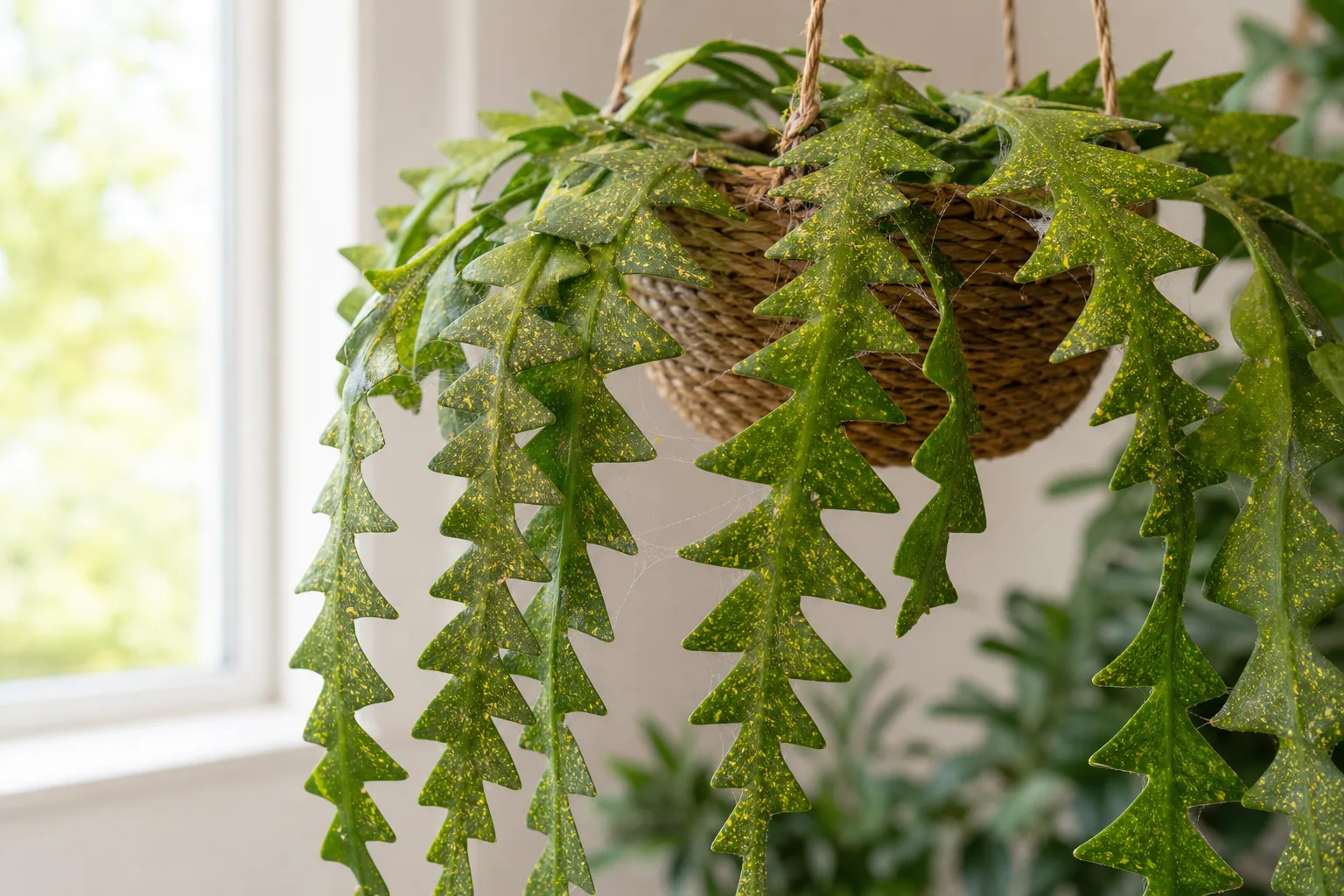
Spider Mites on Fishbone Cactus: Causes, Checks & Fixes
This guide covers spider mites on Fishbone Cactus. See also the general Spider Mites guide, watering, and light pages for this plant.
Spider Mites on Fishbone Cactus: Causes, Checks & Fixes
Quick answer
Spider mites on Fishbone Cactus (Disocactus anguliger) are tiny sap-feeding arachnids that explode in warm, dry indoor air-especially on a hanging basket parked near a south-facing window or above a winter radiator. On this trailing epiphyte, damage shows as fine yellow or white stippling across flat zigzag phylloclades, bronzing on heavy feeding, and delicate webbing at segment bases and overlap angles where casual watering never reaches.
First step: isolate the plant and rinse every stem from top to bottom with lukewarm water. Support trailing growth with one hand, spray undersides and zigzag notches with enough force to knock mites loose, and let the pot drain completely in Fishbone Cactus light guide the same day. Only after a paper-tap test confirms live specks should you reach for horticultural oil or insecticidal soap on a repeat schedule.
Why Fishbone Cactus gets spider mites in dry winter rooms
Spider mites are not random bad luck on a cloud-forest cactus-they track environmental stress. Mites thrive when humidity drops and temperatures stay warm, which describes most heated living rooms from November through March. Fishbone Cactus enjoys 40–60% relative humidity in its native Mexican evergreen forest; when indoor RH falls toward 30% or below for weeks, flat stem surfaces lose moisture faster and mite populations can build quickly on warm trailing growth when humidity stays low.
Several traits of this species make outbreaks easy to miss until stippling spreads:
- Flat, overlapping zigzag segments create sheltered crevices mites colonize on undersides-especially on the wall-facing side of a hanger and inside acute angles where two phylloclades meet.
- Hanging-basket placement often puts the pot at face height near windows and vents. Hot dry air rising from radiators or pulling across sunny glass hits trailing stems directly.
- No true leaves means damage appears on photosynthetic stems. Owners sometimes blame “underwatering on Fishbone Cactus” when they see bronzing, or low humidity when only edges crisp-while mites stipple the flat faces between lobes.
- Fast spring and summer growth produces tender new segments mites prefer, but winter heating can sustain populations on mature arms when humidity crashes.
Fishbone Cactus is an epiphytic jungle cactus, not a desert species. It wants more water and organic bark in the mix than a barrel cactus, but good drainage and bright indirect light still matter. A plant in weak light with chronically soggy mix grows slowly; mite damage on stalled tips then stands out more than on a vigorous specimen-but dry air alone can trigger mites even when watering is correct.
What mite damage looks like on flat zigzag segments
Unlike upright foliage plants where stippling shows on leaf faces, Fishbone Cactus damage reads on phylloclades-the flat, deeply lobed stem segments that give the fishbone silhouette.
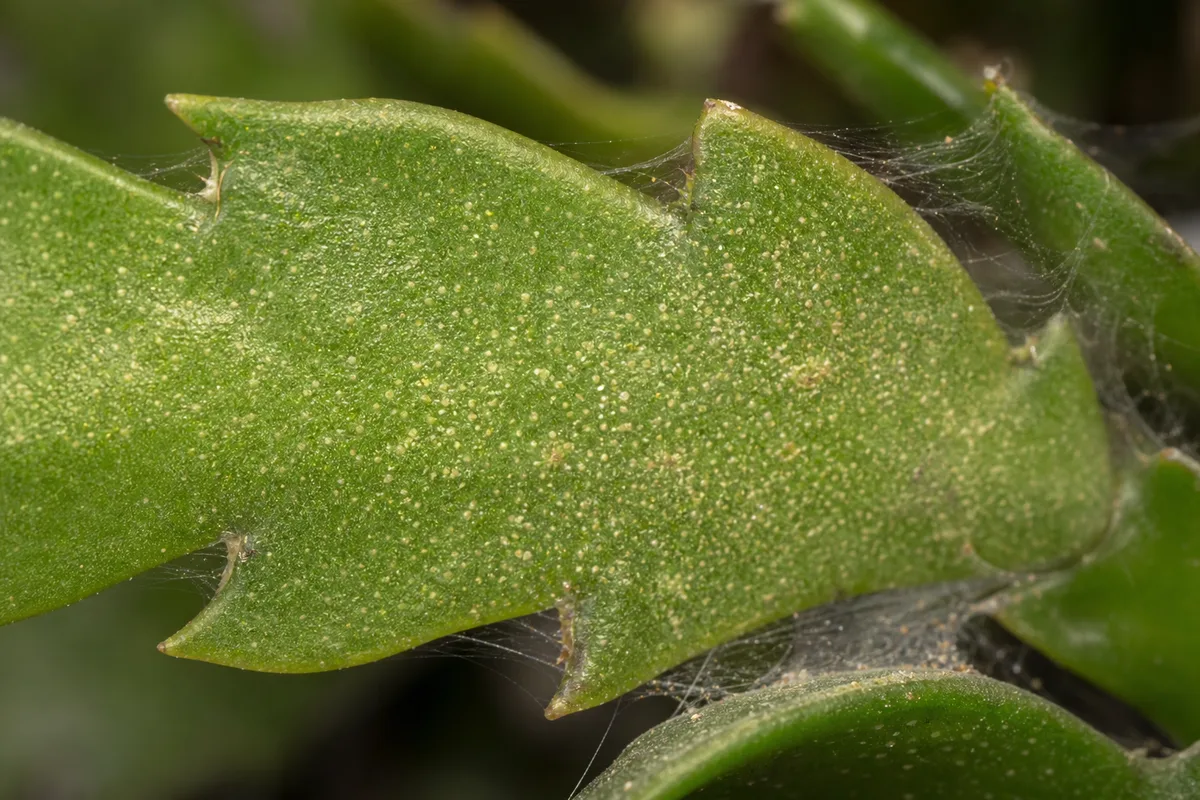
Spider Mites symptoms on Fishbone Cactus - compare with healthy tissue on the same plant.
Typical signs include:
- Fine yellow or white pinprick stippling scattered across flat stem surfaces, visible before bronzing spreads
- Bronze or tan wash over heavily fed segments, especially on outer trailing arms exposed to dry drafts
- Delicate silk webbing at the base of segments, in zigzag notches, and between overlapping arms-often thinnest early in an infestation
- Dry, slightly curled segment tips when feeding is heavy, without the sticky honeydew aphids leave behind
- Fine dust-like specks on a white paper after the tap test-adult spider mites are roughly 0.5 mm and usually live on undersides
Early stippling can hide inside segment overlaps until you lift trailing stems away from the wall or basket liner. Top-down watering alone rarely dislodges colonies tucked under the lower zigzag angles.
Spider mites vs. low humidity, thrips, and hard-water residue
Misidentification wastes weeks on the wrong fix. Use this quick matrix before spraying:
| What you see | Likely cause | Key check |
|---|---|---|
| Dry brown edges only, no pinpricks, no webbing | Low humidity below ~40% RH | Hygrometer near basket; no moving specks on paper tap |
| Fine stippling + webbing on flat stem faces | Spider mites | Paper-tap specks crawl; silk at segment bases |
| Silvery scrape marks, no webbing, no round specks | Thrips | No mites on tap test; scars look scraped, not dotted |
| White crust that does not move | Hard water or fertilizer splash | Wipes off; no bronzing spread over a week |
| Fixed brown bumps on older woody segments | Scale insects | Flicks with a fingernail; not mobile on paper |
| Wilting thin segments on dusty dry mix | Underwatering | Pot very light; mites absent on inspection |
The most common Fishbone Cactus confusion is low-humidity edge browning versus mite stippling. Dry air browns lobed margins on otherwise firm segments without yellow pinpricks across the flat face. Mites add speckled chlorotic dots that merge into bronze patches and almost always bring webbing at segment joints when populations grow.
How to confirm spider mites (six-step checklist)
Work through these checks before committing to sprays:
- Paper-tap test - Hold white paper under a suspect segment and tap sharply. Slow-moving specks confirm mites; static dust does not crawl.
- Inspect zigzag overlaps - Use a 10× hand lens on inner angles and the wall-facing side of trailing stems. Mites and early webbing concentrate where segments shelter one another-the same architecture aphids exploit on soft new tips.
- Look for silk - Fine webbing at segment bases distinguishes mites from thrips scars or mineral residue.
- Check humidity context - A hygrometer reading below 40% near the hanger supports why mites flared even if care otherwise looked fine.
- Scan neighbors - Inspect other hanging plants on the same wall hook or shelf. Mites walk and drift on air currents in dry rooms.
- Note recent history - New nursery plant, summer outdoors, or a move beside a heater? Each is a common introduction or trigger route.
If you see bronzing edges without stippling, webbing, or moving specks, correct low humidity first rather than spraying oils on a plant that may not have pests.
First fix: isolate neighbors, top-down rinse trailing stems, and treat on a schedule
Move the Fishbone Cactus away from other plants and rinse all stems thoroughly with lukewarm water.
Place the pot in a sink or shower. Support trailing stems with one hand and spray from the top of the plant downward so dislodged mites fall away from clean tissue-mirror the top-down rinse technique that works for aphids on this same species. Hit every flat face, underside, and zigzag notch with steady lukewarm water; cold shock stresses epiphytic stems more than room-temperature spray.
Let the bark-heavy mix drain completely in bright indirect light the same day. Fishbone Cactus rots when the crown sits in soggy peat or pooled runoff-so tilt the pot, empty saucers, and avoid leaving segments wet overnight in a dark corner.
Only after this rinse-and after the paper-tap test confirms live mites-apply insecticidal soap or horticultural oil labeled for houseplants and mites. Soaps and oils kill only by contact and must coat undersides and overlap angles missed by the first rinse. Repeat every five to seven days for at least three cycles to catch nymphs that hatch between passes.
Do not start with systemic insecticides, heavy pruning, or Fishbone Cactus repotting guide on day one. None of those replace direct knockdown on a hanging epiphyte whose pests hide along flat stem architecture.
Fishbone Cactus is non-toxic to cats and dogs, which makes repeated rinsing and handling safer than on many toxic ornamentals-but still keep pets from chewing wet stems right after treatment, ventilate the room during sprays, and follow product label precautions.
Step-by-step recovery
Once mites are confirmed, follow this order:
- Isolate - Keep the plant at least a few feet from others until two clean paper-tap tests, one week apart, show no movement.
- Physical knockdown - Repeat the lukewarm shower every two to three days during heavy infestations. Strong water sprays remove many mites when coverage is thorough.
- Contact spray passes - Apply labeled soap or oil until runoff on all segment surfaces, including hidden angles. Treat in evening or bright shade so wet stems do not scorch.
- Hold fertilizer - Skip feed until new growth looks clean for two weeks. Feeding stressed plants pushes soft shoots while populations may still rebound.
- Raise humidity modestly - A small humidifier within a few feet of the basket slows mite reproduction without soaking the crown. Target 40–60% RH, not rainforest saturation.
- Watch for reinfestation - Check zigzag joints weekly through the rest of heating season; dry air can restart a flare from eggs you missed in webbing.
Worsening signs: Bronzing spreads to most new tips despite three full spray cycles, webbing coats multiple trailing arms, or stems go mushy at the base from repeated rinses into sodden mix-prune the worst sections or consult a local extension office before the colony spreads to mealybugs’ and mites’ shared hot spots on neighboring hangers.
Recovery timeline and what “clean new growth” looks like
First week: After the initial rinse, live mite counts should drop noticeably. Old stippling remains visible-damaged chlorophyll does not fully reverse.
Weeks two to four: With soap or oil repeats every five to seven days, expect unblemished new zigzag segments emerging from tips. Judge success by clean young tissue, not by greening old bronze patches.
Bud season: If mites hit autumn flower buds, you may lose some bloom potential this cycle. Next year’s display depends on keeping stems clean through the preceding growth season and honoring the cooler rest this species uses to set buds-see the Fishbone Cactus overview for seasonal rhythm.
When to call it quits: If webbing returns within days after three complete cycles, the infestation may be too entrenched on a multi-foot trailing specimen. Consider cutting back heavily infested arms to healthy tissue, propagating clean tips, or discarding the worst plant to protect a collection.
What not to do
Do not assume general insecticides labeled for aphids or whiteflies will kill spider mites-mites need miticides, horticultural oil, or insecticidal soap aimed at arachnids. Broad-spectrum sprays can kill predatory mites and flare spider mite populations.
Avoid spraying oil or soap on sun-stressed plants in hot direct sun. Fishbone Cactus scorches easily; treat in evening or move the plant to bright shade until stems dry. Do not apply oils when temperatures exceed about 90°F or plants are drought-stressed.
Do not soak the crown or leave the epiphytic mix waterlogged during repeated mite showers. This species rots when drainage fails-same risk called out on the wilting and root-stress guides. Rinse stems, not the soil surface, unless you are correcting a separate watering issue.
Do not return the plant to its hanging spot beside neighbors after a single spray. One pass rarely clears eggs and nymphs in zigzag crevices.
Do not stack repotting, heavy pruning, and pesticide on the same day. Space stressors so the plant can tolerate contact sprays on firm tissue.
Prevention: humidity, zigzag-joint scouting, and hanging-basket placement
- Humidity: Aim for 40–60% RH near the basket during heating season-enough to slow mites without keeping bark mix soggy. See low humidity fixes if edges crisp every winter.
- Placement: Move hangers away from radiator blasts, forced-air vents, and sun-baked window glass that desiccate trailing stems.
- Weekly zigzag-joint checks: Lift stems and scan overlap angles during routine care instead of only glancing at the top of the hanger.
- Quarantine new plants for at least two weeks before hanging them near established Fishbone Cactus specimens.
- Dust rinse: Occasional lukewarm showers during active growth knock off early mites and make stippling visible sooner-without replacing a scheduled spray program once webbing appears.
When to escalate
Escalate if multiple plants on the same wall show stippling, three full treatment cycles fail to stop new webbing, or bronzing reaches most new growth while the paper-tap test still shows specks. At that point, remove heavily infested stem sections with clean scissors, isolate the plant away from the collection, or discard a severely compromised specimen rather than seeding mites across hanging baskets.
A few stippled segments on one outer arm after a single rinse is manageable. Webbing on most trailing stems, repeated bronzing on new tips, and neighbors showing specks are not-speed matters on a fast-growing epiphyte with large surface area.
Conclusion
Spider mites on Fishbone Cactus are a contact problem on flat zigzag stems in dry indoor air-not a mystery disease. Confirm moving specks and webbing in segment overlaps, isolate and top-down rinse first, then follow labeled soap or oil every five to seven days until new zigzag growth stays clean. Keep drainage, light, and humidity steady while you treat-this cloud-forest cactus recovers well once mites stop draining its phylloclades and you stop confusing edge crisping from dry air with true stippling damage.
For baseline care while you treat, see the Fishbone Cactus overview, watering rhythm, and sibling pest guides for aphids and mealybugs.
When to use this page vs other Fishbone Cactus guides
- Fishbone Cactus watering guide - Use for routine moisture checks before assuming spider mites is the main issue.
- Fishbone Cactus problems hub - Browse all 18 common issues on this species.
- Low Humidity on Fishbone Cactus - Different entry point when symptoms overlap with spider mites.
- Slow Growth on Fishbone Cactus - Different entry point when symptoms overlap with spider mites.