Mealybugs on Ficus Benjamina: Causes, Checks & Fixes
Quick answer
Mealybugs on Ficus Benjamina hide in leaf axils and the dense inner canopy of this weeping tree. First step: isolate the plant and dab every visible cottony cluster with a cotton swab dipped in 70% isopropyl alcohol-do not move or shower the whole tree until you have checked for scale lookalikes on the stems.
Mealybugs on Ficus Benjamina: Causes, Checks & Fixes
This guide covers mealybugs on Ficus Benjamina. See also the general Mealybugs guide, watering, and light pages for this plant.
Mealybugs on Ficus Benjamina: Causes, Checks & Fixes
Quick answer
Mealybugs on Ficus Benjamina (Ficus benjamina, weeping fig) are small sap-sucking insects related to scale. Adult females cover themselves and their eggs in white, cottony wax and settle where leaves meet stems-exactly the sheltered forks created by this plant’s arching, weeping branches and dense crown of small glossy leaves.
First step: isolate the tree and dab visible insects with alcohol. Move the weeping fig away from other houseplants, then inspect inner branch axils, leaf petiole bases, and undersides of older leaves with a hand lens. Use a cotton swab dipped in 70% isopropyl alcohol to touch each cottony cluster directly. UC IPM recommends testing alcohol on one leaf first and repeating weekly until the infestation clears-mealybugs are difficult to control because their wax coat protects them from casual sprays.
Do not start by moving a tall weeping fig to the shower or Ficus Benjamina repotting guide on day one. This species reacts to almost any stress by shedding leaves; alcohol dabs on reachable clusters cause less disruption than repeated relocations. Full species context: Ficus Benjamina overview.
What mealybugs look like on Ficus Benjamina
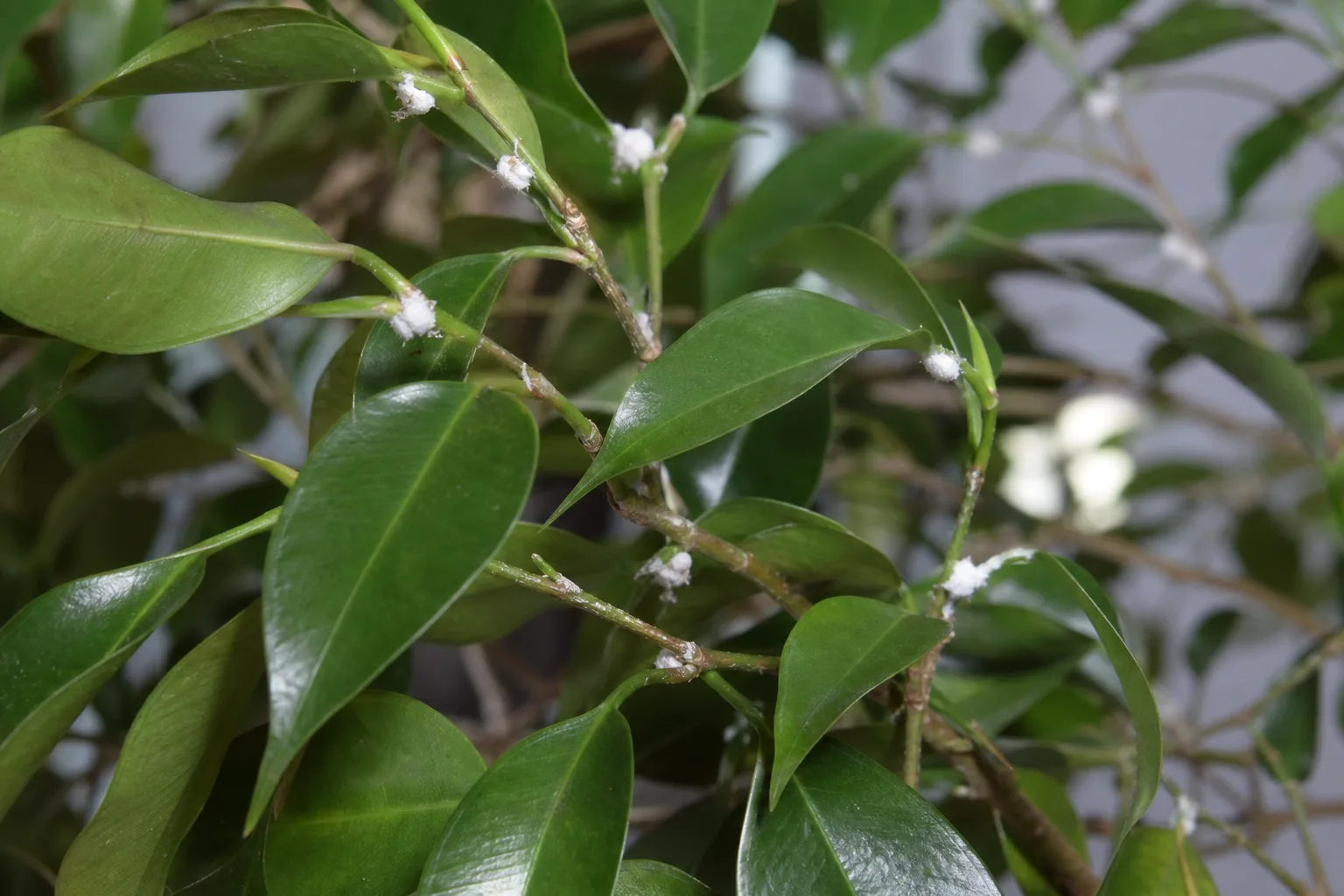
On weeping fig, mealybugs rarely announce themselves on the outer glossy leaves you see from across the room. They concentrate in protected crevices-where a leaf petiole wraps a stem, inside the layered interior canopy, and along the lower trunk below the lowest arching branches.
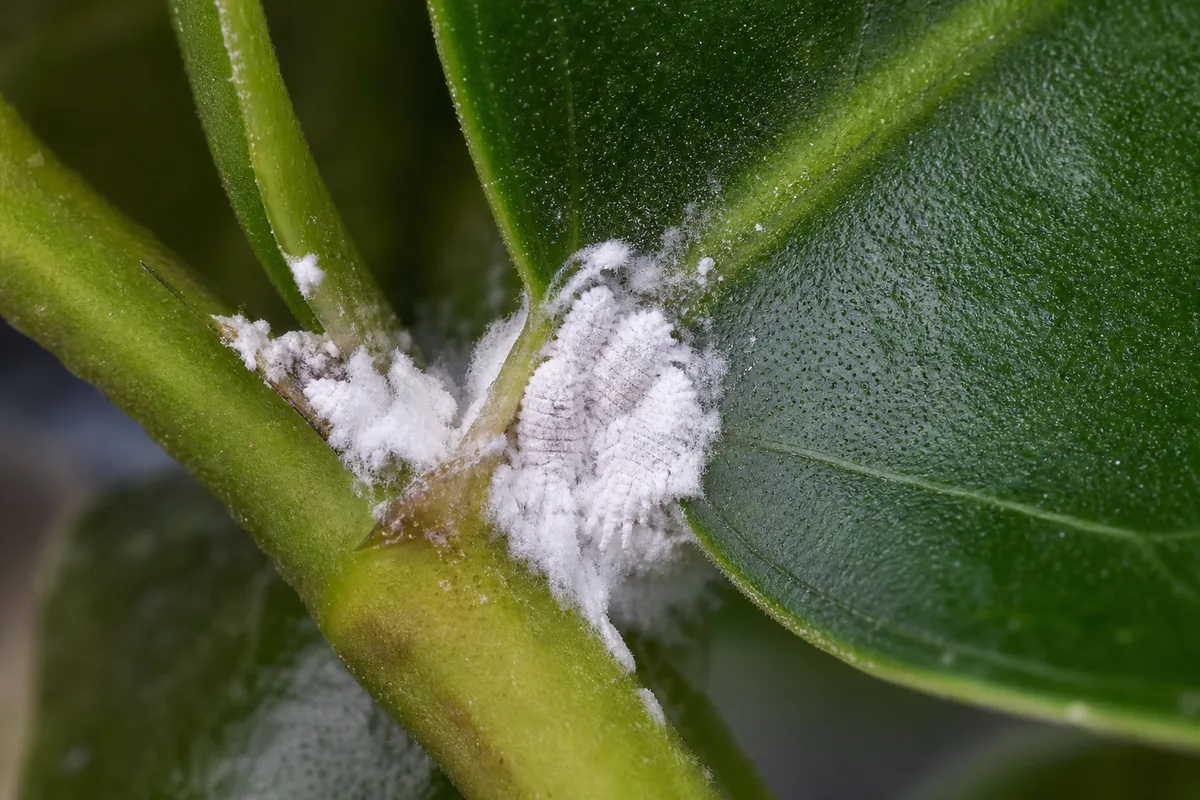
Mealybugs symptoms on Ficus Benjamina - compare with healthy tissue on the same plant.
Typical signs on this plant include:
- White cottony masses roughly 1/16 to 1/4 inch across, sometimes with thin waxy threads extending outward
- Pale, sluggish insects beneath the wax if you tease a cluster apart with a swab
- Sticky honeydew on glossy leaf surfaces-especially visible on weeping fig’s shiny foliage and on the floor or furniture beneath a tall indoor tree
- Black sooty mold growing on that honeydew, blocking light on lower leaves
- Stunted or distorted new shoots when colonies sit at growing tips, though mealybugs more often hide in older axils than aphids do
- Ants on the pot rim or trunk, farming honeydew from insects higher in the canopy
Weeping fig already drops leaves when moved, chilled, or overwatered. Mealybug damage adds localized wax clusters and stickiness that stress-related drop alone does not produce. If the whole tree is shedding and the soil is wet, check watering rhythm before assuming pests.
Why Ficus Benjamina gets mealybugs
Clemson HGIC lists weeping fig among houseplants commonly hit by mealybugs, aphids, scale, and spider mites. The species’ growth habit makes it a good host indoors.
Dense, layered canopy. Hundreds of small leaves on arching branches create hundreds of leaf axils-tight junctions where mealybugs sit undisturbed while they feed. Casual watering from above rarely exposes the inner forks where colonies start.
Stable indoor conditions. Mealybugs reproduce year-round on houseplants in heated rooms. Colorado State University notes ficus among plants most commonly affected by mealybugs indoors, alongside palms, pothos, and philodendron.
Introduction routes on this species:
- New nursery stock-especially multi-stem or braided-trunk specimens with crowded inner stems
- Spread from infested neighbors such as hibiscus, coleus, or other soft-leaved houseplants
- Ant-assisted movement between pots when honeydew bridges plants on a shared windowsill
- Lush nitrogen-heavy growth after feeding; WSU PestSense notes mealybugs thrive on lush new growth and recommends avoiding overfertilization during recovery
Ficus Benjamina does not need heavy pest pressure to look unhappy. A hidden axil colony plus a recent move or draft can produce a dramatic leaf drop that feels worse than the insect count suggests. Treat the mealybugs, but keep light and placement stable while the tree recovers.
How to confirm the cause
Work through these checks in order before spraying the whole canopy:
- Inspect inner branch forks first - Part the weeping branches and look where each leaf meets its stem. Mealybugs cluster there before they spread to exposed leaf faces.
- Run the crush test - Dab a cottony mass with a swab dipped in alcohol. Mealybugs turn light brown when treated with alcohol; crushed bodies smear pink or reddish on the swab. Mineral dust or dried sap wipes clear without color.
- Check undersides of older glossy leaves - Lower-canopy leaves often catch honeydew first; follow stickiness upward to the source axil above.
- Screen for scale lookalikes - Touch suspect bumps on woody stems. Scale is hard, immobile, and shell-like; mealybugs are soft under wax. Ficus Benjamina frequently carries scale on bark while mealybugs occupy leaf axils.
- Look for ants and honeydew - Sticky residue on the pot rim or trunk strongly points to sap feeders-mealybugs, scale, or aphids on tender new growth-somewhere above.
- Rule out stress drop - If the entire canopy sheds green leaves days after a move with no wax or stickiness, stabilize placement first and re-check inner axils in a week. See leaf drop on Ficus Benjamina when relocation shock is the main issue.
- Check the collection - Mealybugs crawl slowly but spread plant to plant. Inspect neighbors if one weeping fig tests positive.
Confirmed diagnosis requires cottony wax clusters in axils plus at least one secondary sign-pink crush smear, honeydew, or live insects under the wax-not white dust alone.
Lookalike symptoms on weeping fig
| What you see | More likely cause | Quick check |
|---|---|---|
| Hard brown bumps on woody stems | Scale insects | Immobile; scrapes off like a shell |
| White cotton in leaf axils | Mealybugs | Soft wax; pink smear when crushed |
| Clusters on newest leaf tips only | Aphids | Pear-shaped insects; no cottony wax |
| Fine stippling and webbing in dry heat | Spider mites | Tap leaf over white paper; specks move |
| White crust on leaf face only | Mineral deposits or dried hard-water spray | Wipes off dry; no insects underneath |
| Whole-tree leaf drop after repotting | Transplant or draft stress | No wax; soil or placement changed recently |
First fix for Ficus Benjamina
Isolate the plant and dab every visible mealybug with 70% isopropyl alcohol.
Move the weeping fig away from other plants-mealybugs crawl between pots and egg sacs hide in crevices you cannot see from across the room. Work branch by branch through the inner canopy, touching each cottony cluster with a cotton swab or fine brush dipped in alcohol. UC IPM recommends dabbing directly on mealybugs for small infestations and testing on one leaf one to two days beforehand to check for burn on glossy foliage.
Let treated leaves dry in bright indirect light, not direct sun through a window. Inspect axils again in five to seven days. Newly hatched crawlers emerge without wax and are easy to miss on the first pass; weekly repeats are required until the infestation is gone.
Only after three to four weekly alcohol passes still show live clusters should you add insecticidal soap labeled for houseplants, sprayed to wet stems and leaf undersides including inner forks. Test one leaf first if the tree was recently stressed or moved-weeping fig can react badly to product buildup on heat-stressed foliage.
Do not start with systemic drenches, heavy pruning, repotting, or extra fertilizer on day one. Each adds stress to a species that already drops leaves when disturbed.
Step-by-step recovery if alcohol dabs are not enough
After the first isolation and dab cycle:
Light infestation (a few axil clusters on one or two branches):
- Continue weekly alcohol dabs on every visible cluster and egg sac for at least three weeks.
- Wipe honeydew off glossy lower leaves with a damp cloth so you can spot new stickiness quickly.
- Hold fertilizer until new growth emerges clean.
Moderate infestation (multiple branches, honeydew on lower leaves, no ants yet):
- Add insecticidal soap or horticultural oil after two alcohol cycles, covering undersides and stem joints. Mississippi State Extension notes foliar oil can control mealybugs with good coverage but may require several applications; read labels for phytotoxicity on ficuses.
- For trees you can move safely, a lukewarm shower rinse once-after a thorough alcohol pass-can dislodge crawlers on outer leaves. Bag the pot and support flexible branches so they do not whip and crack. Expect some leaf drop afterward; keep the tree in one place while it stabilizes.
- Control ants on the pot exterior with soapy water on the saucer-ants protect mealybugs from predators.
Heavy infestation (cottony wax throughout the inner canopy, ants, sooty mold, repeated rebound after a month):
- Prune only the worst branches you cannot reach-stems thick with wax and dead tissue. Sterilize pruners between cuts. WSU PestSense recommends pruning heavily infested shoots but limit removal to no more than one-third of the plant if you prune structurally.
- Wear gloves; weeping fig sap can irritate skin when cutting infested wood.
- Consider systemic imidacloprid spikes or granules labeled for houseplants only after contact methods fail-MS State Extension notes soil treatments are slow-acting but can help heavy mealybug infestations when combined with foliar treatment. Isolate until clear.
- Wipe sooty mold off leaves once insects are gone; the mold itself does not kill the plant but blocks light.
For large floor trees you cannot move, use a step stool and repeated alcohol passes on reachable inner forks rather than skipping the interior canopy because the top is inaccessible. Mealybugs concentrate in the lower and middle third of many indoor weeping figs before spreading upward.
Recovery timeline
Expect visible wax clusters to decline within two weeks of consistent weekly alcohol dabs when the infestation is still localized to a few axils. Soap or oil follow-ups usually take three to four weekly treatments before axils stay clear, because crawlers hatch on a staggered cycle and missed pockets restart the colony.
Old leaves with heavy feeding damage or sooty mold coating rarely return to perfect gloss. Judge success by:
- No live wax clusters during weekly axil checks
- New leaves opening without stickiness at the tips
- Honeydew and ant activity stopping on the pot and floor
- Leaf drop settling to normal levels-not zero drop, because weeping fig may still shed a few leaves after treatment stress
If axils stay clean for three weeks and fresh growth looks normal, consider the infestation controlled. Continue monthly inner-canopy checks through the growing season.
When to worry
Escalate treatment or consider discarding a severely weakened tree if:
- Clusters cover most inner branches and three weekly alcohol cycles plus two soap sprays fail
- Sooty mold coats large sections of the canopy and new growth stays stunted for more than a month
- Multiple plants in the room show white wax and ants at once
- The tree keeps dropping leaves while soil smells sour or roots feel mushy-pests plus root rot on Ficus Benjamina together are harder to reverse
- Root mealybugs appear as white wax at drainage holes or on roots when you slip the plant from its pot-contact sprays alone rarely clear soil-line infestations on large floor pots
A few cottony clumps in one axil are manageable. A sticky, ant-traveled infestation across a collection is urgent. Iowa State Extension recommends discarding heavily infested houseplants rather than repeatedly treating with insecticides when control fails-seal the bag before disposal so crawlers do not spread.
Mistakes to avoid
- Assuming one alcohol pass finished the job; crawlers hatch continuously indoors
- Moving or showering the tree weekly, which triggers location-shock leaf drop that masks treatment progress
- Spraying alcohol or soap on heat-stressed foliage in direct sun-test one leaf first
- Using dish soap mixes not labeled for plants; they can strip the waxy cuticle on weeping fig leaves
- Confusing scale bumps on bark with mealybugs and treating the wrong pest for weeks
- Over-fertilizing after cleanup, which pushes soft shoots mealybugs prefer
- Ignoring ants-until ants are disrupted, mealybug numbers often rebound even after good coverage
- Composting infested prunings indoors where crawlers can crawl to neighboring pots
How to prevent mealybugs next time
- Quarantine new plants for at least two weeks and inspect inner branch forks before placing them near your weeping fig
- Check inner axils monthly-not just outer glossy leaves visible during casual watering
- Wash dust from leaves occasionally with plain warm water so you are forced to look at stem junctions on a regular schedule
- Fertilize lightly when the tree is actively growing; avoid nitrogen spikes that produce soft, pest-friendly shoots
- Inspect before and after any outdoor summer placement; rinse reachable foliage before bringing the tree back inside
- Keep neighboring soft-leaved plants clean-mealybugs often appear on a smaller plant first, then spread to the ficus
Stable placement and consistent watering help weeping fig tolerate occasional pests without catastrophic leaf drop. Prevention is mostly early inner-canopy inspection, not constant spraying.
Conclusion
Mealybugs on Ficus Benjamina are a common, treatable problem when you catch them in leaf axils and inner branch forks before honeydew, ants, and stress-driven leaf drop pile up. Isolate the tree, dab every visible cluster with alcohol, confirm crawlers are gone with weekly checks, then use labeled soap or oil only if needed. Recovery shows up in clean new growth at branch tips, not repaired old foliage-stay patient with this change-sensitive species while keeping its light and watering steady.
When to use this page vs other Ficus Benjamina guides
- Ficus Benjamina watering guide - Use for routine moisture checks before assuming mealybugs is the main issue.
- Ficus Benjamina problems hub - Browse all 17 common issues on this species.
- Yellow Leaves on Ficus Benjamina - Different entry point when symptoms overlap with mealybugs.
- Slow Growth on Ficus Benjamina - Different entry point when symptoms overlap with mealybugs.
- Spider Mites on Ficus Benjamina - Different entry point when symptoms overlap with mealybugs.