Spider Mites on Dischidia: Causes, Checks & Fixes
Quick answer
Spider mites on Dischidia show as fine yellow stippling on small coin or heart-shaped leaves and delicate webbing at vine joints-especially in dry air near heaters or AC vents. First step: move the plant away from Hoyas and other Dischidia, cover bark mix with plastic wrap, and rinse leaf undersides with lukewarm water before applying horticultural oil.
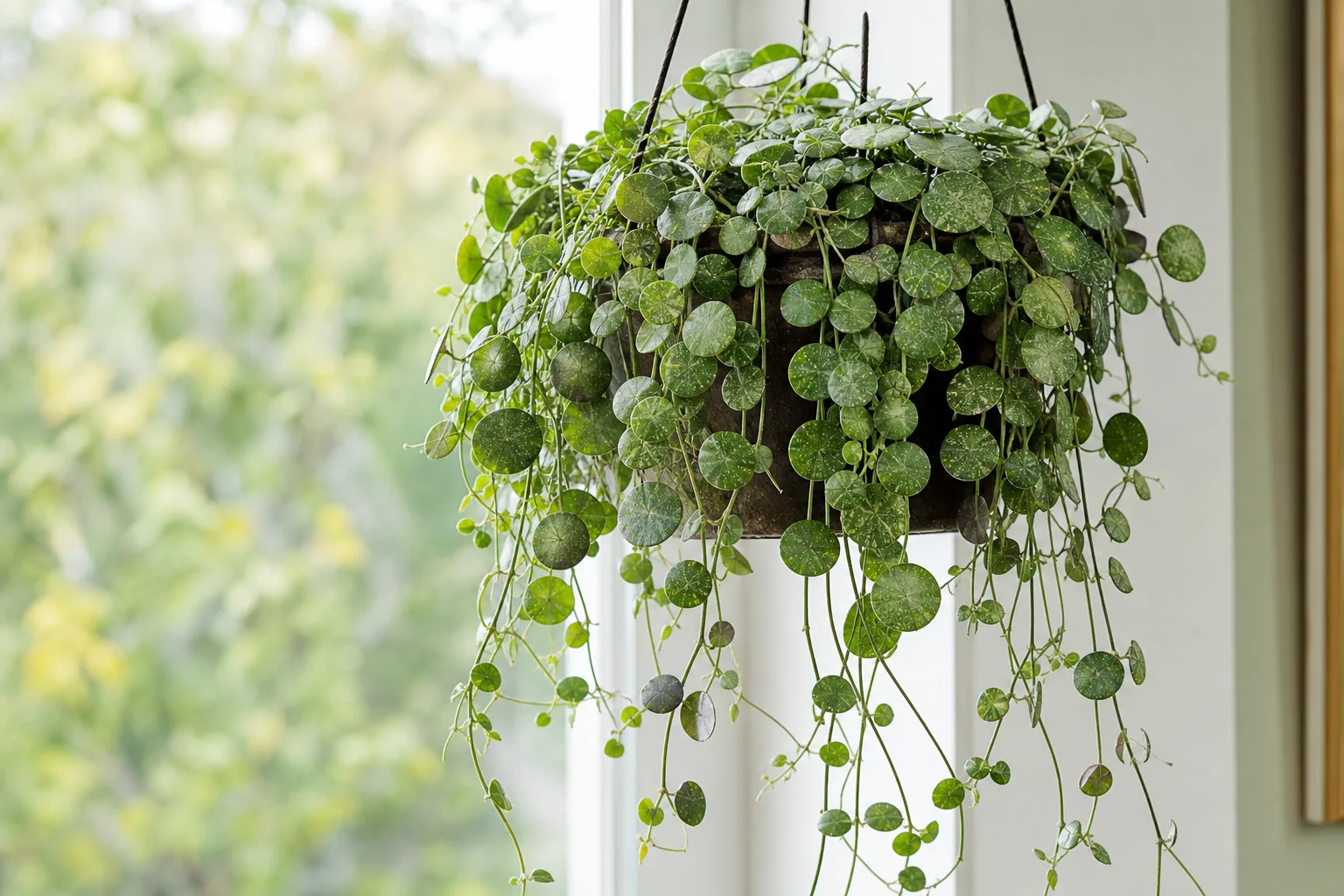
Spider Mites on Dischidia: Causes, Checks & Fixes
This guide covers spider mites on Dischidia. See also the general Spider Mites guide, watering, and light pages for this plant.
Spider Mites on Dischidia: Causes, Checks & Fixes
Quick answer
Spider mites on Dischidia are tiny sap-feeding arachnids that thrive in warm, dry indoor air-exactly what hits hanging baskets at ceiling height near AC vents, sunny glass, or winter heating registers. The twospotted spider mite prefers hot, dry weather and is common on greenhouse and houseplant foliage year-round. On this trailing epiphyte, look for fine yellow or white stippling on coin-shaped or heart-shaped leaves, bronzing along thin succulent blades, and delicate silk webbing where stems fork or leaves meet nodes.
First step: isolate the plant and rinse leaf undersides with lukewarm water before stacking sprays. Dischidia roots live in open orchid bark or on cork mounts, so cover the bark mix with plastic wrap and tilt the pot or mount so rinse water does not soak epiphytic roots overnight. Indoor mite populations rarely shrink on their own because natural predators are absent in most homes.
What spider mites look like on Dischidia
On trailing types such as String of Nickels (Dischidia nummularia) and Million Hearts (Dischidia ruscifolia), mites damage small, thin leaves where each feeding puncture shows up as a pale dot:
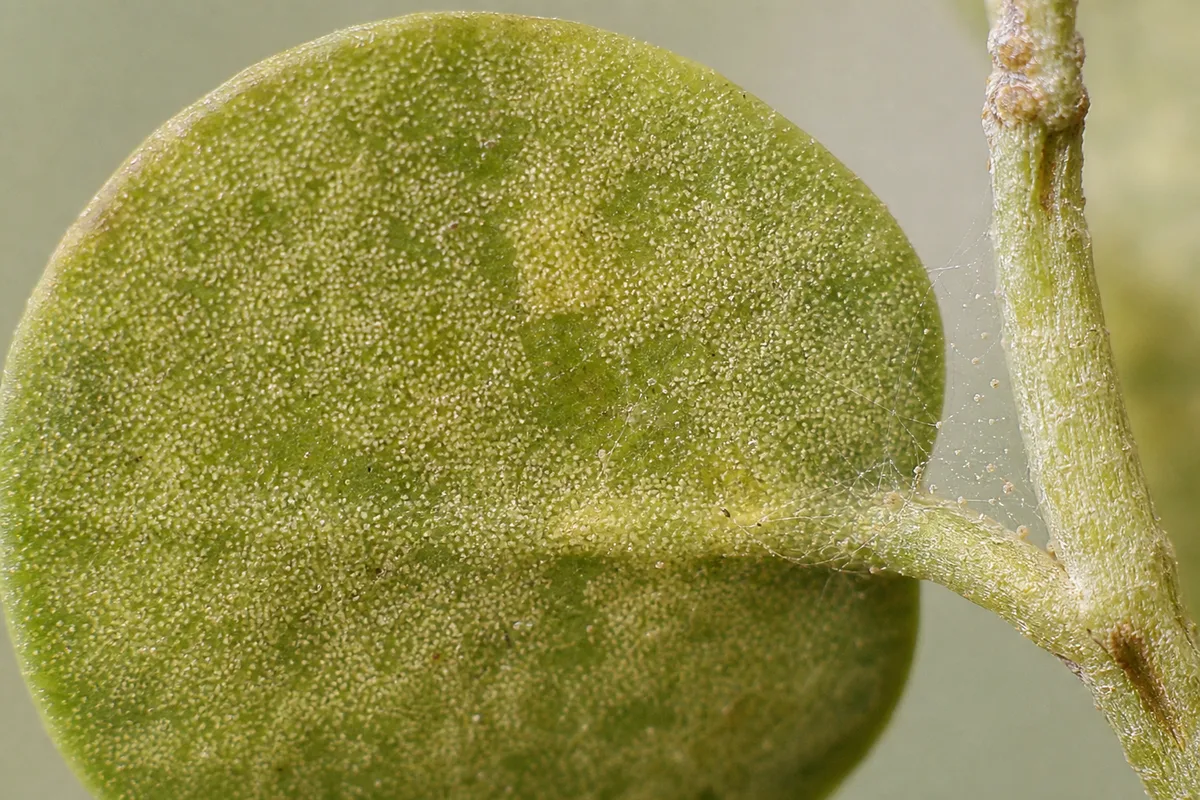
Fine yellow stippling on a coin-leaf underside with delicate silk webbing at the stem joint - mites damage small thin leaves before the whole basket looks bronzed.
- Fine yellow or white stippling scattered across leaf undersides; feeding collapses cells and leaves stippled spots-on coin leaves the pattern can look like someone pricked the surface with a pin
- Bronzing or dulling of formerly glossy green blades as feeding continues
- Delicate webbing at leaf bases, vine joints, and where a stem curves around a hanger-all spider mites spin fine silk webbing, not the thick white cotton of mealybugs
- Crisping or premature drop on heavily fed leaves while neighboring segments still look fine
- Slow-moving specks visible with a hand lens; adults are tiny and often reddish or greenish
Dischidia often hangs at eye level or above, which makes it easy to admire the cascade and miss undersides on the lowest trailing segments. Webbing at a vine joint one node back from the tip is a common first clue before stippling spreads across every coin leaf in the basket.
Normal lookalikes to rule out first:
- Mealybugs - white cottony clumps in leaf axils; static wax, not stippling plus silk
- Thrips - silvery streaks or scarring on leaf surfaces; slender mobile insects, usually no fine webbing
- Low humidity alone - crisp brown margins without stippling or moving specks; see low humidity on Dischidia
- Mineral or fertilizer residue - uniform chalky film on leaf tops; wipes away with water and does not crawl on paper
Why Dischidia gets spider mites
Spider mites are not a sign your Dischidia is doomed. They mean dry, warm air plus absent predators-a common indoor setup, especially on epiphytes that dry fast at the crown.
Hanging-basket height and airflow put Dischidia closer to ceiling vents, sunny window glass, and AC returns than floor plants. Warm air rising past a basket lowers humidity around the foliage while the bark mix below may still hold appropriate moisture from your last soak. Mites exploit that leaf-level dryness even when watering rhythm is correct.
Winter heating season drops room humidity below the 50–70% range most trailing Dischidia prefer. Forced-air registers and radiators create hot, dry microclimates within a few feet of the plant. Mite outbreaks often start on the segment facing the heat source before spreading along the vine.
Mounted specimens dry faster at the crown. Cork boards and exposed bark pads lose moisture quickly after misting or rinsing. If the mount face stays chronically dry while you fight pests, mite-friendly conditions persist on the leaf surfaces above-another reason rinses should target foliage, not flood the mount.
Nearby Apocynaceae plants raise spread risk. Dischidia sits in the same family as Hoya and other milkweed relatives. Spider mites attack many houseplant species and crawl short distances between pots; a stippled Hoya on the same shelf can colonize your Dischidia within days via crawlers or air movement between hanging baskets.
Thin succulent leaves show damage quickly. Dischidia stores some water in each small leaf, but the blade surface is limited. Feeding punctures read as obvious stippling faster than on broad-leaved plants where the same mite density looks subtler at first glance.
How to confirm the cause
Work through these checks in order:
- Inspect from below - Lift or lower the hanging basket and look up at leaf undersides on the lowest trailing stems. Mites and early webbing hide on the side you rarely see at eye level.
- Paper-tap test - Hold white paper under a suspect coin leaf and tap sharply. Strike foliage over white paper to dislodge mites; slow-moving specks confirm live mites-static dust does not crawl.
- Check for webbing at vine joints - Fine silk where leaves meet stems distinguishes mites from thrips scarring or mealybug wax.
- Use a hand lens or phone macro - Eight-legged mite bodies confirm arachnids, not pear-shaped aphids or slender thrips.
- Scan the collection - Examine every Hoya, Dischidia, and trailing plant on the same hanging bar, terrarium, or shelf before treating one pot.
- Rule out dry air alone - Crisp margins without stippling, webbing, or moving specks point to low humidity, not mites. Both can coexist in winter-address humidity after you confirm pests.
If you see stippling but no insects, treat as a probable mite outbreak with the rinse-first protocol below-but do not assume mites without webbing or a positive paper-tap test when thrips or mineral residue are plausible.
Lookalike symptoms on Dischidia
| What you see | Likely cause | Why it differs from spider mites |
|---|---|---|
| Fine stippling + silk at vine joints | Spider mites | Moving specks on paper; worsens in dry heat |
| White cottony clumps in axils | Mealybugs | Static wax; see mealybugs on Dischidia |
| Silver streaks, no fine webbing | Thrips | Slender insects; scarring without stipple dots |
| Crisp brown tips, no stippling | Low humidity | No crawling specks; humidity guide |
| Pear-shaped clusters on new tips | Aphids | Honeydew and clustering; see aphids on Dischidia |
| Chalky uniform film on leaf tops | Mineral residue | Wipes off; no pests on undersides |
First fix for Dischidia
Move the plant away from other epiphytes and inspect neighbors before you treat anything.
Isolation stops crawlers from reaching nearby Hoyas, Dischidia, and other trailing plants on the same hook. Only after separation should you rinse: hold the pot or mount at an angle over a sink, cover open bark mix with plastic wrap so rinse water does not soak epiphytic roots, and use lukewarm water on leaf undersides and vine joints. Dischidia’s thin leaves tolerate gentle rinsing better than fuzzy-leaved plants, but avoid blasting coins with heavy pressure-they tear easily.
Let the plant drain and dry in Dischidia light guide-not hot direct sun, which can scorch wet thin foliage. Recheck in 24 hours. If you still see moving mites or fresh webbing, proceed to targeted treatment. If the rinse cleared them, monitor daily for a week before declaring the plant clean.
Do not apply horticultural oil, insecticidal soap, or miticide on day one without confirming live mites. Do not repot, fertilize, or prune heavily at the same time-stacking stress on an epiphyte already losing sap from feeding slows recovery and raises root-rot risk if bark stays wet.
Step-by-step recovery
Once mites are confirmed and the first rinse is done, work in this order:
- Shower or sink rinse on a schedule - For potted plants, repeat gentle underside rinses every three to five days to knock down adults and eggs. For mounted specimens, tilt the board so water runs off without pooling behind moss or saturating cork overnight.
- Horticultural oil spot test - Spray one older coin leaf and wait 24 hours. If no burn appears, apply commercial horticultural oil labeled for spider mites on all leaf undersides and vine joints. Horticultural oils smother mites on contact and have no residual activity, so coverage matters more than product strength.
- Repeat every five to seven days - Plan at least three weekly passes because most miticides are not effective on eggs and hatchlings survive a single application. Two inspections one week apart with no new stippling or webbing mean you can stop.
- Raise humidity during treatment - Run a cool-mist humidifier near the isolated plant or cluster-not extra watering in the pot. Higher humidity can reduce spider mite damage in indoor settings where dry air speeds outbreaks.
- Prune only when necessary - If one vine segment is densely webbed and spray cannot reach inside, snip that section with clean scissors. Do not strip every trailing stem; Dischidia needs active shoots to recover length.
- Hold fertilizer until new growth looks clean - Resume light feeding only after two weeks with no mites on fresh tips.
- Re-check the collection - Treat or monitor any Hoya, Dischidia, or other plant that shared a shelf, terrarium, or hanging display.
For heavy infestations on multiple plants, consider treating in a shaded spot when temperatures are mild and the label allows, then returning plants indoors only after sprays have dried completely. Keep treated plants out of direct sun while wet.
Recovery timeline
Expect visible mite activity to drop within one to two treatment cycles if you are reaching undersides and repeating weekly. Full clearance often takes two to four weeks indoors because overlapping generations hatch between sprays.
Signs recovery is working:
- No new stippling on the newest coin leaves after two checks one week apart
- Webbing stops appearing at vine joints
- The next leaf pairs open with normal gloss and thickness
- Paper-tap test shows no moving specks
Signs the problem is worsening:
- Bronzing spreads from lower segments up the vine
- Webbing coats multiple forks and growing tips
- New segments emerge small, dull, or fail to lengthen
- The same stippling appears on plants that were not treated or isolated
Stippled or bronzed leaves will not fully re-green-damaged foliage rarely returns to perfect form. Judge success by clean new vine segments, not by repairing old blemished coin leaves. Trailing Dischidia recovers length slowly compared to upright houseplants-one clean node pair every two to four weeks is normal progress once pests are gone.
What not to do
- Skipping isolation - treating one hanging basket while mites crawl to a Hoya on the same hook
- Soaking bark mix or mount boards during rinses - epiphytic roots need air; saturated mix invites rot while you fight pests
- Using insecticides labeled only for insects - many insecticides are marginally effective on spider mites; oils and labeled miticides target arachnids
- One-and-done spraying - a single oil pass rarely clears eggs and hatchlings
- Applying oil in hot direct sun - wet thin Dischidia leaves scorch easily under bright light after treatment
- Letting mount moss stay wet overnight - rinse foliage, then let the board and bark pad dry before the next soak
- Compensating with extra watering - sap loss from mites is not fixed by keeping bark wet; follow normal soak-and-dry watering
When pruning infested vines, wear gloves if sap irritates your skin-Dischidia belongs to Apocynaceae, a family where sap can irritate sensitive skin. Wash tools after cutting.
How to prevent spider mites next time
- Quarantine new plants for 14 days and inspect leaf undersides before placing them near Hoyas or other Dischidia
- Weekly underside checks during winter heating season-mites are easiest to rinse off when only a few are present
- Keep humidity near 50–70% around hanging displays with a humidifier rather than misting alone; see low humidity on Dischidia when air is chronically dry
- Avoid placing baskets directly above heat vents or radiators - redirect airflow or move the hook a few feet away
- Inspect from below on every trailing vine during normal care-colonies on undersides of coin leaves are easy to miss at eye level
Prevention on Dischidia is mostly about early detection on hanging vines and stable humidity, not sterile conditions. One quick look at the lowest trailing segments during your normal watering week stops most indoor outbreaks before webbing coats a whole basket.
When to worry
Most established Dischidia survive spider mites if you isolate early, rinse without soaking bark, and repeat contact treatment until stippling stops. Consider the plant at higher risk if:
- Webbing covers most active vine tips and growing joints despite three treatment cycles
- New segments stop lengthening or emerge repeatedly dull and stippled for three or more weeks
- Multiple plants in an Apocynaceae collection show stippling at once and isolation was delayed
- Root rot symptoms (sour bark mix, mushy roots, collapse) appear alongside chronic overwatering on Dischidia during the infestation
A single stippled coin leaf or shortened vine tip is cosmetic. A plant that stops producing clean new growth for a month after repeated treatment may need propagation from any healthy side shoot-though that outcome is uncommon when action starts at the first webbing on a vine joint.
Conclusion
Spider mites on Dischidia are a dry-air and pest-timing problem more than a mystery disease. Confirm them with stippling on coin leaves, webbing at vine joints, and moving specks on the paper-tap test, isolate before treating, rinse gently without soaking bark mix or mount boards, and repeat horticultural oil until new growth stays clean. Prevent them with quarantine, weekly underside checks on hanging vines, and humidity support through winter heat-Dischidia forgives a missed watering more willingly than it forgives mites spreading through a whole Hoya-and-Dischidia shelf.
Related Dischidia problems
- Dischidia care overview - epiphytic culture hub
- Low humidity on Dischidia - dry edges without stippling
- Mealybugs on Dischidia - white wax in leaf axils
- Aphids on Dischidia - honeydew on new vine tips
- Watering Dischidia - soak-and-dry rhythm during recovery
- Root rot on Dischidia - when wet bark compounds stress
- Yellow leaves on Dischidia - overlapping stress signals
When to use this page vs other Dischidia guides
- Dischidia watering guide - Use for routine moisture checks before assuming spider mites is the main issue.
- Dischidia problems hub - Browse all 16 common issues on this species.
- Low Humidity on Dischidia - Different entry point when symptoms overlap with spider mites.
- Slow Growth on Dischidia - Different entry point when symptoms overlap with spider mites.