Ctenanthe Light Needs: Best Window, Sun, and Warning Signs
Ctenanthe Light Needs: Best Window, Sun, and Warning Signs
Ctenanthe Light Needs: Best Window, Sun, and Warning Signs
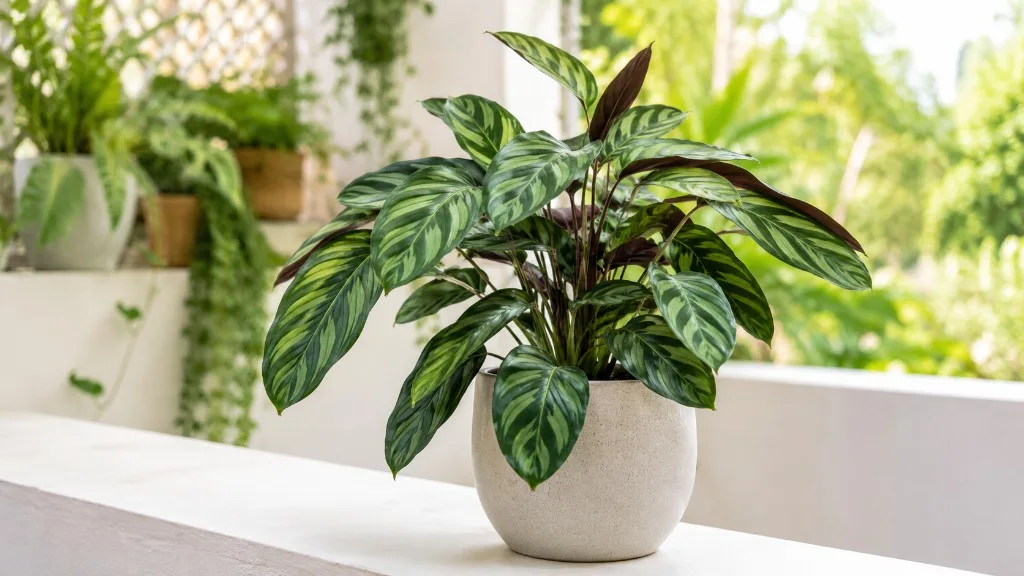
Ctenanthe is sold as an easygoing prayer-plant cousin with striking patterned leaves - and then it arrives in a dim corner or a blazing south window and the foliage tells a different story within days. Bleached silver bands, crisp sun-facing edges, or stems that stretch like they are reaching for a door that never opens. The plant is not being dramatic for sport. It evolved on the rainforest floor of tropical Brazil, where light arrives filtered through canopy gaps rather than as a sustained midday beam on exposed leaves. Your job indoors is to recreate that bright, indirect, consistent exposure - not darkness, and not direct sun.
The practical range for healthy Ctenanthe is medium to bright indirect light: enough photons to keep internodes compact and leaf patterns vivid, without the heat and UV load that scorches thin Marantaceae foliage. North Carolina State Extension lists dappled sunlight - shade through an upper canopy all day - as the cultural light preference for Ctenanthe lubbersiana, and notes the plant is intolerant of direct sunlight, which causes leaf scorch. (NC State Extension) That single sentence eliminates two of the most common mistakes: treating Ctenanthe as a low-light survivor, and parking it in unfiltered afternoon sun because the room “looks bright.”
This guide covers how much light Ctenanthe actually needs, which window placements work in real homes, whether direct sun is ever safe, how to use grow lights when natural light falls short, and the warning signs that tell you to adjust before old damage becomes the plant’s permanent shape.
How Much Light Ctenanthe Actually Needs
Ctenanthe belongs to Marantaceae, the prayer plant family that includes Maranta, Calathea, and Stromanthe. Family members share thin, pattern-rich leaves built for understory life - high surface area for photosynthesis at moderate light levels, low tolerance for the desiccating combination of direct sun, dry air, and inconsistent watering. Ctenanthe is often described as more forgiving than the fussiest Calatheas, but “more forgiving” does not mean “shade-loving.” It means the plant may hold together longer in suboptimal light before collapsing - which is not an invitation to keep it in a hallway with no window.
For compact, patterned growth, aim for roughly 250 to 800 foot-candles of indirect light. University of Missouri Extension lists prayer plant (Maranta) with filtered light indoors, and Illinois Extension classifies Maranta among medium-light houseplants - healthy Ctenanthe growth usually sits in that filtered-to-medium band. Below about 250 foot-candles, Ctenanthe may survive but begins to stretch: internodes lengthen, new leaves emerge smaller and paler, and the distinctive silver, herringbone, or marbled pattern fades on the youngest foliage. Above the plant’s tolerance for direct rays, leaves bleach, curl, and crisp regardless of how much water or humidity you supply.
The daily target in human terms is bright indirect light for most of the day - roughly 8 to 12 hours of useful ambient brightness without sunbeams landing directly on the leaf surface for more than brief, gentle morning exposure. NC State Extension specifies bright, indirect light and dappled sunlight as the baseline, with south and west exposures acceptable only when filtered or set back from the glass. You do not need a light meter to start. You need a two-week new-growth test: if the newest leaf is firm, correctly sized, and shows the species’ expected pattern, the current light is working.
Why Dappled Indirect Light Matches Its Rainforest Origins
In native Brazilian forest habitat, Ctenanthe grows as an understory or edge plant where light is interrupted constantly - shifting patches of brightness as the sun moves, never a static bake on one leaf face for hours. That environment trained the plant to harvest moderate light efficiently while protecting delicate leaf tissue from photodamage. Direct sun forces the leaf to close physiological defenses: margins curl, transpiration spikes, and pigment cells in variegated zones break down, which shows up as faded fishbone lines or washed-out marbling.
Dappled indirect light also keeps the plant’s nyctinastic rhythm - the evening leaf fold shared with other prayer plants - functioning normally. Extreme light stress or deep shade both disrupt the balance between photosynthesis and moisture retention, and stressed Ctenanthe often shows the problem on leaf edges first. Humidity and water quality matter, but light sets the ceiling for how well those other factors can compensate. A plant in correct indirect light tolerates ordinary indoor humidity far better than one scorched by a west window or starved in a basement office.
Common Ctenanthe Species and Slight Light Differences
“Ctenanthe” in shops is not one uniform plant. Three species dominate the houseplant trade, and while they share the same broad light preference, leaf thickness, size, and variegation contrast change how quickly you see stress. Identifying your species helps you interpret the first warning signs correctly instead of chasing humidity fixes when the real issue is a south window three feet too close.
Fishbone Prayer Plant (Ctenanthe burle-marxii)
Ctenanthe burle-marxii - the Fishbone Prayer Plant - is the compact form most often labeled simply “Ctenanthe” in small pots. It carries silver-gray elliptical leaves with dark green fishbone striping and purple-toned undersides, usually staying under 12 to 18 inches tall in a container. Its smaller leaf size dries out faster in harsh sun, so unfiltered midday light burns it quickly, often within days of a bad move. In acceptable indirect light, it maintains tight clumps and produces rhythmic new leaves along short stems.
Fishbone types are popular in terrariums and glass cabinets because the enclosure diffuses light and holds humidity. If you grow burle-marxii in a cabinet, watch for fade on the side farthest from the panel - a sign the internal reflection is not delivering even brightness, not a humidity failure. Slight rotation every week keeps pattern development symmetrical.
Never Never Plant (C. lubbersiana and C. oppenheimiana)
Ctenanthe lubbersiana (Bamburanta) and Ctenanthe oppenheimiana are the larger “Never Never Plant” forms with lance-shaped leaves, bamboo-like stems, and cream or yellow marbling (lubbersiana) or silver bands and maroon undersides (oppenheimiana, including the colorful Tricolor type). NC State Extension notes lubbersiana can reach 2 to 3 feet tall indoors with an upright, clumping habit, still requiring bright indirect light and rejecting drafts and direct sun. (NC State Extension)
These taller types have slightly more leaf mass, which can make them marginally more tolerant of brighter ambient rooms than burle-marxii - but only when acclimated and still without harsh direct rays. Their larger leaves also make bleaching and scorch more visible across a wider surface, so owners sometimes notice pattern loss before crisping begins. If new leaves on oppenheimiana emerge solid green instead of patterned, that is a classic under-lighting signal cited across Marantaceae care references: the plant is prioritizing photosynthetic area over decorative variegation.
Compared with Calathea, Ctenanthe generally accepts a slightly wider indirect-light band and recovers faster from minor placement mistakes, but it will not thrive in the dark corner Calathea owners sometimes try after a meltdown. Think of Ctenanthe as needing the same window quality you’d offer a healthy Calathea, with a little less panic when seasonal light dips - not a fundamentally lower bar.
Best Window Placement for Ctenanthe Indoors
Window direction is a shorthand, not a guarantee. A “north window” in a sunroom differs from a north window on a shaded courtyard. Still, direction gives you a ranked starting point before you fine-tune with distance and curtains.
East, North, South, and West Windows Compared
East-facing windows are the best default for most Ctenanthe. Gentle morning sun supplies enough energy for compact growth, then the plant spends the rest of the day in bright indirect light without the heat load of afternoon rays. Place the pot 2 to 4 feet from the glass so leaves receive light rather than sitting in a hot microclimate against the pane. If morning sun touches leaves directly for an hour, watch for curl or fade on the sun-facing side; sheer fabric converts east exposure to pure indirect if needed.
North-facing windows work in spring and summer when outdoor light is strong enough to bounce deep into the room. In late autumn and winter, north light often drops below the productive range, and Ctenanthe responds with slower growth, longer internodes, and duller new leaves. If your only good spot is north, plan on a grow light from October through March rather than accepting leggy winter growth as normal.
South-facing windows deliver the brightest indoor light, which Ctenanthe can use only when set back and filtered. A practical rule: 4 to 6 feet from the glass with a sheer curtain, or on a side table that receives bright ambient light without a sunbeam on the foliage. Never place Ctenanthe on a south windowsill unless the window is heavily tinted or the plant sits behind multiple diffusing layers. NC State Extension is explicit: the plant is intolerant of direct sunlight, and exposure to bright sun causes leaf scorch.
West-facing windows are the highest-risk orientation because afternoon sun combines intensity with heat. Late-day rays hit leaves when the pot and root zone are warmest, accelerating edge crisping and soil dry-down - a double stress that mimics underwatering on Ctenanthe even when the mix is moist. If west is your only bright option, use sheer curtains and 5 to 7 feet of setback, or place Ctenanthe to the side of the window where it catches reflected brightness, not the beam.
Distance From the Glass and Sheer Curtain Use
Distance matters as much as direction. Light falls off quickly as you move away from a window; so does leaf temperature on hot days. Ctenanthe placed directly against glass in any sunny orientation experiences leaf temperatures far above ambient room readings, which triggers curl and margin burn even when the exposure duration seems short.
Sheer curtains are the simplest upgrade for south and west rooms. They turn harsh direct rays into the dappled-quality light the plant evolved under. Linen or voile fabrics that still allow a readable silhouette of the window are usually sufficient. Opaque blackout curtains used all day create the opposite problem - a plant that looks healthy for a month on stored energy, then stretches as reserves run out.
One practical test used by experienced growers: at midday, hold your hand between the window and the plant. If a sharp, dark shadow forms, direct sun is hitting the spot. Ctenanthe wants a soft or indistinct shadow - evidence of bright, diffused light. If you need the overhead lights on to read at the plant’s location at noon, the spot is too dim for long-term health.
Can Ctenanthe Take Direct Sunlight?
Short answer: not as a default placement, and never as harsh midday exposure on unacclimated leaves. Ctenanthe is not a sun plant. NC State Extension and every major care reference in this genus align on direct sunlight intolerance with scorch as the predictable outcome. (NC State Extension) That does not mean the plant must live in a dim room. It means the usable energy should arrive as reflected and filtered brightness, not as a beam tracing the leaf surface.
Morning Sun vs Afternoon Sun Risk
Early morning sun is lower in UV intensity and cooler than afternoon sun. Some acclimated Ctenanthe plants tolerate 30 to 60 minutes of gentle direct morning light on an east sill, especially in winter when overall day length is short. The tolerance window is narrow. If you experiment, do it in early spring or autumn, not in July when east morning can still build dangerous leaf temperatures by 9 a.m. in hot climates.
Afternoon sun is the exposure type most likely to bleach fishbone patterning, crisp margins, and trigger permanent tan patches on the sun-facing half of the leaf. If you see damage after a west-window experiment, moving the plant “back a foot” is rarely enough. Relocate to a genuinely indirect position and wait for new growth to confirm recovery. Old scorched tissue does not green up again.
Nursery-grown Ctenanthe often arrives from high-humidity greenhouse shade. Those leaves are not sun-hardened. Even morning sun on a fresh purchase can burn within 48 hours. Give new plants two weeks in stable bright indirect light before any direct-sun trial, and increase exposure by no more than 30 minutes per week while monitoring the newest unfolding leaf.
Low-Light Limits and Why Dark Corners Fail
Ctenanthe is frequently mislabeled a “low-light plant” because it dislikes direct sun and because it can linger, semi-alive, in poor conditions longer than a Calathea. That labeling causes more dead plants than honest advice about sun intolerance. Ctenanthe tolerates low light temporarily; it does not thrive there, and chronic under-lighting produces weak structure that invites root rot on Ctenanthe because the plant uses water slowly while owners keep watering on a bright-window schedule.
In a dim interior spot - far from windows, in a hallway, or in a room where you rely on artificial room lighting after dark - Ctenanthe will show elongated stems, smaller new leaves, loss of variegation, and a gradual lean toward the brightest vector. NC State Extension notes that brown leaf margins and curled leaves may indicate underwatering, while yellowing leaves may result from overwatering on Ctenanthe - and at lower light levels, growth slows and variegation can fade on new leaves.
The danger of low light is compounding. A stretched plant has less photosynthetic efficiency per stem length, so it grows even slower, which encourages owners to overwater or overfeed in an attempt to “push” growth. Slower metabolism plus moist soil is how root decline starts in a plant that looks like it only needs fertilizer. Fixing light first - before changing water, soil, or feed - is the correct diagnostic order.
Reading Internode Spacing as a Light Diagnostic
Internodes are the bare stem segments between leaf attachment points. On a well-lit Ctenanthe, internodes are typically 1 to 2 inches on upright shoots, producing a bushy, rhythmic clump. When light is chronically insufficient, internodes stretch to 3 inches or more, and the plant looks like it is running away from its pot toward the window.
This measurement is more reliable than judging “how green” the plant looks, because older leaves can retain decent color on stored reserves while new growth reveals the current problem. Mark a stem with a small tie on the newest leaf. Two weeks later, measure the blank stem added below that leaf. More than 2 inches of blank stem in two weeks under indoor conditions strongly suggests the plant wants more brightness - either closer to the window, a sheer curtain removed from an east exposure, or supplemental LED hours.
Variegation fade on young leaves only is the second diagnostic pillar. If older leaves show strong fishbone or marbling but the newest three leaves look washed, narrow, or nearly solid green, light is limiting expression. Increasing brightness often restores pattern on subsequent leaves within one to two growth cycles, provided you do not jump straight into direct sun as the “fix.”
Grow Lights When Natural Light Is Weak
Apartments with one window, north-only exposures, or winter light collapse are normal constraints, not failures. Full-spectrum LED grow lights let you hold Ctenanthe in the 250 to 800 foot-candle productive band without fighting architecture. The goal is not to replicate desert noon. It is to deliver steady, moderate-intensity photosynthetic light for enough hours that internodes stay short and new leaves keep their pattern.
LED Setup, Hours, and Distance Guidelines
Choose a full-spectrum LED labeled for foliage houseplants - balanced red and blue with green wavelengths included, not a cheap single-color bulb designed only for seed starting. Position the fixture 12 to 18 inches above the canopy, angled to cover the whole clump rather than one side. Run a 12 to 14 hour photoperiod on a timer so the plant receives consistent day length; irregular on-off cycles stress rhythm-sensitive Marantaceae.
Start at the manufacturer’s lower recommended intensity if the unit is adjustable. After ten days, inspect the newest leaf. If it is compact and well patterned, hold the setting. If stems still stretch, raise intensity slightly or add an hour - changing only one variable at a time. If leaves look heat-stressed or faded despite no window sun, the fixture is too close or too strong; lift it 3 to 4 inches.
Grow lights pair well with north windows in winter: the window supplies ambient orientation and subtle seasonal cues while the LED supplies the photon budget the window cannot. Avoid placing Ctenanthe so close to a hot LED housing that leaf temperature rises; if the top leaves feel warm to the touch after six hours, increase distance.
Warning Signs Your Ctenanthe Has Too Much or Too Little Light
Light stress on Ctenanthe is readable early if you watch new growth and the youngest fully opened leaf, not the oldest bottom foliage that has been declining naturally. Split symptoms into two buckets - excess light versus insufficient light - because the fixes move in opposite directions.
Too Much Light - Bleach, Scorch, and Leaf Curl
Bleached or faded pattern on the sun-facing portion of variegated leaves is the hallmark of excess light. Silver fishbone lines on burle-marxii or cream marbling on lubbersiana lose contrast as pigment cells are damaged. The leaf may look uniformly pale green or yellow-green on half the surface while the shaded half still shows normal pattern.
Crisp brown edges and tan patches on leaves that were healthy before a move indicate scorch. Unlike humidity brown tips, which often appear symmetrically on older leaf margins, scorch is directional - worse on the face that faced the window or sunbeam.
Leaf curl during bright hours is a protective response. Ctenanthe may fold or roll margins upward when light and heat exceed what the leaf can hydrate through. If leaves unfold overnight but curl again each afternoon, afternoon sun or reflected heat from glass is the likely trigger.
Sudden wilt or collapse after relocation to a brighter sill, even with moist soil, can follow rapid light shock combined with temperature swing. Move the plant back to the previous indirect position, remove the worst damaged leaves only if they are more than half brown, and acclimate more slowly.
Too Little Light - Leggy Stems and Faded Pattern
Leggy, stretched stems with wide internode gaps are the clearest under-lighting sign. The plant invests in height to search for photons instead of producing dense foliage.
Small, thin new leaves that take longer to unfurl suggest the energy budget is tight. Unfurling is metabolically expensive; dim light slows the process and yields miniature versions of mature leaves.
Lean or asymmetrical growth toward the window or a single bright corner shows the plant is vectoring for light. Rotate the pot weekly for even shape, but rotation alone does not fix insufficient intensity - it only delays a lopsided clump.
Solid green new leaves on variegated types signal the plant is abandoning pattern to maximize photosynthesis. Increase light before reaching for fertilizer; nitrogen will not restore fishbone lines if photons are the limiting factor.
Slower dry-down and chronic soil moisture often accompany low light. If Ctenanthe watering guide that worked in summer now keeps the mix wet for a week, check whether winter light drop slowed the plant’s uptake before assuming root rot - though always verify roots if smell or mushiness is present.
How to Move and Acclimate Ctenanthe Safely
Light changes should be gradual and isolated. Ctenanthe reacts to sudden shifts with leaf drop, curl, scorch, or stalled growth depending on the direction of the change. When you repot, relocate, or bring a plant home from a greenhouse, treat light as the first stable variable - hold water, fertilizer, and humidity steady for two weeks while the plant adjusts to photons.
To increase light, move the pot closer to the window by 6 to 12 inches per week, or add 15 to 30 minutes of filtered morning sun per week on east exposures. Watch the leaf that is currently unfurling; it is the most vulnerable to bleach. To decrease light, move back from the glass immediately if scorch appears - there is no benefit to slow reduction once crisping has started.
Do not combine a major light upgrade with Ctenanthe repotting guide, division, or a heater season start in the same week. Each of those stresses transpiration and root function independently. Sequencing matters: stable light → stable watering rhythm read off new growth → other care changes.
Seasonal moves deserve a calendar note. When day length shrinks in autumn, a spot that worked in August may be marginal by December. Slide the plant closer to the window or start supplemental LED hours before internodes stretch, not after the plant has already reorganized itself into a leggy form that takes months to outgrow.
Light and watering are linked. Brighter exposure increases evaporation from leaf and soil; dimmer exposure reduces uptake. After any light change, re-check the pot’s dry-down speed for ten days before locking a watering schedule. A Ctenanthe that moves from a dim corner to an east window may need water two days sooner; one that moves away from a hot west sill may need two to three extra days between drinks. Let the plant’s new growth rate tell you when the rhythm has stabilized.
Conclusion
Ctenanthe light needs are straightforward once you drop the two myths that kill most plants: that it wants deep shade because it hates direct sun, and that any bright room equals appropriate light regardless of whether rays hit the leaves. The workable target is medium to bright indirect light - east windows and filtered bright rooms first, south and west only with distance and sheer fabric, north in the bright half of the year plus supplementation in winter. Direct midday sun is out; gentle morning exposure is optional and only on acclimated plants.
Judge success by internode length, new-leaf pattern, and firm unfurling, not by how photogenic the oldest leaves still look. Too much light bleaches and crisps; too little light stretches and dulls. Fix light before you chase humidity trays or fertilizer. When natural brightness is insufficient, a full-spectrum LED on a 12- to 14-hour timer at 12 to 18 inches above the canopy keeps Ctenanthe in the same productive band without turning your living room into a greenhouse. Get the window right, read the new growth honestly, and this genus rewards you with rhythmic, patterned foliage that actually matches the plant you thought you were buying.
When to use this page vs other Ctenanthe guides
- Ctenanthe overview - Start here for whole-plant context before deep-diving this topic.
- Ctenanthe problems hub - Jump to symptom-specific fix guides when this care topic does not resolve the issue.
- Not Enough Light on Ctenanthe - Escalate here when light adjustments are not enough.
- Leggy Growth on Ctenanthe - Escalate here when light adjustments are not enough.