Ctenanthe (Never Never Plant) Fertilizer: When, How
Ctenanthe (Never Never Plant) Fertilizer: When, How, and Mistakes
Ctenanthe (Never Never Plant) Fertilizer: When, How, and Mistakes
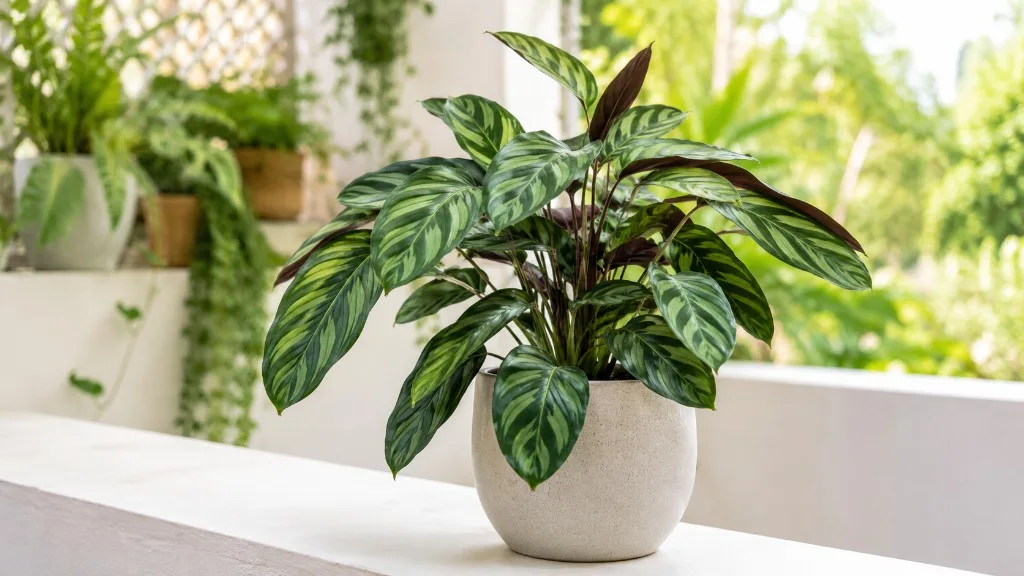
Ctenanthe species - sold as Never Never Plant, fishbone prayer plant, and bamburanta - are Marantaceae foliage plants whose patterned leaves fold upward at night through nyctinasty. That nightly movement is one reason winter feeding goes wrong: the plant still looks alive in December while new shoot production has already slowed, and unused fertilizer salts accumulate along sensitive leaf margins faster than on tougher houseplants. Ctenanthe fertilizer is not about finding a heavy feeder formula. It is about matching half-strength balanced liquid to visible new leaves across the species you actually own.
Quick default for most homes: balanced water-soluble 10-10-10 or 20-20-20 (or foliage-weighted 3-1-2) at half the label strength, applied to moist soil every four to six weeks from mid-spring through early fall, then pause in late fall and winter. NC State Extension documents half-strength fertilizer once per month during active growth for C. lubbersiana; Bloomscape recommends half-strength every four weeks in spring and summer with no winter feed. This page reconciles those extension intervals with a conservative indoor default and explains when burle-marxii, oppenheimiana, and lubbersiana need different timing.
Reviewed by LeafyPixels Review Board · Author: sai-ananth
Use this as the genus fertilizer hub for all Ctenanthe species. For genus-wide light, humidity, and water rhythm, start on the Ctenanthe overview. If brown tips appear after feeding, see the brown tips problem guide before increasing dose.
Ctenanthe (Never Never Plant) Fertilizer: Quick Answer
When: Feed while fresh leaves unfurl with full cultivar markings - roughly March through September in temperate indoor setups.
What: Water-soluble balanced 10-10-10 or 20-20-20 diluted to half label strength on moist mix.
How often (home default): Every 4–6 weeks at half strength in active growth; every 4 weeks in bright humid rooms with fast C. lubbersiana; every 6–8 weeks in moderate light or when slow-release is already in the mix. Pause November–February unless strong grow lights keep continuous new shoots.
How: Pre-moisten, apply evenly, discard saucer runoff within 30 minutes, flush salts monthly in hard-water homes.
Stop when: Winter slowdown, white crust on soil, brown margins after a feed, repotting stress, or dry soil.
Why Never Never Plants Need Restraint, Not Heavy Feeding
Ctenanthe is a moderate to rapid foliage producer depending on species - not a succulent, not a hungry tomato, and not a plant that forgives full label rates in a 15 cm pot. NC State Extension lists C. oppenheimiana at 1 ft 8 in to 3 ft 3 in indoors with medium growth rate, while NC State’s C. lubbersiana page documents rapid growth in favorable conditions. Both species are intolerant of direct fertilization after repotting and sensitive to mineral and salt buildup from tap water - a combination that makes conservative dosing safer than chasing pale leaves with stronger feeds.
In Brazilian rainforest understory, nutrients arrive as a slow, dilute trickle through leaf litter and rainwater. Container culture concentrates that supply at the root zone. University of Maryland Extension links excessive fertilizer to brown leaf tips, marginal necrosis, and white crust on potting media - symptoms Ctenanthe shows on patterned margins before the rest of the leaf looks sick. Fertilizer maintains an actively growing plant; it does not fix a Ctenanthe that is pale because it sits in too little light, dries out repeatedly, or struggles in waterlogged soil.
Ctenanthe in Marantaceae: Biology That Shapes Feeding
Ctenanthe belongs to Marantaceae alongside Calathea, Maranta, and Stromanthe. Popular houseplant forms include fishbone-striped C. burle-marxii, silver-banded C. oppenheimiana ‘Tricolor’, marbled C. lubbersiana, and velvety grey-green C. setosa. None are grown for indoor flowers - they are grown for patterned leaves that fold at night.
Steady leaf production pulls nitrogen, phosphorus, potassium, and micronutrients from the potting mix. Watering leaches some with every drain cycle; root growth and organic matter breakdown consume others. Feeding replaces what the plant uses only when roots are healthy, soil moisture is even, and the plant is actually building new tissue.
Nyctinasty and the Winter-Feed Trap
Nyctinasty - leaves folding upward after dark - continues through winter on many indoor Ctenanthe even when new shoot production has nearly stopped. That visual “activity” tricks growers into maintaining a summer feed calendar while roots absorb nutrients slowly. Unused salts build in the rhizome zone; margins on the next spring leaves arrive already crisp. The fix is not a special winter formula - it is pausing feed until you see fresh spears or side shoots forming again, unless grow lights keep genuine active growth running all season.
Best Fertilizer Type and N-P-K for Ctenanthe
The best Ctenanthe fertilizer for most homes is a complete water-soluble houseplant formula with nitrogen adequate for leafy growth, moderate phosphorus, potassium for stress tolerance, and micronutrients - especially iron, magnesium, and manganese - on the label. Pale new growth on an otherwise well-watered plant sometimes traces to trace-element gaps in peat-heavy mixes rather than macronutrient hunger alone.
Avoid shopping by “prayer plant” on the bottle unless you trust the brand’s dilution guidance. A standard balanced indoor formula used at half strength outperforms specialty products at full label rate on salt-sensitive Marantaceae roots.
Balanced Liquid vs. Organic vs. Slow-Release
A 10-10-10 or 20-20-20 water-soluble fertilizer at half strength is the default across extension and nursery guidance for Ctenanthe. Bloomscape specifies general houseplant fertilizer diluted at half strength every four weeks during spring and summer. A slightly nitrogen-leaning 3-1-2 ratio is reasonable when leaf expansion and pattern contrast are the goal.
Avoid high-phosphorus bloom boosters - formulations heavy in the middle number. Ctenanthe rarely flowers indoors; excess phosphorus encourages weak stretched stems without improving the leaf display.
Organic liquids - fish emulsion, compost tea, seaweed - work at half strength or weaker on the same seasonal schedule if odors and application mess are acceptable. Slow-release granules release unpredictably in small indoor pots and stack dangerously with liquid feeds; skip liquid for two to three months if slow-release was mixed in at repotting. Skip routine foliar feeding - Marantaceae leaves hold residue and foliar sprays do not replace root-zone nutrition.
Pet note: Related prayer plants in Marantaceae are listed as non-toxic to cats and dogs by the ASPCA. That does not make them edible, and concentrated fertilizer solution or crusty salty soil are not safe for pets to ingest.
The Half-Strength Rule and Worked Dilution Example
If you remember one number, make it half strength - never full label strength on container Ctenanthe unless you flush salts regularly and know your water chemistry.
Worked example (metric): A bottle labeled 10-10-10 recommends 5 ml per liter of water for houseplants. For Ctenanthe, use 2.5 ml per liter (half strength). In a 2-liter watering can, that is 5 ml total - roughly one teaspoon if your dropper cap lacks milliliter marks.
Worked example (US): Label says 1 teaspoon per gallon for indoor plants. Half strength for Ctenanthe is ½ teaspoon per gallon. For a half-gallon batch, use ¼ teaspoon.
Measure with a syringe or spoon. “Eyeballing” concentrates errors because scoop sizes differ between brands. Quarter strength is reasonable for monthly feeding on a plant in moderate light with a history of tip burn.
NC State Monthly Guidance vs. Conservative Indoor Schedules
Extension sources and conservative home practice use the same half-strength principle but slightly different intervals. Reconcile them by watching new-leaf output, not guilt.
| Guidance source | Stated frequency | Strength | Best match at home |
|---|---|---|---|
| NC State C. lubbersiana | Once per month when actively growing | Half strength | Every 4 weeks in bright humid rooms with rapid new leaves |
| NC State C. oppenheimiana | Monthly during growth cycle | Half strength implied | Every 4–5 weeks when medium growth and new spears are steady |
| Bloomscape Ctenanthe care | Every 4 weeks spring–summer | Half strength | Aligns with NC State monthly end for fast growers |
| LeafyPixels conservative default | Every 4–6 weeks active season | Half strength | 6-week end for compact burle-marxii, moderate light, or post-repot hold |
| Winter (all above) | No feed when growth slows | - | Pause November–February unless grow lights sustain new shoots |
When sources disagree, choose the longer interval if you see salt crust, hard tap water, or slow new-leaf production. Choose the shorter interval only when the plant steadily unfurls well-marked leaves in bright filtered light and humidity stays above roughly 50%.
Seasonal Schedule: Spring Through Winter
Timing follows metabolism more than the wall calendar. Feed when Ctenanthe is actively producing new leaves; stop when shoot production slows sharply.
Spring and Summer Feeding Window
Start feeding when you see fresh growth - new leaves with full cultivar markings, side shoots filling in, firm texture on the newest blade. In temperate climates that usually means mid-spring through late summer, roughly April through September, though your start date is when new tissue appears.
During this window, half-strength balanced liquid every four to six weeks suits most containers. Fast C. lubbersiana in a bright humid bathroom may sit at four weeks; compact C. burle-marxii on a north-facing desk may need only six weeks.
| Month (temperate climate) | Growth phase | Feeding guidance |
|---|---|---|
| March–April | Waking up | Start half-strength if active growth visible |
| May–August | Peak foliage | Every 4–6 weeks; bright light on shorter end |
| September | Slowing | Every 6–8 weeks or taper |
| October | Wind-down | Final light feed if still growing, then pause |
| November–February | Low growth | No fertilizer for typical setups |
Fall Taper and Winter Pause
Taper in early to mid-fall as day length drops. One practical pattern: a final half-strength feed in early fall if new growth continues, then stop from late fall through winter. Most indoor Ctenanthe do fine with no fertilizer from November through February.
Exception: under strong supplemental grow lights with continuous new shoots, feed lightly at half strength every eight to ten weeks and watch for salt crust. Even then, skipping winter feeds is safer than forcing growth with nutrients roots cannot process.
Species Differences: burle-marxii, oppenheimiana, lubbersiana, and setosa
All Ctenanthe share half-strength and moist-soil rules. Frequency shifts with documented growth rate and how fast your room dries the pot.
| Species / form | Typical indoor size | Growth rate (NC State) | Feeding interval in active season |
|---|---|---|---|
| C. burle-marxii (fishbone) | Compact, often 15–30 cm | Moderate; smaller clumps | Every 5–6 weeks at half strength unless bright bathroom growth pushes monthly |
| C. oppenheimiana ‘Tricolor’ | To ~1 m | Medium | Every 4–5 weeks when new lanceolate leaves with silver bands unfurl steadily |
| C. lubbersiana | 60–90 cm tall, wider spread | Rapid | Every 4 weeks in bright humid conditions per NC State monthly guidance |
| C. setosa | Moderate upright | Medium | Every 4–6 weeks; watch velvety leaves for salt spotting before shortening interval |
Ctenanthe vs. Calathea feeding: Both are salt-sensitive Marantaceae, but Calathea guides often default to quarter strength monthly because many cultivars burn faster on the same dose. Ctenanthe is somewhat more forgiving when half-strength rules are followed - yet still far less tolerant than pothos or dieffenbachia. If you also grow Calathea, read the Calathea fertilizer guide for genus-specific intervals; do not copy Calathea’s weaker dilution onto a hungry C. lubbersiana without watching new-leaf size.
Decision shortcut: If new leaves are smaller than the previous generation despite good light and moisture, try shortening the interval before increasing concentration. If margins brown within two weeks of feeding, lengthen the interval and flush - do not double the dose.
Step-by-Step: Pre-Moisten, Dilute, Apply, and Drain
- Check season and growth. Confirm active shoots; if winter and static, stop.
- Inspect for salt crust or tip burn. White residue means flush, not feed.
- Water with plain water if the top 2 cm is dry. Never pour fertilizer onto dry soil.
- Mix fertilizer at half strength in room-temperature water.
- Apply slowly across the soil surface, keeping solution off the leaf crown and patterned foliage.
- Stop when a little drains from the bottom; discard saucer water within 30 minutes.
- Mark the date so you do not double-feed in an enthusiastic week.
Morning application after the plant has hydrated is fine, but moist-soil-first matters more than the clock.
Adjusting Dose for Light, Pot Size, and Water Quality
Ctenanthe in bright indirect light with consistent watering uses nutrients faster than one in deep shade, where leggy pale growth is usually a light problem, not hunger. A brighter plant also dries its pot faster, which leaches salts - but only if you are not compensating with heavy feeding.
Hard tap water adds a second mineral load on top of fertilizer. NC State notes intolerance to mineral and salt buildup from tap water, recommending distilled or filtered water when margins brown. Bloomscape similarly links tip burn to tap-water chlorine and fluoride. If tips crisp while feeding modestly, improve water quality before increasing fertilizer.
Peat-heavy mixes can show iron or manganese deficiency on new growth - interveinal yellowing on fresh leaves - that mimics over-feed burn in dim rooms. If pattern is yellow between veins on new foliage only, suspect micronutrient gap in acidic mix rather than salt crisis; a complete fertilizer with micronutrients at half strength is the first step, not a bloom booster.
Small pots stack salts faster than large ones. An oversized pot that stays wet for days needs less frequent feed, not stronger dose.
Over-Fertilizing: Symptoms and Recovery
Over-fertilizing is the dominant fertilizer problem on Ctenanthe. Symptoms often appear one to two weeks after a too-strong feed, or gradually when winter feeding, hard water, and skipped flushes compound.
Watch for brown crispy tips and margins on newer leaves, white or yellowish crust on soil or pot rim, sudden leaf curl or drop despite moist soil, leggy weak stems from excess nitrogen, stunted new growth with burnt edges on unfurling spears, and loss of pattern clarity as margins die back.
University of Maryland Extension explains that high soluble salts create osmotic stress - burn looks like drought even when soil is wet. That mismatch sends growers toward more water instead of less fertilizer. Cross-check the yellow leaves and brown tips guides when symptoms overlap watering stress.
Flushing Salts from the Root Zone
If you suspect burn, stop fertilizing and leach the soil.
- Move the pot to a sink or tub.
- Water slowly with plain room-temperature water until it runs freely from drainage holes; let drain completely.
- Repeat two to three times over 30–60 minutes with full drainage between passes.
- Pause all feeding for 4–6 weeks while monitoring new growth.
- Resume at half strength only when new leaves emerge without burnt margins and crust is gone.
Badly burned old leaves will not green up - judge recovery by new growth. Many growers flush with plain water once a month during the active feeding season as preventive maintenance in hard-water areas.
New, Repotted, Stressed, and Propagated Plants
After repotting into fresh mix with starter charge, wait four to six weeks before the first liquid feed. NC State is explicit: intolerant of direct fertilization after repotting until roots settle.
After stress - drought wilt, cold draft damage, pest infestation, low-humidity crisping - hold food until stable new growth appears.
Propagation divisions and cuttings need no fertilizer until roots are established and new leaves open; then use quarter to half strength at wide intervals. See the propagation guide for division timing.
Nursery plants often arrive in nutrient-enriched mix; skip feed for the first month unless active growth clearly outpaces the starter charge.
Fertilizer Alongside Watering, Light, Soil, and Humidity
Fertilizer only works when the rest of the system is in range. NC State C. lubbersiana lists medium to high humidity, bright indirect light, and moist well-drained mix as baseline needs - Ctenanthe in those conditions uses nutrients more efficiently than one in a dry corner where edges crisp regardless of feeding.
Pair this page with the watering, light, soil, overview, and repotting guides on the same genus. When fertilizer seems ineffective, fix placement and moisture rhythm first; when margins brown after every feed, flush and lengthen the interval before chasing a new product.
Conclusion
Match half-strength balanced liquid to visible new-leaf production across the Ctenanthe species you grow - not to a rigid calendar that ignores nyctinasty winter optics. Reconcile NC State’s monthly active-growth guidance with a four-to-six-week conservative default by watching spears, not guilt. Flush when crust appears; pause after repotting and stress; improve water quality before increasing concentration.
Before your next feed, check the newest leaf margins and the soil surface for crust. Crisp herringbone pattern on fresh burle-marxii leaves or clean silver bands on new oppenheimiana foliage means restraint is working. Brown tips mean pull back, flush, and fix light, humidity, and water - then resume weaker, not louder.
When to use this page vs other Ctenanthe guides
- Ctenanthe overview - Start here for whole-plant context before deep-diving this topic.
- Ctenanthe problems hub - Jump to symptom-specific fix guides when this care topic does not resolve the issue.