Calathea (Prayer Plant) Fertilizer: When, How, and Mistakes
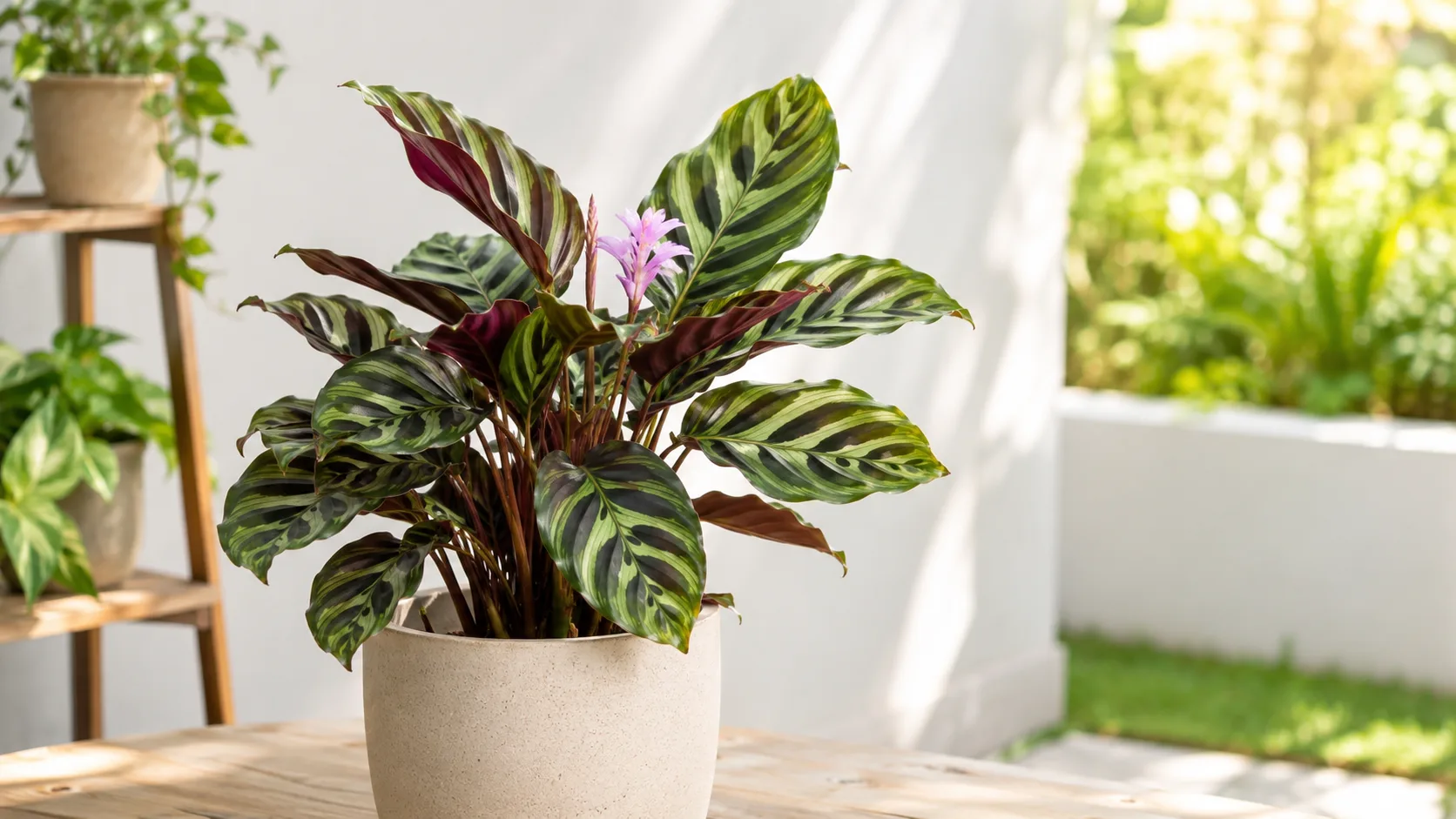
Calathea (Prayer Plant) Fertilizer: When, How, and Mistakes to Avoid
Calathea (Prayer Plant) Fertilizer: When, How, and Mistakes to Avoid
Search for “Calathea fertilizer” and you will find dozens of pages that swap the genus name into the same half-strength paragraph. This guide is the genus hub for feeding prayer plants: it covers shared Marantaceae biology, explains why many species now sit under Goeppertia, and shows where cultivar-specific pages add value when growth rates differ. If you own a Rattlesnake, Orbifolia, Medallion, or Peacock plant, start here for the baseline-then open the cultivar fertilizer guide only when your plant’s visible growth diverges from the defaults below.
Reviewed by LeafyPixels Review Board · Author: sai-ananth
Calathea fertilizer success depends on matching a small, precise nutrient input to visible active growth-not on treating food as a rescue tonic for brown tips caused by water quality, low humidity, or dim light. The NC State Extension Plant Toolbox - Goeppertia notes that these tropical perennials fold their leaves at night through nyctinastic movement, a daily rhythm that reflects overall plant health more reliably than any single old leaf edge. Fertilizer maintains tissue the plant is already building; it cannot replace filtered water, stable humidity, or an airy potting mix. The practical default for most indoor prayer plants: complete liquid fertilizer at quarter to half label strength, applied every three to four weeks from mid-spring through early fall onto moist soil, with a full pause in late autumn and winter unless strong grow-light growth clearly continues.
This guide covers type and N-P-K choices, worked dilution math, a month-by-month calendar, cultivar growth-rate differences, salt flushing, and how feeding fits the broader Calathea care hub.
Calathea Fertilizer Quick Answer
Product: Complete water-soluble 10-10-10 or foliage-oriented 3-1-2 with micronutrients listed on the label. Many growers prefer urea-free formulas for sensitive prayer plants.
Strength: Quarter to half the label’s indoor-houseplant dilution. Start at quarter strength for new purchases, lower-light rooms, or any history of tip burn.
Frequency: Every three to four weeks during active growth (roughly April–September in temperate homes). Royal Horticultural Society calathea guidance recommends once a month during the growing season and no feeding October–March.
Pause rule: Stop when new leaves slow, days shorten, or the plant shows stress. Hold food four to six weeks after repotting or division.
Recovery from overfeed: Flush with plain water, discard runoff, pause feeding four to six weeks, resume at weaker strength.
Why Prayer Plants Need Restraint, Not Heavy Feeding
Prayer plants evolved as understory clump-formers with fine rhizomatous roots in fast-draining forest litter-not as hungry feeders in rich garden soil. University of Maryland Extension states that indoor feeding should add just enough nutrients so new growth compensates for leaf loss, not push a large plant quickly. Calathea and Goeppertia species produce showy leaves one spear at a time. When you overfeed, the failure mode is rarely instant death; it is soluble salt accumulation in a closed container where evaporation and repeated watering leave minerals behind even when uptake slows.
That salt physics matters because prayer plants advertise stress on leaf margins faster than tougher foliage plants. A pothos in the same window may tolerate a winter feed; a Calathea often responds with white crust on the soil rim and crisp brown edges by January-symptoms growers blame on humidity when salts are the trigger. Restraint protects the root zone. Feed the growth you can see, not frustration over an older leaf that formed under nursery conditions.
Salt Buildup vs. Humidity and Fluoride Burn
Three different problems brown Calathea edges, and the fix depends on which one you have:
| Symptom pattern | Likely cause | First response |
|---|---|---|
| Brown tips after recent feeds; white crystals on soil or pot rim | Fertilizer / hard-water salt buildup | Flush, pause feeding, review dose |
| Even crispness on many leaves; no crust; tap water user | Fluoride/chlorine or low humidity | Improve watering source and humidity |
| Yellowing with wet soil; soft roots | root rot on Calathea / overwatering on Calathea | Stop feed; fix drainage and moisture |
NC State Goeppertia orbifolia guidance notes that fluoride in tap water can brown leaf tips-a separate issue from fertilizer salts, though both show on margins. Do not add more food when the real limit is water chemistry or air moisture.
Calathea vs. Goeppertia: What Growers Should Know
Most houseplant labels still say Calathea, but botanical reclassification moved many species into Goeppertia within the prayer plant family (Marantaceae). NC State Extension explains that genetic studies prompted the shift; literature and retailers often retain the old name. For feeding purposes, the change does not require a different product-Goeppertia insignis (Rattlesnake), G. orbifolia, G. makoyana (Peacock), and G. roseopicta share the same conservative liquid-feed framework. What changes is growth speed and leaf size, which affects how quickly a given dose accumulates in a small pot.
If you landed here searching an old cultivar name, use this page for genus-wide rules. Jump to a cultivar guide when you need species-specific context:
- Rattlesnake Calathea fertilizer - moderate, compact growth
- Orbifolia fertilizer - larger leaves, often slower dry-down
- Medallion fertilizer - broad round leaves, similar genus baseline
- Peacock plant fertilizer - patterned foliage, fluoride-sensitive
- Roseopicta fertilizer - vivid markings need adequate light plus modest feed
How Fertilizer Supports Foliage and Nyctinastic Movement
Fertilizer replaces mineral elements leached from potting mix over months: nitrogen for leaf expansion, phosphorus for root function, potassium for water regulation inside cells, and trace elements such as iron and manganese that keep new tissue green. Prayer plants use those nutrients to build patterned foliage and maintain the pulvinus-the joint-like tissue at the leaf base that drives nightly folding. Severe long-term mineral shortage-especially when growers use distilled or RO water without any supplementation-can weaken overall vigor, though stopped leaf movement usually points first to stress, light change, or water issues rather than a single missed feed.
Think of fertilizer as maintenance for growth already underway, not a substitute for fixing a north-facing room or alternating drought and flood. Missouri Botanical Garden guidance on Calathea lancifolia (Rattlesnake) recommends balanced fertilizer monthly during the April–August growing season and reduced feeding when winter growth slows-matching the genus rhythm most homes see.
N-P-K and Micronutrients for Prayer Plant Leaves
Label N-P-K numbers describe proportions, not permission to pour concentrate. 10-10-10 and 3-1-2 both work when diluted; 20-20-20 carries twice the nutrient percentage at the same volume-a common burn source when growers measure by habit. Choose a complete houseplant formula listing micronutrients. In peat-heavy mixes, iron or manganese deficiency can cause interveinal yellowing on new leaves that mimics overfeeding stress; if yellowing appears on fresh growth without salt crust and you use pure RO water, a conservative complete feed may help more than flushing- but diagnose before doubling dose.
Best Fertilizer Type and N-P-K for Calathea
The best product is one you can measure accurately, dilute conservatively, and stop immediately if margins crisp. Brand matters less than form and your ability to avoid stacking doses. Many experienced prayer-plant growers prefer urea-free liquids because urea can convert to ammonia in certain root-zone conditions, adding stress to sensitive roots-though plenty succeed with standard complete houseplant liquids at reduced strength on moist soil.
Avoid high-phosphorus bloom boosters for routine foliage care; phosphorus accumulates without need. Skip foliar feeds as the primary method-Calathea leaves spot easily, and sprays do not replace steady root uptake.
Liquid vs. Slow-Release vs. Organic Options Compared
| Form | Advantage for Calathea | Main risk | Best use case |
|---|---|---|---|
| Liquid or water-soluble | Precise dose; easy to pause | Over-application; salt spikes | Most indoor prayer plants |
| Slow-release prills | Convenient gradual release | Hard to remove; overlaps with liquid | Warm bright room; read bag first |
| Organic liquids (fish emulsion, seaweed) | Mild when diluted | Odor; variable analysis | Careful measurers |
| Worm castings / compost top-dress | Gentle organic input | Compaction; gnats; uneven release | Light top-dress in airy mix only |
Liquid fertilizer is the default because you tie feeding to visible growth and skip a month without hidden prills releasing in the background. N.C. Cooperative Extension notes excellent results from half-strength spring-and-summer feeds with winter reduction-aligned with Calathea’s rhythm. RHS repotting guidance adds that slow-release mixed at repot can supply nutrients for months, meaning you should skip liquid feeds until that charge fades.
The Half-Strength Rule and Worked Dilution Example
“Half strength” means half the fertilizer quantity in the same final water volume the label specifies for houseplants-not half the water with full product. If the label says 1 teaspoon per gallon for indoor plants, half strength is ½ teaspoon per gallon. For Calathea, start at quarter strength (¼ teaspoon per gallon in that example) unless the plant shows strong spring growth in bright indirect light after several uneventful feeds.
Worked example - 10-10-10 liquid, one-gallon batch:
| Target | Teaspoons per gallon | Notes |
|---|---|---|
| Full label (houseplant rate) | 1 tsp | Too strong for most prayer plants as a starting point |
| Half strength | ½ tsp | Upper band for established plants in active growth |
| Quarter strength | ¼ tsp | Safe default for new plants, lower light, or burn history |
Mix in a measured watering can, stir, and apply within the same session. K-State Extension recommends starting at half dilution for sensitive feeders to prevent salt injury-advice that maps directly onto Calathea’s fine root system.
Extension Monthly Guidance vs. Conservative Indoor Default
Extension sources and conservative indoor practice overlap but are not identical:
| Source | Active-season guidance | Winter |
|---|---|---|
| UMD Extension | Diluted liquid monthly March–September | Avoid feeding when growth slows |
| RHS calatheas | Once a month April–September | No feed October–March |
| Missouri BG - C. lancifolia | Balanced fertilizer monthly April–August | Reduce feeding when growth slows |
| LeafyPixels conservative default | Quarter–half strength every 3–4 weeks on moist soil | Pause unless grow-light growth continues |
The conservative default sits at or below extension monthly frequency but weakens concentration because closed indoor pots concentrate salts faster than open garden beds. When in doubt, feed weaker and less often.
Seasonal Schedule: Spring Through Winter
Follow the plant’s behavior, not the wall calendar alone. Resume feeding when spring lengthening days coincide with regular new spears, not the first warm afternoon in February. Ramp over two to three applications rather than jumping from zero to full schedule overnight.
For most established indoor prayer plants: every three to four weeks from mid-spring through early fall at quarter to half strength on moist soil. Pair feeds with plain-water waterings between applications-especially in 6-inch pots where the root zone is tiny. Track date, product, and dilution in a note so six-week-old tip burn is diagnosable.
Taper as day length shortens: extend interval from three weeks to five or six before stopping entirely by late autumn. Winter exceptions stay narrow-quarter strength every six to eight weeks only if grow lights run 10–12 hours, temperatures stay 65–75°F, and full-sized leaves unfurl regularly. Cold roots near drafty windows absorb poorly; Missouri Extension G6510 warns against feeding wilted plants and notes container roots burn easily from excess.
Month-by-Month Feed and Pause Calendar
Temperate Northern Hemisphere indoor homes (adjust if you live in the Southern Hemisphere or run year-round grow lights):
| Month | Typical action | Notes |
|---|---|---|
| January | Pause | Minimal growth; salt risk high |
| February | Pause (watch for early spears) | Do not feed on one winter leaf alone |
| March | Resume weak - quarter strength if new growth steady | Match first feeds to visible spears |
| April | Feed every 3–4 weeks | Baseline active season |
| May–August | Feed every 3–4 weeks; flush once mid-season | Peak growth; watch crust |
| September | Taper - extend to every 5–6 weeks | Shortening days |
| October | Stop or one very weak feed if still pushing leaves | Begin dormancy |
| November–December | Pause | Exception: strong grow-light setup only |
Step-by-Step: Pre-Moisten, Dilute, Apply, and Drain
Safe feeding is sequence and concentration. Confirm a drainage hole and remove decorative cachepots so fertilizer does not recirculate in a sealed outer pot.
Step 1 - Mix accurately. Dilute complete fertilizer to quarter or half the label’s indoor rate in a known water volume. Stir well.
Step 2 - Inspect the plant. No salt crust, no active pest outbreak, no repot within four weeks, no wilt from drought.
Step 3 - Apply to moist soil. If the root ball is hard and hydrophobic, rewet gradually with plain water first so feed distributes evenly instead of running down the pot wall. Never pour concentrate onto dry peat.
Step 4 - Water through. Pour slowly across the soil surface, not over the crown, until excess exits the drainage hole.
Step 5 - Discard runoff after 15–30 minutes. Rinse any foliage contact with plain water. Record the date and watch the next one or two new leaves for size and edge color.
Adjusting Dose for Light, Pot Size, and Water Quality
Prayer plants in bright indirect light use nutrients faster than the same cultivar several feet from the window-but lower-light specimens need longer intervals and weaker dilution, not the same June dose in a dim corner. Feed the growth you see, not the placement you wish you had.
Pot size changes salt concentration faster than leaf count suggests. Root-bound plants in small pots experience higher EC per applied dose than recently repotted specimens in fresh, lean mix. After repotting into nutrient-containing soil, wait four to six weeks before liquid feed unless you know the mix has no starter charge.
Water quality interacts with fertilizer independently. Many growers use filtered, rainwater, or overnight-set tap to reduce fluoride edge burn. If you use distilled or RO water exclusively, you remove incidental calcium and magnesium tap might supply-those plants depend more on a complete fertilizer at conservative doses. Hard tap plus regular feeding accelerates white mineral crust; crust signals flush and review, not stronger feed.
Cultivar Differences: When Schedules Change
Shared genus advice covers 80% of feeding decisions. Adjust when visible growth speed differs:
| Cultivar | Typical indoor growth | Feed interval tweak | Link |
|---|---|---|---|
| Rattlesnake (G. insignis) | Moderate; compact 9–20 in. | Baseline 3–4 weeks at quarter–half strength | Rattlesnake guide |
| Orbifolia (G. orbifolia) | Larger leaves; slower to dry | 4–6 weeks or weaker strength in moderate light | Orbifolia guide |
| Medallion | Broad foliage; steady spears in good conditions | Baseline; watch salt in small pots | Medallion guide |
| Peacock (G. makoyana) | Patterned leaves; fluoride-sensitive | Baseline; prioritize water quality over dose increases | Peacock guide |
| Roseopicta | Moderate; color needs light + modest feed | Do not increase feed when pink fades in shade-fix light | Roseopicta guide |
NC State - Goeppertia insignis recommends balanced fertilizer monthly during spring and summer with reduced winter feeding-matching the genus baseline. NC State - G. orbifolia similarly advises monthly feed in the growing season but emphasizes consistent moisture and high humidity before any nutrient tweak. When a fast Rattlesnake and slow Orbifolia share a shelf, they should not share an identical calendar if light and pot size differ.
Decision tree:
- Bright filtered window, steady new spears, no crust → baseline 3–4 weeks, quarter to half strength
- Moderate light, slow dry-down, small new leaves → 4–6 weeks, quarter strength only
- Grow-light winter growth → optional quarter strength every 6–8 weeks if full-sized leaves continue
- Any stress, repot, or crust → pause, flush, fix water/light/humidity first
Signs Your Routine Is Working
Correct feeding appears in new leaves, not instant changes on old ones. The newest unfurling spear should approach the size of the prior leaf, show pattern clarity appropriate to the cultivar, and open without extensive crispy margins. Soil stays free of thick white crust. Water uptake remains steady-neither constant wilting nor perpetual sogginess. Over months, the plant maintains a slow rhythmic push through spring and summer rather than a burst followed by collapse.
If skipping one summer month changes nothing visible, prior doses were likely adequate. Prayer plants tolerate lean months far better than salty ones.
Over-Fertilizing: Symptoms and Recovery
Over-fertilizing is common because symptoms overlap underwatering on Calathea, low humidity, and fluoride damage. Fertilizer burn often follows a feed or two, with white crystalline crust, brown tips progressing along margins, leaf drop despite moist soil, or stalled spears that abort halfway.
Recovery: stop all fertilizer, flush with plain water roughly three times the pot volume (repeat passes if crust is heavy), discard runoff, and hold plain water for four to six weeks minimum. Old burned tissue will not revert green; judge success on the next one or two clean new leaves. Severe cases may need repotting into fresh mix without new fertilizer for another month. Do not compensate with extra feed “to help it bounce back.”
New, Repotted, and Stressed Plants
Newly purchased plants often arrive with starter nutrient charge or slow-release prills. N.C. Cooperative Extension notes recent purchases may not need fertilizer for two to three months if color and growth are good. Acclimate to your water and humidity before assuming hunger.
After repotting or division, wait four to six weeks before the first liquid application unless you used completely inert mix and the plant actively grows without transplant shock. Stressed plants-curl from dry air, droop from underwatering, yellowing from rot-need the stress resolved first. Fertilizer on a suffering root system is an irritant, not medicine.
Even careful feeders should leach salts periodically during active growth: once every one to two months, water thoroughly with plain water until excess drains, repeating if crust is suspected. A late-summer flush before winter dormancy reduces autumn salt loads when uptake drops.
Common mistakes to avoid: full label strength; winter feeding because one leaf appeared; feeding every watering with drifting micro-dose math; slow-release plus liquid without reading the bag; foliar feeding as primary nutrition; chasing brown tips with more fertilizer when crust means flush; kitchen shortcuts (banana water, unmeasured coffee) that lack complete nutrition.
The ASPCA lists Calathea as non-toxic to dogs and cats, but chewing any plant can cause mild GI upset. Keep stored fertilizer out of reach.
Conclusion
Calathea fertilizer success is matching quarter to half-strength complete liquid feed to visible growth across cultivars-not finding a magic bottle. Use the genus baseline here, then adjust interval only when Rattlesnake vigor or Orbifolia slowness proves your calendar wrong. Pause through late autumn and winter, flush salts before dormancy, and treat nyctinastic folding and new spear size as your feedback loop. When the next leaf opens clean and full-sized, the routine fits; when margins crisp with crust, pull back before you reach for the measuring spoon again.
When to use this page vs other Calathea guides
- Calathea overview - Start here for whole-plant context before deep-diving this topic.
- Calathea problems hub - Jump to symptom-specific fix guides when this care topic does not resolve the issue.