Yellow Leaves on Coriander (Cilantro): Causes, Checks &
Quick answer
Yellow coriander leaves often mean bolting from heat or long days-not a watering fix. First step: check whether a central flower stalk is rising and whether the pot sits in a hot microclimate above 75°F. If stems elongate with pale upper leaves, harvest what you can and sow a new pot in a cooler bright spot.
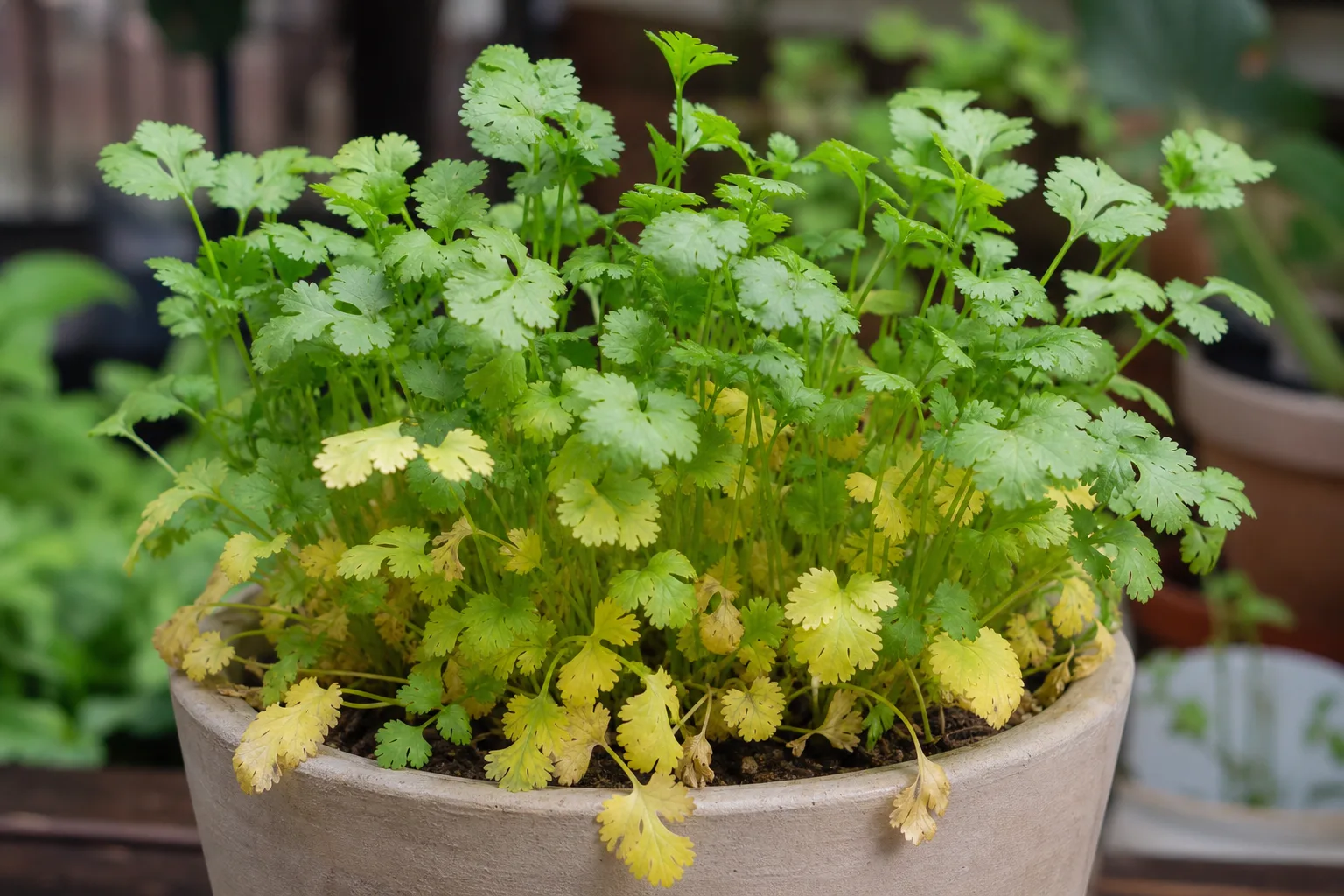
Yellow Leaves on Coriander (Cilantro): Causes, Checks & Fixes
This guide covers yellow leaves on Coriander. See also the general Yellow Leaves guide, watering, and light pages for this plant.
Yellow Leaves on Coriander (Cilantro): Causes, Checks & Fixes
Quick answer
Yellow leaves on coriander (Coriandrum sativum, cilantro) are rarely a mystery disease-they are usually the plant telling you summer has arrived indoors. This cool-season annual bolts-shifts from flat leaf production to flowering and seed-when sustained heat, long day length, root disturbance, or repeated drought stress signal that reproduction should start before the plant dies.
On a kitchen windowsill, the most common pattern is pale yellow upper leaves with elongating stems after a heat spike near the stove, on hot south-facing glass, or under a 16-hour grow-light schedule. That is bolting, and watering or fertilizer will not reverse it. The reliable fix is harvest what remains usable and sow a new pot in a cooler bright spot every two to three weeks.
When yellowing is not bolting, the usual culprits are wet roots in soggy mix, nitrogen deficiency on fast leaf growth, transplant shock after moving nursery seedlings, or natural aging of the oldest lower leaves on a plant nearing the end of its leaf cycle. Full species context: coriander overview.
First step: look for a rising central flower stalk and check temperature at the pot level. If a thin stem is climbing with lacy pale foliage, treat it as bolting-do not reach for the watering can or fertilizer first. If the plant stays compact, press your finger 1–2 cm into the mix and note whether only bottom leaves are fading.
What yellow leaves look like on coriander
Coriander forms an upright clump of broad, flat lower leaves that later give way to finer, fern-like foliage as the plant matures. Yellowing patterns differ by cause-matching the pattern saves a week of wrong fixes.
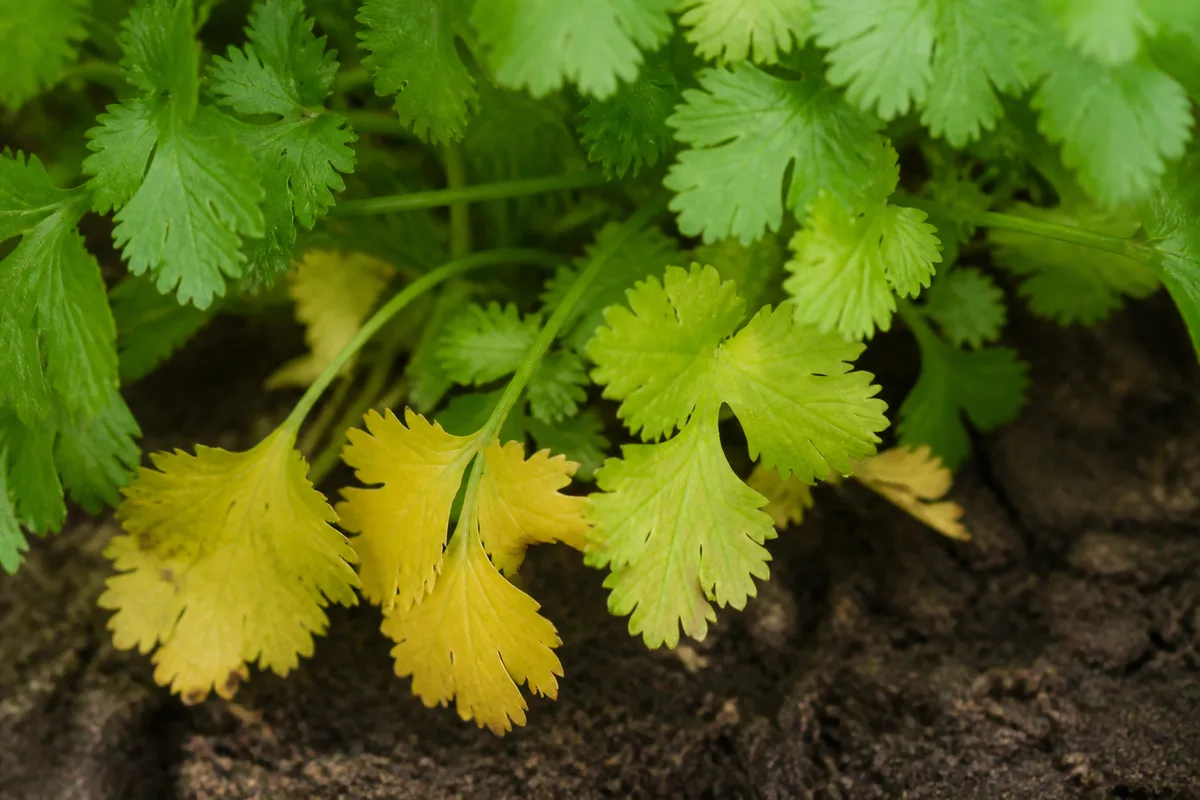
Yellow Leaves symptoms on Coriander - compare with healthy tissue on the same plant.
Bolting and heat stress (most common indoors):
- Central stem elongates; plant height jumps within days
- Upper leaves turn pale yellow or chartreuse, then finer and more lacy
- Lower leaves may yellow as energy shifts upward
- Often follows hot microclimates: south-facing summer glass, stove or oven proximity, grow lights running 14–16 hours
- Flavor turns bitter quickly once flowering begins
Overwatering and root stress:
- Lower leaves yellow first, sometimes with limp texture
- Soil stays wet for days; pot feels heavy; saucer may hold stale water
- No central flower stalk yet-plant stays short but looks tired
- May pair with fungus gnats or mold on soil surface-see overwatering on coriander
Underwatering and drought stress:
- Leaves yellow from edges inward or uniformly pale; feel thin and papery
- Soil pulls from pot walls; pot is light
- Can trigger bolting if dry cycles repeat-coriander interprets drought as a reproduce-now signal
Nitrogen deficiency:
- New growth pale yellow-green while older leaves may still look darker green
- Plant stays compact-no bolt stalk
- Common in fast-growing coriander that has exhausted a small pot without fresh compost or light feeding
- Cross-check coriander fertilizer guide
Natural lower-leaf aging:
- One or two oldest bottom leaves fade to yellow over weeks
- Center and upper leaves stay bright green
- Normal on a plant four to six weeks old nearing harvest end
- No limpness, no wet soil smell, no rising stalk
Transplant shock:
- Yellowing and droop within 24–48 hours of moving seedlings from a six-pack or Coriander repotting guide
- Wisconsin extension notes coriander does not transplant well because of its long taproot
- Oregon State extension adds that the long taproot makes transplanting difficult-direct sowing is the default best practice
Why coriander gets yellow leaves
Bolting and heat stress
Coriander is a cool-season annual that performs best in cool and dry summer climates. Clemson HGIC notes that cilantro tends to bolt as plants mature and temperatures rise, producing bitter foliage and seed. Wisconsin extension describes cilantro as a cool season crop that tends to bolt in hot weather.
Both temperature and day length influence flowering. Oregon State extension explains that in warm weather cilantro completes its life cycle faster-often bolting to seed within four to six weeks of summer sowing-while cooler spring or fall plantings hold leaves for months. Indoors, a 16-hour grow-light schedule or a pot above a warm appliance can trigger the same hormonal shift as outdoor July heat.
Once bolting starts, no amount of watering or fertilizer reverses leaf production. The practical response is harvest, collect seed if you want coriander spice, and sow the next batch in a cooler bright location.
Overwatering and root oxygen loss
Coriander wants consistently moist, well-drained soil-not waterlogged mix. When roots sit in soggy compost, they lose function and lower leaves yellow while the crown may still look green briefly. Heavy pots, blocked drainage holes, and cool dim rooms where evaporation slows are common indoor triggers. This pattern overlaps with root rot on coriander when yellowing spreads quickly with a sour smell.
Nitrogen draw-down in fast annual growth
Coriander can move from seed to harvest in three to four weeks under good light-Missouri Botanical Garden notes young leaves can be pinched in about 30 days. That speed depletes nitrogen in a small container faster than slow houseplants. Clemson HGIC recommends light nitrogen applications to keep plants lush while avoiding over-fertilization. Pale new growth on an otherwise compact plant in cool conditions often points here-not bolting.
Natural senescence on aging plants
Coriander is a short-cycle crop, not a long-lived houseplant. Lower leaves naturally senesce as the plant ages and upper foliage takes over. On a five-week-old pot with no heat stress, one or two yellow bottom leaves may simply mean succession sowing time is approaching rather than a care emergency.
Transplant and taproot disturbance
Moving supermarket cilantro or thinning into a larger pot damages the taproot. The plant yellows because roots cannot supply leaves while regrowing. Wisconsin extension is explicit: cilantro does not transplant well. Direct sow into the final pot instead-see coriander propagation.
How to confirm the cause
Work through these checks in order. One pattern match beats guessing from a single yellow leaf.
- Bolt check - Is a central stem rising? Are upper leaves turning lacy and pale? If yes, bolting is confirmed regardless of soil moisture.
- Temperature at pot level - Use a thermometer at the container surface at midday. Sustained readings above 75°F (24°C) strongly favor bolting over root disease-Clemson HGIC links rising temperatures to cilantro bolting.
- Day length / light schedule - Count hours of natural plus artificial light. More than 13–14 hours daily encourages flowering on coriander; see coriander light guide.
- Soil moisture - Finger-test 1–2 cm deep. Wet heavy pot with limp yellow lowers suggests root stress. Dry light pot with papery leaves suggests drought-see underwatering.
- Which leaves yellow - Bottom only, slowly, on an old plant → aging. Pale new growth throughout → nitrogen. Upper lacy leaves + tall stem → bolting.
- Recent transplant - Yellowing within 48 hours of moving seedlings → taproot shock; sow fresh seed rather than forcing recovery.
- Pest scan - Aphids and spider mites can pale foliage; look for sticky residue, stippling, or webbing-see aphids and spider mites.
Symptom comparison table
| Pattern | Likely cause | First direction |
|---|---|---|
| Rising central stem; pale lacy upper leaves | Bolting / heat | Harvest; sow new pot in cooler spot |
| Yellow lower leaves; wet heavy soil; no stalk | Overwatering / root stress | Stop watering; check drainage |
| Uniform pale leaves; dry soil; light pot | Drought stress | Deep water; then adjust rhythm |
| Pale new growth; compact plant; cool temps | Nitrogen deficiency | Dilute feed once; refresh mix next sowing |
| One to two yellow bottom leaves; green center | Natural aging | Harvest; plan succession sowing |
| Yellow + droop within 48 h of transplant | Taproot shock | Sow fresh; avoid repotting |
First fix for coriander
After you identify the most likely pattern, apply one primary correction-not fertilizer, repotting, and watering changes on the same day.
If bolting or heat stress: Move the pot to the coolest bright spot available-east window, room away from the stove, or grow lights trimmed to 12–13 hours. Harvest usable leaves immediately. Sow a new pot in fresh mix rather than trying to revert the current plant. Bolt yellowing is not reversible.
If overwatering: Stop watering until the top 2–3 cm dries. Empty the saucer. Confirm drainage holes are open. Remove fully yellow mushy leaves. Do not fertilize a waterlogged plant.
If underwatering: Water thoroughly at the base until a small amount drains, then discard runoff. Check daily in warm weather-coriander in shallow pots can dry within hours.
If nitrogen deficiency on a compact cool-season plant: Apply one half-strength balanced liquid feed after a normal watering, then wait two weeks before repeating. Do not feed bolt-bound or soggy plants.
If natural aging only: Pick the yellow lower leaves, harvest the good foliage, and start the next succession pot if harvest quality is declining.
If transplant shock: Provide bright light and even moisture while roots recover-or sow fresh seed direct in the final pot if collapse continues beyond one week.
Recovery timeline by cause
Bolting: Irreversible for leaf quality. You may harvest for a few days as stems rise, but flat leaf production does not return. Plan 7–14 days to usable leaves on a new sowing in cool conditions.
Overwatering: Yellowing often stops spreading within 3–7 days once soil dries to a moist-not-wet band. New center leaves should stay green within one to two weeks if roots were not rotted.
Underwatering: Foliage firms and yellowing halts within 24–48 hours after a deep drink if roots are intact.
Nitrogen deficiency: New growth should green up within one to two weeks after a single dilute feeding when temperatures stay in coriander’s comfort zone.
Natural aging: No recovery of old yellow leaves-they drop. Success means continued green new growth from the center until the next harvest cycle ends.
Transplant shock: Partial recovery possible in one to two weeks if disturbance was mild; severe taproot damage often means starting over with direct-sown seed.
Judge success by new leaf color and absence of a rising bolt stalk, not by old yellow tissue re-greening.
What not to do
- Do not increase watering on a heat-bolted plant-moisture does not cancel flowering hormones.
- Do not fertilize waterlogged yellow coriander-salts worsen root stress.
- Do not assume every yellow leaf needs fertilizer-bolt and overwatering are more common indoors.
- Do not transplant a yellowing mature plant into a bigger pot-taproot disturbance accelerates bolting; sow fresh instead.
- Do not run 16-hour grow lights on coriander and expect prolonged leaf harvest-long days trigger flowering.
- Do not discard a whole pot for one yellow bottom leaf on an otherwise green plant-aging is normal.
How to prevent yellow leaves on coriander
- Succession sow every two to three weeks so one bolted or aging pot does not end your kitchen supply-Oregon State recommends succession planting to maintain leafy cilantro.
- Keep pots in cool bright light: at least six hours of sun per day per Clemson HGIC, but avoid hot afternoon sun on glass in summer-details in coriander light guide.
- Direct-sow seeds in the final container; skip supermarket transplants when possible.
- Check soil daily in warm weather; keep mix evenly moist without soggy cycles-see watering guide.
- Use slow-bolt cultivars (Santo, Caribe) for slightly longer leaf windows in warm kitchens-they delay but do not eliminate bolting.
- Limit grow lights to 12–13 hours to avoid long-day flowering triggers.
- Incorporate compost at sowing so fast growth has nitrogen without heavy mid-cycle feeding.
When to sow a new pot instead of fixing
Coriander completes its leaf cycle quickly. Starting fresh is often the correct “fix.”
- Central flower stalk visible - harvest and sow anew; fighting bolting wastes seed and counter space.
- Plant older than five to six weeks with widespread pale foliage - leaf quality rarely returns to first-harvest standard.
- Transplant shock with continued collapse after one week - direct-sow replacement.
- Root rot smell with mushy stems - discard affected plants and soil; sanitize the pot before reusing.
Yellow leaves on coriander are actionable when you match the pattern to bolting, moisture, nutrients, or age-and honest when the best garden move is harvest, then sow again.
Conclusion
Yellow leaves on coriander usually mean heat, long days, or age-not a generic houseplant deficiency. Bolting shows pale lacy upper foliage and a rising stem; overwatering yellows limp lower leaves in wet mix; nitrogen deficiency pales new growth on a compact plant; natural aging fades only the oldest bottom leaves. Check for a bolt stalk and pot-level temperature before you water or feed. Recovery is measured on new green growth, and bolt yellowing is the signal to succession sow rather than rescue the same pot indefinitely.
When to use this page vs other Coriander guides
- Coriander watering guide - Use for routine moisture checks before assuming yellow leaves is the main issue.
- Coriander problems hub - Browse all 16 common issues on this species.
- Overwatering on Coriander - Different entry point when symptoms overlap with yellow leaves.
- Underwatering on Coriander - Different entry point when symptoms overlap with yellow leaves.
- Not Enough Light on Coriander - Different entry point when symptoms overlap with yellow leaves.