Slow Growth on Coriander: Causes, Checks & Fixes
Quick answer
Coriander should germinate in 7–14 days and reach usable leaves in about three to four weeks under good light and cool temperatures. If seeds never sprout, seedlings stall after emergence, or regrowth after harvest is sparse, first step: note your sow date against the benchmarks below, then check seed age, soil temperature, light intensity, and whether the plant is bolting instead of growing slowly.
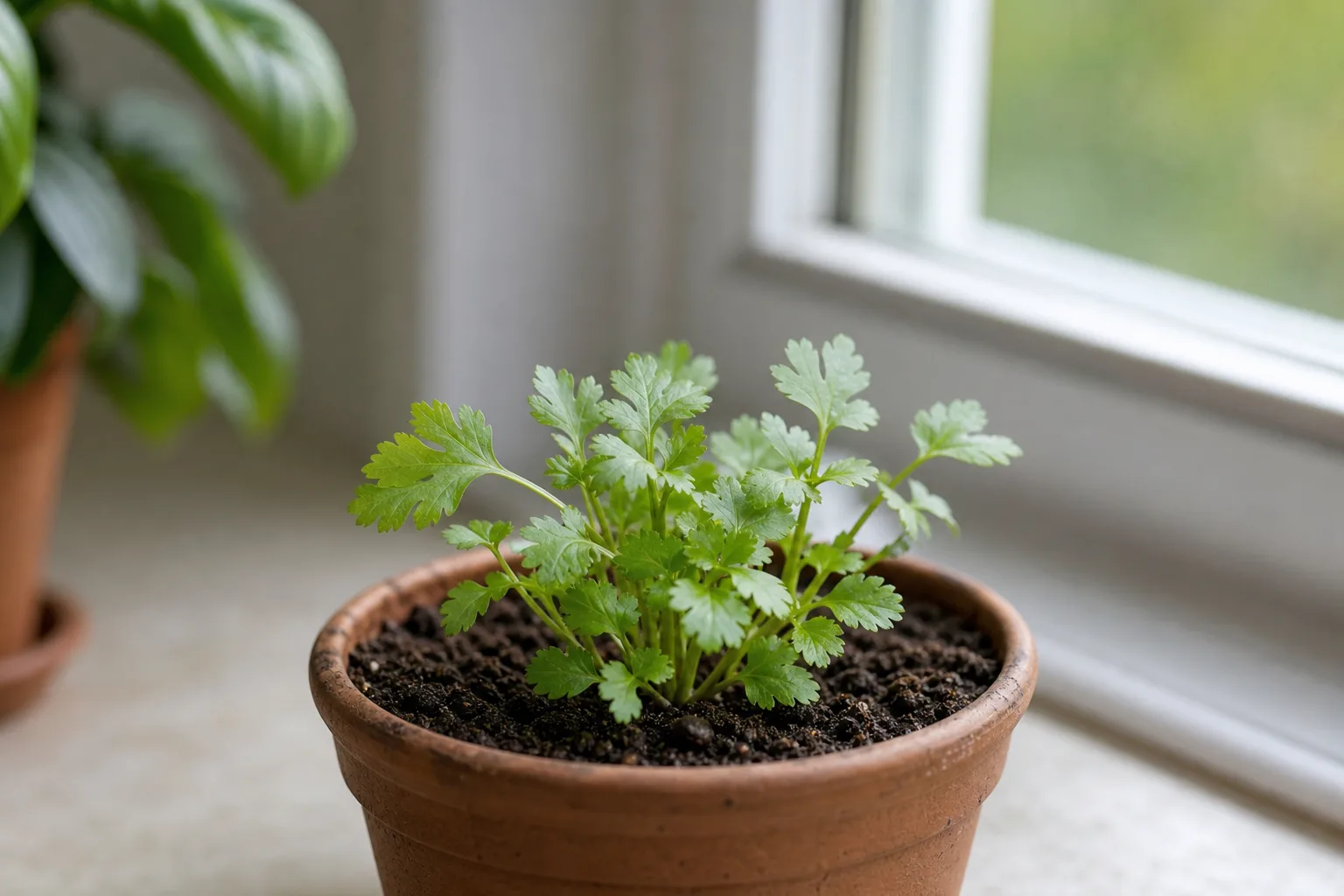
Slow Growth on Coriander: Causes, Checks & Fixes
This guide covers slow growth on Coriander. See also the general Slow Growth guide, watering, and light pages for this plant.
Slow Growth on Coriander: Causes, Checks & Fixes
Quick answer
Coriander (Coriandrum sativum) is a fast cool-season annual-not a slow houseplant. Under good conditions you should see sprouts within 7–14 days, the first true leaves by day 10–14, and usable foliage in roughly three to four weeks. If your timeline lags those marks, slow growth usually falls into one of three buckets: germination failure, seedling stall after emergence, or weak regrowth after harvest.
First step: write down your sow date and compare it to the benchmarks in the next section. That single check tells you whether you are waiting on normal slow germination or fighting a real problem. Do not reach for fertilizer or Coriander repotting guide until you know which stage is stuck.
What slow growth looks like on Coriander
Slow growth on coriander has different faces depending on when it appears:
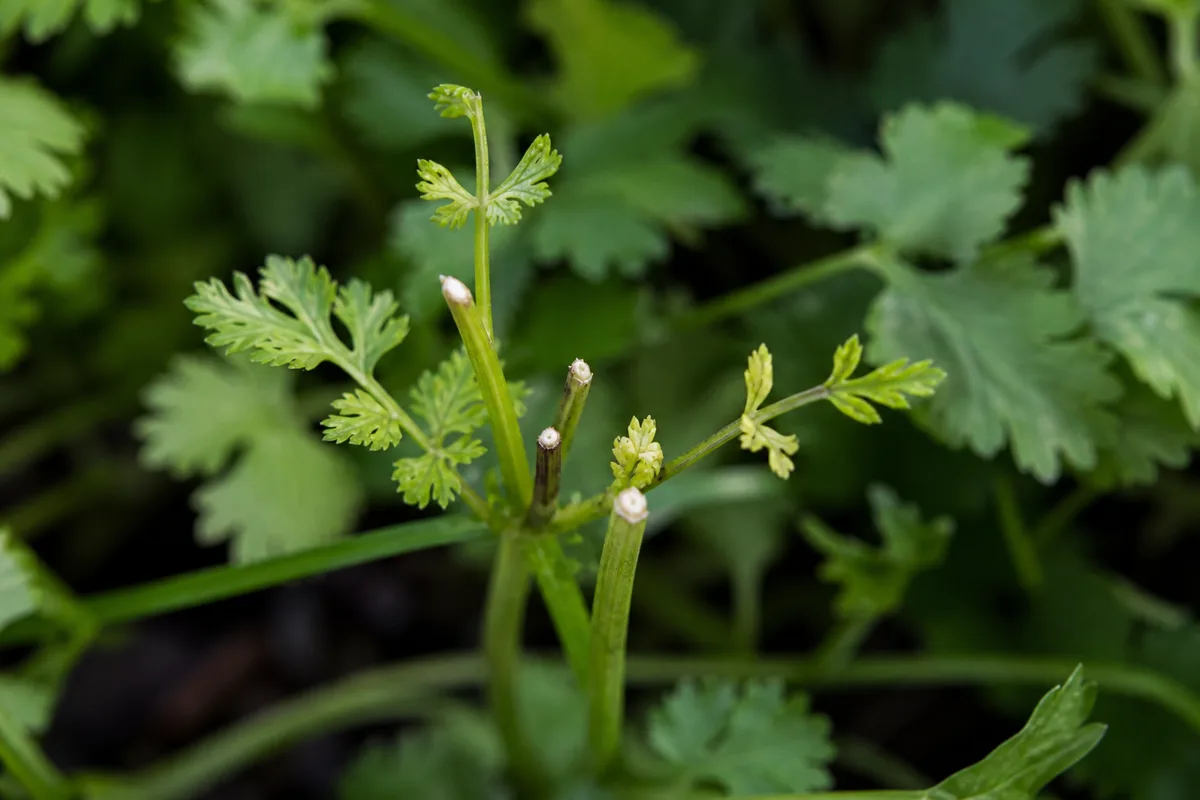
Slow Growth symptoms on Coriander - compare with healthy tissue on the same plant.
Before or right after germination:
- No sprouts 14–21 days after sowing despite moist mix
- Patchy trays where only a few seeds emerge while neighbors stay bare
- Seedlings stuck at the cotyledon stage with no true leaves for a week or more
After seedlings are up:
- Plants remain tiny-under 5 cm-with no new leaf pairs for many days
- Crowded trays where inner rows are pale and compressed while edge seedlings look normal
- One or two survivors in a pot that should hold several strong plants
After you have already harvested:
- Outer stems cut but no new leaf flush within 7–14 days in adequate light
- Regrowth comes in thin and sparse instead of bushy
- The plant sits green but static while a younger succession pot sprints ahead
What slow growth usually is not:
- A thickening central stem with flower buds-that is bolting, not slow leaf production
- Tall stretch toward a window with small pale leaves-that is not enough light
- Yellow lower leaves on chronically wet soil-that points to overwatering more than growth rate alone
How fast Coriander should grow
Use this table to judge whether your plant is genuinely slow or you are comparing it to the wrong expectation. Timelines assume fresh seed, direct sowing, bright cool conditions, and consistently moist well-drained mix-see the coriander overview for full care context.
| Stage | Normal expectation | Likely slow if… |
|---|---|---|
| Germination | 7–14 days | Nothing after 21 days; fewer than half of seeds up after 14 days |
| First true leaves | ~10–14 days after sowing | Cotyledons only past day 14–17 |
| First harvestable leaves | ~3–4 weeks after sowing | Still under 10 cm at week 4 with adequate light |
| Regrowth after light harvest | New leaves within 7–14 days | No flush after 2 weeks in bright cool spot |
| Full leaf crop before bolting | Several weeks in cool weather; faster in heat | Central bolt stalk before any real leaf mass |
NC State Extension lists coriander as a cool-season annual preferring full sun. Oregon State Extension notes seeds germinate at soil temperatures of 55–68°F and that in cool spring or fall weather plants grow leaves for weeks before flowering-while warm summer plantings bolt within four to six weeks with little leaf production.
Why Coriander grows slowly
Coriander’s fast lifecycle means small environmental errors show up as stalled growth within days-not months.
Old or poor-quality seed
Coriander seed viability drops sharply after about a year in storage. Spice-jar seed is often heat-treated or aged for culinary use and may not sprout at all. Patchy germination with a few weak survivors is a classic old-seed pattern.
Cool soil delaying germination
Germination needs warm-enough soil at seed depth-not just warm air in the room. Wisconsin Horticulture recommends sowing 1/4–1/2 inch deep and keeping evenly moist. Soil below the ideal range slows or uneven sprouting, especially on unheated windowsills in early spring.
Insufficient light after emergence
Seedlings can emerge in a dim corner then stall because photosynthesis cannot fuel the next leaf pairs. Coriander needs strong light for compact growth-at least six hours of direct sun outdoors or equivalent intensity indoors. Weak light after harvest produces the same stall. See not enough light on coriander when stretch or pale color accompanies slow growth.
Overcrowding and competition
Sowing too thickly without thinning traps seedlings in a humid mat where inner plants shade each other. Outer rows may look fine while the center stalls. Wisconsin Horticulture advises thinning well-established seedlings to 3–6 inches apart for leaf production.
Transplant shock on a taproot crop
Coriandrum sativum develops a long taproot that resents disturbance. Oregon State Extension notes transplanting is difficult because of this taproot-stressed seedlings often stall or bolt instead of growing on. Direct sowing into the final pot is the default best practice; see coriander propagation.
Post-harvest energy drain in weak conditions
Removing outer leaves is normal harvest practice, but coriander does not regrow as completely as parsley. After a heavy cut in dim or warm conditions, the plant may sit idle while it rebuilds leaf area. That looks like slow growth even when the original crop was healthy.
Heat pushing toward bolting instead of leaves
Sustained temperatures above roughly 75°F (24°C) signal summer to coriander. Growth energy shifts toward flowering. The plant may appear to “stop growing leaves” when it is actually transitioning lifecycle stages-see leggy growth and bolting.
Overwatering or underwatering in small pots
Coriander wants consistently moist mix-not bone dry and not soggy. Drought stress slows growth and triggers bolting; waterlogged roots cannot uptake nutrients or water efficiently. Match the rhythm in our watering guide rather than letting the surface dry completely between every drink.
Lookalike problems to rule out
Work through these before treating slow growth as one generic problem:
| If you see… | More likely cause | Where to read |
|---|---|---|
| Thick center stem, flower buds | Bolting from heat or day length | Leggy growth |
| Tall lean, small pale leaves | Low light | Not enough light |
| Yellow lower leaves, wet heavy mix | Overwatering | Overwatering |
| Crispy edges, light pot | Underwatering | Underwatering |
| Nothing ever sprouted | Seed failure or cold soil | This page - germination section |
| Green plant, no leaves after heavy cut | Post-harvest stall | This page - regrowth section |
How to confirm the cause
Follow this order so you change one variable at a time:
- Date check - Count days since sowing. Under 14 days with moist soil may still be normal germination. Past 21 days with no sprouts points to seed or temperature.
- Seed source - Garden seed from a dated packet beats spice-rack or unknown-age seed. Note germination rate: if fewer than half of 20 seeds sprouted, seed quality is suspect.
- Soil temperature at pot level - A soil thermometer or probe at seed depth helps. Germination stalls when mix stays cold for days.
- Light intensity - Stand where the pot sits. More than 4–6 feet from glass without a grow lamp usually means too dim for post-emergence growth. Our light guide covers six-plus hours of bright light and supplemental fixtures.
- Crowding - Count seedlings per small pot. More than three to four strong plants competing in a 15 cm pot slows everyone.
- Moisture pattern - Top 1–2 cm should dry slightly between waterings while the root zone stays moist. Constant sogginess or dust-dry mix both stall growth.
- Bolting screen - Look at the crown. A thickening center and tiny flower branches mean lifecycle shift, not fixable slow growth.
- Harvest history - If growth stopped right after a heavy cut, test brighter placement for two weeks before assuming disease.
If seedlings firm up and new leaf pairs appear after thinning, brighter light, or warmer soil-without stacking fertilizer and repotting-you have confirmed the limiter.
First fix for Coriander
Match the first action to the stage that is stuck:
Nothing has germinated after 21 days in moist mix: Resow with fresh garden seed directly in the final pot. Cover 6–12 mm deep, keep evenly moist, and place in the brightest cool spot available. Do not transplant seedlings from a failed tray.
Seedlings emerged but stalled: Move the pot within about two feet of an east- or west-facing window or under a grow light, thin to two or three plants per small pot, and confirm soil is moist but drained. That single placement plus thinning fix fixes most post-emergence stalls.
Plant was growing, you harvested heavily, now regrowth is sparse: Move to stronger light and wait 10–14 days. If no meaningful new leaves appear, succession-sow a fresh pot rather than nursing the old one-coriander is a short-cycle crop.
Central bolt stalk is forming: Do not chase slow leaf growth on a flowering plant. Harvest remaining leaves, collect seed if desired, and resow in a cooler bright slot.
Do not fertilize, repot, or drench with water on the same day you diagnose. One correction, then watch the next leaf set.
Recovery timeline
Expect different recovery speeds depending on cause:
- Fresh resow after failed germination: New sprouts in 7–14 days; first usable leaves in about three to four weeks in good conditions
- Seedling stall after light or thinning fix: New leaf pairs within 5–10 days once light and spacing improve
- Post-harvest regrowth: 7–14 days for a visible flush in adequate light; longer in dim warm kitchens
- Transplant-shocked seedlings: May never fully recover; resow direct is often faster than waiting
Old cotyledons and tiny first leaves will not enlarge retroactively. Judge success on new leaf pairs at normal size, not on fixing tissue already formed.
If a tray is severely leggy or bolted, starting fresh under proper light beats weeks of rescue work.
What not to do
Do not fertilize a stalled seedling hoping to force growth-without adequate light, nitrogen produces soft floppy stems.
Do not transplant coriander seedlings to “give them more room” unless you accept bolting risk. Direct sow the next round instead.
Do not keep watering on a schedule designed for mature houseplants. Coriander in fast-draining mix in bright light may need checking daily; in dim cool corners, less often-but never let the root zone go bone dry.
Do not confuse bolting with slow growth and keep feeding a plant that is making flowers.
Do not rely on one pot for months. Wisconsin Horticulture recommends successive sowings at 2–3 week intervals for longer leaf harvest-nursing one tired container is slower than staggered fresh sowings.
Do not use spice-rack seed for a second attempt without accepting high failure rates.
How to prevent slow growth next time
Sow fresh seed directly in the container where plants will live, placed immediately in adequate light-do not start seeds in a dark room and plan to move them later.
Succession-sow every two to three weeks so a stalled batch is not your only supply. This matches coriander’s short lifecycle better than extending one old pot indefinitely.
Keep soil evenly moist through germination and early growth. The top 1–2 cm can dry slightly between drinks, but drought during establishment slows growth and triggers bolting. Follow coriander watering rhythm, not generic “wait until the surface is dry” houseplant rules.
Provide strong light from day one. Six or more hours of direct sun outdoors, or bright indoor placement plus supplemental fixtures in winter. See coriander light.
Thin early to two or three strong seedlings per small pot so none compete into a stall.
Choose slow-bolt cultivars such as Santo or Leisure in warm rooms-they buy time but still need adequate light and cool temperatures.
Harvest outer leaves and leave the center for regrowth, but plan on resowing when regrowth slows rather than expecting perennial-herb vigor.
When to resow instead of fixing
Coriander is cheap and fast from seed. Resow when:
- Germination is past 21 days with almost no sprouts
- Seedlings are severely leggy, bolted, or root-bound in a too-small pot
- Post-harvest regrowth fails after two weeks in corrected light
- The plant is flowering and you wanted leaves, not seed
Fix-in-place makes sense when seedlings are young, firm, and only light or spacing is wrong. When in doubt, sow a parallel fresh pot-you can abandon the slow one without losing your herb supply.
Conclusion
Slow growth on coriander is almost always a timing, seed, light, or lifecycle problem-not mysterious wilt. Compare your sow date to normal 7–14 day germination and three-to-four-week leaf milestones, rule out bolting and low light, then fix one variable or resow. That diagnostic path beats stacking fertilizer on a cool-season annual that simply needs fresh seed, brighter light, or its next succession pot.
When to use this page vs other Coriander guides
- Coriander watering guide - Use for routine moisture checks before assuming slow growth is the main issue.
- Coriander problems hub - Browse all 16 common issues on this species.
- Not Enough Light on Coriander - Different entry point when symptoms overlap with slow growth.
- Leggy Growth on Coriander - Different entry point when symptoms overlap with slow growth.
- Yellow Leaves on Coriander - Different entry point when symptoms overlap with slow growth.