Low Humidity on Coriander: Causes, Checks & Fixes
Quick answer
Coriander on dry winter windowsills often shows crispy leaf margins and midday wilt even when soil is moist-transpiration outpaces uptake in low RH air. First step: check relative humidity near the pot with a hygrometer and move the container at least 60 cm from heating vents or radiators before misting or watering more.
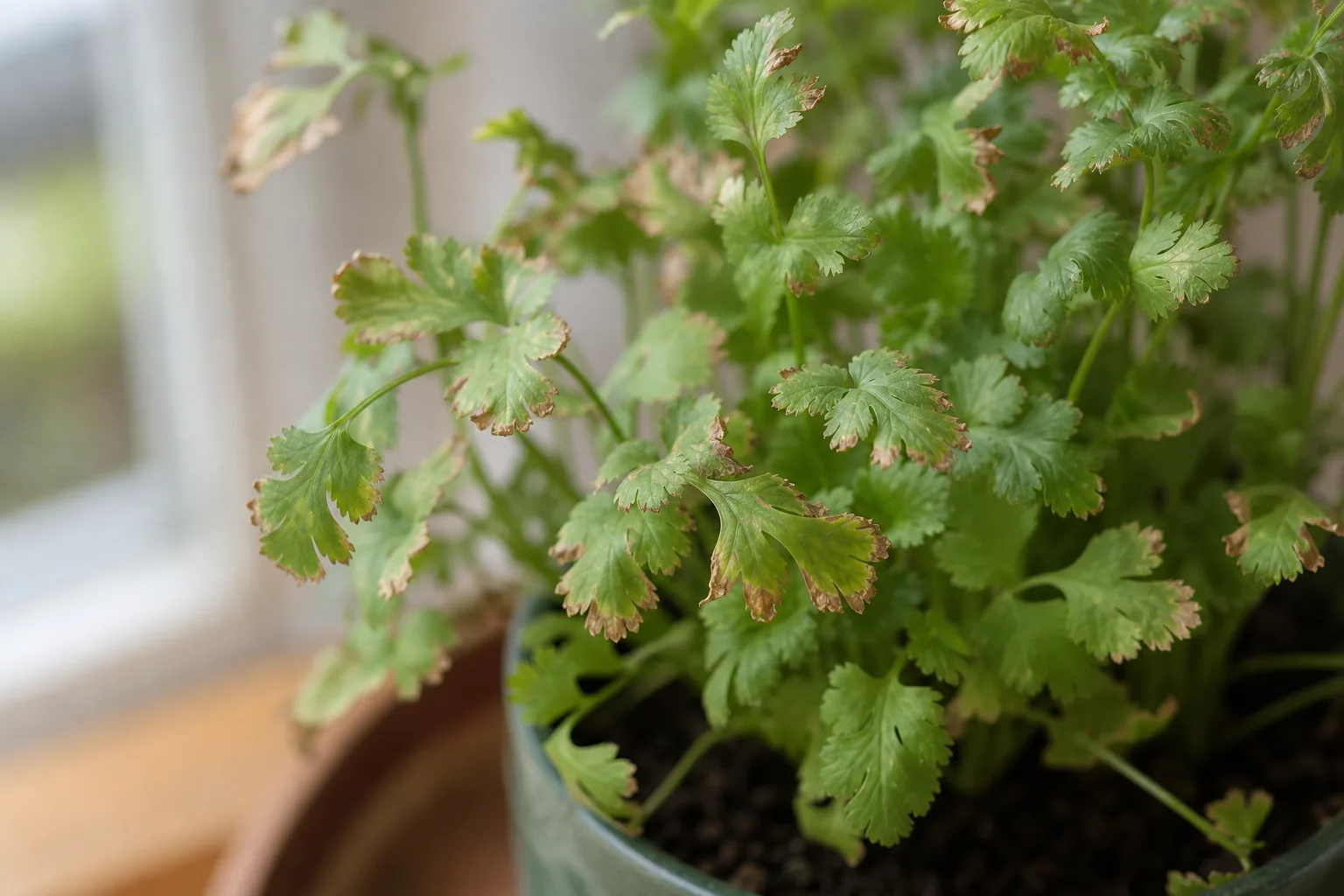
Low Humidity on Coriander: Causes, Checks & Fixes
This guide covers low humidity on Coriander. See also the general Low Humidity guide, watering, and light pages for this plant.
Low Humidity on Coriander: Causes, Checks & Fixes
Quick answer
Low humidity on coriander (Coriandrum sativum) shows up as crispy brown leaf margins, midday wilt with moist soil, and accelerated bolting when dry air teams up with a hot windowsill. Coriander is a cool-season kitchen herb-not a rainforest plant-but heated winter rooms often lack sufficient humidity for healthy foliage, especially within a metre of radiators, forced-air vents, or sun-baked south-facing glass.
The trap most growers fall into is treating dry-air wilt like drought and watering more. That can waterlog shallow herb roots while leaves keep desiccating. Our watering guide separates thirst (dry top 1–2 cm, light pot) from root failure (wet mix, sour smell) from environmental dry-out (moist soil, low RH, crisp edges).
First step: place a hygrometer beside the pot and move the container at least 60 cm from heating vents, radiators, or AC drafts. If RH reads below roughly 35% and margins are browning while soil moisture is adequate, raise ambient humidity with a pebble tray or room humidifier-not extra watering and not daily misting as your only fix.
What low humidity looks like on coriander
Healthy coriander carries soft, bright green, ferny leaflets on upright stems. Under dry-air stress, damage usually starts at the leaf margins and tips-they turn tan or brown and feel papery while the center of the leaflet may still look green. On dense supermarket six-packs, outer leaves desiccate first because they sit closest to the glass and dry airflow.
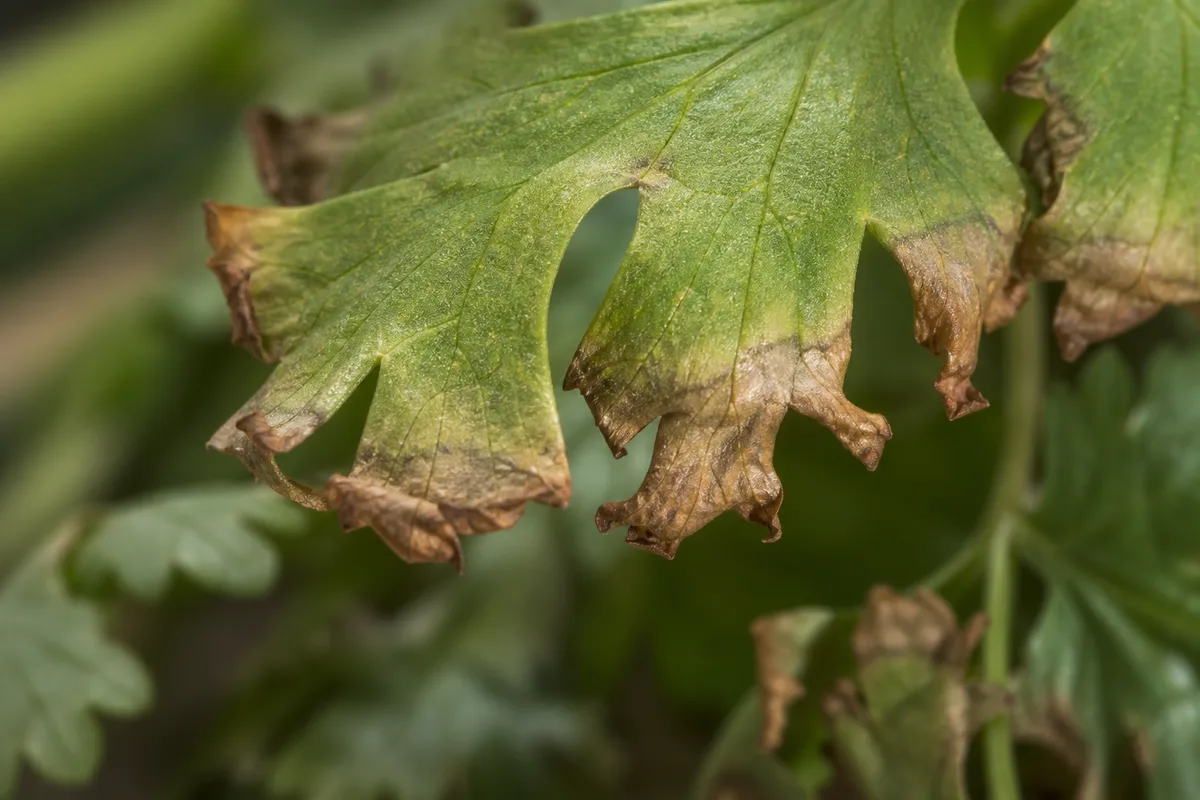
Low Humidity symptoms on Coriander - compare with healthy tissue on the same plant.
Midday wilt with moist soil is the signature low-humidity pattern on winter windowsills. In mid-afternoon, leaflets droop and feel thin; your finger test at 1–2 cm depth still finds cool, slightly moist mix. By evening, foliage may partially recover without watering-because the air cooled and transpiration slowed, not because roots suddenly caught up. If this repeats daily above a radiator, margins brown within a week.
Accelerated bolting can follow sustained heat plus dry air. The central stem elongates, upper leaves turn lacy, and flavor shifts bitter. The RHS notes coriander bolts if it gets too hot or dry on windowsills-low humidity is often the dry half of that pair even when you have been watering conscientiously.
Small, pale new growth on an otherwise watered plant can mean the microclimate is too harsh. Coriander does not need tropical humidity, but most indoor environments lack sufficient humidity in winter, and small pots on dry sills lose leaf moisture fast through transpiration.
Why coriander struggles in dry indoor air
Winter heating and forced-air drafts
Central heating, space heaters, and HVAC vents drop relative humidity sharply. University of Maryland Extension warns that indoor plants are sensitive to drafts and heat from registers and should not sit near heat or air-conditioning sources. Coriander’s shallow roots in small kitchen pots cannot buffer a full day of dry, warm airflow across the leaf surface.
A pot on a sill directly above a radiator experiences both radiant heat (which speeds bolting) and dry air (which pulls water from leaves). The compost may dry on the surface between waterings, tempting you to water more often-while the real stressor is air moisture, not root-zone thirst.
Sun-baked south- and west-facing glass
Coriander needs bright light, but afternoon sun through winter glass creates a hot, dry microclimate. The RHS recommends a bright but reasonably cool spot for windowsill coriander and warns that prolonged indoor growing in heat and dryness leads to pale foliage and bolting. Reflected heat off glass amplifies transpiration without raising RH.
Small pots and fast transpiration
Coriander is commonly grown in shallow supermarket trays and four-inch pots. Limited soil volume dries quickly, but low humidity dries leaves even faster when the plant has plenty of ferny leaf surface area. Container coriander should be checked daily in warm weather; in dry winter rooms, the leaf damage may appear before the pot feels light.
Heat-plus-dry bolting pathway
Coriander is a cool-season annual that bolts when summer conditions arrive-indoors, that can mean a warm kitchen, long grow-light hours, and dry air together. Drought is a listed bolting trigger for leafy crops, and dry atmospheric moisture stresses the plant similarly even when soil is moist: the plant reads “hot and dry” and shifts to seed production.
Lookalike symptoms to rule out
Low humidity overlaps with several other coriander problems. Confirm before you change care:
| Pattern | Soil / pot | Air / placement | Likely cause | First direction |
|---|---|---|---|---|
| Low humidity | Top 1–2 cm moist; pot moderate weight | RH low; near vent, radiator, or hot glass | Dry air desiccation | Relocate + raise RH |
| Underwatering | Dry, crumbly; light pot | Any placement | Root-zone drought | Deep base watering |
| Overwatering / root stress | Wet, heavy; sour smell possible | Often cool, dim, or poor drainage | Root failure | Pause water; see overwatering |
| Heat bolting | May be moist | Hot sill; long days | Life-stage shift | Sow next batch |
| Brown tips from salt or fertilizer | Moist; recent feed | Any | Tip burn | Flush soil; pause feed |
Underwatering crisps leaves too, but the finger test at 1–2 cm is dry and the pot is noticeably light. Recovery after a thorough drink within hours confirms thirst. See underwatering on coriander when dry soil is the consistent pattern.
Overwatering can also cause wilt with wet soil-but usually with yellow lower leaves, soft stems, or mold on the surface. Low humidity wilt keeps green tissue longer and often spares the crown if you fix the air.
Brown tips from fertilizer burn or tap-water salts can mimic margin burn. If you fed recently or use very hard water, cross-check brown tips on coriander. Margin burn from dry air tends to appear on the window-facing side first and tracks with low RH readings.
Wilting is the sharper collapse at the severe end of water-balance failure. See wilting on coriander when leaves go limp all day and recovery is poor even after correcting humidity.
How to confirm low humidity on coriander
Work through these checks in order:
- Hygrometer reading near the pot - Place the sensor at canopy height beside the container, not across the room. RH consistently below 35% in winter with browning margins supports dry-air stress. Comfortable herb growing often sits around 40–50% locally.
- Finger test at 1–2 cm depth - Moist or cool mix with crispy margins points away from drought and toward air desiccation or heat. Dry crumbly mix points to underwatering first.
- Pot weight - A moderate-weight pot with wilted leaves fits transpiration stress or root issues, not simple thirst. A very light pot fits drought.
- Time-of-day pattern - Afternoon wilt that eases by evening on moist soil fits heat plus low RH. All-day collapse on wet soil fits roots.
- Placement audit - Within 60 cm of a heating vent, radiator, oven, or cold AC blast? Directly on a south-facing sill above a heat source? Relocation alone is a valid diagnostic test.
- Bolting check - Central stem elongating with lacy upper leaves means flowering has started. Humidity fixes will not restore flat leaf production on that plant.
- Window-side pattern - Damage worse on the glass-facing side supports microclimate stress from hot, dry air at the pane.
If RH is adequate (above ~40% locally), soil is moist, and margins still brown, investigate salt burn, pests, or root stress before buying a humidifier.
First fix for coriander
Move the pot at least 60 cm away from heating vents, radiators, stoves, and cold AC drafts, and set it on a pebble tray or run a small room humidifier nearby.
Choose the coolest bright spot you have-an east-facing windowsill or a south-facing sill pulled back 30–60 cm from the glass often beats a hot afternoon bake against the pane. The RHS advises growing windowsill coriander in a bright but reasonably cool location with successional sowing because individual plants are short-lived.
For the pebble tray, fill a shallow tray with pebbles and water to just below the pot base so the container never sits in standing water. Maryland Extension recommends pebble trays to increase humidity around plants and notes that grouping plants raises local humidity. A room humidifier is more reliable than misting for sustained RH gains.
Do not respond to dry-air wilt by watering wet soil. Coriander dislikes soggy conditions, and high humidity plus waterlogged mix invites fungal problems on dense foliage.
Step-by-step recovery
After relocation and humidity support:
- Verify soil moisture rhythm - Continue checking the top 1–2 cm and watering deeply only when that layer approaches dry, per our watering guide. Dry air is not fixed by keeping soil constantly wet.
- Add afternoon shade in summer - If the plant sits in blazing west or south sun, filter midday exposure. The RHS recommends sowing in a cooler spot out of midday sun to delay bolting in warm weather.
- Group herb pots - A cluster of coriander, parsley, and basil raises humidity a few percentage points in a small kitchen zone.
- Run a humidifier on a timer - Target roughly 40–50% RH near the plants during heating season. Maryland Extension notes an automatic humidifier can provide extra humidity for plants and people.
- Trim fully crisp leaves - Remove only leaves that are mostly brown and papery. Partial margin damage can wait; new growth tells you whether conditions improved.
- Sow successionally - If bolting already started, start a fresh pot in a better microclimate every two to three weeks rather than rescuing a bolt-bound plant.
- Improve airflow without drafts - A gentle fan elsewhere in the room can reduce stagnant pockets, but do not blow dry heat directly across the canopy.
Judge progress by new center leaves unfurling without crisp edges-not by old damaged tissue greening up.
Recovery timeline
Margin burn from dry air is permanent on affected tissue. After relocating and raising RH, new growth often looks clean within one to two weeks on coriander’s fast cycle. Midday wilt on moist soil may ease within days once the pot leaves the hottest, driest microclimate.
If the central stem is already elongating with feathery upper leaves, recovery of leaf harvest quality is unlikely-plan the next sowing. Severe crown softness or spreading yellowing on wet soil is not humidity stress; inspect roots instead.
Mistakes to avoid
Do not treat every wilt as thirst. Moist soil plus afternoon sag on a winter sill is a humidity and placement problem first.
Do not rely on daily misting as your only fix. Maryland Extension states it is questionable whether misting really increases humidity; wet leaves in still, crowded conditions can encourage fungal issues on herbs.
Do not mist heavily right before harvest on kitchen coriander-residue and microbial risk matter on edible foliage. Ambient humidity fixes are safer.
Do not compensate for dry air by keeping soil soggy. Coriander wants consistently moist, well-drained compost-not mud.
Do not stack Coriander repotting guide, fertilizer, and humidity interventions on the same stressed plant. Change placement and RH first; let new growth guide the next step.
Do not expect a humidifier to reverse bolting. Once flowering starts, sow again in a cooler, more stable spot.
How to prevent low humidity stress next time
Sow coriander where it will finish-direct sowing avoids taproot shock-and choose the coolest bright window available. Pull pots back from glass in winter and summer peak sun. Keep containers off radiators and away from oven heat.
Run a pebble tray or humidifier in the room during heating season. Group kitchen herbs to share a slightly more humid microclimate. Check RH once with a cheap hygrometer so you know whether your kitchen is genuinely dry or whether watering rhythm is the real issue.
Maintain the finger-test watering habit from our watering guide: moist well-drained soil, never bone-dry swings, never soggy saucers. Succession sow every two to three weeks so one dry-sill failure does not end your harvest. Review coriander overview for placement, light duration, and bolt-sensitive cultivar choices.
When to worry
Escalate if the crown softens, lower leaves yellow widely on wet soil, or pests coat new growth-those patterns overlap root rot on Coriander and infestation more than dry air. Act before repeated heat-plus-dry cycles push a young plant into bolt; once the flower stalk forms, leaf harvest quality will not return.
Firm green plants with localized margin burn on a dry sill are lower urgency. Relocate, raise RH, and watch the next two flushes of center leaves.
Conclusion
Low humidity on coriander is a placement and microclimate problem as often as a watering problem. Crispy margins and afternoon wilt on moist soil mean dry air is pulling water from leaves faster than roots replace it-common on winter windowsills above heat sources. Confirm with a hygrometer and soil check, move the pot away from vents and hot glass, raise ambient RH with pebble trays or a humidifier, and keep the watering rhythm steady without waterlogging. Differentiate drought, root failure, and bolting before you pour another round-and sow fresh coriander when heat and dry air have already triggered flowering.
When to use this page vs other Coriander guides
- Coriander watering guide - Use for routine moisture checks before assuming low humidity is the main issue.
- Coriander problems hub - Browse all 16 common issues on this species.
- Brown Tips on Coriander - Different entry point when symptoms overlap with low humidity.