Slow Growth on Chrysanthemum: Causes, Checks & Fixes
Quick answer
Slow growth on chrysanthemum is normal after autumn bloom and through winter dormancy on hardy garden mums. First step: confirm the season-if May through July passes with full sun available but no new basal shoots appear, check rootbound pots, depleted mix, and porch lights that interrupt short-day flowering.

Slow Growth on Chrysanthemum: Causes, Checks & Fixes
This guide covers slow growth on Chrysanthemum. See also the general Slow Growth guide, watering, and light pages for this plant.
Slow Growth on Chrysanthemum: Causes, Checks & Fixes
Quick answer
Slow growth on chrysanthemum (Chrysanthemum × morifolium, garden mum) requires separating normal seasonal rest from a fixable spring stall. After autumn bloom, mums naturally slow or die back-hardy cultivars rest through winter and resume from crown buds when soil warms. That pause is expected, not a care failure.
First step: confirm the calendar. If May through July passes with full sun available but no new basal shoots emerge from the crown, inspect rootbound pots, compacted depleted mix, and night lighting that disrupts photoperiod-not generic “bright indirect light,” which is insufficient for this sun-loving species.
For a full light-placement audit, see not enough light on chrysanthemum. For photoperiod and missing autumn buds, see leggy growth (stretch overlap) and the light guide’s short-day section.
What slow growth looks like on Chrysanthemum
Slow growth on mums is not one uniform picture. The same “nothing is happening” complaint covers healthy dormancy and a rootbound stall that needs action today.
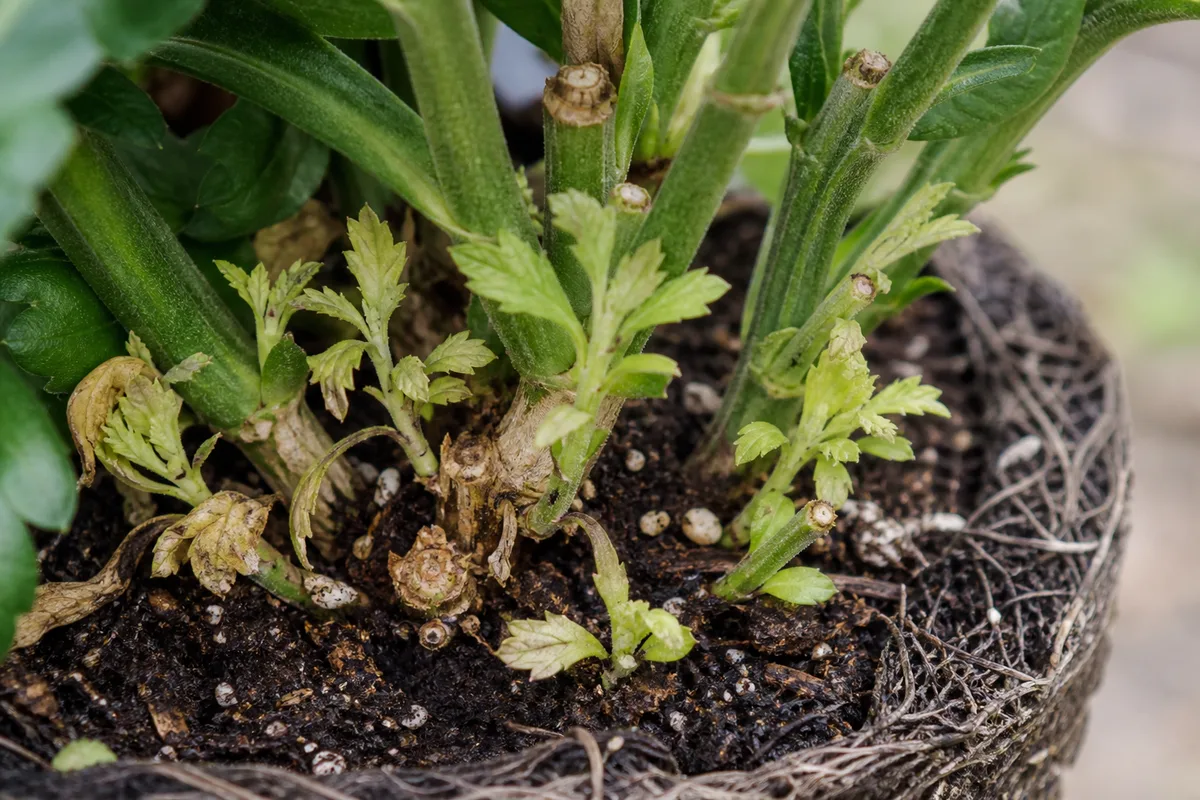
Sparse basal shoots with undersized pale leaves on a rootbound garden mum - compare new leaf size to what vigorous spring growth should look like.
Normal post-bloom and winter rest
After flowering, growth stops or foliage senesces into winter. Hardy garden mums in cold climates die back partially or fully while crowns sit dormant underground. Clemson HGIC notes that garden mums are hardy perennials that spread rapidly when grown as perennials-winter dieback followed by spring crown shoots is part of that cycle. No new leaves for months after frost is normal.
Pathological stall during the growing season
Concern starts when warm weather arrives but the plant stays static:
- No new basal shoots from the crown May through July despite adequate heat
- Smaller new leaves than the prior season on shoots that do appear
- Pale weak stems in less than full sun-not the long internodes of leggy growth, but thin slow extension
- Roots circling a nursery pot that has not been divided in years
- Gift mum that never perennialize after one season of display bloom
Gift mum vs. established garden mum
Florist mums sold in tight pots at peak autumn bloom are often rootbound before purchase. Many gardeners treat them as seasonal color. A gift mum that shows no spring regrowth after overwintering in the same small pot is usually telling you the container-not your patience-is the bottleneck.
Dormancy vs. pathological stall
| Signal | Normal rest (expected) | Stall (needs action) |
|---|---|---|
| Season | Post-bloom (Oct–Nov) through winter | May–July growing window |
| Crown condition | Firm, dry to slightly moist in well-drained soil | Soft, mushy, or foul-smelling in wet mix |
| Foliage | Senescing or absent after frost | Present but static, pale, or smaller each flush |
| Sun exposure | N/A-plant is dormant | Full sun available but no basal shoots |
| Roots | Dormant; no inspection needed | Circling pot walls, sour compacted mix |
| Night lighting | Irrelevant during dormancy | Porch or street lights on after dusk |
| Recovery without intervention | Resumes naturally in spring | Stays static weeks into warm season |
Why Chrysanthemum grows slowly
Post-bloom and winter dormancy
Garden mums follow a cool-season bloom cycle. Growth pauses after flowering as the plant shifts energy toward crown survival-not toward continuous leaf production like a tropical houseplant. This is the most common “slow growth” report and requires no fix beyond protecting crowns from wet rot.
Insufficient direct sun
Mums are bred for outdoor full sun. NC State lists full sun as the baseline for Chrysanthemum × morifolium-plants in shade grow weak, produce fewer flowers, and often fail to return vigorously the following year. Clemson HGIC warns that mums set in shady areas give nice color the first year but do very poorly the following year. Partial shade produces slow weak growth, not the dramatic stretch of leggy etiolation.
Rootbound nursery pots and aging clumps
Shallow mum roots fill small pots fast. Penn State Extension advises dividing chrysanthemums in spring when new shoots are one to three inches tall, every three to five years, to avoid overcrowding-without division, the center dies while outer shoots weaken. Gift mums forced into decorative pots for one bloom cycle commonly stall the following spring because circling roots cannot access fresh mix.
Photoperiod disruption from night lighting
Chrysanthemums are short-day plants that initiate flower buds in response to long nights. Iowa State Extension explains that mums bloom in response to short days and long nights and recommends avoiding locations exposed to street or porch lights. Missouri Botanical Garden notes that street or porch lights interfere with the flowering light response to shortened autumn days-disrupting not only bloom timing but the seasonal rhythm that governs vegetative growth in some cultivars. Even modest night interruption from a motion-sensor porch lamp can keep plants vegetative longer than neighbours in true darkness.
Compacted, depleted potting mix
Old peat in small containers breaks down into a water-repellent, airless mass after one forced bloom cycle. Water runs through without soaking in; roots lose feeder hairs; spring flush cannot expand even when temperatures rise.
Overwatering during dormancy
Wet cold crowns rot-growth never resumes in spring. Nebraska Extension warns that poorly drained soils cause root rots in wet summer periods and winter injury when water stands around crowns during freeze-thaw cycles. A mum that looked fine in autumn but fails to wake in spring often traces to saturated winter soil, not lack of fertilizer.
How to confirm the cause
Work through these checks in order before repotting, dividing, or feeding:
- Season check - Is the plant in post-bloom rest or winter dormancy? If yes, wait unless crowns feel soft or smell sour.
- Growing-window test - After your last frost, do basal shoots appear within three to four weeks? Iowa State recommends spring as the best planting time so mums establish roots before summer extremes.
- Direct sun hours - Count hours of unblocked sun May through August. Five to six hours minimum; six to eight ideal for vigorous shoots.
- Basal shoot inspection - New growth should emerge from the crown base, not only from old woody stems. Absent basal shoots with warm soil point to crown damage or root failure.
- Root and mix check - Slide the plant partly out of the pot. Circling white roots with little loose soil, or sour-smelling compacted mix, confirm container failure.
- Night-light audit - Note streetlamps, porch sensors, and landscape lighting that stay on after sunset August through October.
- Leaf size comparison - New leaves smaller and paler than last season suggest light or root limitation, not normal dormancy.
- Grey mould scan - Fuzzy grey growth on spent flowers or lower leaves in humid stagnant post-bloom pots signals Botrytis-Clemson HGIC lists Botrytis blight among common mum diseases.
First fix for Chrysanthemum
Confirm the season before any intervention.
- Dormant phase (post-bloom through winter): Protect crowns from wet rot; reduce watering; do not fertilize dormant plants. Remove spent blooms and diseased foliage to limit grey mould spread in humid shade.
- Spring stall with full sun access: Proceed to the numbered recovery steps below-division or repot is the primary fix when roots circle or mix is depleted.
- Insufficient sun during the growing season: Move to a full sun location with six or more hours of direct light before repotting or feeding.
Do not treat mums like low-light houseplants. Do not fertilize wet dormant crowns hoping to force wake-up.
Step-by-step spring recovery
When May arrives with adequate sun but growth stays absent, follow this sequence:
- Wait for soil warmth - Work when new shoots reach one to three inches tall, typically late March through May depending on zone. Penn State Extension recommends dividing when shoots are one to three inches in early spring.
- Water the day before - Moist roots flex without snapping during division.
- Slide the plant out - Inspect the root ball. Circling roots, little visible soil, and a hard outer wall confirm binding.
- Divide or repot - For garden mums, dig the clump and cut through with a sharp knife. Each division needs several shoots and healthy roots; discard the woody dead center. For pot mums, move to a container one to two inches wider with fresh well-drained mix per the repotting guide.
- Set crown depth - Plant at the same depth as before-crowns buried too deep rot; crowns heaved above soil dry out. Iowa State advises planting at the same depth as in the container.
- Tease circling roots - Score or loosen the outer inch of a bound root ball so new roots grow outward into fresh mix.
- Water thoroughly once - Then match moisture to active growth per the watering guide.
- Place in full sun - Six or more hours of direct light. Shade after repotting slows recovery.
- Begin pinching when shoots reach six inches - Remove the top half-inch to one inch of each shoot to force branching. Clemson HGIC recommends pinching beginning at six inches tall, continuing until early July in the Piedmont and early August at the coast.
- Hold fertilizer two to three weeks - Let roots establish before feeding per the fertilizer guide.
Gift mum: perennialize or compost?
If a fall-purchased florist mum shows no spring shoots after overwintering in its original pot, division and repot in step 4 is the last reasonable attempt. If still no basal growth four weeks after spring repot in full sun, treating it as a seasonal annual is practical-many cultivars in tight display pots lack the hardiness and root room for reliable perennial return. Hardy garden mums planted in spring in the ground have far better survival odds than fall-planted gift pots.
Recovery timeline
- Basal shoots: two to three weeks after crowns wake and limiting factors clear
- Compact mound rebuild: six to eight weeks with regular pinching through early July
- Autumn bloom return: same season if photoperiod, sun, and pinching schedule align-buds initiate when nights lengthen without light interruption
- Post-repot pause: one to two weeks of slowed top growth is normal; sustained wilting beyond three weeks warrants root inspection for root rot
Judge success by new basal shoots, normal-sized leaves on fresh growth, and firm green stems-not by old senesced foliage from last year.
When slow growth is getting worse
Escalate beyond patience when:
- Crowns soften or smell sour in wet winter soil-drainage correction and possible crown trimming needed
- Grey mould spreads on spent flowers or lower leaves in stagnant humid pots-remove affected tissue, improve airflow, avoid overhead watering on foliage
- Wilting pairs with soggy mix during what should be active growth-see overwatering and root rot guides
- No basal shoots by late June despite full sun, fresh mix, and firm crowns-cultivar hardiness or prior crown freeze damage may mean the plant will not recover
Slow growth vs. related chrysanthemum problems
| Pattern | Likely cause | First check |
|---|---|---|
| No growth Oct–Feb, firm crown | Normal dormancy | Season; protect from wet rot |
| Little new length, normal internode spacing | Slow growth stall | Roots, sun, mix age |
| Long internodes, leaning toward light | Leggy etiolation | Leggy growth guide |
| Pale leaves, no autumn buds | Light or photoperiod failure | Not enough light guide |
| Yellow lower leaves, sour soil, wilt | Root rot in wet mix | Root rot guide |
| Buds fail despite good spring growth | Night-light photoperiod disruption | Night-light audit; light guide |
What not to do
- Do not treat mums like low-light houseplants-partial indoor brightness stalls outdoor perennials.
- Do not fertilize dormant or wet crowns hoping to force spring wake-up.
- Do not expect gift mums to thrive in original tiny pots without spring division.
- Do not repot during peak autumn bloom unless severe root binding leaves no choice-enjoy flowers first, recover in spring.
- Do not increase watering because growth paused in winter-dormant crowns need less moisture, not more.
- Do not ignore porch lights when diagnosing year-round weak growth near entryways.
How to prevent slow growth next time
Site garden mums in full sun from planting day per the light guide. Plant in spring when possible-Iowa State notes spring-planted mums survive winter much better than fall-planted pots with little establishment time.
Divide every two to three years in early spring before clumps develop dead woody centers. Pinch through early July so energy goes into branching, not a single weak stem. Keep autumn nights dark-shield pots from street and porch lighting during bud formation. Match watering to growth phase per the watering guide: more during active summer growth, less during dormancy.
Conclusion
Chrysanthemum slow growth is often seasonal rest, not neglect-post-bloom pause and winter dormancy are normal on hardy garden mums. When May through July arrives with full sun but crowns stay silent, rootbound pots, depleted mix, insufficient light, and night-light photoperiod disruption are the usual culprits. Confirm the calendar first, then divide or repot in spring, place in full sun, and pinch for a compact framework. Gift mums in tight autumn pots may never perennialize; hardy spring-planted stock rewards division and dark autumn nights with vigorous return bloom.
When to use this page vs other Chrysanthemum guides
- Chrysanthemum watering guide - Use for routine moisture checks before assuming slow growth is the main issue.
- Chrysanthemum problems hub - Browse all 16 common issues on this species.
- Not Enough Light on Chrysanthemum - Different entry point when symptoms overlap with slow growth.
- Leggy Growth on Chrysanthemum - Different entry point when symptoms overlap with slow growth.
- Yellow Leaves on Chrysanthemum - Different entry point when symptoms overlap with slow growth.