Spider Mites on Christmas Cactus: Causes, Checks & Fixes
Quick answer
Spider mites on Christmas cactus show as fine yellow stippling on flat phylloclade segments, often starting at segment joints and the crown center where dry winter air concentrates. First step: isolate the plant and run the white-paper tap test on a suspect segment before rinsing or spraying anything.
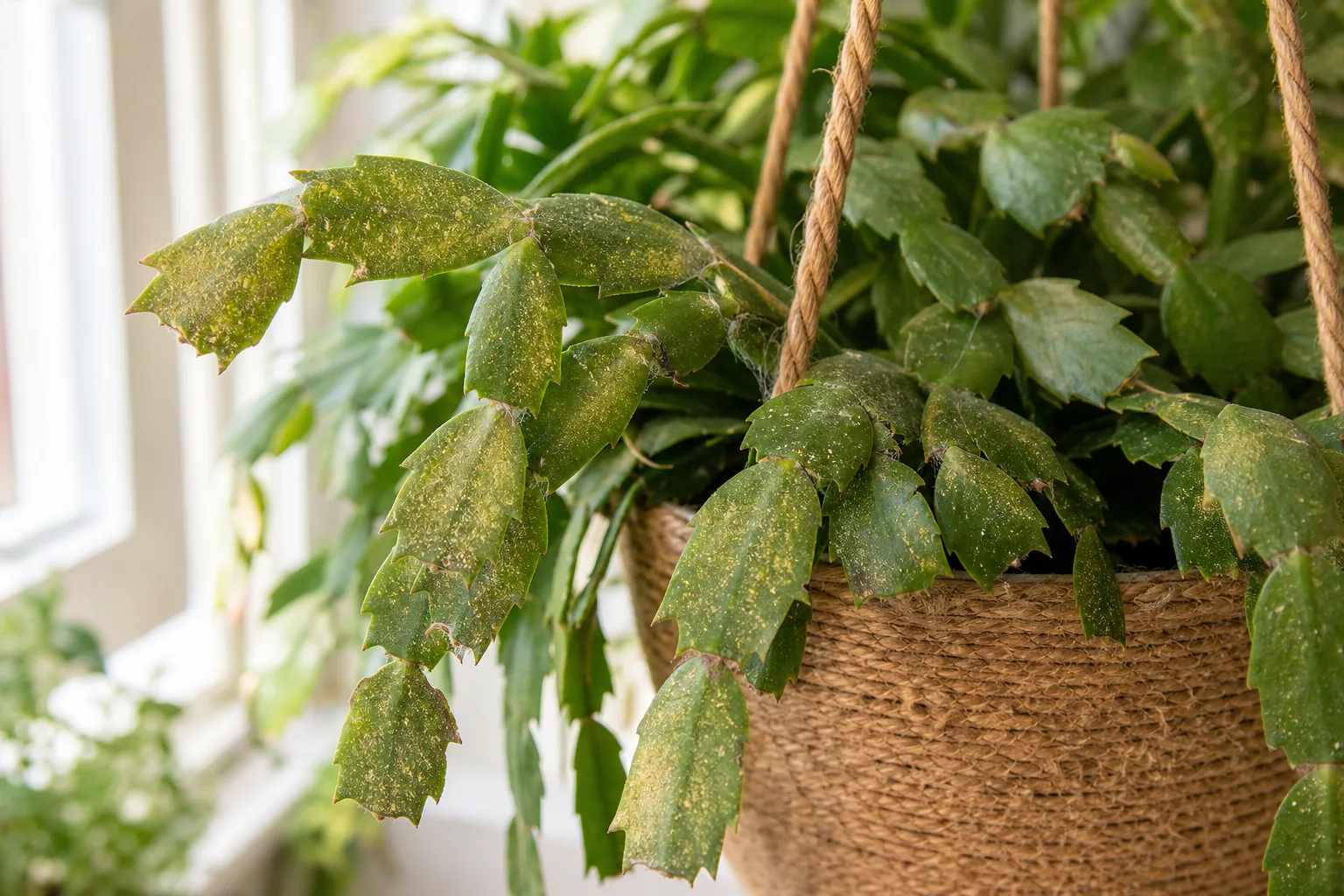
Spider Mites on Christmas Cactus: Causes, Checks & Fixes
This guide covers spider mites on Christmas Cactus. See also the general Spider Mites guide, watering, and light pages for this plant.
Spider Mites on Christmas Cactus: Causes, Checks & Fixes
Quick answer
Spider mites on Christmas cactus (Schlumbergera × buckleyi and related holiday cacti) show up as fine yellow or white stippling on flat phylloclade segments, often first at the narrow joints where one segment overlaps the next and at the crown center where arching branches emerge. You may see delicate silk webbing threading those gaps before stippling covers whole segments. The pattern is common in late autumn through winter when forced-air heating dries the air around a plant that evolved in humid Brazilian rainforests and is entering pre-bloom rest with reduced watering.
First step: isolate the plant the same day you suspect mites. Move it away from other holiday cacti, succulents, and shared shelves before you rinse or spray. Then run the white-paper tap test on a stippled segment-moving specks confirm active mites; stippling alone without crawlers may be sun stress, edema, or low humidity instead.
Christmas cactus grows as flattened, segmented cladodes on a pendulous epiphyte that benefits from higher humidity than desert cacti. Judge recovery by clean new segments without fresh webbing, not by expecting old stippled phylloclades to look perfect again. Full species context: Christmas cactus overview.
What spider mites look like on Christmas cactus
Early damage hides in segment joints, so check these patterns together-not just the outer segments facing the window:
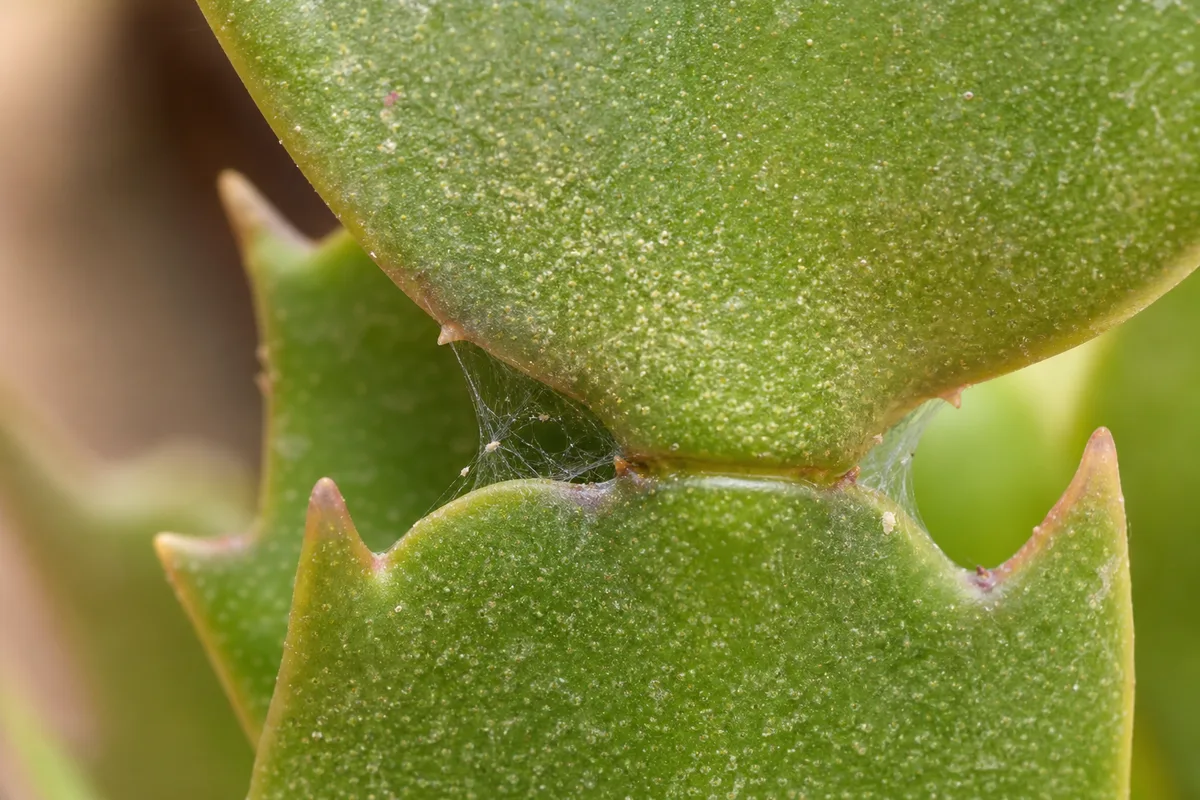
Fine yellow-white stippling on a flat phylloclade surface with delicate silk webbing in the narrow gap where two segments overlap.
- Fine yellow or white stippling on flat green phylloclades-each dot is a dead cell from piercing-sucking mouthparts
- Bronzing or dull gray-green segments as feeding spreads across overlapping cladodes in a hanging basket
- Delicate silk webbing at segment joints, crown folds, and along arching branch undersides-not the fluffy white wax of mealybugs
- Amber-colored eggs, whitish cast skins, and black fecal specks visible with a hand lens at joint gaps
- Crisp segment margins or segment drop only on heavy, untreated infestations in prolonged dry heat
Do not mistake normal plant features for pests. Christmas cactus (S. × buckleyi) has rounded, scalloped segment margins; Thanksgiving cactus (S. truncata) has pointed teeth-these are permanent morphology, not mite damage. Red or purple segment edges from direct sun look like uniform margin color, not random stippling. Hard-water crust wipes off dry; mite stippling is embedded in the tissue.
Where to look first: the narrow gap where one phylloclade overlaps the next, the crown center where multiple branches emerge, segment undersides on the lowest arching stems in a hanging basket, and any segment directly above a heating vent or radiator.
Why Christmas cactus gets spider mites
Spider mites are tiny arachnids, not insects-Clemson Extension lists red spider mites among routine pests on Thanksgiving and Christmas cacti, and NC State notes spider mites on holiday cacti. They rarely arrive because Schlumbergera is uniquely prone; they exploit warm, dry microclimates on a plant that wants more humidity than most desert succulents.
Several traits of Christmas cactus culture create mite hotspots in winter:
Epiphytic humidity needs vs. heated rooms. In Brazilian rainforests, Schlumbergera grows on tree branches in humid, shaded forest air. Indoors, a plant on a holiday display shelf above a radiator or beside a forced-air vent loses moisture from flat segment surfaces faster than roots can replace it-exactly the dry, warm conditions spider mites favor.
Segment joints trap dry air and webbing. Flat, overlapping phylloclades create sheltered feeding sites at each joint and at the crown center-similar hiding spots to mealybugs, but mites spin silk instead of wax. Pendulous hanging baskets make undersides hard to see from above, so colonies build at joint gaps before stippling shows on the window-facing side.
Pre-bloom rest reduces watering without reducing heat. From mid-September until buds set, many growers reduce watering while keeping the mix evenly moist for flowering. Less frequent watering does not add humidity; if heating runs daily, segment surfaces still dry while the plant channels energy into buds-stressed phylloclades at joints become easy mite targets.
Crowded holiday displays. Multiple plants on one shelf share dry air and make crawler spread easy when you water or move pots during bloom prep.
Mites on a well-humidified Christmas cactus in bright indirect light are manageable. The same outbreak on an underlit specimen beside a heating vent during bud formation can bronze segments and contribute to bud drop faster than on a forgiving pothos vine.
How to confirm the cause
Do not treat from one pale speck on a single segment. Use this inspection order:
- Isolate first - Move the plant away from other pots before handling so mites do not ride your hands, watering can, or sleeve to neighboring holiday cacti.
- Segment joints - With bright sidelight, inspect every gap where one flat phylloclade meets the next. Most Christmas cactus mites concentrate here before they spread to segment faces.
- Crown center and undersides - Lift or tilt hanging baskets and inspect from below. Follow each arching branch to the base and check both sides of overlapping segments.
- White-paper tap test - Hold white paper under a suspect segment and tap sharply. Mites fall onto the paper and crawl slowly-confirm with movement, not color alone.
- Webbing check - Fine silk at joints distinguishes mites from thrips (no webbing) and mealybugs (cottony wax, not silk threads).
- Neighbor check - Inspect holiday cacti and succulents that shared a windowsill, nursery shipment, or display shelf for stippling or webbing.
If segments feel firm and turgid, mix smells neutral, and the only issue is stippling with confirmed crawlers, spider mites fit. If segments are limp on wet soil with no mites on paper, rule out overwatering before aggressive spraying.
Lookalike symptoms to rule out
| What you see | Likely cause | Key difference |
|---|---|---|
| Fine stippling plus silk at segment joints | Spider mites | Moving specks on white paper; webbing without wax |
| Dry, thin segment edges without stippling | Low humidity | No crawlers on tap test; improves when humidity rises |
| Irregular silvery streaks on segments or buds | Thrips | Scraping damage; slender insects when disturbed; no fine joint webbing |
| White cottony tufts in joints with honeydew | Mealybugs | Fluffy wax; pink smear when crushed; no stipple pattern |
| Raised blisters on segment surfaces | Edema from overwatering | Bumpy texture; no mites on paper; often follows heavy watering |
| Red or purple margins on sun-exposed segments | Sun stress | Margin color uniform; no webbing; segment faces toward glass |
| Crusty white patches that wipe off dry | Mineral deposits from tap water | No stippling; no crawlers; no webbing |
First fix for Christmas cactus
Isolate the plant away from your collection first. Isolation stops crawlers from spreading to other pots on the same shelf or hanging hook before you rinse or spray.
Then rinse segment undersides and joints with lukewarm water-shower small plants in a sink or spray large ones in a bathtub, aiming at the gaps between phylloclades and the crown center where mites feed. A forceful water rinse knocks down mites on houseplants when you can reach the undersides. Work in the morning so flat segments and joint gaps dry before evening; Christmas cactus phylloclades are smooth, not fuzzy, but water pooling in the crown center during cool bloom-rest nights can stress buds and invite rot-tilt the pot to drain and never leave the plant sitting in a full saucer after rinsing.
Test one branch first and wait 24 hours before treating the whole plant. If stippling and webbing persist after the rinse, apply insecticidal soap or horticultural oil labeled for spider mites on houseplants, covering segment undersides and joints thoroughly. Read the product label-mites are arachnids, and many insecticides labeled for aphids or whiteflies do not control them.
Repeat schedule and when webbing stops
Most miticides do not kill mite eggs, so one rinse or spray rarely finishes the job. Repeat rinses or soap/oil treatments at five- to seven-day intervals-two to three cycles minimum-until you find no fresh webbing at segment joints for two consecutive weekly checks. UF/IFAS recommends seven-day intervals during winter when mite development slows in cooler rooms.
Wash your hands and any tools after working with infested plants so mites do not spread on clothing or watering cans.
Treating during bud formation
If flower buds are forming, prioritize gentle morning rinses over whole-plant oil sprays until you test one segment. Buds are sensitive to sudden environment shifts-heavy treatment plus dry air or draft stress can drop buds even after mites are gone. Spot-treat the worst joint webbing first; escalate to labeled soap or oil only if rinsing fails after two cycles and a patch test shows no segment burn.
If rinsing and soap are not enough
After three treatment cycles with continued webbing, consider a miticide labeled for indoor ornamentals following label directions exactly-apply in a well-ventilated area, away from direct sun on wet segments. Imidacloprid and many “general insect” products do not control spider mites and may worsen outbreaks by killing predatory mites. Trim and discard a heavily webbed branch tip with clean scissors if mites are buried in tissue you cannot reach-bag prunings before composting.
Step-by-step recovery
- Day 1: Isolate the plant. Photograph affected joints for comparison. Rinse segment undersides and joints with lukewarm water; let the plant drain fully.
- Day 2–3: Recheck crown center and segment undersides with a magnifier. Tap suspect segments onto white paper.
- Day 5–7: Repeat rinse or apply labeled soap/oil if webbing persists-first on a test segment if you have not sprayed yet.
- Week 2: Continue five- to seven-day treatments. Wipe dust from segment surfaces with a damp cloth so you can see new stippling clearly.
- Weeks 3–4: Keep weekly inspections even if webbing declines-eggs hatch in waves. Check plants within a few feet of the original host.
- Week 4+: Return to the collection only after two consecutive weekly checks find no crawlers on paper, no fresh webbing at joints, and clean new segment tips forming.
During recovery, hold fertilizer until new growth looks clean. Resume light feeding only after mites are gone for two weeks.
Recovery timeline
Light infestations often show stopped stippling spread within one to two weeks of consistent rinsing and repeat treatments. Check segment joints and crown folds weekly for at least a month because mite eggs hatch on staggered schedules.
Judge success by clean new segments from branch tips, no fresh webbing at joints, intact flower buds where bloom season matters, and no crawlers on the tap test-not by whether an old bronzed phylloclade returns to perfect green. Badly stippled segments may never fully recover; trim them once the plant is mite-free and producing healthy new growth.
Signs the problem is worsening include webbing spreading to multiple branches, segments crisping and dropping, buds aborting before open, and stippling appearing on plants within a few feet of the original host.
What not to do
Do not assume a pesticide labeled for insects will kill mites-mites need miticides, horticultural oils, or insecticidal soaps labeled for spider mites. Many insecticides are ineffective against mites and some worsen infestations.
Do not apply soap or oil in direct sun or when the room is hot-wet Christmas cactus segments on a bright windowsill scorch easily.
Do not leave the plant sitting in a full saucer after rinsing. Schlumbergera needs drainage between waterings; soggy mix at the crown invites root problems on top of pest stress.
Do not rinse at night and let water sit in segment joints until morning-on smooth phylloclades the risk is crown and joint moisture during cool heating-season nights, not fuzzy-leaf water spots. Morning rinses with full drainage are safer.
Do not return the plant to a shared shelf until two weekly checks find it clear. Do not compost heavily infested prunings indoors where crawlers can spread.
Christmas cactus care cross-check during treatment
While fighting spider mites, keep baseline care steady so the plant can push clean new segments:
- Humidity: Aim for roughly 50–60% relative humidity during heating season-a pebble tray or room humidifier helps more than misting alone. See low humidity on Christmas cactus if dry air is the underlying stress.
- Light: Bright indirect light-not direct sun on wet or soap-treated segments. See Christmas cactus light for placement.
- Water: During pre-bloom rest, keep mix evenly moist without waterlogging-dry segments from drought plus mite feeding compound stress. Watering guidance applies during recovery.
- Bloom season: If buds are forming, favor gentle rinses over aggressive sprays. Mite stress plus treatment timing can interact with bud drop-watch bud initials at segment tips closely.
How to prevent spider mites next winter
Quarantine every new Christmas cactus for at least two weeks before placing it near your collection. Inspect segment joints and the crown center under magnification during that period.
Fold mite checks into your normal watering routine from October through bloom. When you test whether the top 2–3 cm of mix is dry, scan segment undersides and joint gaps from below hanging baskets. Keep the pot off radiators and away from forced-air vents; grouping plants slightly raises local humidity, but avoid crowding so segments do not rub walls or neighboring pots.
Address low humidity before mites appear-dry segment edges without stippling today become mite-friendly tissue tomorrow when heating runs daily. A room humidifier set to roughly 50–60% relative humidity during heating season is more reliable than occasional misting on smooth phylloclades.
When to worry
Escalate immediately if webbing covers multiple arching branches, segments are crisping and dropping, buds abort en masse before bloom, or stippling appears on several plants in the same room. A few stippled joints with confirmed crawlers can wait for isolation and rinse cycles if caught early.
If dense webbing persists after three to four weeks of consistent five- to seven-day treatment, consider pruning the worst affected branch tips, discarding a severely compromised plant before the infestation spreads through a holiday cactus collection, or contacting your local extension office if reinfestation continues after labeled miticide use.
Conclusion
Spider mites on Christmas cactus are an isolate, confirm with the tap test, rinse joints, and repeat treatment problem-not a mystery disease. Look for stippling and silk at phylloclade segment joints and the crown center, especially from below a hanging basket in dry heated air during pre-bloom rest. Prevent recurrence with humidity in the 50–60% range during winter, weekly joint inspections, and early correction of low-humidity stress before mites move in. Compare crown symptoms with mealybugs when you see white patches-wax tufts and honeydew mean a different first fix.
When to use this page vs other Christmas Cactus guides
- Christmas Cactus watering guide - Use for routine moisture checks before assuming spider mites is the main issue.
- Christmas Cactus problems hub - Browse all 21 common issues on this species.
- Low Humidity on Christmas Cactus - Different entry point when symptoms overlap with spider mites.
- Slow Growth on Christmas Cactus - Different entry point when symptoms overlap with spider mites.