Aphids on Christmas Cactus: Causes, Checks & Fixes
Quick answer
Aphids on Christmas cactus cluster on new cladode segments and flower buds, often with sticky honeydew on flat green stems. First step: isolate the plant and rinse every segment with lukewarm water before any spray.
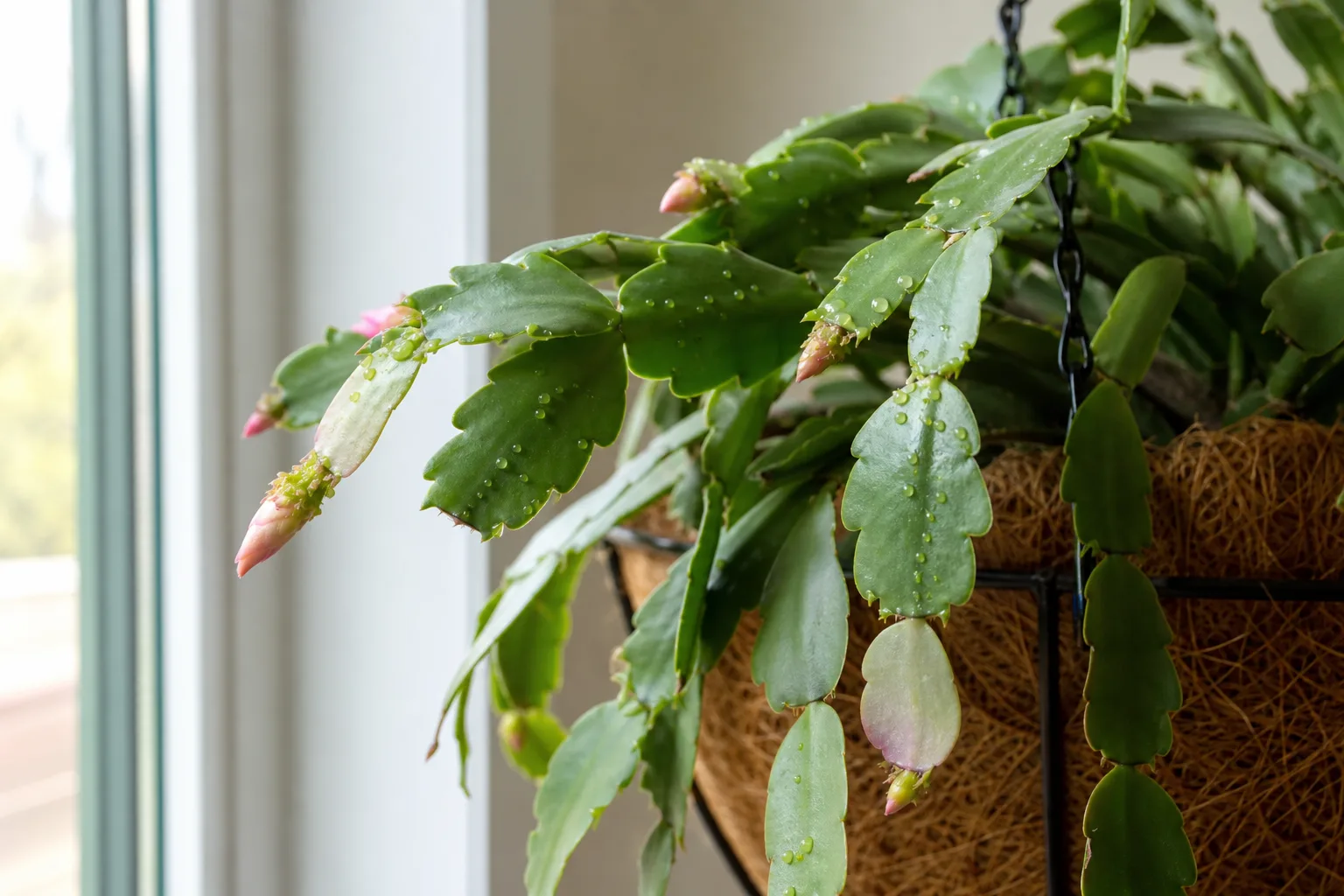
Aphids on Christmas Cactus: Causes, Checks & Fixes
This guide covers aphids on Christmas Cactus. See also the general Aphids guide, watering, and light pages for this plant.
Aphids on Christmas Cactus: Causes, Checks & Fixes
Quick answer
Aphids on Christmas cactus (Schlumbergera × buckleyi and related holiday cacti) are small sap-sucking insects that colonize tender new growth-the flat cladode segments at branch tips, fresh joints where segments overlap, and flower buds forming in late autumn. On this pendulous epiphyte, one distorted segment or dropped bud can ruin the season’s display because mature cladodes do not fully repair feeding damage.
First step: isolate the plant the same day you spot insects or sticky residue. Move it away from other holiday cacti, succulents, and shared shelves before you rinse or spray. Then rinse every flat segment with lukewarm water in a sink or shower, spraying from multiple angles through arching stems. Confirm live insects before reaching for soap or oil-wet Christmas cactus segments in direct sun scorch easily, and old segment damage does not heal.
Christmas cactus grows as flattened, segmented cladodes on a pendulous epiphyte that prefers bright indirect light and moderate humidity. Judge recovery by clean new segments from branch tips, not by expecting twisted older cladodes to look perfect again. Full species context: Christmas cactus overview.
What aphids look like on Christmas cactus
Early infestations hide at segment tips and joints, so check these patterns together-not just the outer segments facing the window:
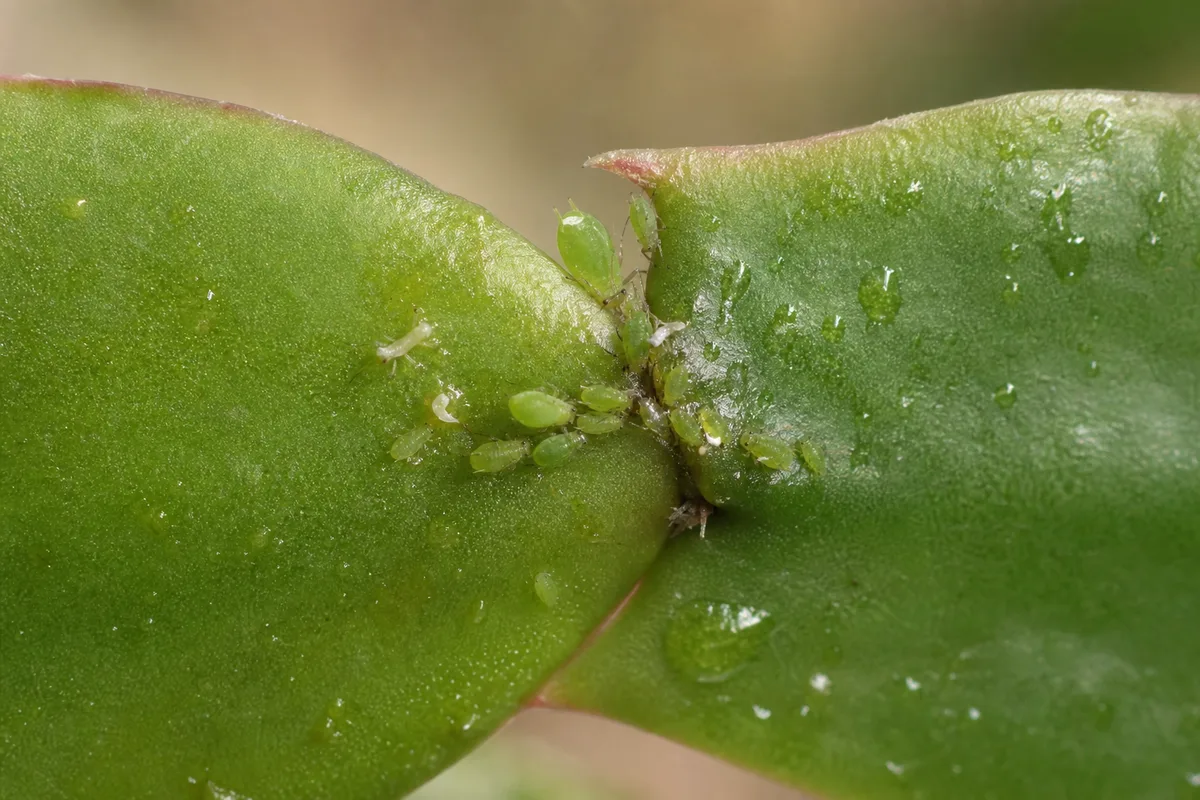
Soft pear-shaped aphids clustered in a segment joint with shiny honeydew on flat green cladodes - inspect tender tips and buds from below hanging baskets.
- Soft, pear-shaped insects roughly 1/16 to 1/8 inch long-green, black, brown, pink, or yellow-clustered on tender new growth at branch tips, segment joints, and developing flower buds
- Shiny, sticky honeydew on flat green cladode surfaces-droplets stand out against smooth segments and may drip onto lower branches or the pot rim
- Fine black sooty mold speckles that wipe off but return if aphids remain; sooty mold can follow honeydew
- White flecks at joints or on segment faces-often shed aphid exoskeletons from molting, not hard-water crust or perlite splash
- Twisted or pale new segments and deformed bud initials when feeding is heavy; holiday cacti already drop unopened buds when conditions shift suddenly, and aphid pressure during bloom adds another trigger
Do not mistake permanent plant features for pests. Christmas cactus (S. × buckleyi) has rounded, scalloped segment margins; Thanksgiving cactus (S. truncata) has pointed teeth at each margin-these are fixed morphology, not moving insects. Compare crown symptoms with mealybugs when you see white patches: fluffy wax tufts mean a different first fix.
Where to look first: the newest segments at the end of each arching branch, the narrow gap where one flat cladode meets the next, any flower buds or bud initials at segment tips in autumn, and segment undersides on the lowest arching stems in a hanging basket you cannot see from above.
Why Christmas cactus gets aphids
Aphids usually arrive on a new nursery purchase, an open window near outdoor garden plants, or a neighboring infested pot on a crowded holiday display shelf. They are generalists indoors and will feed on Schlumbergera even though they prefer soft, nitrogen-rich new shoots on almost any houseplant. Clemson Extension lists aphids among the common pests on Thanksgiving and Christmas cacti, and NC State notes aphids as a routine insect problem on holiday cacti.
Several traits of Christmas cactus culture make aphid problems easy to miss. Flat, overlapping cladode segments in a cascading habit give aphids sheltered feeding sites at joints and on undersides you rarely inspect from above a hanging hook. Moderate humidity-Christmas cactus prefers roughly 50–60%-does not prevent aphids, but sticky honeydew on flat green segments becomes very visible once colonies build.
Slow inspection during pre-flowering dormancy means you may not notice insects until buds form and aphids move onto the most valuable tissue. Over-fertilized plants with soft, fast segment growth in spring and summer are especially attractive; high nitrogen promotes succulent new growth aphids prefer. See Christmas cactus fertilizer for half-strength timing that supports steady growth without soft shoots. Crowded hanging baskets and shelves also spread pests when crawlers and winged adults move pot to pot during casual watering.
How to confirm the cause
Work in good light with a magnifying glass. Check in this order:
- Isolate first - Move the plant away from other pots before handling so aphids do not ride your hands or watering can to neighboring holiday cacti.
- Newest segments at the end of each arching branch.
- Segment joints - Aphids often hide in the narrow gap where one flat cladode meets the next; lift or tilt hanging baskets and inspect from below.
- Flower buds or bud initials forming at segment tips in autumn.
- Neighboring plants - Holiday cacti, succulents, and anything on the same shelf or windowsill.
Crush test: Crush one insect with a dry swab. Aphids leave a green or pink smear; perlite, dust, or dried water spots do not.
Tap test: Hold white paper under a suspect segment and tap sharply. Live aphids move slowly; thrips jump quickly. Shed skins stay put.
If you see sticky segments but no insects, check for ants farming aphids on nearby plants before assuming the Christmas cactus is clear.
Symptom lookalike comparison
| What you see | Likely cause | Key check | First action |
|---|---|---|---|
| Soft pear-shaped insects on new tips and buds | Aphids | Crush test smears green/pink; insects move slowly on paper | Isolate and rinse all segments |
| White cottony wax in joints and crown | Mealybugs | Wax tufts, not exposed soft bodies; alcohol dissolves wax | Alcohol dab on wax only |
| Immobile brown bumps on older stems | Scale | Does not move; not clustered on tender tips | Scrape or labeled horticultural oil on crawlers |
| Fine stippling and silk at joints | Spider mites | White-paper tap shows crawling specks; dry air context | Tap test before rinsing |
| White flecks, no live insects | Shed aphid skins or hard water | Flecks do not move; wipe tests distinguish crust | Rinse; recheck for live aphids in 3 days |
| Limp segments on wet soil, no insects | Overwatering or draft stress | Soil moisture and root firmness | Fix water before assuming pests |
First fix for Christmas cactus
Isolate the plant away from your collection first. Isolation stops winged aphids and crawlers from spreading to other pots on the same shelf or hanging hook.
Then rinse the plant thoroughly with lukewarm water in a sink or shower. Support the pot, tilt it so water runs through every arching branch, and spray segment tops, bottoms, and joints where aphids feed. Repeat the rinse every three to four days until two consecutive checks find no live insects. Aphids reproduce quickly indoors; one wash rarely clears an established colony.
Rinsing hanging baskets without crown waterlogging
Hanging Christmas cactus needs the same thorough rinse as a bench pot-but pouring water straight into the crown center can leave epiphytic mix soggy at the base while outer segments dry.
- Wrap the pot in a plastic bag secured at the rim so mix stays in place.
- Lower the basket into a sink or shower; spray lukewarm water through arching branches from the sides and below, not only from above into the crown.
- Tilt the pot so water exits drainage holes; empty the saucer before rehanging.
- Air-dry in bright indirect light-not direct sun, which can scorch wet stems.
- Morning rinses are safer than evening so water does not sit in segment joints overnight during cool heating-season nights.
If rinsing is not enough
For colonies that remain after a week of rinsing, use a product labeled for houseplants-typically insecticidal soap or neem oil-and test one segment first. Wait 48 hours before treating the whole plant. Clemson HGIC recommends insecticidal soap or horticultural oil as the first spray choice for aphids, applied in cooler evening hours when temperatures are not high.
Coverage on Schlumbergera: Spray segment undersides and joint gaps, not just the window-facing face. Pendulous growth hides colonies on the lowest arching branches-lift stems gently and coat both sides of overlapping cladodes. Insecticidal soaps kill soft-bodied aphids by suffocation and can also wash honeydew and sooty mold from segment surfaces.
Flower buds: Labeled soap or neem is generally acceptable on forming buds when you test first and apply in evening away from direct sun-but heavy coating on open flowers is unnecessary. Prefer targeted alcohol dabs on tight joint clusters near precious buds rather than soaking the whole inflorescence. Never use homemade dish soap, which can burn foliage. Avoid soap or oil when temperatures exceed 90°F or on drought-stressed plants.
Dab individual aphids in tight joint clusters with a cotton swab dipped in 70% isopropyl alcohol when a spray would soak too much tissue at once-touch the insect, do not pool liquid on tender bud tissue. Remove a heavily infested flower bud or segment tip with clean scissors if insects are buried in tissue you cannot reach.
Chronic infestations: when contact sprays fail
If dense colonies persist after three weeks of consistent rinsing and labeled soap or neem at seven- to ten-day intervals, consider escalation carefully:
- Pyrethrin products labeled for houseplants can knock down large aphid populations; Clemson HGIC notes pyrethrin as a step up from soaps and oils. Read the label for indoor ornamentals and repeat only while live aphids remain.
- Systemic insecticides (imidacloprid, dinotefuran) are sometimes used on ornamentals, but root drenches take several days to distribute through the plant and must be labeled for the specific crop. On epiphytic Schlumbergera in shallow, airy mix, drenches carry extra risk of root stress-prefer contact treatments first and consult your local extension office before applying systemics to a blooming holiday cactus collection.
Recovery timeline
Light infestations often clear within one to two weeks of consistent rinsing or combined rinsing and spot treatment. Check segment tips and bud initials weekly for at least a month because nymphs hatch on staggered schedules.
Judge success by clean new segments from branch tips, no fresh honeydew on flat stems, intact flower buds where bloom season matters, and no live insects-not by whether an old twisted segment returns to perfect form. Badly distorted or yellowed cladodes may never fully recover; trim them once the plant is insect-free and producing healthy new growth.
Signs the problem is worsening include sooty mold spreading across multiple segments, ants visiting the pot, stunted new segments, dropped buds before bloom, and aphids appearing on plants within a few feet of the original host. Bud loss during bloom may be irreversible for that season even after pests are gone-see bud drop if buds vanish after treatment while segments stay firm.
What not to do
Do not apply insecticidal soap or oil in direct sun or when the room is hot-wet Christmas cactus segments on a bright windowsill scorch easily, and heat plus soap increases phytotoxicity risk.
Do not fertilize while the plant is under pest stress. Soft new segment growth from extra nitrogen gives aphids more food exactly when you want the plant to recover slowly and preserve bloom energy.
Do not leave the plant sitting in a full saucer after rinsing. Christmas cactus needs drainage between waterings; soggy mix at the crown invites root problems on top of pest stress. Watering guidance still applies during recovery-keep mix evenly moist without waterlogging.
Do not return the plant to a shared shelf until you have checked it clear for two full weeks. Do not assume one rinse finished the job-indoor aphid populations rarely collapse without repeated treatment.
Christmas cactus care cross-check during treatment
While fighting aphids, keep baseline care steady so the plant can push clean new segments:
- Light: Bright indirect light-not direct sun on wet or soap-treated cladodes. See Christmas cactus light for placement.
- Humidity: Roughly 50–60% relative humidity is adequate; aphids are not humidity-driven like spider mites, but steady conditions support recovery.
- Water: During pre-bloom rest, keep mix evenly moist without crown saturation after rinses. See watering guide.
- Fertilizer: Hold until insects are gone; resume half-strength feeding only during active growth per fertilizer guide.
How to prevent aphids next time
Quarantine every new Christmas cactus for at least two weeks before placing it near your collection. Inspect segment tips and joints under magnification during that period-firm new cladodes, no sticky residue, no collapsed stems at the base.
Fold pest checks into your normal watering routine. When you test whether the top 2–3 cm of mix is dry, scan branch tips and any forming buds from below hanging baskets. Give pendulous plants enough space so segments do not rub walls or neighboring pots.
Feed lightly during active growth only-every two to four weeks at half strength in spring and summer, then hold back during pre-flowering dormancy. Steady, moderate growth is less attractive than over-fertilized soft shoots. When buying, examine branch ends closely; clean outer segments can hide an infested tip inside a dense hanging basket.
When to worry
Escalate immediately if aphids cover flower buds before bloom, honeydew coats multiple segments, sooty mold is spreading, ants are climbing the pot, or aphids appear on several plants in the same room. A few insects on one new segment can wait for isolation and rinsing if caught early.
If dense colonies persist after three weeks of consistent treatment, or if new segments stop forming entirely, consider pruning the worst affected branch tips, discarding a severely compromised plant before the infestation spreads through a holiday cactus collection, or contacting your local extension office for help with collection-wide outbreaks or chronic reinfestation after labeled products.
Conclusion
Aphids on Christmas cactus are an isolate, rinse every cladode joint, and repeat until clear problem-not a mystery disease. The bloom window is the stake: check flower buds and segment tips before spraying oil on wet stems in afternoon sun. Compare sticky segments with mealybugs and spider mites when white patches or stippling appear-wax tufts and silk mean different first fixes. Full care baseline: Christmas cactus overview.
When to use this page vs other Christmas Cactus guides
- Christmas Cactus watering guide - Use for routine moisture checks before assuming aphids is the main issue.
- Christmas Cactus problems hub - Browse all 21 common issues on this species.
- Mealybugs on Christmas Cactus - Different entry point when symptoms overlap with aphids.
- Spider Mites on Christmas Cactus - Different entry point when symptoms overlap with aphids.
- Yellow Leaves on Christmas Cactus - Different entry point when symptoms overlap with aphids.