Low Humidity on Boston Fern: Causes, Checks & Fixes
Quick answer
Boston fern needs 50–70% relative humidity; below ~40% for extended periods, fine pinnae crisp and spider mites surge. First step: measure RH at foliage height with a hygrometer, then move the plant away from heating vents and run a humidifier-not more water.
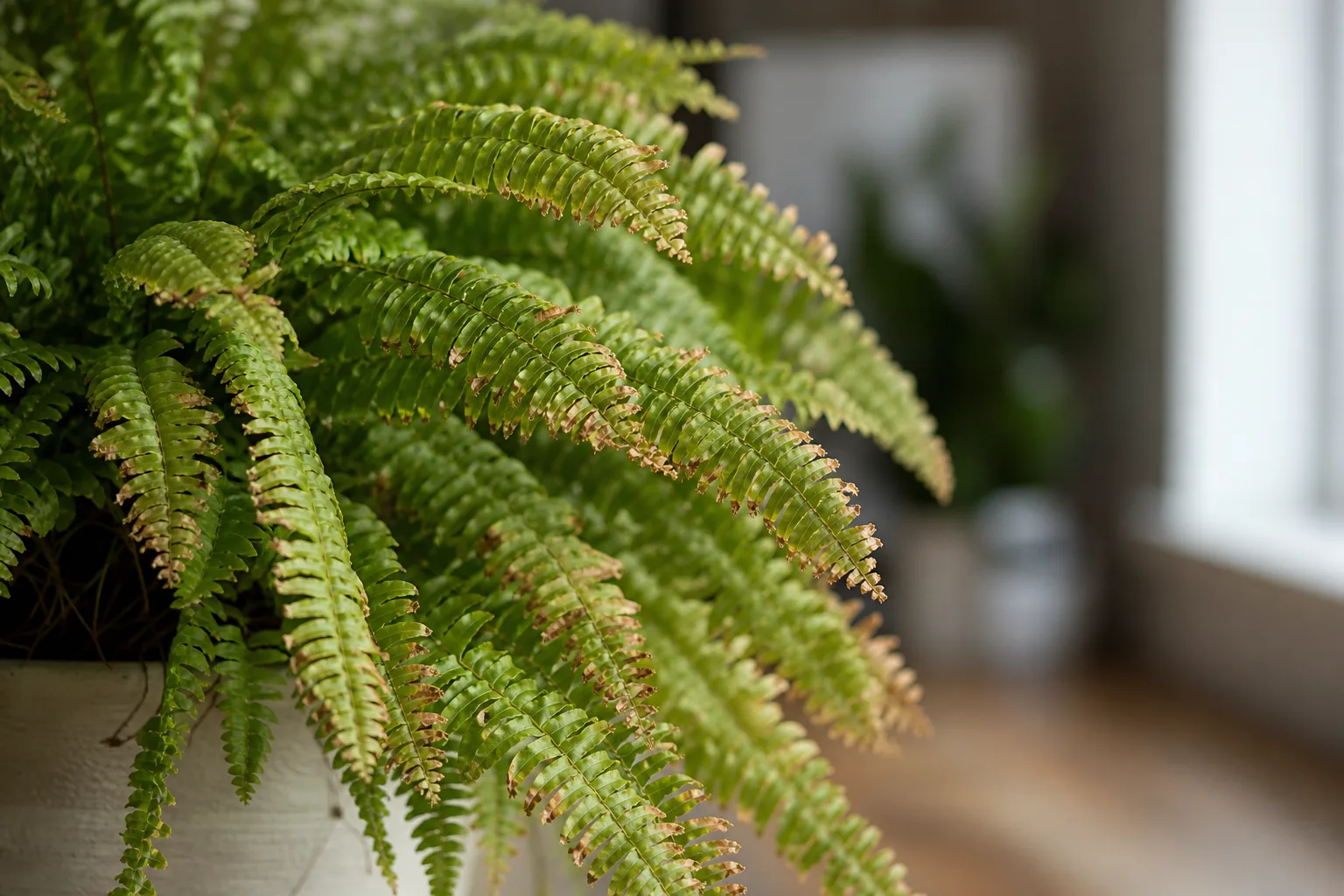
Low Humidity on Boston Fern: Causes, Checks & Fixes
This guide covers low humidity on Boston Fern. See also the general Low Humidity guide, watering, and light pages for this plant.
Low Humidity on Boston Fern: Causes, Checks & Fixes
Quick answer
Low humidity on Boston fern (Nephrolepis exaltata) means the air around the fronds is too dry for this tropical forest understory plant. Fine, divided pinnae lose water faster than thick-leaved houseplants, so heated winter rooms, forced-air vents, and air-conditioning blowers show up as crispy pinnae tips, afternoon frond limpness on otherwise moist soil, and spider mite outbreaks-not as a mystery watering failure.
Target 50–70% relative humidity at foliage height. Act when a hygrometer reads below ~40% for more than a few days. NC State Extension lists high humidity among Boston fern’s core indoor needs, and Wisconsin Extension notes that tips and edges of pinnae turn brown in dry interiors-especially when furnaces run.
First step: measure RH at frond height, then move the plant away from heating vents and HVAC drafts before you add water. Dry air and underwatering overlap on Boston fern, but soaking a pot to fix crisp tips while air stays at 28% invites root problems without solving transpiration loss. See our watering guide for moisture rhythm after humidity is addressed.
What low humidity looks like on Boston Fern
Dry-air stress on Boston fern is a frond-surface problem first. Roots can be adequately moist while pinnae still crisp because transpiration outpaces uptake in very dry air.
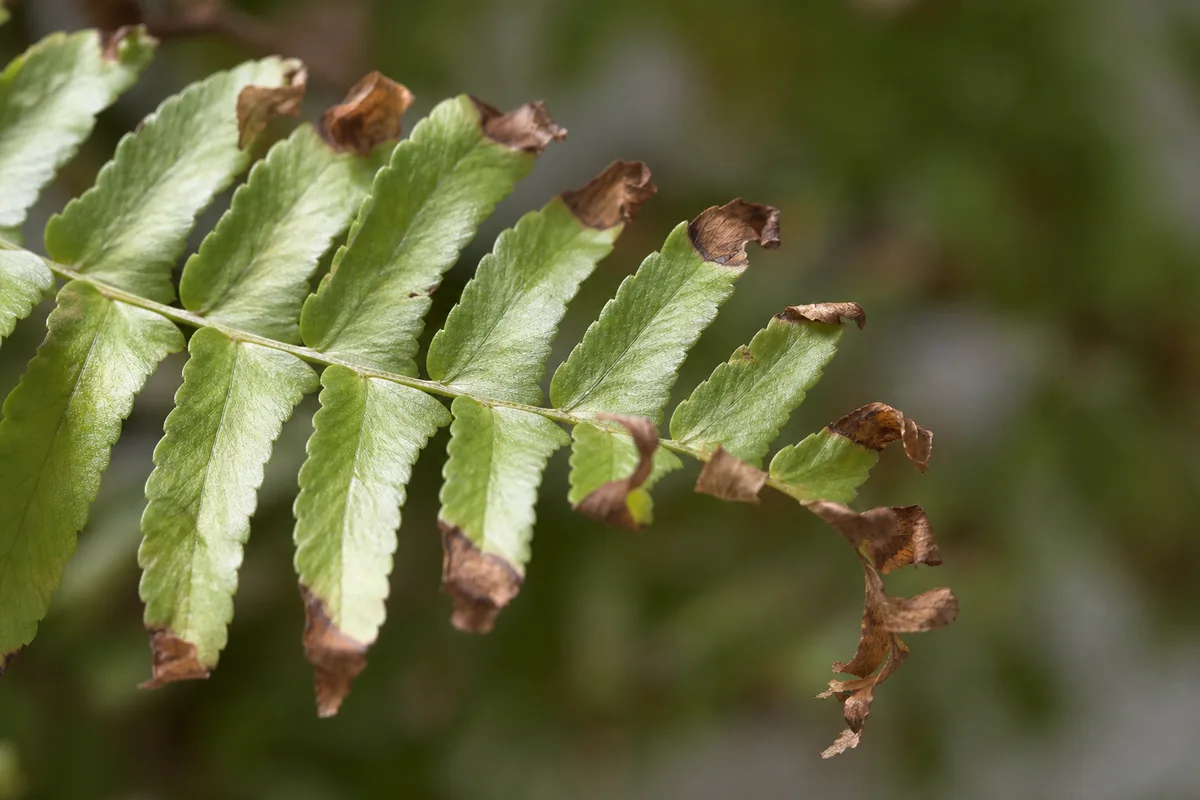
Low Humidity symptoms on Boston Fern - compare with healthy tissue on the same plant.
Crispy brown pinnae tips and margins, often starting on the outer arching fronds closest to a heat vent, sunny window glass, or AC diffuser. Damage is usually tan to brown and papery, not the dark wet rot of crown failure.
Afternoon frond limpness with moist soil-fronds hang limp midday, may perk overnight, while a finger probe shows damp mix at depth. That pattern fits dry-air wilt more than drought; see wilting on Boston fern for the full water-pathway checklist.
Slow or aborted crozier unfurling-new fiddleheads stall, emerge small, or unfurl with brown edges when RH stays low for weeks.
Increased dust and dull frond color in heated rooms, sometimes followed by fine yellow stippling and webbing from spider mites that thrive when air around the plant is too dry.
Whole-frond browning from the tips inward on fronds directly above a radiator or in the path of a car heater vent after transport-localized environmental burn, not disease.
Unlike brown tips from fluoride or salt, pure low-humidity damage often appears room-wide on multiple fronds after heating season starts, with a hygrometer confirming dry air-not isolated tip burn that persists after humidity is already adequate.
Why Boston fern struggles in dry indoor air
Boston fern evolved under tropical and subtropical forest canopies across the Americas, where humidity stays high and direct sun is filtered. NC State Extension describes the species as native to humid forests and adapted to moist soil that should never be allowed to dry out plus high ambient humidity indoors.
Fine frond structure loses water fast
Each arching frond carries hundreds of tiny linear pinnae with a large combined surface area. That lacy structure maximizes gas exchange in humid shade-and maximizes water loss in dry air. A succulent in the same 30% RH room may look fine while a Boston fern crisps within days.
Winter heating and forced-air drafts
Central heating can pull indoor RH into the low twenties or thirties-far below what Clemson HGIC notes fine, thin-leafed ferns need. Furnace cycles create repeated desiccation bursts. Forced-air vents, space heaters, and frequently opened exterior doors in winter amplify local dryness around hanging baskets.
Air conditioning and summer dryness
Cool, dry AC airflow desiccates fronds in summer as effectively as winter heat. A fern beside a return vent or under a ceiling diffuser may crisp while a hygrometer across the room reads acceptable.
Cultivar sensitivity
Most indoor Boston ferns are ‘Bostoniensis’ or fine-cut sports like ‘Fluffy Ruffles’ and ‘Whitmanii’. Wisconsin Extension lists ‘Dallas’ / ‘Dallas Jewel’ and ‘Whitmanii’ as more tolerant of lower humidity, while densely divided cultivars show stress sooner. Finer pinnae need RH toward 60–70% for pristine edges.
Why grouping alone often fails
Clustering plants raises local humidity only a few percentage points through shared transpiration. In a heated room at 25% RH, grouping helps marginally but rarely reaches the 50%+ Boston fern needs without a humidifier or dedicated humid microclimate.
How to confirm low humidity is the problem
Run this numbered confirmation workflow before changing care:
- Measure RH at foliage height - Place a hygrometer beside the fronds for 24 hours. Readings below 40% with crisping tips strongly support dry-air stress. Fairfax County Master Gardeners note that 30% is about as low as a fern can tolerate, with 40–50% more desirable for Boston fern.
- Probe soil moisture at depth - Stick your finger 2–3 cm into the mix. Moist soil + crispy tips points to air humidity, not thirst. Dry soil throughout may be underwatering alone or combined with dry air-fix both, but check roots before soaking repeatedly.
- Map the microclimate - Note distance to heating vents, radiators, AC blowers, south-facing glass, and exterior doors. Damage concentrated on the vent-facing side of a hanging basket is a strong dry-air signal.
- Read the pinnae pattern - Even brown tips across arching fronds after heat season starts → humidity. Yellow stippling with webbing on undersides → spider mites even if air is dry. Tip burn on old fronds only with good RH now → may be fluoride or salt, not current humidity.
- Check time-of-day limpness - Afternoon droop on moist soil that recovers overnight fits transpiration loss in dry air; see wilting guide to separate from root failure.
- Rule out overcompensation - If you increased watering to fix crisp leaves and the mix stays wet while fronds keep browning, stop watering and address air moisture first-wet soil with dry air is a common Boston fern trap.
Confirmed diagnosis: hygrometer below 40% near fronds, symptom pattern matches dry air, and soil moisture is not bone-dry throughout. Proceed with humidity fixes before stacking Boston Fern repotting guide, fertilizer, or pesticides.
First fix for Boston Fern
Move the plant out of the driest microclimate, then raise ambient humidity-one change at a time.
Step 1: Relocate away from vents and radiators
Shift the hanging basket or pot at least 1–2 metres (3–6 feet) from forced-air heating vents, radiators, space heaters, and AC diffusers. Keep fronds from touching cold window glass in winter and hot afternoon glass in summer. Clemson HGIC warns that humidity in houses is very low during winter and fine ferns need extra attention.
This single move often stops active tip burn within days if RH in the new spot is meaningfully higher.
Step 2: Run a humidifier (primary fix for heated homes)
Place a small cool-mist or ultrasonic humidifier near the plant-not pointed directly at fronds so leaves are not continuously soaked. Target 50–70% RH at foliage height. Fairfax County Master Gardeners recommend a room humidifier to obtain 30–50% within the room, with higher local levels near grouped plants; for Boston fern, aim for the upper half of that range.
Run it consistently through heating season, not only when tips are already crisp.
Step 3: Add secondary buffers (if RH is still low)
- Pebble tray - Pot elevated above a water-filled tray so the base never sits in standing water; Fairfax County Master Gardeners advise keeping at least 5 mm of water in the tray while the pot bottom stays dry.
- Double potting - Set the grow pot inside a larger container lined with moist sphagnum moss, as Wisconsin Extension recommends for retaining moisture and humidity around the plant.
- Grouping with other humidity-loving plants - helpful as a supplement, not a standalone fix in arid rooms.
- Bright bathroom or kitchen - only if the window still delivers adequate indirect light per our light guide.
Wait seven days after the humidifier and relocation before adding misting routines, repotting, or fertilizer.
Recovery timeline
Crisp brown pinnae will not turn green again. Judge success by new croziers unfurling without tip burn and by fronds holding their arch through the afternoon on moist soil.
Mild tip burn after a dry week - With RH stabilized above 50%, new growth often looks clean within 7–14 days. Old damaged pinnae can be trimmed cosmetically once stability returns.
Moderate winter desiccation - Expect two to four weeks of consistent humidifier use before the plant resumes steady fiddlehead production, especially if multiple fronds browned during a heating spike.
Afternoon limpness on moist soil - Often eases within 48–72 hours after relocation and humidity correction, without extra watering.
Spider mite damage - Raising humidity helps prevention but does not clear an active infestation. Allow two to three weeks combined environmental correction and mite treatment before expecting clean replacement foliage.
If the crown softens, fronds collapse despite corrected RH and appropriate watering, or the mix smells sour-inspect roots for rot instead of adding more humidity.
Lookalike symptoms
| Pattern | Likely cause | Key differentiator |
|---|---|---|
| Crispy pinnae tips, moist soil, near heat vent | Low humidity | RH below 40% at frond height; no stippling |
| Gray-dull fronds, light pot, dry soil 3 cm down | Underwatering | Probe dry throughout; see underwatering |
| Afternoon limp, moist soil, perks overnight | Dry-air transpiration loss | Timing; RH low; wilting checklist |
| Yellow stipples + fine webbing on undersides | Spider mites | Tap test; mites thrive in dry air-spider mites |
| Tip burn persists after 50%+ RH for weeks | Fluoride, salt, or fertilizer burn | See brown tips; flush pot |
| Yellowing lower fronds, wet heavy soil, sour smell | overwatering on Boston Fern / root stress | Not fixed by humidifier; see root rot |
Low humidity and underwatering overlap often on Boston fern-confirm soil moisture, then fix air RH before soaking.
Mistakes to avoid
- Watering more to fix crisp tips while air stays below 35% RH-roots sit wet while fronds still desiccate; rot risk rises without solving transpiration loss.
- Relying on daily misting alone in a heated room-surface moisture evaporates in minutes; Clemson HGIC allows light misting only as a minor supplement for fine ferns.
- Placing the pot directly in a pebble tray’s standing water-Fairfax County Master Gardeners warn that sitting in water causes fungal disease and root rot; elevate the pot base.
- Pointing a humidifier jet at the crown so fronds stay wet 24/7-encourages foliar spotting; raise ambient RH instead.
- Ignoring spider mites when stippling appears-dry air is a contributing stress; active mites need rinsing or labeled treatment per our spider mite guide.
- Fertilizing a stressed fern before humidity stabilizes-Wisconsin Extension notes over-fertilizing browns and dries frond ends; fix environment first.
How to prevent dry-air stress long term
Monitor RH through heating season. A $10 hygrometer at foliage height beats guessing. Act when nightly readings dip below 40%, not after half the basket has crisped.
Keep the stable microclimate from our overview guide-50–70% RH, 60–75°F (16–24°C), away from vents and cold glass. Boston fern is less forgiving of dry air than pothos or snake plant; plan a humidifier before you buy the fern if your winter room runs below 35%.
Align watering with air dryness-dry air increases transpiration, so check the top inch of mix every few days per watering guidance, but do not keep soil soggy to compensate for crisp leaves.
Inspect weekly in winter for early stippling on pinnae undersides when furnaces run-catch spider mites before webbing coats new croziers.
Choose cultivar to match your room-if you cannot humidify, a more tolerant cultivar like ‘Dallas Jewel’ fares better than fine-cut ‘Fluffy Ruffles’ in dry apartments.
When to worry
Escalate promptly if:
- Webbing and stippling spread on new growth in warm dry air-mite outbreak needing treatment, not humidity alone.
- Crown feels soft or fronds collapse despite moist soil and corrected RH-inspect for root rot or overwatering compensation.
- Entire fronds brown rapidly from the base after sitting above a radiator-heat damage may require removing dead fronds and relocating; recovery depends on crown health.
- No new croziers for six weeks after humidity fixes-audit light per light guide and root health before assuming humidity is still the only issue.
Conclusion
Low humidity on Boston fern is one of the most common indoor failures because this species is built for humid forest understory, not furnace-dried living rooms. Confirm with a hygrometer at frond height, probe soil to separate dry air from drought, and apply one first fix: relocate off vents and run a humidifier targeting 50–70% RH.
Crisp old pinnae will not re-green-watch new croziers for proof. Link overlapping symptoms to brown tips, wilting, and spider mites, and keep soil evenly moist without waterlogging per the overview and watering guides. In most heated homes, a humidifier is not optional equipment-it is core Boston fern care.
When to use this page vs other Boston Fern guides
- Boston Fern watering guide - Use for routine moisture checks before assuming low humidity is the main issue.
- Boston Fern problems hub - Browse all 16 common issues on this species.
- Brown Tips on Boston Fern - Different entry point when symptoms overlap with low humidity.