Leggy Growth on Basil: Causes, Checks & Fixes
Quick answer
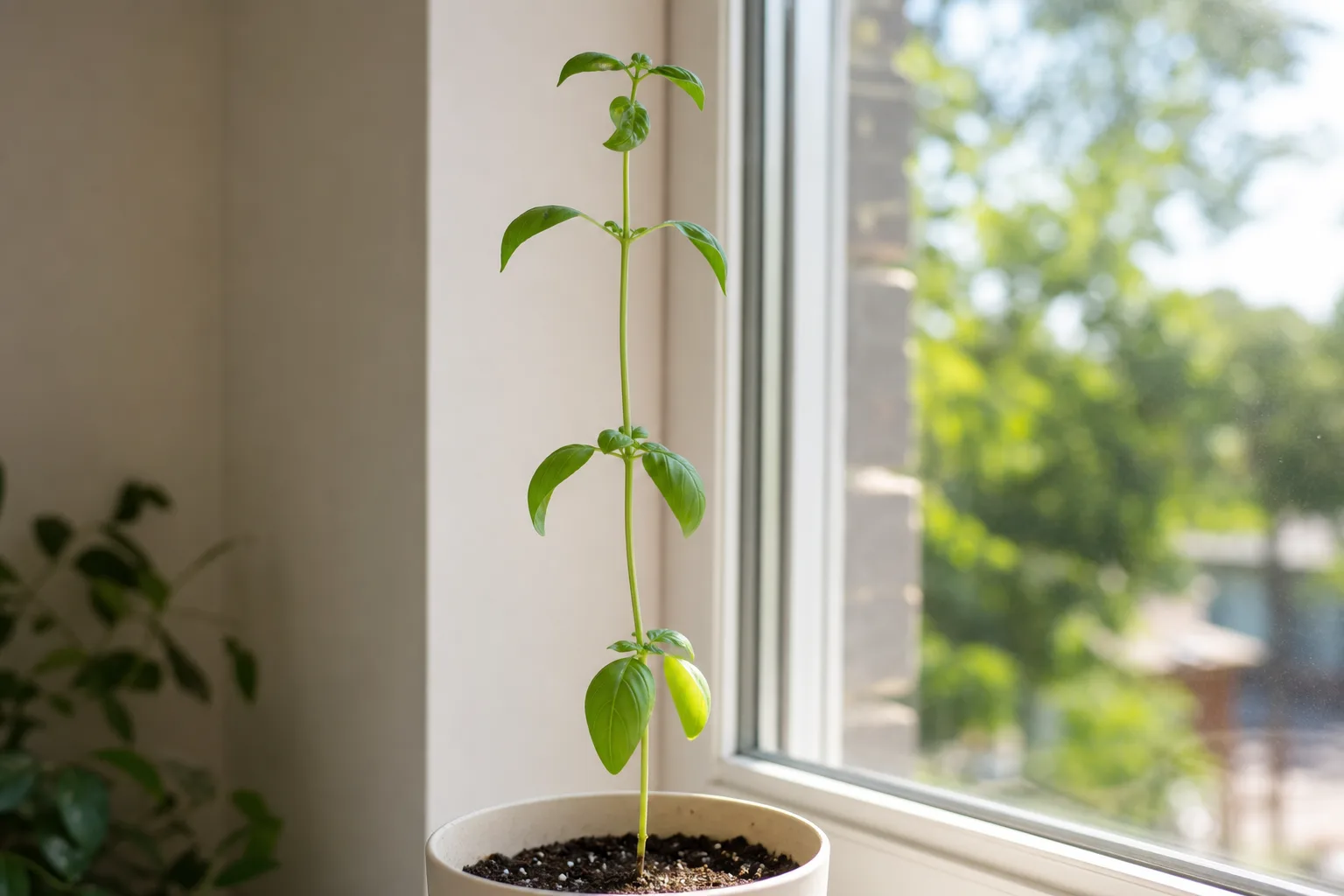
Leggy basil grows as one or two upright stems with long bare gaps between leaf pairs and harvestable foliage clustered at the tips-usually from skipped pinching, leaf-only picking, or grocery-store single-stem format, sometimes worsened by flower spikes. First step: cut or pinch every growing tip one-quarter inch above a leaf node, then reassess light if new side shoots stay thin or pale.
Leggy Growth on Basil: Causes, Checks & Fixes
This guide covers leggy growth on Basil. See also the general Leggy Growth guide, watering, and light pages for this plant.
Leggy Growth on Basil: Causes, Checks & Fixes
Quick answer
Leggy basil is usually a harvesting and shape problem before it is a mystery disease. Sweet basil (Ocimum basilicum) naturally pushes one strong stem tip under apical dominance unless you cut above a leaf node. Skip that step and you get a kitchen candlestick-long bare internodes below, aromatic leaves only at the top.
First step: pinch or cut every active growing tip one-quarter inch above a leaf node with clean fingers or scissors. That removes the terminal bud and wakes side buds in the leaf axils below. If side shoots emerge pale, thin, or far apart within two weeks, light is still limiting-see our not enough light on basil guide before you pinch again.
This page covers maintenance legginess-neglected pinching, leaf-only harvests, grocery-store pot format, and post-harvest single-stem regrowth even when light is borderline-adequate. If your main symptoms are pale small leaves, strong window lean, and a dim-room placement, start with the not-enough-light guide instead; pinching in deep shade cannot produce bushy flavor-rich growth.
What leggy growth looks like on Basil
Leggy basil is easy to spot once you know you are looking at form and harvest habit, not a single damaged leaf.
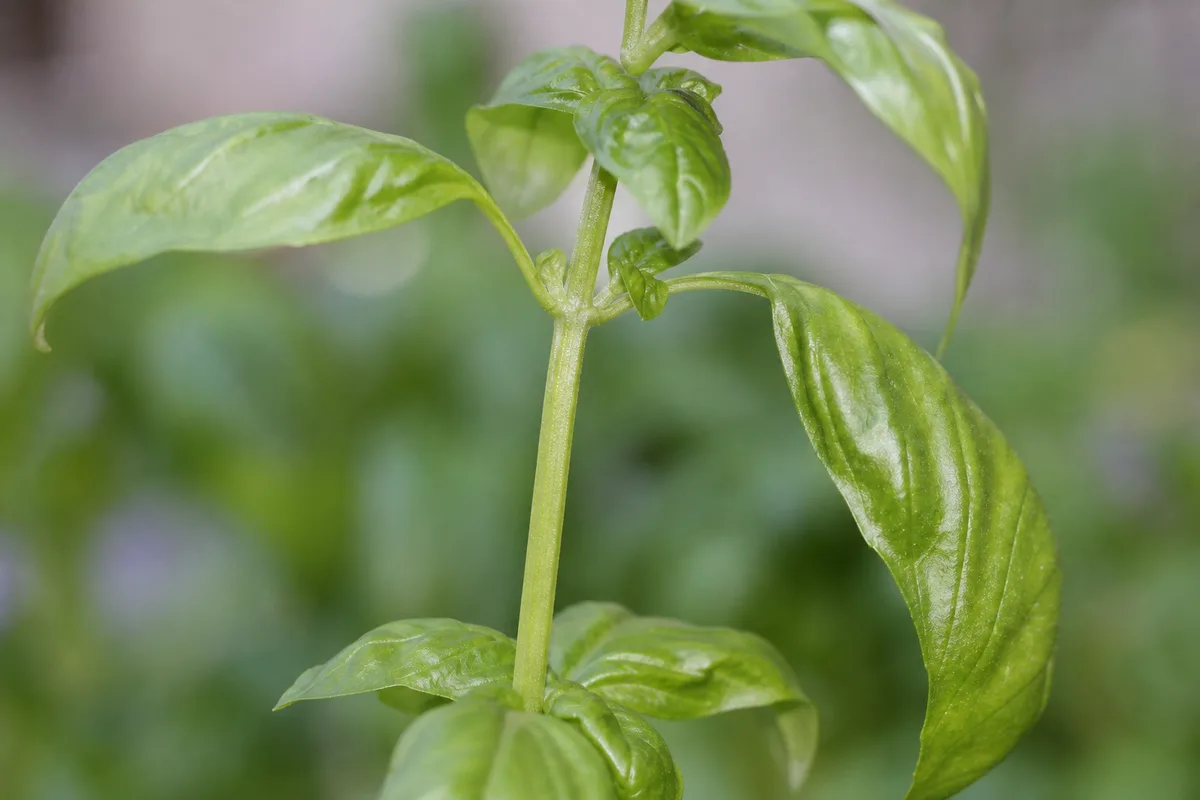
Leggy Growth symptoms on Basil - compare with healthy tissue on the same plant.
Typical leggy-growth signs:
- One or two dominant upright stems with little branching on the lower two-thirds
- Long bare internodes-gaps of 3–8 cm or more between opposite leaf pairs on new growth
- Leaves concentrated at tips while lower stems stay green and leafless
- Single candlestick silhouette after you harvest only the top cluster and leave the terminal bud growing
- Grocery-store pot shape-several crowded seedlings in a tiny container, each stretching upward for light
- Flower spikes at stem ends if buds were left on-energy leaves the leafy canopy
- Seedling trays with thin pale stems leaning toward glass when starts were never tipped early
Compare with not enough light on basil: low light usually adds pale dull new leaves, strong lean toward the brightest window, and smaller blades across the whole plant. Leggy growth from skipped pinching can happen on a south-facing sill where you simply never cut stem tips after harvest.
Leggy form is also different from slow growth on basil: a stalled plant produces almost no new tissue. A leggy basil may grow vigorously upward while refusing to branch.
Why Basil gets leggy
Skipped pinching and apical dominance (most common on this page)
Basil is a fast annual herb whose natural habit is to race upward unless you intervene at nodes. University of Arizona Extension notes that regular pruning during the growing season maintains productivity and promotes succulent new growth, while plants left to elongate without tipping stay tall and thin.
University of Minnesota Extension recommends pinching off flower buds to keep plants bushy and delay the shift toward woody, less productive growth. Without early and repeated cuts above nodes, a single stem dominates-especially in warm bright conditions where the plant has energy to grow but no reason to branch sideways.
Leaf-only harvest without stem cuts
A common kitchen mistake: pluck a few large leaves from the sides and leave the terminal bud at the stem tip in charge. UF/IFAS Extension Pasco County describes pruning at the node so the plant grows out instead of up-new shoots emerge from axils below the cut. Leaf picking alone does not break apical dominance; the stem keeps stretching while lower sections go bare.
Grocery-store basil format
Supermarket basil-often several seedlings crowded in one small peat pot-arrives leggy by design. Production growers optimize for quick top growth, not bushy kitchen form. Long internodes and weak lower stems are normal out of the clamshell. Crowding competes for light and root room; pruning alone cannot fix a dense clump until you separate seedlings and repot into individual containers with drainage.
Flower spike energy diversion
University of Minnesota Extension warns that allowing basil to flower drops yields and turns flavor bitter. Even before full bloom, budding stems divert energy from leaf pairs lower on the plant. A basil allowed to bolt often looks leggier afterward-longer stems, fewer side branches, tougher lower tissue. Pinch buds as soon as you see them; cut flowering stalks at least four nodes down if re-bolting continues.
Low light as a co-factor-not always the whole story
NC State Extension lists full sun-six or more hours of direct sunlight daily-for sweet basil. Dim light absolutely stretches internodes. On this page we treat light as a co-factor when pinching has been neglected: you can pinch a dim plant and still get weak side shoots.
When color fade, window lean, and wet soil in a dark corner dominate, read not enough light on basil first-fix light, then pinch once compact new growth appears.
Seedling crowding on trays
Basil seedlings started indoors without early tipping become classic “leggy seedlings” within a week-thin stems, long gaps, small cotyledons. Overcrowded cells compete for light and air; even adequate windows may not reach the center of a dense flat. Tip seedlings at 6–8 inches per the basil pruning guide, and thin or transplant so each plant has space.
Leggy growth vs not enough light - which guide to read
| What you see most | Start here | Why |
|---|---|---|
| Bare lower stems, tip-heavy shape, no node cuts in weeks | This page (leggy growth) | Harvest form and pinching are the fix |
| Pale small leaves, lean toward window, dim room placement | Not enough light | Energy deficit drives etiolation |
| Almost no new growth for weeks in warm weather | Slow growth | Stall, not just shape |
| Cut placement, one-third rule, flower-stalk removal | Basil pruning | Full shaping workflow |
Both leggy-growth and low-light pages can apply to the same plant. Work light first when color and lean scream “dim,” then pinch once brighter growth proves the plant has energy to branch.
How to confirm the cause
Run this basil-specific checklist before you repot or fertilize:
- Pinch history - When did you last cut stem tips one-quarter inch above a node? If you only plucked leaves or never tipped after purchase, skipped pinching is the prime suspect.
- Internode pattern - Measure the newest stem section. Gaps longer than older compact growth below confirm ongoing stretch; one long stem after a heavy harvest is expected; uniform spindliness on every shoot is not.
- Light sanity check - Does the pot get six or more hours of direct sun outdoors or sit within about 60 cm (2 ft) of a sunny window? If it lives on a distant shelf with pale leaves, confirm light before blaming harvest habit alone.
- Flower spikes - Look for budding clusters at stem tips. Remove one above a node and watch whether the stem redirects energy to side shoots within a week.
- Pot format - Is this a crowded grocery clump? Tease roots apart before expecting pinching alone to create a bush.
- Soil moisture in dim spots - Wet mix for many days while stems stretch can mean low light is slowing water use. Firm roots and normal dry-down support a pinching-first approach.
- Cross-check lookalikes - Soft black stems at soil level with sour smell point to overwatering or root rot, not form alone.
Confirmation test: Pinch all active tips above nodes. In warm bright conditions, you should see two new shoots per cut within about a week. University of Minnesota Extension notes new growth at the cut point should be visible within that timeframe when stems are harvested correctly. If side growth stays pale and sparse, move to the not-enough-light guide before the next pinch round.
First fix: pinch growing tips above nodes
Cut or pinch every active growing tip one-quarter inch above a leaf node-the point where an opposite leaf pair meets the square stem. Use clean fingers for soft tips or sharp scissors for woody lower sections.
That single action breaks apical dominance and is the correct first response when light is adequate but form is not. Do not remove more than one-third of foliage in one session if you also need to shorten long bare stems-stage severe reshaping over two to three weeks.
After pinching:
- Remove flower spikes if present-snap or cut just above the top leaf node below the cluster.
- Rotate the pot weekly so all sides branch evenly toward light.
- Hold fertilizer for one week unless the plant is actively growing in warm bright conditions.
- Reassess light if new side shoots are thin, pale, or widely spaced-upgrade placement or add grow lights before pinching again.
For cut diagrams, store-bought clump rescue, and the one-third harvest rule, see our full basil pruning guide.
Step-by-step recovery
Once tips are pinched:
- Wait one to two weeks for lateral buds to break. Warm rooms above ~18°C (65°F) speed branching.
- Pinch again when new tips reach two to three leaf pairs-repeat every one to two weeks during active harvest season to keep the plant compact.
- Shorten severely bare stems after side shoots establish-cut back to a node above healthy leaves, not into naked internodes with no visible buds.
- Separate crowded grocery seedlings into individual pots with fresh mix and drainage if the clump has not been divided yet.
- Root tip cuttings from pinch trimmings in water if you want backup plants-basil roots easily from green stem tips in bright light.
- Upgrade light if needed after two weeks of weak side growth-pinching cannot substitute for photosynthesis.
Make one major change at a time when diagnosing. Pinch first when form is the issue; move the pot first when color fade and window lean dominate.
Recovery timeline
Expect the first side shoots to appear within one to two weeks after pinching in warm bright conditions. A second pinch round at one to two weeks keeps the plant from reverting to a single dominant tip.
Old bare internodes never shorten. Maryland Extension notes that faded or stretched growth does not revert, though new leaves on side branches improve. Stretched stem sections stay long; success means new branches emerging lower on the plant and a fuller silhouette from the top down.
Full recovery to a dense, kitchen-ready plant usually takes three to five weeks of good light plus regular pinching. Basil grown entirely under weak light may never match outdoor flavor even after shaping-see not enough light or restart from seed or sunny cuttings for serious cooking use.
If no side shoots appear after two weeks in a bright spot, revisit light placement or check for root stress in wet soil. If side shoots are pale and widely spaced, read the not-enough-light guide before another pinch cycle.
Lookalike symptoms to rule out
Not enough light - Pale dull leaves, pronounced lean toward glass, and smaller new blades across the plant. Fix light before repeated pinching. See not enough light on basil.
Slow growth - Little or no new tissue for weeks in warm weather. Different from vigorous upward stretch. See slow growth on basil.
Overwatering in dim corners - Yellow lower leaves, soggy mix, soft stem base. Leggy stretch can coexist, but root trouble needs separate treatment. See overwatering on basil.
Nitrogen deficiency in strong light - Pale yellow-green leaves on a plant in full sun may need feed; pale stretchy stems in shade usually need light first.
Normal post-harvest stretch - A single long stem after you took only the top cluster is expected until you pinch the regrowth tip above a node.
What not to do
Do not skip pinching because the top leaves “look fine”-a flavorful tip on a bare stem is still leggy.
Do not pinch repeatedly in a dark corner hoping for bushiness. Side shoots need light to thicken and develop full flavor.
Do not fertilize heavily to “boost” a shaded plant-lush weak growth tastes worse and invites disease.
Do not pluck only side leaves without cutting the stem tip; that leaves apical dominance intact.
Do not hard-prune more than one-third of foliage in one session on a stressed plant; stage severe rejuvenation over two to three weeks.
Do not assume grocery basil will bush out in the original tiny pot without dividing seedlings and improving light.
Do not stack Basil repotting guide, heavy pruning, and pesticide on the same day. Give the plant one stress at a time.
How to prevent leggy Basil next time
Pinch on a schedule-start when seedlings reach 6–8 inches with three to four true leaf sets, then harvest stem tips above nodes every one to two weeks during active growth, not only when the plant already looks like a candlestick.
Remove flower spikes early so energy stays in leafy branching and flavor stays sweet.
Harvest correctly-cut one-quarter inch above a node, not random leaf plucking. Utah State University Extension recommends beginning harvest when plants have six to eight leaves, leaving two to four leaves on young plants after each cut.
Separate grocery-store clumps into individual pots with drainage and full sun when you bring them home.
Rotate pots weekly for even branching on all sides.
Reassess light each winter when daylight shortens-neglected pinching and seasonal dimming often combine. Add grow lights before stems go fully bare; details in our basil light guide and not-enough-light guide.
Keep technique reference handy in our basil pruning guide for node placement and flower-stalk cuts.
When to worry
Pure legginess is a shape and harvest issue-your basil is not dying because it looks like a single spear.
Escalate when:
- The plant topples or stem bases crack under top-heavy weight
- Stems wilt on wet soil with soft black tissue at soil level-inspect for root rot
- New growth stays pale and widely spaced after two weeks of pinching in what you thought was bright light-light is still inadequate
- The plant has fully bolted with woody stems and bitter leaves-restart from seed or cuttings may be faster than rehab
Conclusion
Leggy basil usually means the terminal bud has been running the show too long-not that the plant is beyond help. Confirm whether you are dealing with form (this page) or true low light (not-enough-light guide), pinch every active tip above a node as the first fix when light is adequate, and judge recovery on new side shoots and the next harvest-not on old stretched internodes shrinking back. Basil wants regular node-aware cuts first; everything else in basil care works better when that habit is in place.
When to use this page vs other Basil guides
- Basil watering guide - Use for routine moisture checks before assuming leggy growth is the main issue.
- Basil problems hub - Browse all 16 common issues on this species.
- Not Enough Light on Basil - Different entry point when symptoms overlap with leggy growth.
- Slow Growth on Basil - Different entry point when symptoms overlap with leggy growth.
- Yellow Leaves on Basil - Different entry point when symptoms overlap with leggy growth.