Wilting on Anthurium: Causes, Checks & Fixes
Quick answer
If your Anthurium wilted suddenly, lift the pot first. A heavy wet pot means stop watering and inspect roots-not another drink. A light dry pot means one full soak, drain fully, and reassess turgor in 24 hours.
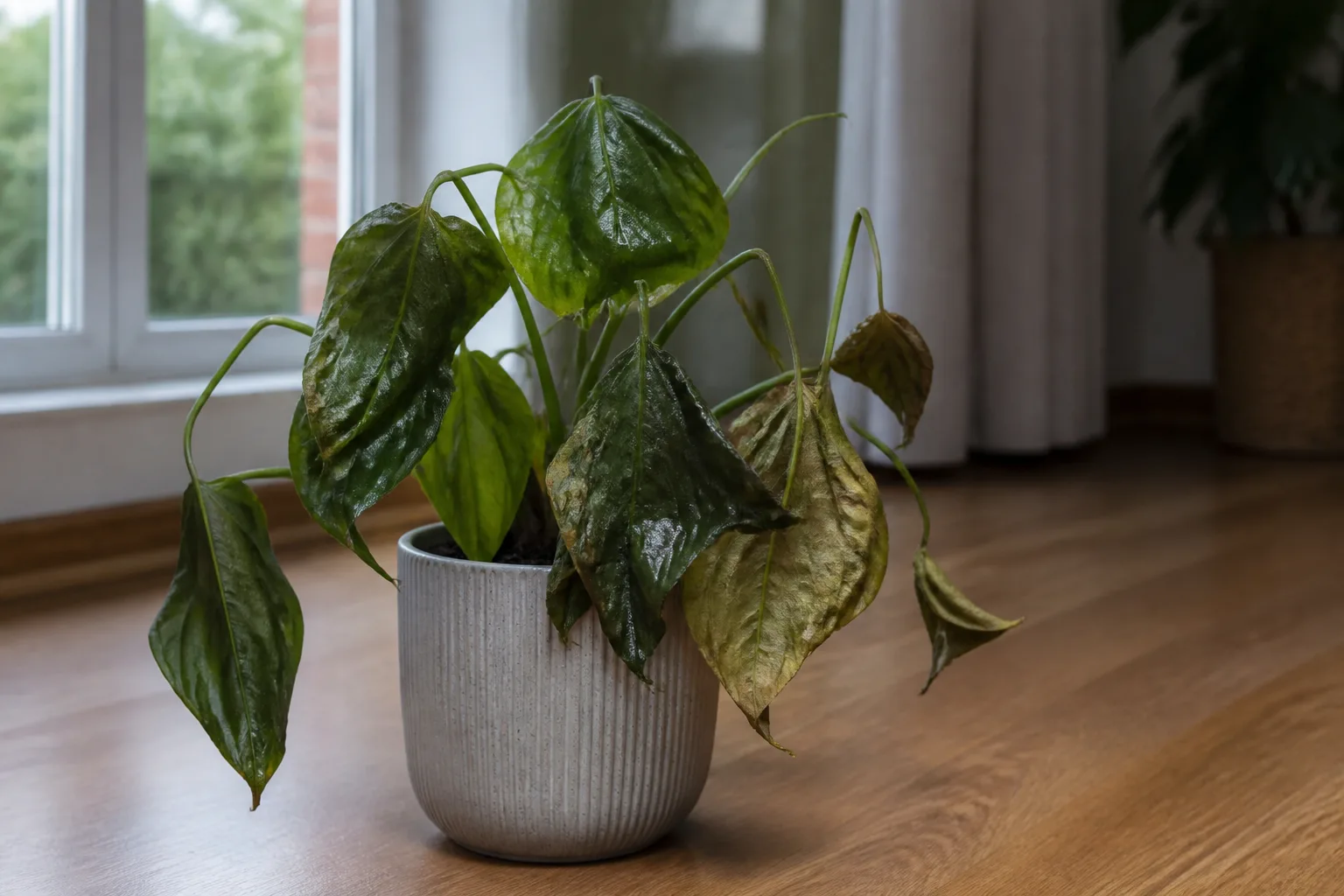
Wilting on Anthurium: Causes, Checks & Fixes
This guide covers wilting on Anthurium. See also the general Wilting guide, watering, and light pages for this plant.
Wilting on Anthurium: Causes, Checks & Fixes
Quick answer
Lift the pot before you touch the watering can. Acute wilting on Anthurium (Anthurium andraeanum, flamingo flower) almost always traces to a root-zone failure-either the mix stayed wet too long and roots lost function, or the root ball dried out and can no longer supply turgor to leaves and spathes. On this semi-epiphytic aroid, both extremes produce the same limp look through opposite mechanisms.
- Heavy, wet pot + sudden collapse: stop watering now. Wet-soil wilt means roots are not moving water-not that the plant is thirsty.
- Light, dry pot + limp foliage: one thorough soak until water runs from drainage holes, drain completely, reassess in 24 hours.
Do not fertilize, mist heavily, or repot on day one unless you confirm mushy roots or a completely desiccated root ball.
Visual diagnosis cues (match your plant before you act)
Use these text markers when you cannot compare photos-each branch has a distinct pot-and-tissue signature:
| Branch | Pot signal | Leaf / spathe signal | Crown at soil line | First move |
|---|---|---|---|---|
| Wet-soil wilt | Heavy, cool; damp at one-third depth | Whole rosette limp; lower leaves yellow on wet mix | Firm early; softening = escalate | Stop water; inspect roots if decline continues |
| Dry-soil wilt | Light; top 2 in. dusty; mix may shrink from wall | Crisp margins possible; blades feel thin | Firm | One full soak; drain; wait 24 h |
| Cachepot trap | Outer pot holds standing water; inner mix sour | Wilt despite surface looking merely moist | Variable | Empty outer pot; unpot if smell persists |
| Repot shock | Moist but not sour; recent repot within 7–10 days | Temporary limpness; roots firm on check | Firm | Stable light; normal rhythm; no extra water |
| Cold draft | Moisture unchanged | Sudden flop near vent or cold window | Firm | Move plant; wait 48 h before Anthurium repotting guide |
Wilt vs. drooping leaves: choose the right page
This URL covers acute turgor loss-sudden limp collapse of leaf blades, petioles, and often spathes together. Use drooping leaves on Anthurium when foliage angles downward over days but tissue still feels mostly waxy-firm and the change is posture-related, not whole-plant flop.
Use overwatering on Anthurium when wet-soil patterns, cachepot traps, and chronic watering mistakes are the main story-not acute collapse alone. Use root rot on Anthurium once you confirm brown mushy roots or soft crown tissue. Use underwatering when the pot is light, dry at depth, and edges are crisp.
The faster the collapse and the wetter the pot, the sooner you should unpot and inspect roots.
What wilting looks like on Anthurium
Wilting on A. andraeanum differs from one old leaf yellowing at the base. Systemic stress pulls multiple leaves and spathes down at once.
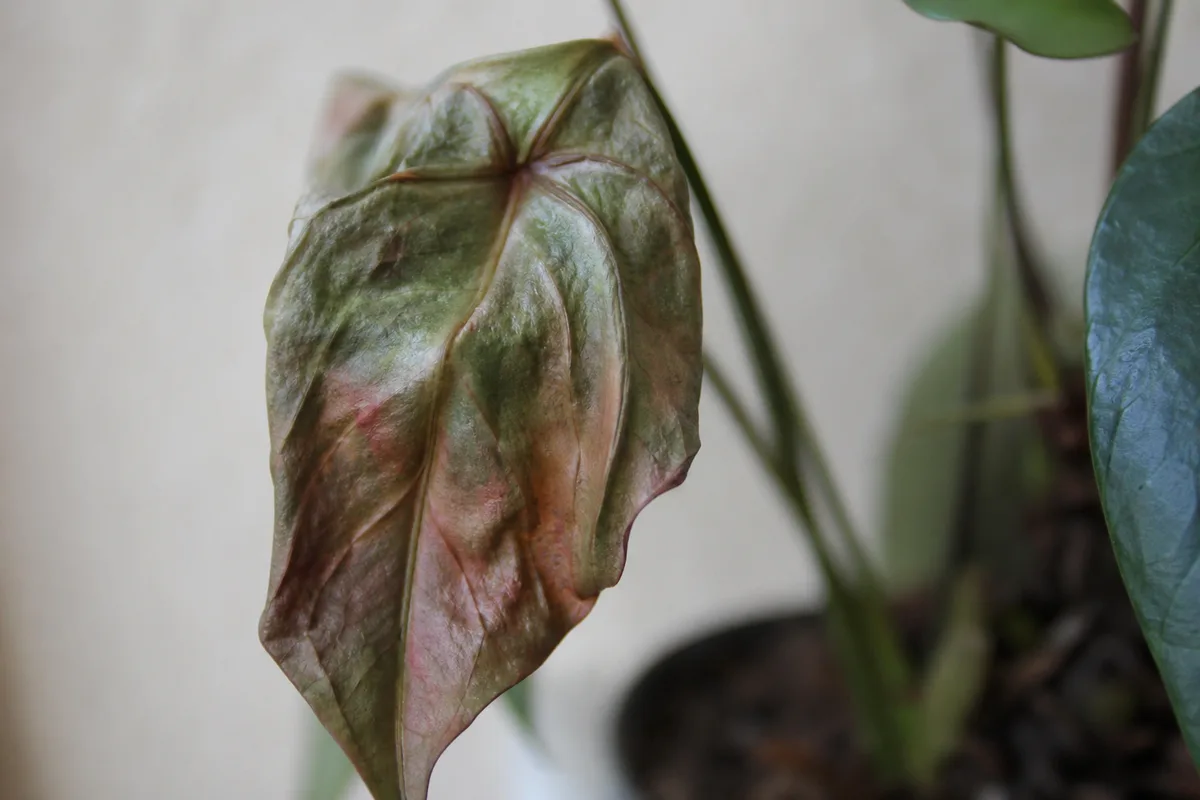
Wilting symptoms on Anthurium - compare with healthy tissue on the same plant.
Typical acute patterns:
- Whole-rosette limpness - Blades and petioles hang together; glossy tissue feels soft rather than waxy-rigid
- Spathe flop - Waxy inflorescences curl or drape with leaf wilt, not in isolation
- Wet-soil paradox - Collapse despite dark, cool mix at depth-the signature misread that sends owners toward another drink
- Dry-soil collapse - Pot lifts easily, mix has pulled from the wall, margins may feel papery before full wilt
- Lower-leaf yellow prelude - On chronic wet soil, outer leaves yellow before the center collapses
NC State Extension notes that Anthurium prefers evenly moist but well-drained conditions with humidity around 60–80%. Wilt appears when that balance breaks toward prolonged saturation or prolonged dryness. UF/IFAS lists both insufficient water and excess water as causes of tip burn, root damage, and reduced growth on Anthurium-the same genus wilts from both extremes.
Why Anthurium wilts: root oxygen and water uptake
Anthurium roots evolved for brief wet-to-dry cycles in tropical leaf litter and on tree branches-not for sitting in dense, airless peat. When mix stays saturated, roots lose oxygen and decay; the plant can no longer transport water upward, so leaves collapse even surrounded by wet soil. Missouri Botanical Garden notes that a wilted appearance with moist soil can indicate damaged roots-the plant cannot absorb water even when it is present.
Overwatering, poor drainage, and root rot
The highest-risk cause indoors. Blocked drainage holes, peat-only mix, oversized pots, and cachepots that hold standing water keep the root zone wetter than the surface suggests-a “dry-looking top, swampy bottom” trap common on flamingo flowers in decorative outer pots. UF/IFAS warns never to let finished plants sit in standing water.
Self-watering pots and wick systems can maintain constant bottom moisture that semi-epiphytic roots tolerate poorly unless the reservoir is managed aggressively and the mix is very chunky. If wilt appears in a self-watering setup, treat it as a wet-soil branch first: pause the reservoir, confirm the wick is not keeping the core saturated, and inspect roots if collapse continues.
Underwatering and drought stress
When the root ball desiccates, thick leaves eventually lose turgor. You usually see a light pot, dry mix at one-third depth, and often crisp margins before full collapse. Missouri Botanical Garden recommends compost that must not be allowed to dry out completely-yet many owners underwater after reading about root rot.
Post-repot and transplant shock
Repotting can cause temporary wilt for three to seven days, especially when roots were disturbed or the new mix was pre-soaked too heavily. Firm roots on inspection and a recent repot date point here rather than active rot.
Cold, heat, and low humidity
Cold below about 60°F (15°C) slows root activity; a plant in cool wet mix can wilt while soil still feels moist. Dry heated air increases transpiration without fixing a dry root ball. UF/IFAS emphasizes adapting indoor watering to seasonal light and temperature shifts rather than fixed calendar schedules.
How to confirm the cause
Work through these checks in order:
- Pot weight and moisture at depth - Push a dry skewer to one-third of pot depth. Heavy and damp means do not add water yet.
- Stem base and odor - Softening, darkening, or sour smell strongly suggests root-zone decline.
- Root inspection when wilt + wet coincide - Slide the root ball out carefully. Firm pale roots suggest stress or shock; brown mushy roots mean rot-see root rot guide.
- Recent events - Repotting, HVAC changes, cachepot use, self-watering reservoir refills, and schedule shifts often explain why wilt started this week.
Wilt vs. droop vs. rot escalation table
| What you see | Speed | Pot / soil | Crown | Urgency | First action | Read next |
|---|---|---|---|---|---|---|
| Acute whole-plant flop | Hours to 1 day | Heavy, wet at depth | Firm | Moderate | Stop water; prepare root check | This page |
| Acute flop + sour smell | Same day | Saturated | Firm or softening | Urgent-same day | Unpot; trim mush | Root rot |
| Soft dark crown on wet mix | Progressive | Wet | Soft | Urgent-same day | Trim rot; repot airy mix | Root rot |
| Gradual petiole hang | Days | Variable | Firm | Lower | Pot weight fork | Drooping leaves |
| Crispy edges + limp | 1–3 days | Light, dry | Firm | Moderate | One thorough soak | Underwatering |
| Yellow lower leaves, wet mix | Days to weeks | Heavy, not yet sour | Firm | Moderate | Stop water; fix drainage | Overwatering |
| Wilt 1–2 weeks after repot | After repot | Moist, no rot smell | Firm roots | Shock | Stable light; wait | Transplant shock patterns |
The first fix to try
Branch on moisture state-one action only:
- Wet, heavy pot: stop watering immediately. Move to Anthurium light guide with airflow. Do not add another drink, mist heavily, or fertilize.
- Light, dry pot: one thorough soak until water runs from drainage holes, then drain completely and empty any cachepot saucer.
This single fork prevents the most damaging mistake on moisture-sensitive aroids: watering an already saturated Anthurium and advancing rot.
Step-by-step recovery
Wet-soil pathway
- Pause irrigation until the top inch of mix dries if the crown is still firm.
- Empty cachepots and confirm drainage holes are open.
- Unpot the same day or next day if wilt continues, yellowing spreads, or the mix smells sour.
- Trim all mushy roots with sterile scissors; keep only firm tissue.
- Repot into chunky aroid mix in a snug pot with drainage-avoid sizing up.
- Withhold water for three to five days after rot trimming unless the new mix is bone dry at depth.
- Resume watering only when moisture is genuinely low at one-third depth.
Dry-soil pathway
- Water thoroughly until runoff, then drain fully.
- Reassess turgor after 24 hours-thirst wilt often improves within that window when roots are intact.
- If mix repels water (hydrophobic), see underwatering on Anthurium for rehydration technique.
- Stabilize humidity with a humidifier rather than repeated shallow drinks.
Both pathways
Keep bright indirect light, no fertilizer until active new growth, and no direct hot sun on stressed roots. Judge improvement by firm new center leaves and halted symptom spread-not by old collapsed blades re-inflating.
Field observation: what recovery actually looks like
Dry-wilt case: A 6-inch nursery flamingo flower left dry for ten days in winter heating showed limp petioles and a pot that lifted with one finger. One bottom-up soak until runoff, full drain, and saucer emptied. By the next morning petioles had lifted 30–40°; center leaves felt waxy again within 48 hours. Lower leaves that had creased stayed slightly bent but did not spread.
Wet-wilt case: A cachepot-grown plant wilted on mix that felt merely “cool” at the surface. Outer decorative pot held half an inch of stale water. After removing the cachepot and stopping water, sour smell appeared at day three-unpotting revealed brown mush on outer roots only. Trim, repot into bark-heavy mix one size down, no water for four days. New center leaf emerged at week three; two oldest yellow leaves were removed and did not recover.
These timelines assume firm crown tissue at the start. Soft crown changes the prognosis (see escalation below).
Recovery timeline
- 24–48 hours: thirst-related wilt often improves after one proper soak when roots are healthy
- 3–7 days: post-trim rot cases should stop worsening if the root zone is now airy
- 1–2 weeks: repot shock usually settles when moisture and light are stable
- 3–8 weeks: new center growth and spathe buds may return after moderate root loss once watering rhythm is corrected
Older collapsed leaves rarely re-inflate fully even when the plant survives. Track recovery by new glossy center foliage and a predictable light-to-heavy pot cycle-not by every old petiole returning upright.
When to escalate beyond home rescue
Treat wilt as same-day urgent when the crown softens, the mix smells sour with rapid yellowing, or collapse continues on saturated soil. Contact your local cooperative extension office with photos if rot persists after two trim-and-repot cycles.
Home treatment is unlikely to succeed when:
- The crown (stem base at soil line) is soft, dark, and spreading-advanced crown rot often does not regenerate even with aggressive trimming
- More than half the root mass is mush after two inspection cycles separated by a week of corrected care
- Total loss of new center growth for more than two weeks despite dry-or-wet branch fixes and stable environment
- Collapse continues while soil is appropriately dry at depth-may indicate vascular or crown infection beyond root trim
In those cases, propagating from any firm lateral shoot or replacing the plant is often more practical than repeated rescue attempts. Salvage is still worth trying when at least one-third of roots remain firm and the crown is solid.
If pets chewed wilted tissue during troubleshooting, contact your veterinarian promptly-flamingo flower contains insoluble calcium oxalates toxic to cats and dogs if ingested.
Mistakes to avoid
- Watering again when wilted leaves sit in wet soil-the classic wet-soil wilt trap
- Keeping the nursery pot inside a cachepot that holds standing water
- Repotting into dense peat-only mix or an oversized pot “to help drying”
- Fertilizing before roots recover
- Treating all limp foliage as thirst without the pot-weight fork
- Running a self-watering reservoir on full while the plant is already wilted on wet mix
How to prevent wilting next time
- Water by moisture at one-third depth and pot weight, not by calendar
- Use porous chunky aroid mix and open drainage paths
- Empty saucers and cachepots within 20 minutes of every watering
- Adjust intervals through seasonal light and temperature shifts (UF/IFAS EP159)
- Keep humidity steadier at 60–80% with a humidifier rather than extra water in the pot
- Learn your container’s dry-down rhythm: weigh the pot when freshly watered versus ready-to-water
For baseline culture, use the Anthurium overview and watering guide; return here when acute collapse appears.
Related Anthurium problems
- Anthurium overview - Semi-epiphytic biology, humidity band, and culture hub
- Overwatering - Chronic wet-soil patterns, cachepot traps, and watering rhythm fixes
- Root rot - Confirmed mushy roots, trim-and-repot protocol, fungicide context
- Underwatering - Light dry pot, crispy edges, hydrophobic mix rescue
- Drooping leaves - Slower petiole hang when tissue stays mostly firm
- Yellow leaves - Lower-leaf progression on chronic wet mix
- Watering - Top-inch-dry rhythm and seasonal intervals
- Soil - Chunky aroid mix for recovery repot
Is wilting the same as drooping leaves on Anthurium?
Wilting on this page means acute turgor loss-rapid limp collapse of leaves and spathes. Drooping leaves describes slower petiole hang while tissue stays mostly firm. Both use the same wet-vs-dry fork, but wilt warrants faster root inspection when the pot is heavy.
When to use this page vs other Anthurium guides
- Anthurium watering guide - Use for routine moisture checks before assuming wilting is the main issue.
- Anthurium problems hub - Browse all 20 common issues on this species.
- Underwatering on Anthurium - Different entry point when symptoms overlap with wilting.
- Overwatering on Anthurium - Different entry point when symptoms overlap with wilting.
- Root Rot on Anthurium - Different entry point when symptoms overlap with wilting.