Low Humidity on Aluminum Plant: Causes, Checks & Fixes
Quick answer
Aluminum Plant (Pilea cadierei) grows best at 50–60% relative humidity and shows crisp brown edges when forced-air heat drops rooms below ~40%. First step: move the pot off heating vents and run a humidifier near the canopy before changing watering.
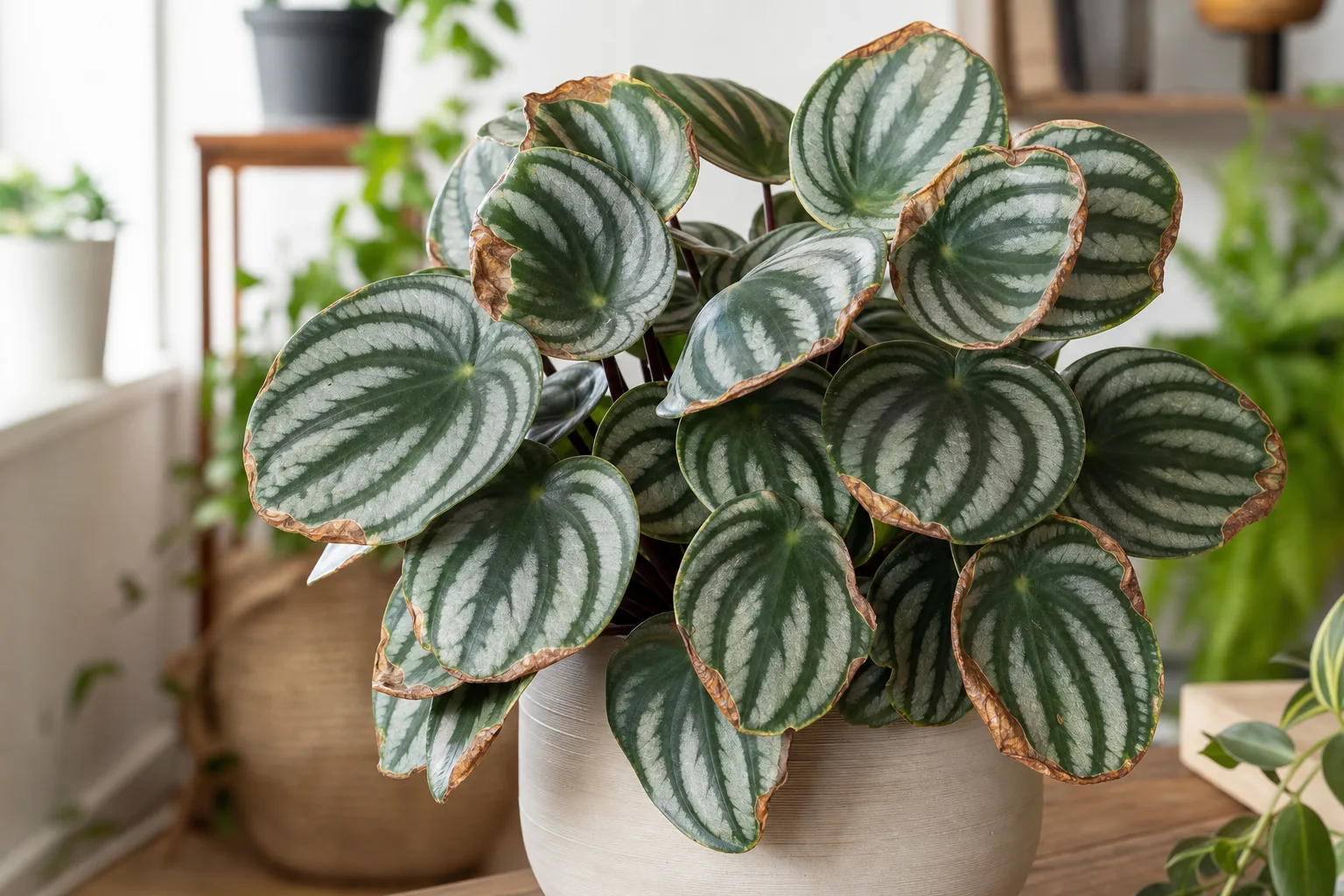
Low Humidity on Aluminum Plant: Causes, Checks & Fixes
This guide covers low humidity on Aluminum Plant. See also the general Low Humidity guide, watering, and light pages for this plant.
Low Humidity on Aluminum Plant: Causes, Checks & Fixes
Quick answer
Aluminum Plant - Pilea cadierei, also sold as watermelon pilea - is a shaded tropical understory plant from Vietnam and southern China. Its bushy clump of oval leaves with raised silver patches needs more moisture in the air than most succulents, though it is more forgiving than prayer plants or ferns in average homes.
First step: scan for forced-air vents, radiators, and drafty winter glass, then move the pot out of those dry-air paths. After relocation, run a humidifier near the canopy until relative humidity at leaf height holds around 50–60% - the target from our Aluminum Plant overview. NC State Extension and Missouri Botanical Garden both describe this species as appreciating humidified rooms or placement on a bed of wet pebbles.
Do not flood the pot to fix crisp edges. When air is dry, aluminum plant loses water through leaf margins faster than roots replace it - but adding water without raising humidity often leads to soggy mix and root stress. Our watering guide explains the top-half-inch dry-down rhythm that pairs with humidity fixes.
What low humidity looks like on Aluminum Plant
Dry-air damage on Pilea cadierei has a pattern tied to its small, silver-marked foliage:
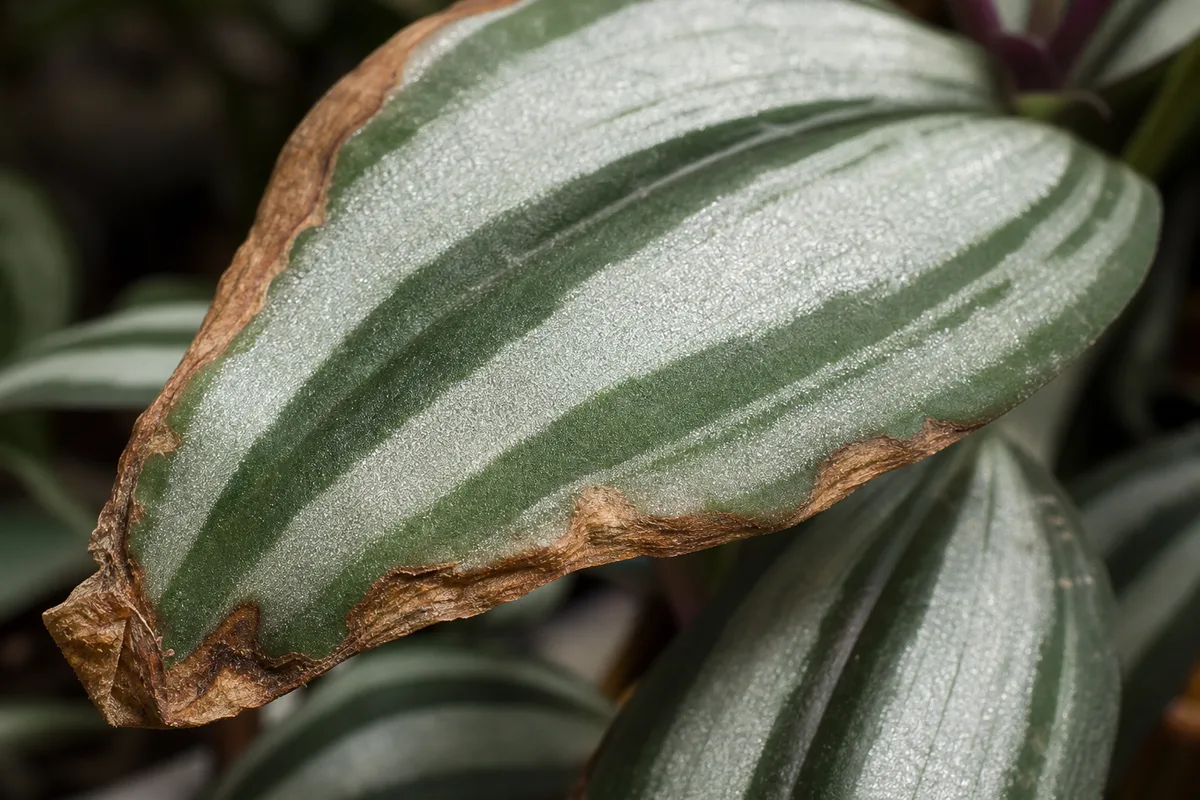
Low Humidity symptoms on Aluminum Plant - compare with healthy tissue on the same plant.
Early dry-air stress:
- Tan or brown crisping on leaf edges and tips, often starting on the oldest lower leaves
- Silver patches look dull or flat instead of bright and raised - the leaf is a built-in health meter
- Slight inward curl on exposed blades near a heat source while stems stay firm
- New leaves open smaller or with thin brown lines at the margin
Established dry-air damage:
- Widespread brown edges across multiple leaves, worst on the side facing a register, radiator, or hot window glass
- Lower leaf drop after margins fully desiccate, especially in winter
- Growth slows even when soil moisture looks normal at depth
- Fine stippling on undersides if spider mites move in behind the humidity drop
What damaged tissue will not do:
- Crisp brown edges do not turn green again on the same leaf
- Fully desiccated tips rarely reopen cleanly - wait for the next leaf pair
Because aluminum plant leaves are only 2–4 inches long, a single crispy margin is cosmetic; repeated damage on new growth means the environment still needs work.
Why Aluminum Plant needs steady humidity
Pilea cadierei evolved in moist, shaded forest habitats where warm air holds steady vapor. Indoors, winter heating commonly drops relative humidity below 30%, far below the 50–60% band that keeps this species looking its best.
The raised silver bands on each leaf are thin tissue at the margin. When vapor pressure deficit rises - near forced-air vents, fireplaces, or desert-climate HVAC - the plant loses moisture through those edges first. A cast-iron plant might shrug at 35% RH; aluminum plant often shows crisp margins while the pot still feels evenly moist.
Winter is the usual trigger. Heat vents and sunny window sills create microclimates even drier than the thermostat suggests. Moving a greenhouse-grown plant straight into a heated living room without acclimation accelerates the same injury.
Dry air also weakens natural defenses. Spider mites thrive in warm, dry conditions - so low humidity and mite stippling often appear together on bushy foliage. See spider mites on Aluminum Plant if webbing shows up after a dry spell.
Compared with Calathea or fittonia, aluminum plant tolerates average home humidity better - but it is not a succulent. Below roughly 40% RH near the leaves, expect dull silver markings and creeping brown edges, especially on plants sitting in the path of dry airflow.
Lookalike symptoms to rule out
| What you see | Likely cause | Where to read more |
|---|---|---|
| Even crisp margins, moist soil, RH below 45% at canopy | Low humidity | This page |
| Limp leaves, very light pot, dry mix throughout | Underwatering | Underwatering |
| Limp leaves with wet, sour mix and yellow lower leaves | Overwatering / root stress | Overwatering |
| Brown tips with erratic dry-wet cycles | Inconsistent watering | Brown tips |
| Whole plant limp in hours | Drought or root failure | Wilting |
| Gradual leaf sag, firm stems, moist soil | Humidity or light stress overlap | Drooping leaves |
| Bronze stippling and webbing on undersides | Spider mites | Spider mites |
| Bleached patches on window-facing side only | Direct sun scorch | Light guide |
Humidity vs. underwatering: Dry-air crisping usually hits several leaf margins at once while soil at depth stays lightly moist and the pot has normal weight. Underwatering adds limp stems, a very light pot, and bone-dry mix from top to bottom. If you are unsure, check moisture at the root zone before watering - our brown tips guide covers the overlap when both causes stack.
How to confirm the cause
Work through these checks before changing multiple care variables at once:
- Measure humidity at canopy height - Room thermostats lie. Hold a hygrometer 15–30 cm above the pot for 24 hours. Below 45% RH near the leaves strongly supports dry-air stress; aim to hold 50–60% for aluminum plant.
- Vent, radiator, and AC draft scan - Walk the room and note every forced-air register, radiator cover, fireplace, and drafty winter window. Damage clustered on one side of a leaf usually traces to a local dry zone. Most houseplants prefer 40–60% RH and suffer when placed in drying airflow paths.
- Check soil moisture honestly - Stick a finger into the top half inch. If mix is wet and heavy but margins still crisp, the problem is likely air moisture, not drought. If bone dry throughout, underwatering may be primary or compounding.
- Inspect the newest leaf pair - Firm new growth with brown edge lines in moist soil screams humidity gap. Soft, mushy stems at the base point elsewhere - see root rot.
- Review silver patch brightness - Dull, flattened silver bands on several leaves often precede visible crisping. Bright raised patches on new growth confirm conditions are improving.
- Look for mites - Tap a marked leaf over white paper. Moving specks plus fine webbing mean pests joined the stress; treat mites after stabilizing humidity.
If RH stays above 50%, soil cycles normally per the watering guide, and new leaves open with clean edges, low humidity is unlikely the main issue - look at light scorch, inconsistent watering, or root problems instead.
First fix for Aluminum Plant
Move the pot off forced-air paths - at least 1 metre from heating vents, radiators, and drafty winter glass - then run a humidifier within 1–2 metres of the canopy.
Relocation is the fastest zero-cost correction when a register has been blasting dry air across the silver-marked leaves. After the move, add sustained humidity: a cool-mist or ultrasonic humidifier sized for the room, not a one-shot misting bottle. Portable humidifiers are the most effective way to raise humidity consistently in heated winter rooms.
Keep the humidifier running through the dry period, not only for ten minutes after you notice damage. Aluminum plant responds to average conditions over days, not a single moisture spike.
While humidity climbs, leave watering rhythm alone unless soil is genuinely dry at the top half inch. Do not compensate for crisp leaves by keeping mix constantly wet - that raises root-rot risk while edges stay dry.
Step-by-step recovery
After relocation and humidifier setup:
- Group with other tropicals - Grouping plants together raises humidity in their vicinity through shared transpiration. It supplements a humidifier but rarely replaces one in heated winter rooms.
- Add a pebble tray if needed - Set the pot on stones above - not in - water. NC State notes aluminum plant appreciates placement on a bed of wet pebbles; combine with the humidifier rather than expecting the tray alone to solve winter dryness.
- Stabilize temperature - Keep the plant in its 60–79°F comfort zone. Cold window glass and heat blasts both stress margins. See our overview for placement notes.
- Trim only fully dead tissue - Snip crispy brown tips or entire leaves that are mostly desiccated once conditions improve. Sterilize scissors between cuts. Partial edge damage can stay until the leaf is replaced naturally.
- Scout for spider mites weekly - Rinse undersides with lukewarm water if stippling appears. Dry air often precedes mite flare-ups on bushy foliage.
- Water consistently once humidity holds - If edges browned partly from drought overlap, resume the top-half-inch dry-down from our watering guide without keeping soil soggy.
Hold Aluminum Plant repotting guide, fertilizer, and major pruning until new leaf pairs open cleanly for two to three weeks.
Recovery timeline
Humidity corrections show in new growth, not old leaves. Within 7–14 days of stable 50–60% RH, the next leaves should open with cleaner edges and brighter silver patches. A full flush of undamaged foliage may take four to eight weeks as older crisp leaves age out on this moderately fast grower.
If margins keep spreading while RH reads adequate, reassess watering consistency, light intensity, or hidden pests before assuming humidity was the only factor.
Worsening signs: yellowing across whole leaves while soil stays wet, soft stems at the crown, widespread leaf drop, or mite webbing spreading - those mean a different or additional problem and need a new diagnosis path.
Mistakes to avoid
Do not mist once daily and assume the problem is solved. Brief leaf wetting evaporates in minutes on small oval blades and can spot silver banding if water sits overnight.
Do not overwater to “help” crisp leaves. Extra water without humidity raises root-rot risk while edges stay dry - a common trap when brown margins look like thirst.
Do not blast aluminum plant with direct sun to “dry it out faster” after overwatering - that compounds margin burn on thin leaf tissue.
Do not relocate the plant daily between rooms hunting humidity. Stable conditions beat bouncing between a dry living room and a steamy bathroom unless light in both spots is adequate.
Do not trim every leaf the moment edges brown. Wait until humidity holds, then remove only tissue that will never recover.
Do not increase fertilizer to “green up” humidity-stressed leaves. Feed only after new growth looks stable per our fertilizer guide.
Aluminum Plant care cross-check
Low humidity fixes work best when the rest of the routine supports steady transpiration:
- Light - Bright indirect light keeps silver markings vivid without scorching thin leaves. Too dim and growth weakens; too harsh and edges desiccate faster in dry air. Full placement guidance: light guide.
- Water - Water when the top half inch dries. Consistent moisture prevents stacking drought stress on dry-air injury.
- Temperature - Aluminum plant prefers roughly 60–79°F (15–26°C). Cold drafts and heat vents both stress leaf margins.
- Soil - Well-draining, light mix. Heavy soggy pots worsen stress when you overwater during a humidity panic - see soil guide.
How to prevent dry-air stress next winter
Run a humidifier from the first cold snap, not after widespread crisping. A hygrometer near the plant gives early warning when RH slides under 45%.
Place aluminum plant where bright filtered light and humidity can coexist - east or north windows with sheer curtains often work better than a hot south sill above a radiator.
Group aluminum plant with other humidity-tolerant tropicals to buffer microclimates. Keep succulents in a separate drier zone so you are not fighting opposite humidity needs in one cluster.
Acclimate new plants gradually when moving from greenhouse to home. A week of stable intermediate conditions reduces shock crisping on tender new leaves.
Inspect newest leaf pairs weekly through winter. One brown tip on a single old leaf is cosmetic; repeated failed new growth means the environment still needs work.
When to worry
Treat as urgent when multiple new leaf pairs brown and stall within one week, when crisping spreads across the entire clump despite moist soil, or when mite webbing covers several stems. Those patterns suggest the plant is losing leaf area faster than it can replace.
Step up intervention - stronger humidification, pest control if confirmed, and trimming dead leaves - before stems soften at the crown.
A few brown tips on lower leaves after a dry spell is not an emergency if new growth stays clean once humidity rises. Aluminum plant always shows some cosmetic edge wear in average homes; judge health by the newest leaves and bright silver patches.
Conclusion
Low humidity on Aluminum Plant is an environmental problem with a clear first response: move off vent paths, measure air moisture at the leaves, and run a humidifier until RH stays consistently around 50–60%. Old crispy margins will not heal, but firm stems, bright silver patches on new leaves, and stopped edge spread tell you the fix is working. Keep watering steady, stay away from forced-air drafts, and watch new growth - not yesterday’s brown edge - for proof of recovery.
Related Aluminum Plant problems
- Brown tips - dry-air crisping overlapping with inconsistent watering
- Wilting - limp leaves when drought or root stress compounds humidity stress
- Drooping leaves - gradual sag when humidity and moisture overlap
- Underwatering - drought curl when mix is bone dry
- Overwatering - wet soil with limp leaves, not dry margins alone
- Aluminum Plant overview - Pilea cadierei biology and baseline humidity needs
When to use this page vs other Aluminum Plant guides
- Aluminum Plant watering guide - Use for routine moisture checks before assuming low humidity is the main issue.
- Aluminum Plant problems hub - Browse all 16 common issues on this species.
- Brown Tips on Aluminum Plant - Different entry point when symptoms overlap with low humidity.