Aluminum Plant (Pilea cadierei) Light Needs, Placement
Aluminum Plant (Pilea cadierei) Light Needs, Placement, and Grow Light Guide
Aluminum Plant (Pilea cadierei) Light Needs, Placement, and Grow Light Guide
Author: sai-ananth · Reviewed by: LeafyPixels Review Board · Updated: 2026-06-15
Aluminum Plant (Pilea cadierei) Light Needs, Placement, and Grow Light Guide
If the metallic silver splashes on your Pilea cadierei are dulling, stems are stretching, or new leaves arrive almost solid green, light is the first variable to check - not fertilizer, not Aluminum Plant repotting guide, and usually not a new watering schedule until you have ruled out placement. Aluminum plant - also sold as watermelon pilea - is a compact tropical foliage species from the shaded forests of China and Vietnam that looks best in bright, filtered indoor light. This page owns proactive light placement and adjustment for the species. For whole-plant context, see the aluminum plant overview. If symptoms are already advanced, use the not enough light diagnosis page or the leggy growth guide after you read the placement logic here.
Why Silver Markings Need More Light Than Solid-Green Leaves
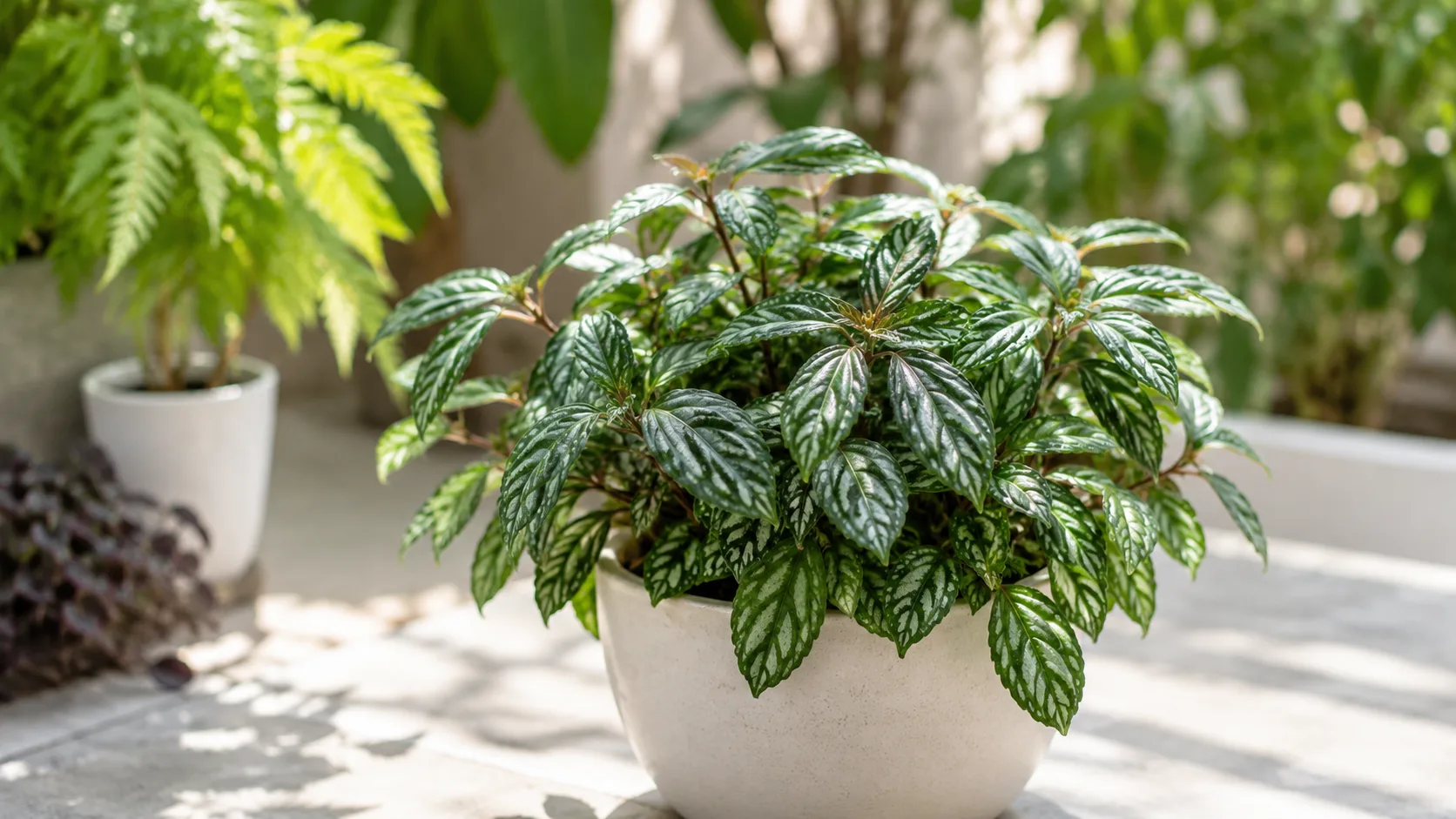
The aluminum plant earns its name from four rows of raised silver patches on each dark-green leaf. Those metallic splashes are not pigment variegation. They are tiny air pockets in the leaf tissue - cystolith-bearing tissue with almost no chlorophyll - that scatter light and create the brushed-metal look. Because Pilea cadierei cannot photosynthesize as efficiently per square inch of leaf as a solid-green houseplant, it leans on a steady, generous light source to push compact new growth and keep the silver contrast vivid.
In the wild, the species grows across the tropical understory, where canopy gaps deliver a soft, dappled wash rather than all-day direct sun. NC State Extension classifies its light tolerance as dappled sunlight and deep shade (less than 2 hours to no direct sunlight) - language that describes filtered forest light, not a dim interior hallway. Indoors, the practical match is bright indirect light: strong ambient brightness at the leaf without harsh afternoon beams on the glass.
Missouri Botanical Garden adds an important lifecycle note: best foliage is on new plants. As specimens age, stems elongate and silver contrast softens even under good care - which is why many growers restart from cuttings each spring. Light quality determines how long that window of peak patterning lasts.
What Bright Indirect Light Means for Pilea cadierei
“Bright indirect light” is accurate horticultural language and vague room advice at the same time. For aluminum plant, translate it with two tools: where the pot sits relative to the window and, when possible, a light meter reading at leaf height at midday.
Foot-Candles, Lux, and Extension Light Bands
University of Florida/IFAS Gardening Solutions defines general indoor bands at mid-day:
| Foot-candles (mid-day) | Light level | Typical indoor location |
|---|---|---|
| 25–100 ftc | Low | Interior rooms lit mainly by overhead bulbs |
| 100–500 ftc | Medium | Near windows with no direct sun; unshaded north windows; shaded east/west |
| 500–1000 ftc | High | Near windows with softened direct light; unshaded east/west |
| Over 1000 ftc | Direct sun | Unfiltered south or southwest glass |
University of Maryland Extension places many common foliage houseplants in the 100–500 foot-candle medium-bright band at east or west windows - the same band UF/IFAS labels medium light. Human eyes adapt so quickly that a hallway measuring under 100 foot-candles can still feel adequately lit; the plant’s response is the more honest reading.
For species-specific Pilea guidance, House Plant Journal’s light chart lists Pilea cadierei (grouped with other pileas) at 200 foot-candles minimum and 400 foot-candles optimal, with 2–3 hours of direct sun tolerable when acclimated. That aligns with UF/IFAS medium-to-high transition and with extension guidance that pileas should not sit in unfiltered direct light (Penn State Extension).
Lux conversion for app users: multiply foot-candles by roughly 10.8 to get lux (UF/IFAS notes lux differs by about a factor of 10 from foot-candles). A 400 ftc east-window sill is roughly 4,300 lux - useful when your phone app reports lux only.
Editorial Target vs Survival Minimum
Extension bands describe what a species can tolerate. Editorial targets describe what keeps aluminum plant looking like the plant you bought:
- Survival minimum (extension-aligned): about 200 foot-candles - the floor House Plant Journal cites for Pilea; below this, leggy growth and leaf drop become likely.
- Editorial growth target (LeafyPixels): 400–800 foot-candles of bright indirect light, or up to 2–3 hours of gentle morning direct sun - the range where silver stays crisp, internodes stay short, and new leaves match nursery quality.
- Too much: sustained exposure above roughly 1000 foot-candles of direct afternoon sun without acclimation - bleaching and scorch territory per Missouri Botanical Garden, which warns that too much direct sun turns leaves pale and scorched.
Label these bands explicitly so you do not confuse “medium light per UF/IFAS” (100–500 ftc) with “looks its best indoors” (400–800 ftc editorial target).
Window Placement Scorecard
Use this table as a fast decision aid. Readings are approximate mid-day values in a typical home; curtains, trees, and season shift the numbers.
| Window | Spring–Summer | Winter | Aluminum plant verdict | Action if stressed |
|---|---|---|---|---|
| East | 400–800+ ftc; 1–3 hr gentle direct AM sun | 300–600 ftc | Best default - matches understory dapple | Rotate weekly; watch summer intensity |
| North | 200–400 ftc; no direct sun | 100–250 ftc | Good spring–summer; winter may need supplement | Add grow light Dec–Feb if silver fades |
| West | 600–1200+ ftc PM sun | 300–500 ftc | Usable with sheer curtain | Pull back 2–4 ft or filter in summer |
| South | 800–2000+ ftc direct | 400–700 ftc | Diffusion required | Sheer curtain or 3–6 ft setback |
East-Facing: Gold Standard
An east-facing window gives Pilea cadierei roughly 1 to 3 hours of gentle morning sun, followed by softer indirect light for the rest of the day. Morning sun is low in intensity and closest to the dappled light of its native understory. Place the pot on the sill or on a stand within two feet of the glass. Rotate a quarter turn weekly so the plant does not lean.
North-Facing: Soft Light and Winter Limits
A bright north window delivers strong indirect light all day with essentially no scorch risk - ideal for beginners who tend to overwater, because slower photosynthesis in softer light pairs with slower soil drying (see the watering guide for the light–water link). The trade-off is winter intensity: a north window on a grey December day can drop toward 100–200 foot-candles, which keeps the plant alive but may trigger leggy growth and faded silver. If stretching starts in midwinter, add a grow light rather than moving the plant to harsh south glass.
West and South: Diffusion Required
West and south windows pour in strong afternoon light - the part of the day Pilea cadierei handles worst. A sheer curtain, frosted film, or moving the plant 3 to 6 feet back from the glass turns these exposures into viable spots. Without diffusion, expect pale, bleached leaves within a week or two in summer. Missouri Botanical Garden explicitly recommends bright indirect light indoors and to avoid full sun.
Southern Hemisphere Note
In the Southern Hemisphere, window logic flips: north windows are the hot exposure, south windows are the soft one. Treat whichever window receives unobstructed midday sun as the harsh exposure requiring diffusion.
Low Light: Survival vs Appearance
Aluminum plant can survive low light better than many showy tropicals because of its natural understory habit, but “tolerate” is not “prefer.” In a low-light spot, the plant pulls energy from older leaves to push new growth - older leaves yellow and drop, silver patches turn dull and greenish, and stems stretch toward the brightest source. Anything consistently under 200 foot-candles tends to produce leggy growth on Pilea species per House Plant Journal.
For a real-world reference, University of Maryland Extension notes that the interior of a well-lit home is often less than 100 foot-candles - low light by plant standards even when the room feels bright. A spot six to ten feet from a window, behind heavy curtains, or in a north room with no direct sun often measures 50–150 foot-candles. Plan on slower growth, regular pinching, and a supplemental grow light in winter. Full recovery steps live on the not enough light page.
Direct Sun: Safe Doses and Scorch Limits
A little direct sun works in the right conditions with acclimation. The two variables that matter: time of day and how the plant was raised. A plant propagated on a bright windowsill can usually handle 1–2 hours of direct morning sun - what an east window provides. The same plant may scorch in one hour of west or south afternoon sun. NC State Extension lists dappled sunlight as ideal; unfiltered midday and afternoon beams exceed that.
A practical rule: morning sun is gentle, midday sun is moderate, afternoon sun is harshest. Aim for morning exposure, treat midday as a ceiling unless filtered, and avoid afternoon direct sun entirely unless behind a sheer curtain.
Warning Signs Your Aluminum Plant Is Getting Too Much Light
The silver patches react first, because the air-pocket tissue that creates the metallic sheen is also the tissue most vulnerable to bleaching:
- Bleached silver patches - metallic splashes fade toward chalky white, then yellow; the whole leaf may look washed out.
- Leaf scorch - brown, crispy patches on the upper surface and tips of leaves most exposed to the beam.
- Rapid lower-leaf yellowing and drop - stress shedding when light plus heat exceed what thin leaves can handle.
- Crispy margins - edges dry and curl even when watering is on schedule.
- Soil drying unusually fast - a bright-light plant drinks faster; bone-dry soil the same day you watered is a light-stress signal, not automatically a call to water more.
Move the plant 2–3 feet back, hang a sheer curtain, or shift to a less intense exposure. Damaged leaves will not recover their original color, but healthy new growth should arrive within 3–6 weeks once light is corrected.
Warning Signs Your Aluminum Plant Is Not Getting Enough Light
Low light is a slower problem, which makes it easier to miss. The plant will not collapse; it will gradually lose the traits that made you buy it:
- Leggy stems and one-sided lean - internodes stretch (etiolation) as the plant reaches for light; see leggy growth for pinching and recovery.
- Faded silver variegation - raised patches lose contrast and look greenish; some new leaves emerge almost solid green because the plant reabsorbs silver air-pocket tissue under stress.
- Smaller, slower new leaves - the newest fully opened leaf is smaller or less patterned than leaves from when you bought the plant.
- Lower-leaf drop while the top looks fine - energy redistribution toward weak new growth.
Simple test: compare the newest fully opened leaf to a mature leaf from the nursery tag photo. If patterning and size are declining, check light before changing water or fertilizer.
Grow Lights: Distance, Duration, and Spectrum
A full-spectrum LED grow light is the most reliable way to hit the 400–800 foot-candle editorial target on a schedule - especially in winter, in basement apartments, or in rooms with small or north-facing windows. Aluminum plant is not a high-light crop like a tomato seedling; a modest panel is enough.
Distance: For a typical 20–40 watt full-spectrum LED panel, start 6–12 inches above the foliage. For a single bulb or clip-on fixture, start at 8–12 inches. If leaves feel warm under the lamp, raise it - aluminum plant tolerates brightness better than heat.
Duration: Run the lamp 12–14 hours per day with 8–10 hours of darkness. UF/IFAS Gardening Solutions notes that 16 hours light / 8 hours dark is a workable indoor cycle for houseplants under artificial light; a slightly shorter 12–14 hour photoperiod keeps Pilea cadierei compact and closer to understory day-length rhythms. University of Maryland Extension recommends illuminating plants for no more than 16 hours total when combining natural and artificial light.
Spectrum: A white full-spectrum LED in the 4000K–6500K range covers the blue and red bands foliage plants use. UF/IFAS recommends cool white or broad-spectrum lamps for houseplants; incandescent bulbs produce too much heat and far-red light for most foliage species.
When to add a lamp: When a free lux/foot-candle app reads below 200 foot-candles at leaf height at midday, or when winter north-window growth stalls and silver fades despite consistent watering.
How to Acclimate an Aluminum Plant to Brighter Light
Abrupt moves cause the most common light-related damage. Leaves formed in low light are thinner and lower in protective pigments; a sudden shift to bright south glass can sunburn tissue in hours.
Safe acclimation plan:
- Expose the plant at the new spot for 1–2 hours, then return it to the original location.
- Increase exposure by 1–2 hours every 3–5 days, watching for bleaching, browning, or curling.
- If stress appears, hold steady for a week before increasing again.
- Use a sheer curtain to bridge big intensity jumps - especially greenhouse-to-home or indoor-to-sunroom moves.
- Trim badly damaged leaves once new growth is healthy so energy goes to recovery, not scorched tissue.
Plan 1–2 weeks for a north-to-east move and 2–3 weeks for deep-shade-to-filtered-south moves. Treat the first week after any greenhouse purchase as acclimation regardless of how bright your room feels.
Seasonal Adjustments for Indoor Light
Light at the same window is not the same light in January and July. Sun angle, day length, and outdoor shading all change what reaches the leaves:
- Summer - sun is high and intense. Pull the plant 1–3 feet back from south or west windows, or add a sheer curtain. East windows stay ideal.
- Winter - sun is low and weaker. Move closer to the brightest window or run a grow light to offset short days. Growth slows but should not stop entirely; if it does, light is the usual cause.
- Spring and fall - shoulder seasons need the least adjustment. Most homes deliver strong indirect light without intervention.
Re-check placement in late November and late June - the two moments when window intensity shifts fastest in the Northern Hemisphere.
Cultivars and Special Setups (Terrarium, Office)
NC State Extension lists two common cultivars:
- ‘Ellen’ - bushier habit with metallic-like silver leaves; same foot-candle bands as the species, but the compact form shows stretch sooner when light drops.
- ‘Minima’ - dwarf form to about 6 inches; lower canopy means less self-shading, but the smaller leaf area also means less photosynthetic reserve - do not place it farther from the window than a standard plant “because it is small.”
Terrariums: Closed jars filter and reduce light dramatically. A terrarium on a bright sill may deliver only 100–300 foot-candles at the soil surface. Open-top terrariums or grow lights mounted 6–10 inches above the glass are safer for keeping silver vivid.
Office fluorescent-only rooms: Overhead tubes alone often measure 40–80 foot-candles at desk height per UF/IFAS low-light descriptions - fine for human tasks, not for Pilea cadierei. A dedicated desktop grow light is required; ceiling fluorescents are supplemental at best.
Pet-aware sill placement: Aluminum plant is generally pet-safe, but a sunny sill reachable by cats still risks knocked pots and chewed leaves - use hanging or shelf placement if pets treat window ledges as playgrounds.
Quick Reference Cheat Sheet
- Editorial target: 400–800 foot-candles bright indirect, or 2–3 hours gentle morning sun.
- Extension minimum: ~200 foot-candles; below this, expect stretch and fade.
- Best window: East. Bright north is second. Filtered west/south works; unfiltered south/west is risky.
- Too much light: Bleached silver, scorch, crispy edges, fast-drying soil.
- Too little light: Leggy stems, faded silver, small new leaves, lean - see not enough light.
- Grow light: Full-spectrum white LED, 6–12 inches above foliage, 12–14 hours daily.
- Acclimation: 1–3 weeks; increase exposure gradually.
- Do not: Increase fertilizer when silver fades - increase light first.
Conclusion
Pilea cadierei rewards precise placement: a bright east window, a bright north window with winter supplementation, or a filtered west exposure keeps silver vivid and stems compact. Match foot-candle reality to the editorial 400–800 band rather than trusting how bright the room feels, and treat any move toward stronger light as a 1–3 week acclimation. When natural light falls short, a modest full-spectrum LED on a timer closes the gap cleanly. If symptoms are already established - stretch, fade, or one-sided lean - start on this page for placement, then follow the not enough light or leggy growth guides for recovery while keeping watering steady.
Reviewed by LeafyPixels Review Board · Author: sai-ananth · Methodology: recommendations checked against botanical and extension references, LeafyPixels plant-care data, and practical indoor growing constraints before publication.
When to use this page vs other Aluminum Plant guides
- Aluminum Plant overview - Start here for whole-plant context before deep-diving this topic.
- Aluminum Plant problems hub - Jump to symptom-specific fix guides when this care topic does not resolve the issue.
- Not Enough Light on Aluminum Plant - Escalate here when light adjustments are not enough.
- Leggy Growth on Aluminum Plant - Escalate here when light adjustments are not enough.