Aluminum Plant (Pilea cadierei) Fertilizer Guide
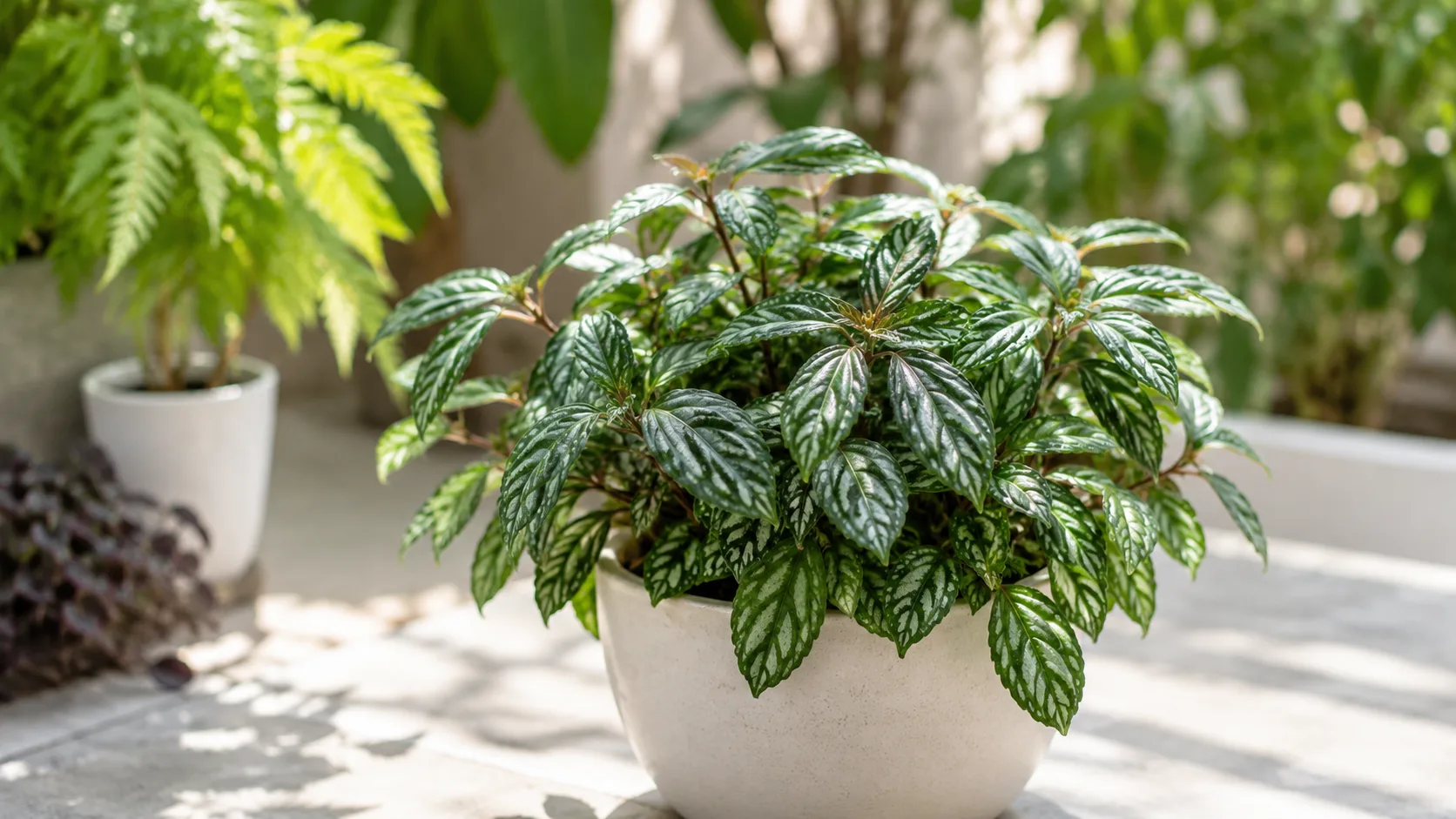
Aluminum Plant (Pilea cadierei) Fertilizer Guide
Aluminum Plant (Pilea cadierei) Fertilizer Guide
Aluminum plant fertilizer for Pilea cadierei is not about pushing maximum growth - it is about keeping the silver-patched leaves crisp while the fine, shallow roots stay salt-free in a small pot. This fast-growing tropical understory herb from Vietnam and China evolved on forest floors where nutrients arrive in thin, steady doses from decomposing leaf litter, not in concentrated weekly bursts. Indoors, that biology translates into one practical rule: half-strength balanced or foliage-leaning liquid feed every 4 to 6 weeks from spring through summer, applied only onto moist soil, with a full pause in fall and winter unless strong grow lights keep new leaves coming.
The growers who keep aluminum plant looking like the tag photo are conservative. They water first, dilute to half the label rate, mark the feed date, and flush salts with plain water every month or two - the same leaching rhythm that protects peat-based mix from mineral buildup described in our watering guide. Overfeeding shows up as brown leaf tips, white crust on the soil, and wilt that does not respond to water - symptoms that look like drought but mean the opposite.
This guide covers N-P-K choices for silver foliage, a worked dilution example, a month-by-month calendar, light-based frequency adjustments, organic alternatives, flush recovery, and how P. cadierei feeding differs from [Pilea peperomioides](/plants/aluminum-plant/Aluminum Plant overview/). Fertilizer is the last variable to tune after light, moisture, and potting mix are stable on the same plant.
Why Pilea cadierei Wants Steady, Light Feeding
Aluminum plant is grown almost entirely for patterned foliage - dark green leaves with four rows of raised silver patches that read like brushed metal. That pattern is built from nitrogen-driven leaf expansion plus micronutrient availability in slightly acidic mix. NC State Extension describes Pilea cadierei as a clumping evergreen reaching 6 to 12 inches tall with elliptic leaves 2 to 4 inches long, each carrying the signature silver bands. New leaves emerge in pairs at stem tips during warm months; when feeding and light align, those new leaves match or slightly exceed the size of older ones and the silver patches stay bright rather than washed out.
Penn State Extension’s Pilea houseplant overview places aluminum plant among low-growing tropical forest-floor species that need watering and feeding “just right” - not the feast-and-famine cycle many hungry foliage crops tolerate. University of Maryland Extension reinforces the indoor-plant goal: fertilizer should replace nutrients lost to leaf growth, not force a large plant quickly. For a 4- to 6-inch pot on a windowsill, that means modest doses on a weeks-long rhythm, not label-strength feeds every watering.
Heavy feeding does not deepen silver markings faster - it raises soluble salts in a closed container where evaporation leaves minerals at the soil surface and pot rim. University of Maryland Extension soluble salt guidance links excess fertilizer to brown leaf tips, reduced growth, and white crust on potting media. Aluminum plant’s fine roots have less buffer than a large outdoor bed, so conservative feeding is the safer default.
How Forest-Floor Origins Shape Your Schedule
In habitat, Pilea cadierei sits in dappled shade on well-drained, organic-rich ground. Missouri Botanical Garden recommends bright indirect light indoors, a peaty soil-based potting mix, and moderate watering in the growing season with reduced watering from fall to late winter. Nutrient uptake tracks that same seasonal curve: active metabolism when days are long and warm, slower processing when light drops.
The forest-floor analogy matters for timing. Nutrients in nature arrive as dissolved organic matter after rain, not as a monthly spike of synthetic salts on dry soil. Your indoor routine should mimic low background nutrition during growth months and zero added salts when the plant is not producing new leaves. That is why “every 4 to 6 weeks at half strength” and “monthly at half strength” are the same practical instruction - four weeks is one month; the wider window gives you room to wait when the pot still holds unused fertilizer from the last feed.
Pair feeding with the rest of the aluminum plant care cluster: even moisture without soggy roots (watering), airy peat-perlite mix (soil), and bright indirect light (light guide). Nutrition amplifies what light and water already provide; it cannot fix Leggy Growth on Aluminum Plant from dim placement or root stress from waterlogged mix.
Reading the NPK Label for Silver-Patched Foliage
Every fertilizer bottle shows three numbers - such as 20-20-20 or 3-1-2 - for nitrogen (N), phosphorus (P), and potassium (K) by weight. For aluminum plant, the label is a map of which leaf processes you are fueling. Because the plant is grown for foliage, not flowers, nitrogen leads the priority list; phosphorus and potassium stay present but secondary.
Nitrogen and the Silver Patch Pattern
Nitrogen drives chlorophyll production and leaf expansion. A nitrogen-hungry P. cadierei pushes smaller new leaves, paler green between the silver patches, and slower stem-tip pairs. Because the silver zones are structural - raised silvery cells on a dark green base - under-feeding often shows first as dull pattern contrast, not as classic interveinal yellowing. Bright silver on the newest leaf pair is a better success signal than calendar compliance.
University of Maryland Extension notes that indoor plants often need micronutrient replacement once a year and that monthly diluted liquid fertilizer in summer keeps most houseplants healthy. A complete label with iron, magnesium, and manganese supports the green base color that makes silver patches pop.
Phosphorus and Potassium in a Foliage-First Routine
Phosphorus supports root function and energy transfer; potassium governs water regulation and stress tolerance. Aluminum plant rarely flowers meaningfully indoors - NC State lists flowers as insignificant on houseplants - so phosphorus-heavy “bloom boosters” add salt without benefit. A balanced 20-20-20 or foliage-leaning 3-1-2 keeps all three macronutrients available without skewing toward bloom chemistry.
Best Ratios: Balanced 20-20-20 vs. 3-1-2 Foliage Feed
Two ratio families cover nearly every successful aluminum plant routine. Both work at half label strength; neither should be applied at full strength in a small indoor pot.
Balanced 20-20-20 or 10-10-10 is the path of least resistance. Equal nitrogen, phosphorus, and potassium simplify dosing when you also feed other foliage houseplants from the same bottle. The 20-20-20 concentrate delivers more nutrition per measuring spoon than 10-10-10, which is slightly more forgiving if you tend toward heavy pours. University of Maryland Extension recommends commercially labeled indoor plant fertilizers mixed per label directions, with concentration choice depending on whether you prefer monthly feeds or lighter doses at each watering - for P. cadierei, monthly half-strength is the safer default.
3-1-2 foliage ratios - three parts nitrogen, one phosphorus, two potassium - lean nutrition toward leaf work. Many experienced growers use complete 3-1-2 liquids for indoor foliage collections. For aluminum plant, 3-1-2 is a small upgrade over balanced feed when new leaves are the scoreboard, but it still requires half-strength dilution and occasional flushing because total dissolved salt, not ratio alone, drives root burn.
| Approach | Best for | Caution |
|---|---|---|
| Balanced 20-20-20 liquid | Beginners, multi-plant households | Easy to over-concentrate; flush salts monthly |
| Balanced 10-10-10 liquid | Smaller pots, lighter feeders | Same flush discipline |
| 3-1-2 foliage liquid | Growers optimizing leaf color | Less margin for error than 10-10-10 |
| Worm castings top-dress | Organic baseline, sensitive roots | Slow release; pair with summer liquid if needed |
| Slow-release granules | Large floor containers | Unpredictable in 4-inch pots; hard to pause in winter |
Liquid vs. Slow-Release for Small Pots
Liquid feeds give precise control - skip a month, halve the dose after tip burn, flush immediately when crust appears. Slow-release pellets track temperature and moisture on a curve that is hard to predict on a 4- or 6-inch windowsill pot. They can work in larger containers but make winter pauses and emergency flushes harder. For typical aluminum plant pots, liquid at half strength every 4 to 6 weeks is the default aligned with extension monthly summer guidance.
Seasonal Schedule: Spring Through Winter
Feed when P. cadierei shows active new growth - paired leaves at stem tips, pot weight increasing as roots take water, silver patches deepening on fresh foliage. Stop when growth stalls in short days, even if the plant still looks green. University of Maryland Extension recommends fertilizing March through September and warns that winter feeding can harm some indoor plants when reduced light and temperature slow growth. NC State mirrors Missouri Botanical Garden on reducing watering fall to late winter - the same months when fertilizer should pause for most homes.
Spring and summer: half-strength balanced or 3-1-2 liquid every 4 to 6 weeks. A bright east window with warm days may need the shorter end; a cooler, shadier room can stretch toward six weeks. When unsure, wait an extra week - slight hunger is safer than fresh salt burn.
Fall and winter: no fertilizer for typical temperate indoor rooms. Unused nutrients accumulate while roots absorb water slowly, priming spring tip burn.
Grow-light exception: if full-spectrum lights run 12 to 14 hours daily and new leaf pairs keep appearing, one light half-strength feed in midwinter is acceptable. No visible new growth means hold off.
Month-by-Month Feeding Calendar
| Month (Northern Hemisphere) | Growth phase | Feeding guidance |
|---|---|---|
| March–April | Wake-up, new stem-tip pairs | Start half-strength liquid when active growth visible; every 4–6 weeks |
| May–August | Peak foliage production | Every 4 weeks default in bright light; every 6 weeks in medium light; flush salts monthly |
| September | Slowing | Final feed or stretch to 6 weeks if growth continues |
| October | Wind-down | Taper; skip if no new leaves |
| November–February | Low growth indoors | No fertilizer in typical rooms; optional single half-strength feed under strong grow lights only |
| After repotting | Root recovery | Wait 4–6 weeks - fresh mix often holds starter nutrients (repotting guide) |
| After propagation | Cutting establishment | Wait until first new leaf hardens (propagation) |
| After overfeed flush | Salt recovery | Pause 4–6 weeks; resume at quarter to half strength |
The calendar is a framework. Let new leaf size, silver-patch brightness, and soil crust override the date.
Bright Light vs. Medium Light vs. Grow-Light Winter
| Light situation | Typical feed interval (active season) | Notes |
|---|---|---|
| Bright east or filtered south window | Every 4 weeks at half strength | Faster nutrient use; check for crust by week 3 |
| Medium indirect light, 5+ feet from window | Every 5–6 weeks at half strength | Slower water use keeps salts longer - do not force monthly |
| Low light / north window only | Every 6–8 weeks or skip if growth stalls | Fix light before increasing fertilizer |
| Grow lights 12–14 h, winter active growth | One half-strength feed every 6–8 weeks Dec–Feb | Stop if tips brown or no new pairs |
Step-by-Step: Water First, Dilute, Apply, Drain
Safe feeding is order of operations. Brand matters less than moist soil, season, and salt management.
- Check season and plant. Confirm new leaf pairs or visible stem-tip growth. If winter dormancy, recent repot, or wilt stress, stop.
- Inspect for salt crust or tip burn. White residue on soil means flush, do not feed.
- Water with plain water if the top inch is dry. Bring the root zone to even moisture before fertilizer. University of Maryland Extension warns that feeding dry soil concentrates salts at root surfaces.
- Mix fertilizer at half strength in room-temperature water in a separate container - never guess dilution in the pot.
- Apply slowly across the soil surface inside the pot rim, not over silver-patterned leaves where pooled moisture can invite spotting.
- Let excess drain and empty the saucer within 30 minutes.
- Monthly, follow a feed week with a plain-water flush - water until runoff runs clear - to leach accumulated salts per soluble salt management guidance.
Mark the feed date on a tag or calendar. A skipped month is harmless; a doubled dose is not.
Worked Dilution Example for a 6-Inch Pot
Measuring beats eyeballing in small pots. Here is a typical label and how to scale it for P. cadierei in a 6-inch diameter container - the size most aluminum plants occupy after their first year.
Label says: 1 teaspoon (5 ml) balanced 20-20-20 per 1 gallon (3.8 L) of water for houseplants.
| Strength | Mix per gallon | Use case |
|---|---|---|
| Half strength (default) | ½ teaspoon per gallon | Standard spring–summer feed every 4–6 weeks |
| Quarter strength | ¼ teaspoon per gallon | After tip-burn recovery; “every second watering” method if tracked carefully |
For a 6-inch pot, you typically need roughly 1 to 1½ cups (250–350 ml) of solution to moisten the root zone - not the full gallon. Mix the gallon batch, stir well, and pour only what the pot needs. Discard unused mixed solution within 24 hours; diluted fertilizer can grow microbes in the can.
If the label gives per liter instead of gallon, halve that volume the same way. A digital measuring spoon removes the most common failure mode: double scooping when the plant already received feed three weeks ago.
Organic Options: Worm Castings, Kelp, and Fish Emulsion
Synthetic liquids are not mandatory. University of Maryland Extension names earthworm castings as an excellent houseplant fertilizer, and they fit aluminum plant’s preference for steady, low-dose nutrition. LSU AgCenter notes castings deliver macronutrients with a variable NPK roughly 1-0-0 to 5-5-3, release slowly as moisture solubilizes nutrients, and will not burn plants when applied as a surface top-dress.
Worm castings: top-dress 1 to 2 tablespoons on a 6-inch pot every 2 to 3 months in spring and summer, or stir a small amount into the top inch at season start. Nearly odorless and forgiving - a strong organic baseline.
Liquid kelp or seaweed extract: mild mineral and hormone profile; half strength every 4 to 6 weeks through summer supports stress tolerance. Combines well with castings or alternates with synthetic half-strength feeds.
Fish emulsion: fast nitrogen (often 5-1-1) greens foliage quickly but smells strongly for 24 to 48 hours indoors - poor fit for closed apartments unless deodorized. Ventilate, dilute more than you think necessary, and keep pets away from freshly applied soil surface.
Simple organic rhythm: castings top-dress in early spring, half-strength kelp or fish emulsion monthly through summer, nothing fall–winter, flush with plain water every other month as with synthetics.
Mixing Feed With Your Watering Routine
Two routines work; both require discipline.
“Water, then feed later” - water normally, wait until the next day or the same cycle when soil is evenly moist, then apply half-strength solution. Easiest for beginners and aligns with the moist-soil rule.
“Weaker, more often” - quarter-strength at every second or third summer watering mimics forest-floor micro-doses. The risk is losing track and feeding at every watering, the fastest route to salt crust on aluminum plant. If you choose this path, mark feed days on a calendar and keep plain-water days explicit.
For most growers, one half-strength feed every 4 to 6 weeks with plain water between produces better results because it is the routine that actually gets followed - and it pairs cleanly with monthly salt flushes described in our watering guide.
Signs Feeding Is Working vs. Over-Fertilization
Success signals on P. cadierei are visible on new growth:
- New leaf pairs at stem tips every few weeks in summer, sized similarly to or slightly larger than older leaves
- Silver patches bright and crisp on the newest foliage, not washed out or shrunken
- Dark green base color stays deep between silver bands
- Soil surface looks like soil, not white mineral scale; no sour smell from the pot
- Stems stay firm without sudden wilt after feeding
A monthly leaf check beats the calendar. If new growth is small, pale, or slow and light and moisture have been stable for months, try slightly more frequent half-strength feeds - not full strength. If patches fade in bright sun, suspect too much direct light before adding nitrogen.
Over-fertilization shows a recognizable cluster: brown crispy leaf tips and margins, white or yellowish crust on soil or pot rim, stunted or distorted new growth, sudden leaf drop on otherwise firm stems, and wilting despite moist soil right after a feed. University of Maryland Extension links these patterns to high soluble salts from excessive or concentrated fertilizer applications.
EC, pH, and Salt Flush Recovery
A visible white crust is evaporated fertilizer the plant did not use - a warning that root-zone salts are climbing. A TDS or EC meter on leachate (water draining from the bottom after a regular watering) gives a number. Greenhouse substrate guidance from University of Georgia horticulture resources places salt-sensitive foliage plants around 1.0 to 2.6 mS/cm growing-medium EC depending on method - aluminum plant in peat-perlite behaves closer to the lower half of general houseplant ranges. No extension publishes a Pilea cadierei-specific EC target; treat 0.8 to 1.6 mS/cm leachate as a workable indoor heuristic and flush when readings climb well above that band.
pH on the same leachate should sit roughly 5.8 to 6.5 for nutrient availability in peat-based mix - aligned with NC State’s acid-to-neutral preference for P. cadierei. Persistent readings below 5.5 or above 7.0 suggest mix drift; flush and resume light feeding rather than chasing numbers with amendments in a small pot.
Flush recovery when over-feed signs appear:
- Move the pot to a sink or tub.
- Pass three to four pot volumes of plain room-temperature water slowly through the soil.
- Let drain fully between passes; never let the pot sit in runoff.
- Withhold fertilizer 4 to 6 weeks - plain water only.
- Resume at quarter to half previous strength on the first feed after new clean growth appears.
- Repot into fresh mix if crust is thick, soil smells sour, or flush water stays discolored - coordinate with repotting timing rather than stacking repot, prune, and feed in one weekend.
Damaged leaf edges will not green up; judge recovery on the next leaf pair only.
Aluminum Plant vs. Other Pilea Species
Not every Pilea shares the same appetite. Penn State Extension groups several species - aluminum plant, friendship plant (P. involucrata), moon valley (P. mollis), and Chinese money plant (P. peperomioides) - but their native climates differ.
Pilea cadierei (aluminum plant) is a warm understory sprawler that produces steady leaf pairs in summer and benefits from half-strength feed every 4 to 6 weeks when actively growing. Patterned foliage makes nitrogen the priority.
Pilea peperomioides (Chinese money plant) comes from cooler, shadier mountains in southern China. It grows from a central stem with coin-shaped leaves and often needs less frequent feeding - many growers succeed with half-strength monthly feeds only in bright active summers, and less in cooler rooms. You can use the same balanced bottle at the same dilution, but aluminum plant in a warm bright window will typically use nutrients faster than a peperomioides on a shelf.
Pilea mollis / involucrata types (friendship, moon valley) share aluminum plant’s humidity appetite but similar moderate feeding - half-strength monthly in growth months, pause in winter. Do not copy a peperomioides lean schedule onto a fast summer flush from P. cadierei without watching silver-patch quality.
Common Fertilizer Mistakes With Aluminum Plant
Predictable errors cause most fertilizer damage:
Feeding dry soil - concentrated salts pull water from fine roots by osmosis; wilt and tip burn follow within days. Water first, always.
Full label strength in small pots - synthetic concentrates assume outdoor beds and large containers. Half strength is the working default; quarter strength after any burn history.
Winter feeding in dim rooms - salts accumulate while growth is paused. Resume only when new pairs appear in spring.
Slow-release pellets in 4-inch pots - unpredictable release and difficult flush. Prefer liquids for typical aluminum plant containers.
Feeding stressed, wilted, or newly repotted plants - wait for active healthy growth. Fresh repot mix often holds nutrients 4 to 6 weeks without supplemental feed.
Chasing dull silver patches with more fertilizer before checking light - pattern fade in insufficient light is a light problem. Move the plant or add a grow lamp before increasing nitrogen.
Fish emulsion in unventilated rooms - odor lingers; pets may investigate treated soil. Use castings or kelp indoors if smell is an issue.
Conclusion
Pilea cadierei rewards conservative feeding tied to real growth. Use balanced or 3-1-2 liquid at half strength every 4 to 6 weeks in spring and summer, on moist soil, with a monthly plain-water flush to control salts. Pause when days shorten and new leaf pairs stop - not when the plant still looks green. Judge success by bright silver patches on the newest leaves, not by how fast the pot gains height. When in doubt, skip a feed; aluminum plant recovers from a lean month far faster than from burned fine roots.
When to use this page vs other Aluminum Plant guides
- Aluminum Plant overview - Start here for whole-plant context before deep-diving this topic.
- Aluminum Plant problems hub - Jump to symptom-specific fix guides when this care topic does not resolve the issue.