Syngonium Pink Care: Light, Water & Soil
Syngonium podophyllum 'Pink'
Syngonium Pink needs bright indirect light to keep its rosy colouring. Water when the top inch dries and prune regularly to keep it bushy.
Syngonium Pink Care: Light, Water & Soil
Start with wateringThe most common care mistake for Syngonium PinkWatering guide →Syngonium Pink care essentials
Light
bright indirect light, medium indirect light
Water
Water when top inch of soil dries.
Soil
Well-draining potting mix.
Humidity
Moderate humidity (50–60%)
Temperature
16°C to 27°C (60–80°F)
Fertilizer
Feed lightly during active growth. Use monthly in spring and summer..
About Syngonium Pink
Syngonium Pink has a upright growth habit.
| Detail | Information |
|---|---|
| Growth habit | Upright |
| Scientific name | Syngonium podophyllum 'Pink' |
Syngonium Pink Care: Light, Water & Soil
What Is Syngonium Pink?
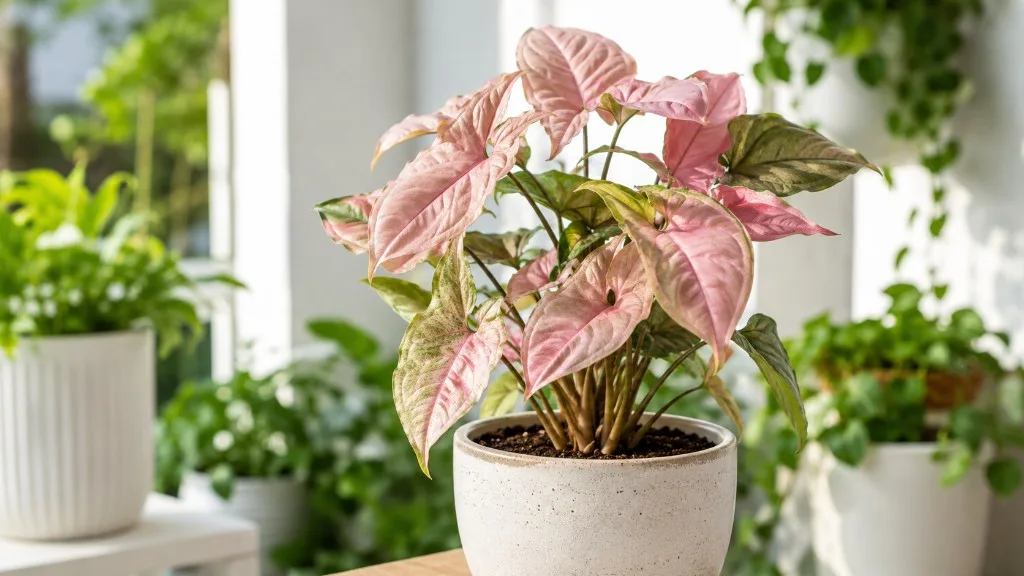
Syngonium Pink is a pink-foliage cultivar of the arrowhead vine, Syngonium podophyllum, grown indoors for soft blush-to-rose arrow-shaped leaves on a compact, eventually vining aroid. In shops and online listings you will most often see it sold as Pink Allusion, pink arrowhead plant, pink syngonium, or simply Syngonium podophyllum ‘Pink’ - names that usually refer to the same general look even when the exact cultivar tag is missing. The plant belongs to the family Araceae, the aroid family that also includes philodendrons, monsteras, pothos, and anthuriums, and it shares their baseline needs: airy roots, filtered light, and soil that drains faster than it stays wet.
In a typical indoor pot, Syngonium Pink starts upright and bushy, with juvenile leaves shaped like arrowheads and colored in dusty pink, salmon, and light green. As it matures, stems lengthen, internodes stretch, and the plant begins to vine and climb if you give it a moss pole, trellis, or shelf to lean on. Mature leaves can develop more lobes and a less strictly arrowhead silhouette - a normal phase change, not a sign that you bought the wrong plant. Growth is moderate in average home conditions: neither as slow as a snake plant nor as explosive as a pothos in bright summer light. Most container specimens reach a manageable 12 to 24 inches (30 to 60 cm) before vining behavior becomes obvious, though a supported climber can grow taller over time.
If you are deciding whether Syngonium Pink overview fits your home, the honest summary is this: Syngonium Pink rewards Syngonium Pink light guide, consistent moisture without sogginess, and a well-draining aroid mix - and it punishes dim corners, waterlogged soil, and neglect of any one of those basics. It is easier than many finicky calatheas and more demanding than a ZZ plant when it comes to light and color. The payoff is year-round blush foliage without waiting for flowers, plus propagation simple enough that one healthy parent can supply several gifts. One critical caveat for pet owners: according to the ASPCA, Syngonium podophyllum is toxic to cats, dogs, and horses because all parts contain insoluble calcium oxalate crystals. That makes Syngonium Pink a poor choice for homes where curious pets can reach accessible shelves.
Botanical Background and Cultivar Confusion
Syngonium podophyllum is native to the tropical forests of Central and South America, including regions in Mexico, Ecuador, Brazil, Bolivia, and the West Indies, where it grows as an understory climber in warm, humid air. In that environment the plant receives filtered light through the canopy, roots into loose, organic forest floor material, and experiences a wet-dry rhythm driven by rain and drainage - not a fixed weekly watering calendar. Indoor care works best when you approximate that pattern: bright but softened light, a chunky mix that holds some moisture while staying airy, and watering triggered by how fast the actual pot dries in your room.
Taxonomically, Syngonium sits firmly in Araceae. Aroid houseplants share a few practical rules that matter more than any single product label: root oxygen matters, compacted peat-heavy mixes cause trouble over time, and most visible problems begin underground days or weeks before leaves show distress. The juvenile arrowhead leaf shape is characteristic of young syngoniums; mature foliage on older vines often looks more divided. Neither stage is “wrong” - they are different growth phases of the same species.
Commerce creates naming noise. Pink Allusion is a widely sold cultivar with dusty pink leaves edged in darker green. Neon Robusta is another pink-leaning syngonium, but its tone reads more coral-pink and pastel than the muted blush of Pink Allusion. Maria Allusion and Berry Allusion add speckled or veined pink patterns. A pot labeled only “Syngonium Pink” may be any of these, or a batch-grown pink selection without a stable cultivar name. For care purposes they are close cousins: all want bright indirect light, aroid soil, and steady moisture. For color expectations, treat the newest leaves as the truth - if your plant came without a tag, you are growing the plant in front of you, not the photo on a marketing page.
According to Plants of the World Online, Syngonium podophyllum is an accepted species with a broad Neotropical distribution. You do not need a botany degree to grow it well, but knowing the species name helps you filter reliable care advice and avoid confusing this plant with unrelated “arrowhead” labels used for other genera.
Why Pink Color Depends on Light
The pink in Syngonium Pink is not paint - it is live tissue pigmentation that responds to light intensity, leaf age, and cultivar genetics. In adequate bright indirect light, newer leaves show the strongest blush: pink veins, rose-tinted zones between green margins, or an overall salmon wash depending on the cultivar. In too little light, the plant survives for a while but new growth turns greener, internodes lengthen, and the plant looks like a generic syngonium that lost its selling point. In too much direct sun, especially on leaves formed in lower light, pigments bleach and sun-facing patches scorch before the plant can acclimate.
This is why two identical pots in different rooms can look like different plants within a month. The owner with an east window and a sheer curtain keeps compact pink new growth. The owner across the hall in a dim corner gets leggy green stems with only a faint pink memory on the oldest leaves. If you bought Syngonium Pink specifically for color, light is not a secondary detail - it is the main maintenance task, more important than fertilizer brand or decorative pot choice.
Best Growing Conditions for Syngonium Pink
Syngonium Pink does best when your room approximates the warm, bright, humid rhythm of a tropical understory. The four variables that decide almost every outcome are light, water, soil, and temperature. Align those and feeding, Syngonium Pink repotting guide, pruning, and propagation become routine. Misalign one - especially light or drainage - and the plant declines in ways that fertilizer cannot fix.
Light Requirements
Syngonium Pink needs bright indirect light to stay compact and keep strong pink tones. A practical starting point is the kind of light you get near an east-facing window, or a west- or south-facing window filtered by a sheer curtain so leaves receive strong ambient daylight without harsh midday sun directly on the foliage. North windows can work in genuinely bright rooms, but they are often too dim for reliable pink coloration over the long term. If you would not comfortably read a book at that spot for several hours without switching on a lamp, the plant probably wants to be closer to the glass or nearer a brighter exposure.
The fastest diagnostic for incorrect light is new growth, not old leaves. Compact internodes, firm stems, and pink or blush tones on freshly unfurled leaves mean the plant is likely happy. Long, floppy stems with small pale leaves mean it wants more light. Bleached patches, brown crispy zones on sun-facing leaves, or sudden collapse after a move to a brighter sill mean it wants softer light or slower acclimation. When upgrading light, move the plant gradually over one to two weeks so leaves formed in lower light are not burned in afternoon sun.
Some growers report that a short period of gentle morning direct sun - especially from an eastern exposure - improves color without damage. That can work, but it is not a license for hot midday rays on a windowsill. Watch the plant, not the calendar: if the newest leaves stay well colored and undamaged, the exposure is probably acceptable. If color improves but tips crisp, pull the plant back or add filtering.
When natural light is weak in winter, a full-spectrum grow light on a 10–12 hour timer, positioned roughly 12–18 inches above the canopy, prevents the stretched, washed-out look common on syngoniums parked far from windows in northern latitudes between November and February. Rotate the pot weekly so growth stays even rather than leaning hard toward the light source.
Temperature and Humidity
Syngonium Pink prefers stable indoor temperatures between 60 and 85°F (16 and 29°C). Most homes already sit inside that band, but problem spots are predictable: cold winter window sills, air-conditioning vents blowing directly on leaves, and radiators or heat registers that cook one side of the pot. Sudden cold drafts can stall new growth and encourage leaf drop on stressed plants. Sustained temperatures below about 55°F (13°C) slow metabolism sharply; treat that as a stress zone, not a normal operating range.
Humidity is helpful but rarely the first limiting factor if watering and light are correct. 40 to 60% relative humidity supports healthy foliage in most homes. Very dry winter air - consistently below 30% - can encourage spider mites and increase brown tip frequency, especially if soil also dries too far between waterings. A small humidifier, grouping plants, or a pebble tray with water below pot level (not touching the drainage holes) all raise humidity more effectively than misting, which provides only a brief surface wetting and can invite fungal spotting on crowded foliage.
Because Syngonium Pink is an aroid from humid forests, it tolerates kitchen and bathroom microclimates better than desert-dry office cubes - as long as light is still adequate. Do not trade a dark humid room for a brighter dry one; light wins that decision for this cultivar.
Soil and Drainage
Use a well-draining aroid mix, not straight garden soil or heavy, all-peat indoor potting soil that compacts after a few months. A practical home recipe is 40–50% high-quality potting base, 20–30% perlite or pumice, and 20–30% orchid bark or coco chips to create air pockets roots can explore. Some growers add a small portion of worm castings or compost for organic matter; the non-negotiable part is fast drainage and root airflow.
The pot must have drainage holes. A decorative cachepot is fine only if you empty runoff after every watering. Syngoniums are susceptible to root rot when mix stays saturated for days, especially in lower light where the plant drinks slowly. If water runs straight through a pot without soaking in, the mix may have gone hydrophobic or the root ball may be too tight - both are repotting signals, not reasons to pour water daily.
Aroid literature often cites a preferred substrate pH around 5.5 to 6.5. Hobbyists rarely need to measure pH unless the plant chronically struggles despite good light and watering; repotting into fresh, airy mix every 12 to 24 months usually matters more than fine-tuning acidity.
How to Water Syngonium Pink
The general rule is: water when the top 1 to 2 inches (2.5 to 5 cm) of mix feel dry, then soak thoroughly until excess drains from the holes. Syngonium Pink is tropical - it dislikes staying bone dry for long periods - but it drowns faster in soggy soil than it wilts from one missed check. Calendar watering is where most owners go wrong; pot weight, skewer moisture, and finger depth are better decision tools than “every Tuesday.”
Use your finger, a bamboo skewer, or a moisture meter at root depth before you pour. If the deeper mix is still cool and damp, wait. If the top layer is dry and the pot feels light for its size, water evenly across the surface until 10–20% of the volume flows out the bottom, then discard saucer water. A plant in brighter light or a smaller pot may need checks every few days in summer; the same plant in a cool dim room in winter may go 10 to 14 days between drinks. Both rhythms can be correct.
Syngonium Pink watering guide During Active Growth
During active growth - typically spring through early fall when new leaves unfurl regularly - Syngonium Pink uses water predictably if light is stable. The goal is a full wetting followed by a partial dry-down, not permanently damp soil. Small daily sips keep the surface wet while deeper roots starve or rot; deep watering when dry mimics rainforest showers and drying breezes more closely.
Watch the plant’s language. Firm, upright stems and leaves that perk back up within hours after watering suggest the rhythm is close. Chronic wilting with wet mix points to root trouble, not thirst. Crispy leaf margins with very dry, shrunken mix point to underwatering or roots too damaged to absorb water. When in doubt, check roots at the drainage hole opening before escalating fertilizer or moving the plant again.
Seasonal Adjustments
In cooler, dimmer months, growth slows and evaporation drops. The summer schedule that worked on a sunny sill will overwater the same plant in January if you do not adjust. Stretch intervals, verify depth moisture more carefully, and pause fertilizer when no new leaves are forming. Resume the warmer rhythm only when you see consistent new growth and faster drying again.
Seasonal change also means moving plants away from cold glass at night in heated rooms. Roots near a frigid windowpane stay cold even when the thermostat reads 70°F; cold roots absorb water poorly and mimic overwatering damage on the leaves above.
Common Watering Mistakes
The single most common mistake is watering on a schedule without checking the pot. The second is letting the plant sit in runoff, which suffocates roots exactly where drainage should help. The third is responding to wilt by watering reflexively when the mix is already wet - a classic root-rot acceleration move.
Hard tap water high in fluoride or chlorine can contribute to brown leaf tips over months, especially in small pots where salts accumulate. If tips persist despite good moisture rhythm, try filtered or rainwater for a few months and flush the pot occasionally by running plain water through until it flows freely from the holes. This is not mandatory everywhere, but it is a low-cost test when tips appear on otherwise healthy leaves.
How to Feed Syngonium Pink
Syngonium Pink does not need heavy feeding. A modest, balanced fertilizer during active growth is enough to support leaf color and steady size increase. Overfeeding burns roots, salts the mix, and creates more problems than it solves - especially on a plant you mainly grow for foliage, not flowers.
A balanced water-soluble houseplant fertilizer (for example 10-10-10 or 20-20-20) diluted to one-quarter to one-half of the label rate is a safe starting point. Apply to already-moist soil so the solution distributes without concentrating at dry root surfaces. Many growers feed monthly in spring and summer; fast-growing, brightly lit plants may tolerate biweekly quarter-strength doses, while dimmer plants need less. If your potting mix includes a starter fertilizer charge, skip supplemental feeding for the first 4 to 6 weeks after repotting.
Pause feeding during dormant or slow-growth periods, immediately after a major repot, while the plant recovers from pest damage or root pruning, and whenever the soil has been kept too wet. Fertilizing a plant that cannot use nutrients adds salt without growth. Resume at low strength only when new leaves appear and the pot dries on a normal rhythm again. Yellow leaves from nitrogen deficiency are uncommon in fresh commercial mix but can appear after 12 to 18 months without any feeding or repotting. If yellowing is uniform on older leaves while new growth stays green, a gentle feeding cycle after correcting water and light is reasonable. If yellowing appears with wet soil smell, treat roots first - fertilizer will not fix rot.
Repotting and Root Health
Repot Syngonium Pink roughly every one to two years, or whenever the pot dries much faster than it used to, roots circle drainage holes, water runs straight through without soaking in, or growth stalls despite good light. The best timing is early in the active growing season so roots have months of warmth and brightness to recover.
Move up only one pot size - typically 1 to 2 inches (2.5 to 5 cm) wider in diameter. Oversized pots hold excess wet mix around a small root ball, the most common post-repot rot scenario. Tease circling roots gently, remove only obviously mushy tissue, plant into fresh aroid mix, and water lightly the first week while cut surfaces callus. A clear plastic pot can help you read root color without disturbing the plant.
Signs It Is Time to Repot
Physical signals beat the calendar. Roots emerging from drainage holes, a top-heavy plant that tips easily, mix that dries in a day or less, or mix that stays wet for two weeks despite modest watering all suggest the current container or substrate is mismatched to the root mass. A sour smell, white fungus gnats every time you water, or soil that has collapsed into a dense brick also warrant repotting even if the season is slightly less than ideal. Late winter through late spring is ideal in the Northern Hemisphere - the plant is waking up, days are lengthening, and roots heal quickly. Repotting in deep winter dormancy or mid-summer heat stress is possible in emergencies but expect slower recovery. If you must repot a struggling plant because of rot, do it immediately regardless of month; saving roots outweighs seasonal optimization.
Propagation Methods for Syngonium Pink
Syngonium Pink propagates easily from stem cuttings, which makes it inexpensive to multiply or replace a leggy parent. Division works when a pot holds multiple rooted stems. Because cultivar color can vary with light, propagate from the pinkest healthy stems if color is your priority.
- Choose a stem with at least one node (the knuckle where leaf meets stem) and two or more leaves.
- Cut with clean scissors or a knife; include ¼ inch (6 mm) below the node so the node is not damaged.
- Root in water, moist sphagnum, perlite, or a light aroid mix. Water propagation lets you watch root formation; change water weekly to limit rot.
- Keep the cutting in bright indirect light and stable humidity. Enclose loosely in a clear bag only if your air is very dry, opening daily for airflow.
- Pot when roots are 1 to 2 inches (2.5 to 5 cm) long, usually 2 to 4 weeks in warm conditions. Water gently the first week.
Stem cuttings root readily because syngoniums are built to reroot along climbing stems in the wild. A leggy parent can become three compact youngsters with pruning and cuttings combined. Do not propagate from pest-infested, rotting, or severely dehydrated plants. Cuttings inherit the parent’s health profile, and weak material fails at high rates. Clear mealybugs, scale, or root rot first, then take cuttings from recovered new growth. Also avoid propagating patented nursery cultivars for resale if your region restricts vegetative propagation of patented plants - home propagation for personal use is generally fine, but commercial resale has legal limits depending on patent status.
Common Syngonium Pink Problems
Most Syngonium Pink problems are environmental, not mysterious. Leaves are sensors for root and light conditions that went wrong days earlier. The hardest part is patience: damage took weeks to appear and usually takes weeks to outgrow after you fix the cause.
Yellow Leaves, Fading Color, Brown Tips, and Pests
Yellow leaves most often mean overwatering or poor drainage, especially if yellowing starts on lower leaves while the mix smells musty or stays wet at depth. Underwatering can yellow and crisp leaves too, but the mix is usually dry and light. Low light produces yellowing on older leaves as the plant sheds foliage it cannot support while stretching toward brightness. Natural senescence - one old leaf yellowing as a new one opens - is normal; panic is only warranted when multiple leaves yellow quickly.
Fading pink color is almost always a light problem, not a fertilizer deficiency. Move gradually to brighter indirect exposure and watch the next two leaves for improved blush. Pruning green, leggy stems can redirect energy to compact new growth with better color if light is already fixed. Do not chase color with high nitrogen alone; you will get bigger green leaves, not pinker ones.
Brown tips often combine low humidity, inconsistent watering, and salt buildup in small pots. Flush the mix, stabilize watering, and raise humidity slightly if your winter air is desert dry. Leggy growth means insufficient light - shorten stems by pruning above a node and improve placement simultaneously so new shoots stay tight.
Watch for spider mites in dry air (fine webbing, stippled leaves), mealybugs in leaf axils (white cottony clusters), scale on stems (brown bumps), and fungus gnats when the surface stays wet. Inspect weekly. A shower rinse, manual removal, and insecticidal soap handle most outbreaks if you act before pests blanket the plant. Isolate new purchases for two weeks so problems do not spread to your collection.
Is Syngonium Pink Safe for Pets?
No - Syngonium Pink is not safe for pets or small children who might chew plants. The ASPCA lists Syngonium podophyllum (arrow-head vine, nephthytis) as toxic to cats, dogs, and horses. Toxic principle: insoluble calcium oxalate crystals in all plant parts. Chewing leaves or stems typically causes oral irritation, pain and swelling of the mouth, tongue, and lips, excessive drooling, vomiting in pets other than horses, and difficulty swallowing, according to the ASPCA Arrow-Head Vine listing.
This is usually a painful irritation event, not silent poisoning - but severity depends on how much was ingested and the individual animal. Keep Syngonium Pink on high shelves, in closed rooms, or behind barriers when pets explore plants. If you suspect ingestion, contact your veterinarian or the ASPCA Animal Poison Control Center at (888) 426-4435 (fee may apply). Do not assume “toxic” means lethal in every nibble; do assume it is not a plant to make accessible in pet-forward homes.
Conclusion
The most useful thing to know about Syngonium Pink is that it is a tropical aroid from the arrowhead vine lineage, bred for blush foliage that only stays special in bright indirect light, rooted in airy, well-draining mix, and watered on a check-the-pot rhythm rather than a calendar. Treat it like a compact pink syngonium when young, expect vining as it matures, and propagate stem cuttings freely when you want bushier pots or backup plants. Fix light and drainage before fertilizer, read yellow leaves as moisture or light signals, and keep the plant away from pets. When those basics align, Syngonium Pink is one of the more forgiving colorful foliage plants for bright indoor rooms - a plant worth placing where you can actually see the pink.
When to use this page vs other Syngonium Pink guides
- Syngonium Pink overview - Canonical hub for this species - care topics and problems branch from here.
- Syngonium Pink problems - Symptom-first path when you already know something is wrong.
Related Syngonium Pink guides
How to care for Syngonium Pink?
How much light does Syngonium Pink need?
bright indirect light, medium indirect light
- bright indirect light, medium indirect light - bright indirect light, medium indirect light.
When should you water Syngonium Pink?
Water when top inch of soil dries.
- Check top 2 inches - Water when top inch of soil dries.
- Drain excess water - Water when top inch of soil dries.
What soil works best for Syngonium Pink?
Well-draining potting mix.
- Well-draining mix - Well-draining potting mix.
Grower notes for Syngonium Pink
Pink Syngonium identity note
Pink Syngonium is usually sold for a stronger pink arrowhead look and may vine more obviously as it matures. The color can vary by cultivar and light, so judge the newest leaves rather than the oldest ones in the pot. Give it support if you want mature leaves, or prune it if you want a bushier shelf plant. Compared with Neon Robusta, it often reads bolder and less pastel.
Best use for Pink Syngonium
Use Pink Syngonium where foliage color matters more than perfect symmetry. It responds well to pruning, so it can stay compact, trail lightly, or climb depending on how early you shape it.
What makes Pink Syngonium different
Pink Syngonium can be more variable than Neon Robusta: some leaves blush strongly, while others come in pale green or salmon depending on light and maturity. The goal is steady color, not forcing every leaf to look identical.
What matters most with Syngonium Pink
Syngonium Pink can change leaf shape as it matures, so juvenile leaves are not always a sign of poor care. Give it support or pruning depending on whether you want a compact tabletop plant or a climbing arrowhead vine. In practice, the care checkpoint is simple: bright indirect light, medium indirect light. Pair that with well-draining potting mix, and avoid changing water, pot size, and placement all at once.
Best placement in a real home
Syngonium Pink belongs where bright indirect light, medium indirect light is realistic for most of the day, not only where the pot looks good. Water when top inch of soil dries. If the pot stays wet longer than expected, move the plant into better light or reassess the mix before watering again. Humidity target: Moderate humidity (50–60%).. Temperature comfort zone: 16°C to 27°C (60–80°F).
Before you buy this plant
Choose Syngonium Pink with firm new growth, clean leaf undersides, and soil that does not smell sour or feel compacted. Be cautious if you see leggy-growth, sticky residue, collapsed crowns, or a pot that is wet in poor light. Cosmetic old-leaf damage is less worrying than weak roots or active pests.
First month after bringing it home
Do not repot Syngonium Pink on day one unless the mix is failing or pests are obvious. Quarantine it, learn how fast the pot dries, and keep care boring while it adjusts. Watch especially for leggy-growth and yellow-leaves. If problems appear, correct the condition first rather than stacking fertilizer, repotting, and pruning together.
Safety note for Syngonium Pink
Syngonium Pink is not a plant to keep within reach of pets or children. Treat it as an inaccessible display plant. Use gloves if sap or plant tissue is irritating, and pick a pet-safe alternative for floor pots or low shelves.
How to tell Syngonium Pink is settling in
If you plan to multiply it later, common methods include Stem cuttings. If yellow-leaves shows up early, inspect light, watering, and roots before assuming the plant is permanently weak.
Is it pet safe?
Syngonium Pink is toxic to cats and dogs.
Toxic - calcium oxalate crystals.
Watering Syngonium Pink
Water when top inch of soil dries.
Soil & potting for Syngonium Pink
Well-draining potting mix.
Humidity & temperature for Syngonium Pink
Syngonium Pink prefers moderate humidity (50–60%), though normal home humidity is usually fine. Keep temperatures around 16°C to 27°C (60–80°F).
| Detail | Information |
|---|---|
| Humidity | Moderate humidity (50–60%) - normal home humidity is fine. |
| Ideal temperature | 16°C to 27°C (60–80°F) |
Fertilizer & pruning for Syngonium Pink
Use feed lightly during active growth. Use monthly in spring and summer.. for Syngonium Pink.
| Detail | Information |
|---|---|
| Fertilizer type | Feed lightly during active growth. Use monthly in spring and summer.. |
Common problems on Syngonium Pink
Leggy Growth
MediumLikely cause: Low light.
Quick fix: Move to brighter indirect light.
Full fix guide →Yellow Leaves
MediumLikely cause: Overwatering.
Quick fix: Allow soil to dry between waterings.
Full fix guide →