Leggy Growth on Syngonium Pink: Causes, Checks & Fixes
Quick answer
Leggy growth on Syngonium Pink is etiolation-long bare internodes as the plant reaches for photons, often with fading pink wash on new leaves. First step: move to brighter filtered light, wait for one compact new leaf, then prune leggy tips above a node.
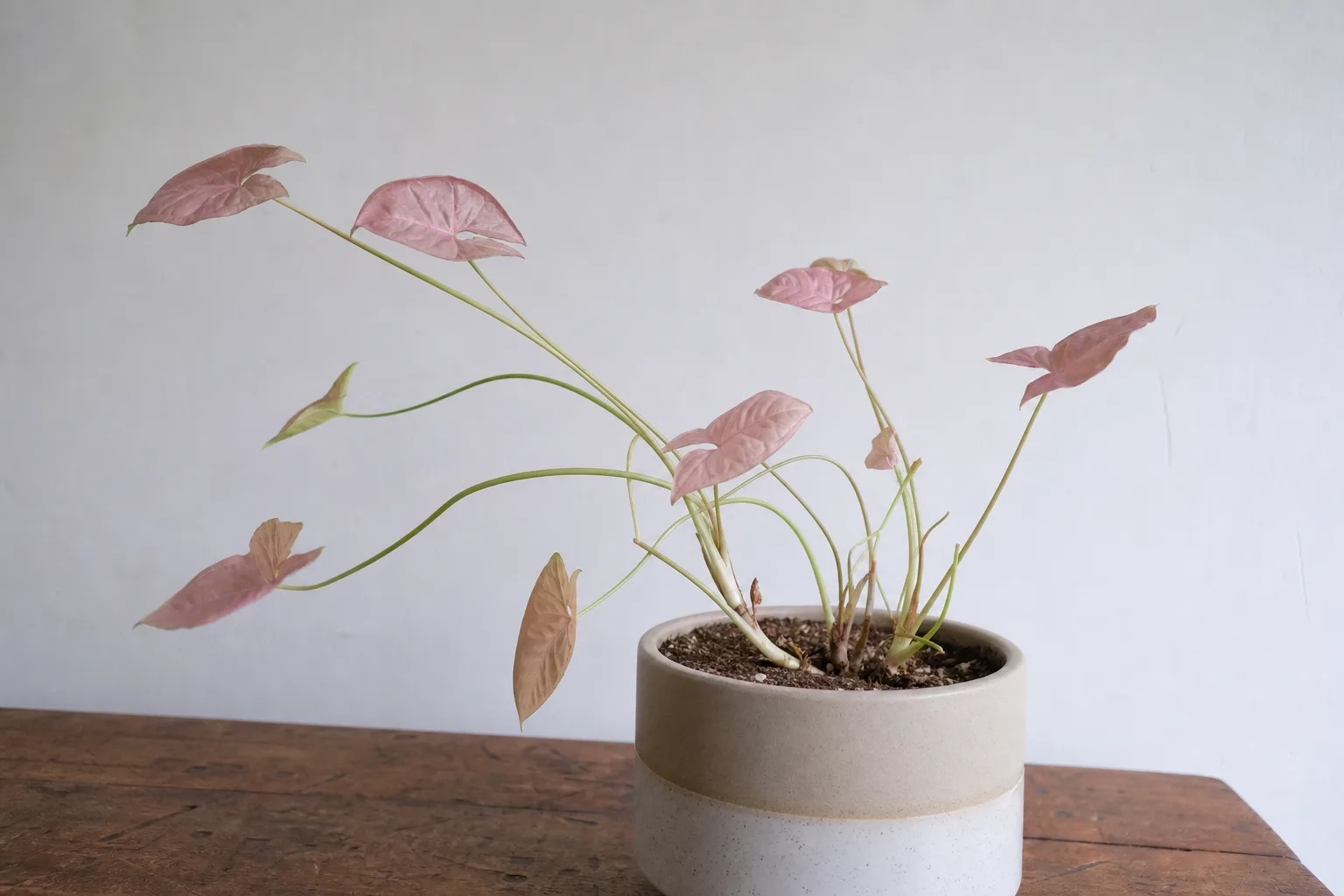
Leggy Growth on Syngonium Pink: Causes, Checks & Fixes
This guide covers leggy growth on Syngonium Pink. See also the general Leggy Growth guide, watering, and light pages for this plant.
Leggy Growth on Syngonium Pink: Causes, Checks & Fixes
Quick answer
Leggy growth on Syngonium Pink (Syngonium podophyllum ‘Pink’) is etiolation-the plant stretching toward usable light because current brightness is too low to support compact pink foliage. Pink arrowhead cultivars carry less chlorophyll in young leaves than green forms, so they stretch sooner when photons drop. When light is insufficient, internodes lengthen, leaves shrink, stems lean toward glass, and the bold pink wash greens or dulls as the plant produces more chlorophyll in pale tissue.
First step: move the pot to brighter filtered light and acclimate over one to two weeks. Do not prune heavily, fertilize, or repot on day one. Wait until the plant produces at least one new leaf with tighter spacing and stronger pink, then prune leggy tips above a node to reshape the canopy.
This page owns stretch morphology and prune-after-compact-growth timing. If your main symptoms are placement confusion, color fade in a north-facing room, wet soil in deep shade, or a full low-light diagnostic workflow, start with not enough light on Syngonium Pink instead.
What leggy growth looks like on Syngonium Pink
Pink Syngonium starts compact with juvenile arrowhead leaves on short petioles. Etiolation changes that silhouette in recognizable ways:
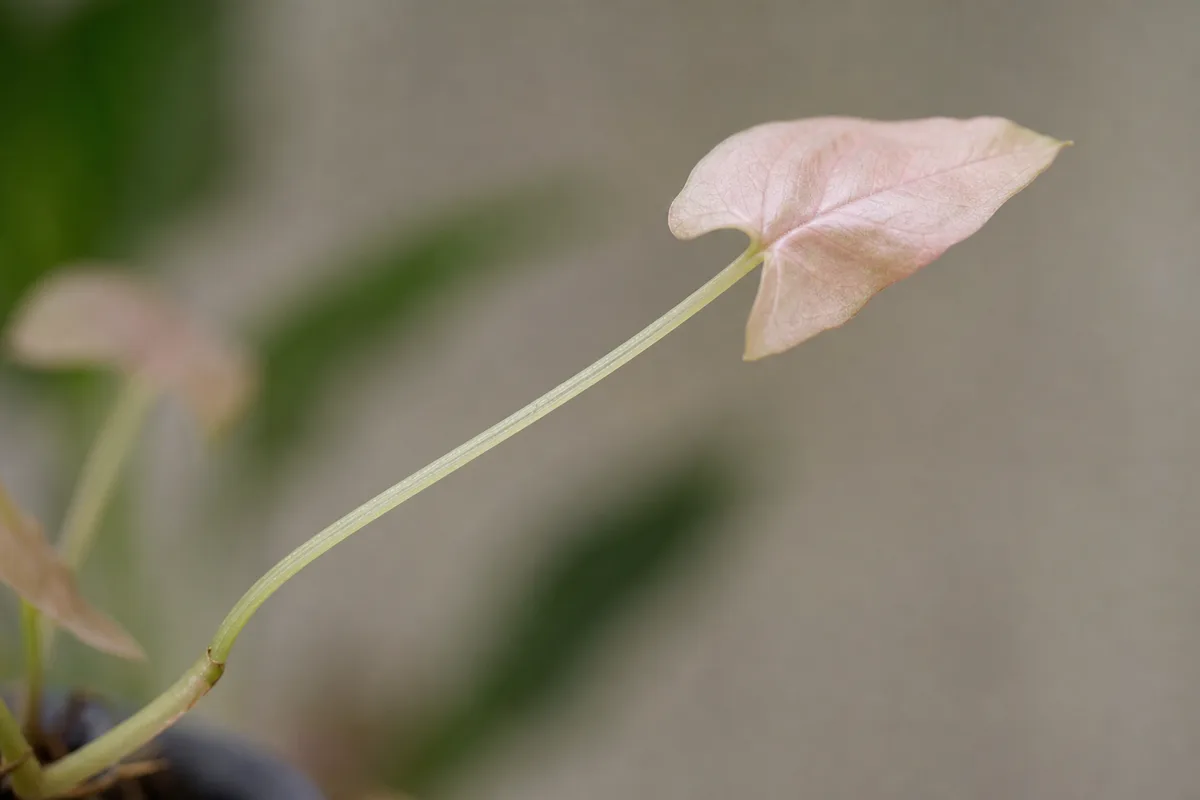
Leggy Growth symptoms on Syngonium Pink - compare with healthy tissue on the same plant.
- Long bare stem sections with leaves spaced far apart compared with earlier growth in the same pot
- Smaller new arrowhead leaves opening pale salmon, washed-out pink, or mostly green instead of bold blush
- Stems leaning strongly toward the brightest window or lamp
- Soft, floppy vines that cannot support their own weight without leaning on a shelf or wall
- One-sided stretch when only one face of the pot receives real light
- Lower leaf drop on older sections, leaving a sparse vine-like profile
Some vining is normal as Syngonium matures. NC State Extension notes that young plants stay shrubby while older plants develop a vine-like habit with cascading stems. The diagnostic question is whether stretch coincides with declining leaf size and pink quality, not just age. If newest leaves are smaller, greener, and farther apart than leaves from six months ago in the same spot, treat it as etiolation-not mature climbing habit alone.
Compare with not enough light on Syngonium Pink: that guide covers broader dim-Syngonium Pink light guide, acclimation schedules, green-reversion biology, and foot-candle targets. Leggy growth here focuses on internode stretch and when to prune after light improves.
Why Syngonium Pink gets leggy growth
Insufficient light for pink tissue
Pink Syngonium is selected for anthocyanin pigment over reduced chlorophyll in young leaves. That color costs photosynthetic efficiency, so the plant stretches toward brighter zones when light drops. Missouri Botanical Garden recommends bright indirect light for arrowhead vine, and pink cultivars need the middle of the practical range-not survival-level shade. UF/IFAS EP244 places commercial Syngonium at 250 to 1,000 foot-candles; dim interior shelves often deliver far less.
Seasonal light drop indoors
Winter shortens daylight and pushes pots deeper into rooms. A Pink Syngonium that looked fine in summer can etiolate after months at the same interior shelf. University of Maryland Extension notes that indoor plants become spindly or leggy as they stretch for more light, often leaning when light arrives from one direction.
Natural vining habit mistaken for a problem
Syngonium is a climbing aroid. Fast summer growth on a moss pole can look leggy even when light is adequate. Context matters: healthy vining keeps pink quality steady on new leaves; etiolation shows declining leaf size and pink wash at the same time.
Overfertilizing in low light
Heavy feeding when the plant cannot use light efficiently can push weak, elongated tissue. This is secondary to light, but it explains why some Pink Syngoniums stay spindly despite regular fertilizer. Fix light first; feed lightly only during active growth in brighter conditions.
Low light plus slow water use
Leggy Pink Syngoniums in dim corners transpire slowly. Soil that stayed appropriately dry in a bright window may remain wet too long in shade, compounding stress. Light correction often improves dry-down rhythm without changing pot size.
How to confirm the cause
Work through these checks in order:
- New growth quality - Are the last two or three leaves smaller, paler, or greener than older pink leaves? That pattern confirms light-driven etiolation.
- Internode length - Measure the gap between consecutive leaves on a new shoot. Etiolated growth shows noticeably longer spacing than compact nursery growth.
- Direction of lean - Strong lean toward one window means the plant is actively seeking light. Rotate the pot and watch whether new growth follows the brightest side within two weeks.
- Shadow test at the leaf - Hold your hand above the foliage at midday. Bright indirect light casts a soft, diffuse shadow; deep shade gives almost none.
- Watering cross-check - Confirm whether soil stays wet for days. Wet mix with stretch suggests low light slowing uptake; see not enough light if that combination dominates.
- Pest screening - Spider mites can pale leaves, but they add stippling and webbing-not long internodes with directional lean. Inspect undersides before blaming culture alone.
If color fade, placement confusion, and wet-soil-in-shade are your primary concerns, the not-enough-light guide has the fuller diagnostic path. Return here once light is adequate but old stretched stems still need reshaping.
The first fix to try
Move the pot to brighter filtered light-east window, sheer-filtered south, or a full-spectrum LED 30–45 cm above the canopy for 10–12 hours daily in winter. Acclimate over a week if coming from deep shade to avoid scorch on pale pink tissue.
Do not prune on day one. Let the plant produce one or two compact new leaves with stronger pink and tighter nodes. That confirms light is working before you cut back stretched tissue.
Step-by-step recovery
Once brighter light is in place and new growth looks tighter:
- Wait for confirmation - Judge the next two or three leaves. Tighter spacing and stronger pink mean the foundation is set.
- Prune leggy tips - Cut stretched stems 1–2 cm above a node where a leaf attaches. Use clean scissors. Wear gloves; Syngonium contains calcium oxalate crystals toxic to cats and dogs.
- Choose your shape - For a bushy shelf plant, prune multiple long tips and leave shorter nodes to branch. For a climbing vine, add a moss pole and train the least-stretched leader while pruning bare side shoots.
- Rotate weekly - Even light prevents one-sided stretch from returning.
- Adjust watering - Brighter light means faster dry-down. Water when the top 1–2 inches of mix feel dry, not on a calendar from the dim corner era.
- Light feed only if actively growing - A half-strength balanced fertilizer every four to six weeks during warm months is enough once compact growth resumes. Skip feed in winter or while recovering from heavy pruning.
Recovery timeline
| Stage | What to expect |
|---|---|
| Week 1–2 | Lean may persist; first new leaf may still be pale while the plant acclimates |
| Week 3–4 | New leaves should open closer together with stronger pink if light is adequate |
| Week 4–6 | Side shoots often emerge from nodes below prune cuts in warm bright conditions |
| Month 2+ | Old stretched internodes remain long permanently-judge success by new tissue only |
Fully yellowed or greened old leaves do not revert to pink. Prune them once compact replacement growth is established.
Lookalike symptoms
| Pattern | What you see | Likely cause | Where to go |
|---|---|---|---|
| Etiolation (this page) | Long internodes, lean toward window, shrinking pale new leaves | Too little light for pink tissue | Brighter light, then prune |
| Low light + wet soil | Stretch plus yellow lower leaves, sour smell, days-wet mix | Light stress feeding overwatering | Not enough light first |
| Mature vining | Long stems but steady pink quality and normal leaf size on new growth | Natural climbing habit | Support with moss pole; prune only for shape |
| Spider mites | Stippling, webbing, dusty undersides; internodes not necessarily long | Pest stress | Rinse and treat pests |
| Overfertilizer | Sudden weak upward growth after heavy feed in dim spot | Nutrient push without light | Flush lightly; fix light |
Mistakes to avoid
- Pruning before light improves - Cuts in deep shade produce weak side shoots that stretch again.
- Fertilizing heavily to force bushiness - Nutrients cannot replace photons for pink tissue.
- Assuming Neon Robusta needs less light - Both pink cultivars want real brightness; softer pink does not mean lower light tolerance.
- Expecting old internodes to shorten - Only new growth compacts; stretched sections stay long unless pruned.
- Ignoring wet soil in the dim corner - Slow growth plus soggy mix is a dangerous overlap; fix light and dry-down together.
When to worry
Legginess alone is a form problem, not an emergency. Escalate when:
- Multiple leaves yellow while soil stays wet for days-possible root stress layered on low light
- Stems feel soft at the base or the pot smells sour
- All-green shoots outgrow pink sections fast-reversion risk in chronic shade
- New growth stays pale and stretched after four weeks in a confirmed bright spot-recheck actual foot-candles or pest pressure
How to prevent leggy growth next time
Keep the plant where bright indirect light is realistic most of the day. Rotate the pot weekly if one-sided leaning starts. Supplement winter with a grow lamp if daylight drops below what pink tissue needs. Prune early for a compact shelf plant or train onto support before stems become bare. If your home cannot deliver filtered bright light, a green Syngonium will stay compact longer than fighting for pink color in a north-facing room-see not enough light on Syngonium Pink for placement detail.
When to use this page vs other Syngonium Pink guides
- Syngonium Pink watering guide - Use for routine moisture checks before assuming leggy growth is the main issue.
- Syngonium Pink problems hub - Browse all 2 common issues on this species.
- Yellow Leaves on Syngonium Pink - Different entry point when symptoms overlap with leggy growth.