Syngonium Pink Light Requirements: Windows, Grow Lights
Syngonium Pink Light Requirements: Windows, Grow Lights, and Warning Signs
Syngonium Pink Light Requirements: Windows, Grow Lights, and Warning Signs
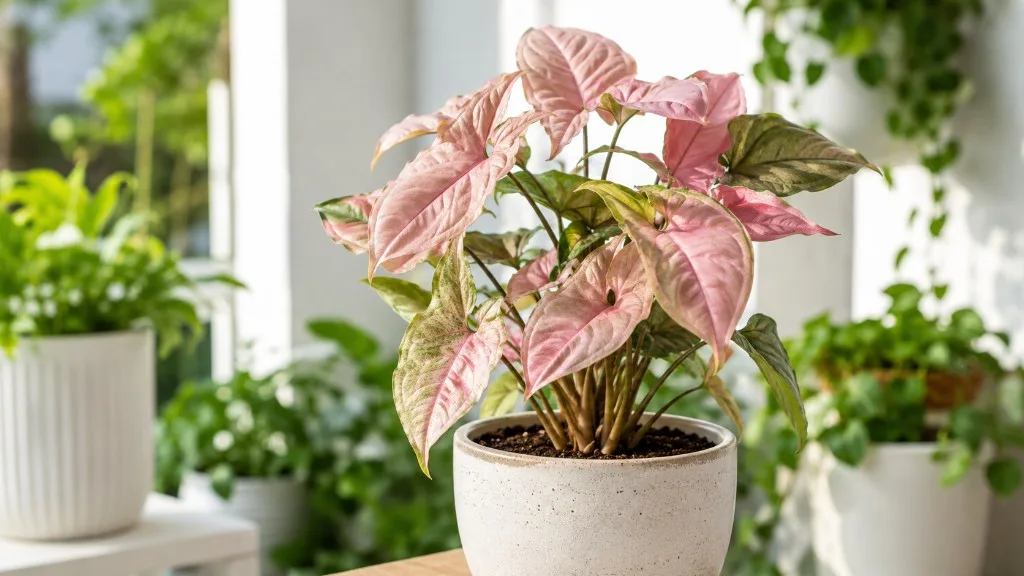
Syngonium Pink (Syngonium podophyllum ‘Pink’) is sold for one visual promise: bold pink arrowhead foliage that reads from across the room. Light is the dial that keeps or breaks that promise. Give the plant enough bright, filtered daylight and new leaves open with a strong blush - sometimes fully pink, sometimes pink over green with a salmon cast depending on the individual plant and how mature the leaf is. Park it in a dim hallway and it will survive for months while slowly turning muted, greenish, and stretched, a different plant wearing the same label. Almost every owner searching for Syngonium Pink light requirements is really asking one of three questions: Is my spot too dark, too bright, or about right? The honest answer is that “about right” is a band, not a single number, and the plant tells you which edge of the band you are on within a few weeks if you know what to look at.
What “bright indirect” actually means for bold pink Syngonium
“Bright indirect light” appears on every Syngonium care page, including the Missouri Botanical Garden entry for Syngonium podophyllum, which recommends bright indirect light and protection from direct sun. The phrase is accurate and incomplete. It does not tell you whether your north window in January qualifies, whether three metres from a south window is enough, or why two plants in the same room can look completely different. For Syngonium Pink specifically, bright indirect means the plant receives strong ambient daylight at the leaf surface without sustained direct sunbeams hitting the foliage. Your eyes are a poor meter for this because human vision adapts to dim rooms and compresses brightness differences. A corner that looks “fine” to you may deliver less than a tenth of the light the plant needs to hold its pink. Measuring at the leaf - or watching new growth - removes the guesswork.
Syngonium Pink in the Wild: Understorey Arrowhead Vine From Central America
A light guide only makes sense when it is anchored in where the species evolved. Syngonium podophyllum is native to the tropical and subtropical forests of Mexico, Central America, and much of northern South America, including Panama, Colombia, and Brazil. In those forests it grows as a hemiepiphytic vine: it may start on the forest floor and climb tree trunks using aerial roots, or it may root directly on bark and work its way toward brighter layers of the canopy. The University of Florida IFAS Extension publication EP244 on commercial interiorscape Syngonium notes that optimal light for the genus in interior settings ranges from 250 to 1,000 foot-candles, which reflects the filtered, variable light of a tropical understorey rather than open sun or deep cave shade.
Forest-floor dappled light versus dark-room “shade”
The rainforest understorey is warm, humid, and sheltered from wind - conditions most homes already approximate in temperature. What homes often miss is the quality of light. Understorey plants receive dappled daylight filtered through multiple canopy layers. Intensity spikes during brief sunflecks when a gap in the leaves aligns with the sun, then drops back to moderate ambient levels. Syngonium Pink leaves are thin compared with many succulents and lack the thick cuticle that sun-hardened desert plants use to block UV. That physiology matches a life spent in filtered light, not on a south-facing sill at noon. Translated to indoor care, the plant wants to sit near a window where it can harvest real photons, not in the middle of a bright-looking room where almost no usable light reaches the leaves.
One persistent mistake is treating “shade-loving” as “dark-loving.” Understorey is not a closet. Plants on the forest floor still receive meaningful photosynthetically active radiation during sunflecks - often a substantial fraction of full daylight for short intervals. Syngonium species have evolved to capture those pulses efficiently, which is why the genus tolerates lower indoor light than many flowering houseplants. Tolerance is not the same as optimal performance. Syngonium Pink in deep shade will live, but it will not keep the bold pink that justified the purchase. The practical distinction: a spot where you can read a book without turning on a lamp during the day is usually adequate for survival; a spot within one to two metres of a bright window with filtered sun is where pink color and compact growth actually happen.
Why a pink cultivar pushes back when light drops
Not every Syngonium podophyllum cultivar has the same light appetite. Solid green forms like older nephthytis selections carry chlorophyll across most of the leaf surface and can photosynthesise efficiently in relatively dim conditions. Syngonium Pink is different. Its appeal is a bold pink wash - anthocyanin pigment layered over reduced chlorophyll in young tissue. Pink zones photosynthesise less efficiently than green zones; the green margins and veins subsidise the paler areas. When light drops, the plant’s survival response is to push more chlorophyll into pink tissue, which reads visually as greening or fading. A solid green Syngonium in the same dim corner may look acceptable for a year. Syngonium Pink in that spot will look washed out within a few new leaves. If you chose this cultivar for colour, treat it as a bright-indirect plant, not a low-light survivor.
Syngonium Pink also shows more color variability than some other pink cultivars. Two plants from the same batch can open leaves that blush strongly pink, pale salmon, or green with a pink edge depending on light intensity, leaf age, and how the grower produced the stock. That variability is normal, not a sign you bought the wrong plant. Judge the newest leaves after a stable two-week placement, not the oldest foliage that formed under nursery conditions you cannot replicate.
The Measurable Light Range Syngonium Pink Wants Indoors
Putting numbers on “bright indirect” turns a vague label into a placement decision you can test in five minutes with a phone app or a cheap lux meter.
Foot-candles, lux, PPFD, and DLI targets
The units that matter for home growers are foot-candles (fc) and lux, because smartphone light meter apps report them directly. PPFD (photosynthetic photon flux density, in µmol/m²/s) and DLI (daily light integral, in mol/m²/day) are the units botanists and serious grow-light users prefer; apps like Photone estimate them from your phone camera. All four describe the same reality in different languages.
| Category | Foot-candles (fc) | Lux | PPFD | DLI |
|---|---|---|---|---|
| Survival minimum | 50–150 fc | 540–1,600 lux | 25–50 µmol/m²/s | 2–3 mol/m²/day |
| Healthy growth and bold pink for Syngonium Pink | 250–800 fc | 2,700–8,600 lux | 60–150 µmol/m²/s | 4–8 mol/m²/day |
| Upper limit before scorch risk on pale leaves | ~1,000 fc | ~10,800 lux | ~200 µmol/m²/s | ~10 mol/m²/day |
| Direct sun at an unobstructed south window (noon) | 2,000–5,000+ fc | 21,000+ lux | 400–1,000+ µmol/m²/s | 30+ mol/m²/day |
Light range adapted from University of Florida IFAS EP244 (250–1,000 fc for interiorscape Syngonium), Missouri Botanical Garden guidance for Syngonium podophyllum, and Iowa State University Extension Yard and Garden indoor light categories. Conversion: 1 fc ≈ 10.76 lux.
UF IFAS EP244 places commercial Syngonium production at 250–1,000 fc and notes that plants pushed below that range lose aesthetic quality over time. For Syngonium Pink, aim for the middle band of that table: bright enough to drive steady photosynthesis and hold pink pigment, not so intense that pale tissue bleaches. Survival happens in the first row; the bold pink arrowhead look you bought the plant for lives in the second.
Pink Syngonium vs Neon Robusta: same band, different color read
Owners often compare Syngonium Pink with Neon Robusta, another popular pink arrowhead cultivar. Both belong to the same species and want the same 250–800 fc bright-indirect band for best color. The difference is visual, not horticultural. Neon Robusta reads softer and more pastel; Syngonium Pink tends toward a bolder, less muted pink when light is adequate. In low light, both green and stretch - but Syngonium Pink’s stronger pigmentation can make the fade feel more dramatic because the contrast between good and poor light is larger. Do not assume Neon Robusta “needs less light” because its pink looks gentler; both cultivars need real brightness at the leaf. If your Pink opens mostly green with a blush, increase light before you hunt for a different cultivar.
Best Window Placement for Syngonium Pink
With targets in hand, placement becomes a geometry problem: window direction sets the ceiling on intensity; distance from the glass sets what the plant actually receives; season adjusts both.
East-facing windows as the default
For most homes in the Northern Hemisphere, an east-facing window is the safest default for Syngonium Pink. Morning sun is lower in the sky and less intense than midday or afternoon sun, so a few hours of gentle direct light on the leaves rarely causes scorch if the plant is acclimated. The rest of the day delivers bright indirect light - a pattern that closely matches rainforest sunflecks followed by filtered ambient daylight. Missouri Botanical Garden recommends bright indirect light and direct-sun protection for Syngonium podophyllum; an east sill with a sheer curtain, or a plant stand 0.5 to 1 metre (1.5 to 3 ft) back from an unobstructed east window, usually lands in the 300–700 fc range at midday. That is squarely inside the healthy growth band. Rotate the pot a quarter turn every week or two if growth leans toward the glass, but avoid daily spinning - the plant acclimates to a light direction over several days, and constant rotation can slow that adjustment.
North, south, and west windows: how to use each safely
A north-facing window in the Northern Hemisphere (south-facing in the Southern Hemisphere) is the lowest-intensity option. It almost never scorches a leaf, which makes it forgiving for beginners. The trade-off is seasonal: in winter above roughly 40° latitude, a north window can fall below 100 fc at the sill on overcast days. Syngonium Pink will survive there in summer but may fade and stretch from November through February. Plan on a grow light supplement or a temporary move closer to an east window during the darkest months if pink colour matters to you.
South- and west-facing windows deliver the highest indoor energy. Unfiltered midday sun at the glass can exceed 2,000 fc - far above Syngonium Pink’s upper comfort zone. Pale pink leaves bleach faster than dark green ones because they have less chlorophyll to dissipate excess light energy. Two reliable fixes: hang a single layer of sheer fabric, which typically cuts 40–60% of incoming intensity and turns a harsh sill into a bright-indirect spot; or place the plant 1.5 to 2.5 metres (5 to 8 ft) back from an unobstructed south or west window, where intensity often falls into the 400–900 fc range without any curtain. Brief morning sun on an east exposure is gentler than the same duration of west-afternoon sun, which arrives when ambient temperature and light intensity are both at their daily peak.
Distance from glass and why room brightness lies
Indoor light drops off faster than most people expect. A plant on a south windowsill may receive 800 fc while the same species two metres into the room gets 80 fc or less on a cloudy day - not because the room is “dark” to your eyes, but because photons scatter and walls absorb them. The inverse square law applies in simplified form: doubling the distance from the window often cuts intensity to roughly a quarter. Practical rule: if Syngonium Pink looks acceptable in the centre of a large living room, you have probably never seen it in good light. Measure at the leaf, not at your desk across the room. Hold a lux meter or smartphone app sensor at the top of the foliage, pointed toward the window, at solar noon on a clear day. Below 2,000 lux (about 185 fc) at the leaf, expect gradual fading and stretching over the next several new leaves. Above 8,000 lux (about 740 fc) at the leaf without filtration, watch for bleaching on the pinkest tissue.
Signs Your Syngonium Pink Is Getting Too Little Light
Syngonium is honest about insufficient light, but the symptoms unfold slowly enough that owners often blame watering first. Learning the order saves months of misdiagnosis.
The first visible sign is etiolation: internodes - the gaps between leaves - lengthen, stems stretch toward the brightest source, and the plant loses the compact, bushy shape that makes Syngonium Pink work as a tabletop specimen. Phototropism is the mechanism. The plant is literally reaching for photons. If you rotate the pot every few days just to counter lean, that is a low-light symptom, not routine maintenance.
The second sign is colour fade. New leaves open with less pink and more green-grey or plain green with only a faint blush at the edge. Older leaves may not recover their colour because anthocyanin distribution was set when they formed. This is the signature Syngonium Pink problem in dim rooms: the plant is not “reverting” to a different cultivar - it is compensating for low light by building more chlorophyll. Smaller new leaves tell the same story. Without enough energy for full-size foliage, each leaf arrives a little shorter and narrower than the last.
There is a hidden third consequence. A Syngonium Pink in a dim corner uses water much more slowly than one in a bright window. Watering on the same calendar schedule in both spots invites root rot in the dim one. UF IFAS EP244 recommends allowing the potting surface to dry slightly between irrigations; in low light, that dry-down takes longer. If your light diagnosis points to “too dim,” move the plant or add a grow light and extend the interval between waterings by roughly a third until you see how the new spot dries.
Signs Your Syngonium Pink Is Getting Too Much Light
Sun damage on Syngonium Pink is faster and more permanent than low-light decline. A bleached patch will not turn pink again.
Classic sun stress on pale Syngonium leaves starts as a washed-out, almost white zone on the tissue most exposed to the beam - usually the tip, the edge, or the centre of a leaf facing the window. Within hours to a few days that zone turns papery, then yellow, then tan or brown and crispy. Chlorophyll destroyed by excess light cannot be rebuilt in that tissue. Because Syngonium Pink’s pink zones already run lower on chlorophyll, they bleach before the green margins show damage - the opposite order from low-light greening.
Three secondary signs often appear alongside bleaching. Leaves may feel warm to the touch in direct sun, which indicates the leaf is absorbing more energy than it can use for photosynthesis. They may curl inward to reduce light-catching surface area. They may wilt despite moist soil because transpiration outpaces root uptake on a hot windowsill. If a curtain comes down, a tree outside is trimmed, or you move the plant outdoors for “more air” without shade, check leaves daily for the first two weeks. Pull back into bright indirect at the first sign of pale, warm, or curling tissue - do not wait for brown edges.
Grow Lights for Syngonium Pink: Fixtures, Distance, and Timing
Grow lights are not a hobbyist luxury for Syngonium Pink in many homes. They are the realistic way to hit 4–8 mol/m²/day DLI during winter, in north rooms, or in offices with a single small window.
Spectrum, wattage, photoperiod, and placement
The default choice is a full-spectrum white LED in the 4,000–6,500 K range. Kelvin describes colour appearance, not intensity - 6,500 K is a cool daylight white; 4,000 K is neutral and often looks more natural in a living room. Both support foliage growth. Avoid purple-only “blurple” fixtures tuned for flowering crops; they work but look harsh in shared spaces and are harder to evaluate by eye.
Three variables control what the plant receives: fixture output, distance from the canopy, and hours on per day. For a single Syngonium Pink in a 15–20 cm (6–8 in) pot, a 20–40 W LED panel mounted 30–45 cm (12–18 in) above the top leaves, run 10–14 hours per day on an outlet timer, is a solid starting point. Doubling distance cuts intensity to roughly a quarter because of the inverse square relationship - mounting too high wastes wattage. Plants also need 6–8 hours of darkness nightly for normal respiration; do not run lights 24/7.
Pink colour responds to consistent intensity more than to exotic spectra. A steady 80–120 µmol/m²/s at the leaf for 12 hours beats a brighter fixture that is so close it bleaches tissue every afternoon.
How to measure what your plant actually receives
Two tools help. A smartphone PAR app like Photone estimates PPFD and DLI; it is not laboratory-accurate but is usually within 10–15% of a dedicated quantum sensor - close enough for placement decisions. A basic lux meter app also works; remember lux is weighted for human vision and diverges slightly from photosynthetic light under some LED spectra.
A no-tool check that still works: the shadow test. Hold your hand 30 cm (12 in) above the leaves at the brightest time of day. A soft, faint shadow means adequate light for active growth. No visible shadow means add light. A sharp, dark shadow with leaves warming in the beam means filter or move back. Confirm with new growth over two to three weeks - compact pink leaves are the final verdict.
Acclimating Syngonium Pink to a New Light Position
Syngonium does not handle abrupt light jumps well. Moving from a dim shelf to a south sill in one step is how pink leaves get bleached in a single afternoon.
A reliable 10–14 day acclimation for increasing light: on days 1–3, place the plant in slightly brighter ambient light with no direct sun - for example, 1.5 metres back from an east window or behind a sheer curtain on a south window. On days 4–7, move 30–60 cm (1–2 ft) closer to the target spot every two days, checking leaves for pale, warm, or curling signs. By days 8–14, settle into the permanent position and continue watching - scorch sometimes appears 5–10 days after the move because tissue damage lags behind exposure.
Decreasing light is gentler. You can move from bright to dim in one step; expect possible leaf yellowing on older foliage and a brief pause in new growth while the plant adjusts its chlorophyll balance. Pair any move to a dimmer spot with reduced watering for the first two weeks.
Three checks matter during acclimation. Leaf temperature at midday - ambient, not warm. New leaf quality - firm, appropriately pink for that plant’s range, not papery or tiny. Soil dry-down rate - if the pot stays wet a full week after watering, the new spot is dimmer than the old one and the Syngonium Pink watering guide should slow.
Light, Pink Intensity, and Growth Habit: Tabletop Bush or Climbing Vine
Syngonium Pink was bred for a bold pink juvenile look on a compact, upright-to-trailing plant. Light controls all three traits: colour, internode length, and leaf size.
Light too low (consistently under ~150 fc / 1,600 lux at the leaf): pink fades toward green-grey, internodes stretch, new leaves shrink, and the plant becomes a thin vine instead of a dense clump. Light in the target band (250–800 fc / 2,700–8,600 lux): pink stays bold and visible on new growth, stems stay short enough that pruning maintains a full silhouette, and the plant pushes a new leaf every one to three weeks in the active season. Light too high (unfiltered direct sun above ~1,000 fc / 10,800 lux on pale tissue): pink bleaches to white-tan, edges crisp, and the plant looks tired even when watering and humidity are fine.
If you want the compact pink tabletop look, combine bright indirect light with early pinching of long stems - but pinching cannot fix colour lost to dim light. If you want a climbing arrowhead with larger mature lobed leaves, the same light rules apply; more light supports bigger foliage, and a moss pole gives the vine something to climb without changing the intensity requirement. Syngonium Pink may vine more obviously as it matures than when you first bought it in a nursery pot; that is normal morphology, not a light failure - but long pale stems in a dark room are a light problem dressed up as a training problem.
Seasonal adjustment matters. Daylight intensity in winter can drop 30–40% at the same window. A spot that held pink all summer may fade by February. Move the plant closer to the glass, add a grow light, or accept slower growth and slightly greener new leaves until spring - but do not compensate with extra fertilizer in low light; that creates a different set of problems.
Conclusion
Syngonium Pink is forgiving enough to live in almost any room, and that tolerance is exactly what makes light mistakes invisible until the pink is gone. The band where it actually thrives - 250 to 800 foot-candles, 2,700 to 8,600 lux, roughly 60 to 150 µmol/m²/s of PPFD, and 4 to 8 mol/m²/day of DLI - is a measurement problem, not a mystery. Place it near an east window or a filtered south or west window, confirm intensity at the leaf with a meter or the shadow test, and add a 20–40 W full-spectrum white LED on a 10–14 hour timer if the room is dim or the season is dark. Watch the signals: long stems and greening new leaves mean more light; bleached pink, warm leaves, and midday curl mean less light, a curtain, or more distance from the glass. Acclimate over 10–14 days when you change spots, and slow watering when the plant moves dimmer. Judge new leaves, not nostalgia for old ones, and accept that individual plants vary in how strongly they blush. A Syngonium Pink in the right light keeps its bold colour, stays compact enough for a tabletop or climbs cleanly on a pole, and pushes steady new growth - not because you got lucky, but because the window, the number, and the timer matched what a Central American understorey vine actually expects.
When to use this page vs other Syngonium Pink guides
- Syngonium Pink overview - Start here for whole-plant context before deep-diving this topic.
- Syngonium Pink problems hub - Jump to symptom-specific fix guides when this care topic does not resolve the issue.
- Leggy Growth on Syngonium Pink - Escalate here when light adjustments are not enough.