Scale Insects on Schefflera: Causes, Checks & Fixes
Quick answer
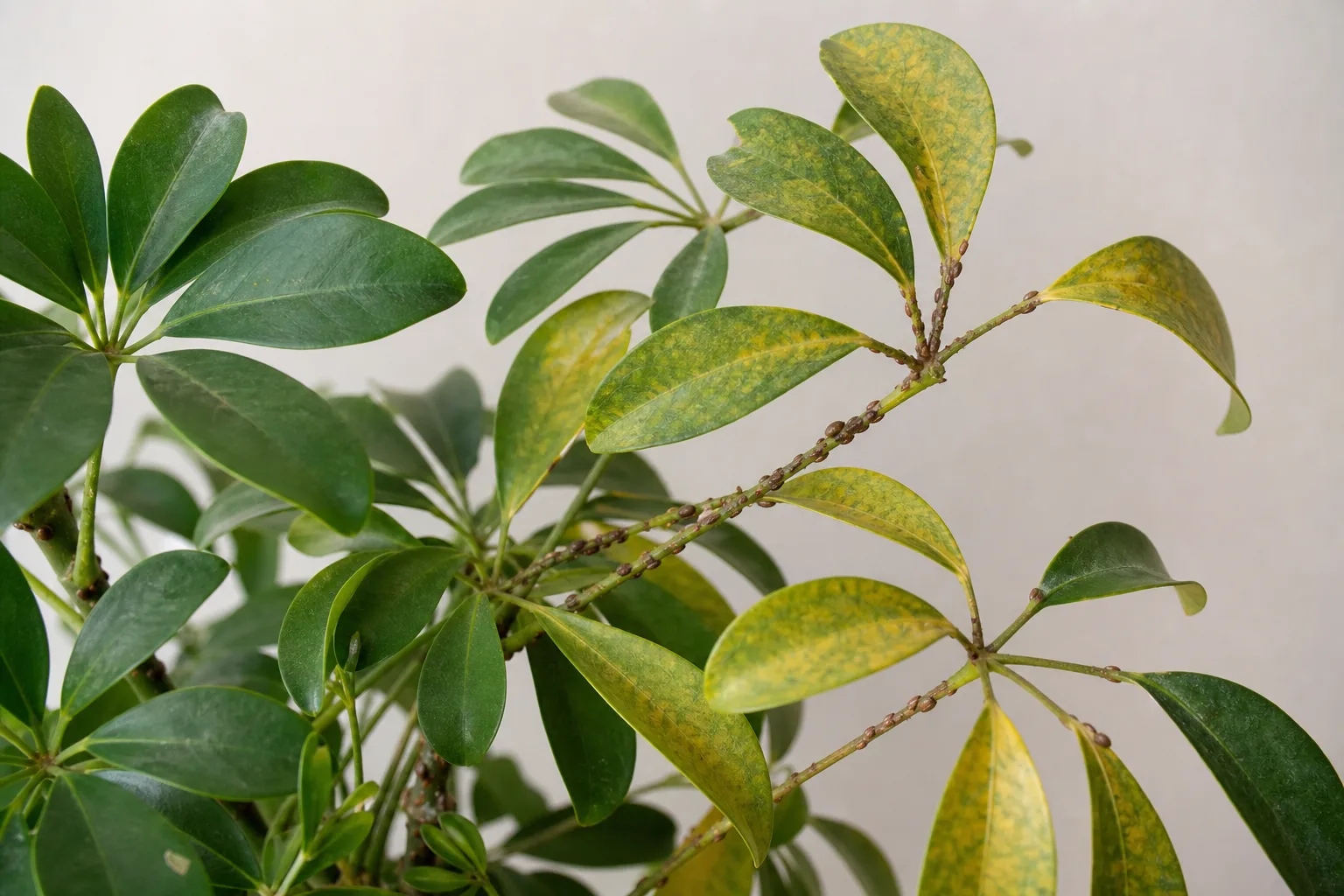
Scale on Schefflera hides on petiole joints and woody stems as immobile brown or tan bumps. First step: isolate the plant and scrape off every bump you can see before applying horticultural oil or insecticidal soap on a repeat schedule.
Scale Insects on Schefflera: Causes, Checks & Fixes
This guide covers scale insects on Schefflera. See also the general Scale Insects guide, watering, and light pages for this plant.
Scale Insects on Schefflera: Causes, Checks & Fixes
Quick answer
Scale on Schefflera (Schefflera arboricola, dwarf umbrella tree) shows up as small immobile bumps along petiole joints, leaflet veins, and older woody stems-easy to miss on compound leaves until honeydew makes lower leaflets shiny and sooty mold follows. On indoor umbrella plants, brown soft scale (Coccus hesperidum) is the species you will most often find; the adults do not move, and only brief crawler stages spread between plants.
First step: isolate the plant and scrape off every visible bump with a fingernail, cotton swab, or soft toothbrush. That physical removal comes before any spray. Once you have cleared what you can reach, follow with horticultural oil or insecticidal soap, repeating on label intervals until new growth stays clean for several weeks. Sticky leaflets without hard stem bumps may point to aphids or mealybugs instead-use the comparison table below before you commit to a treatment.
What scale looks like on Schefflera
Schefflera’s whorled compound leaves give scale dozens of sheltered attachment points. On a healthy umbrella plant, look along these surfaces:
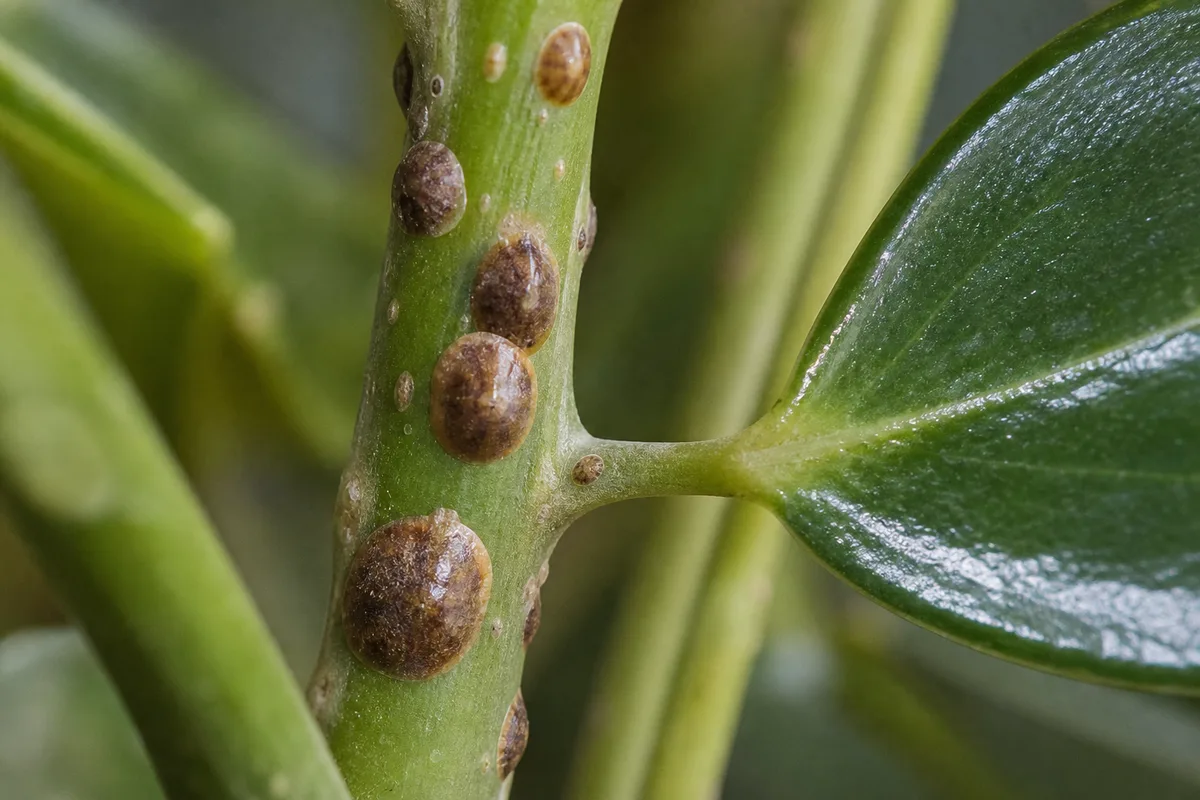
Scale Insects symptoms on Schefflera - compare with healthy tissue on the same plant.
- Petiole joints where several leaf stalks meet the main stem-the tightest crevice on the plant
- Leaflet midribs and veins on both upper and lower surfaces
- Older woody stems as the plant matures, especially on leggy specimens kept for years
- Leaf undersides near the base of each leaflet cluster
Petiole joints and whorled hiding spots
Scale colonizes the spoke-like joints where Schefflera leaflets radiate from each whorl. Sprays sheet off glossy foliage but miss the crevice where petioles meet the trunk-always fan whorls apart and inspect with bright side light before assuming a stem is clean.
Woody stems on mature leggy specimens
As Schefflera lignifies with age, brown soft scale attaches along woody lower stems that casual leaf wiping never reaches. Leggy ten-year specimens often carry the heaviest loads on trunk sections below the active canopy while upper whorls look fine until honeydew drips onto leaflets below.
Adult scale appear as flat or domed bumps roughly 1/16 to 1/8 inch across, often brown, tan, or gray with a waxy shell. They look like part of the stem until you try to flick them off. Heavy feeding produces shiny, sticky honeydew on leaflets below the infestation. That honeydew feeds black sooty mold-a wipe-able dark film, not tissue damage inside the leaf.
Secondary symptoms on Schefflera include yellowing leaflets on heavily infested whorls, premature leaf drop when sap loss combines with existing stress, and ant trails on the pot or nearby surfaces harvesting honeydew. Schefflera already drops leaves dramatically after drafts or watering swings; scale adds another stress layer that can trigger a sudden shed if populations are large.
Why Schefflera gets scale
Scale is not a random Schefflera disease-it is a sap-feeding insect that establishes where the plant offers protected stem tissue and steady indoor warmth. Clemson Extension lists mealybugs, scale insects, and mites as common Schefflera pests that share honeydew symptoms but attach in different places.
Introduction on new plants is the most common entry route. Scale hitchhikes on nursery stock, mixed greenhouse tables, or gifts that skip quarantine. Because early bumps are tiny and match stem color, they can ride in unnoticed for weeks.
Sheltered stem joints suit scale perfectly. Schefflera’s whorled architecture creates pockets where sprays miss and where the insect’s waxy cover stays dry. As stems lignify with age, brown soft scale in particular attaches along woody sections that casual wiping does not reach.
Indoor conditions without predators let populations build quietly. Parasitic wasps and other natural enemies that control scale outdoors rarely reach houseplant collections. Warm rooms, stable humidity, and year-round feeding mean scale can reproduce continuously on a long-lived Schefflera-indoor life stages overlap year-round with eggs, crawlers, and adults present at once.
Stressed plants attract reinfestation. Schefflera in dim corners with wet soil or cold drafts pushes weak, soft growth that crawlers colonize faster. Over-fertilizing with high-nitrogen products also produces tender tissue scale prefers. Fix culture alongside pest control-not instead of it, but in parallel once the first scrape-and-isolate step is done.
How to confirm the cause
Work through these checks before you treat:
- The scrape test - Press a fingernail or toothpick against a suspect bump. Scale flakes off and leaves a moist spot underneath. Corky stem tissue, lenticels, or normal bark on older wood does not come off cleanly.
- Movement check - Adult scale do not walk. If the spot moves when disturbed, suspect a mealybug or aphid instead.
- Honeydew pattern - Sticky residue on upper leaflets directly below infested petioles points to sap feeders above. Uniform dryness with no tackiness makes heavy scale less likely.
- Sooty mold wipe - Rub a dark patch with a damp cloth. Sooty mold smears and wipes away; scale shells stay attached to stems.
- Mealybug comparison - Mealybugs form cottony white clusters in leaf axils, not hard individual shells. Both can coexist on Schefflera; treat what you actually find.
- Alcohol swab on cottony patches - If white wax dissolves and pinkish insects appear, route to mealybugs on Schefflera rather than repeating scale scrapes.
- Ant activity - Ants on the pot rim or climbing stems strongly suggest honeydew producers are present even if bumps are still small.
- Whole-plant scan - Check every whorl and woody lower stem, not just the worst-looking one. Scale on one hidden petiole reinfects the plant after you clean the obvious cluster.
If bumps scrape off and honeydew or sooty mold is present, you have confirmed scale-not edema, not normal stem texture, and not underwatering on Schefflera alone.
Lookalike symptoms to rule out
Sticky Schefflera leaflets share symptoms across several pests. Use this table before you commit to a treatment:
| What you see | Likely cause | Key check | Next step |
|---|---|---|---|
| Brown or tan disks glued to stems and petioles | Scale insects | Immobile shells; scrape test | Isolate and scrape-this page |
| White cottony tufts in leaf axils | Mealybugs | Waxy patches; alcohol dissolves wax | See mealybugs on Schefflera |
| Pear-shaped clusters on new whorl tips | Aphids | Cornicles; insects move slowly | See aphids on Schefflera |
| Fine stippling with webbing, little honeydew | Spider mites | Dry indoor air; tap test | See spider mites on Schefflera |
| Corky raised patches on old woody stems | Normal lenticels | Part of bark; no moist spot under scrape | No pest treatment |
| Small corky bumps on leaf surfaces only | Edema | Uneven watering; no ants or honeydew | Stabilize watering |
| Yellow lower whorls, clean stems | Cultural stress | Wet soil, cold below 60°F, recent move | Overview care cross-check |
Spider mites cause fine stippling and webbing on leaflet undersides, not raised bumps. Mites thrive in dry heated air-confirm with a white-paper tap test, not by assuming every speck is scale.
Normal leaf drop from drafts or a recent move can happen without any bumps present. If stems are clean under inspection and the pot dries on schedule per our watering guide, scale is not the primary issue.
First fix for Schefflera
Move the plant away from other houseplants and physically remove every scale you can reach.
Place Schefflera in a quarantine spot with good light for inspection-not a dark closet where you cannot see new crawlers. Working stem by stem, scrape bumps with a fingernail, cotton swab, or soft toothbrush. Wipe honeydew off leaflets with a damp cloth as you go. Bag and discard the material you remove rather than composting it near other plants.
Do not spray oil or soap on day one before removal. The waxy adult shell blocks most contact sprays; scraping first drops the population and exposes crawlers the next treatment can hit. Do not repot, prune heavily, or fertilize on the same day-Schefflera hates stacked stress, and your goal right now is pest reduction, not a full makeover.
Wear gloves when handling heavily infested stems. Schefflera is toxic to cats and dogs if chewed, and sap from broken petioles can irritate skin on sensitive people.
Step-by-step recovery
After isolation and manual removal:
- Apply horticultural oil or insecticidal soap covering petioles, leaflet undersides, and stems until surfaces glisten. UC IPM notes these materials work best on immature crawler stages; follow label rates for indoor houseplants. Repeat every five to seven days through at least two to three cycles to catch newly hatched crawlers.
- Test sensitivity first - Clemson Extension lists Schefflera among species sensitive to insecticidal soap. Treat one leaflet or one small stem section, wait 48 hours, and check for burn before spraying the whole canopy. Horticultural oil is often better tolerated when soap causes spotting.
- Wash sooty mold off leaflets with plain water once honeydew production stops. Coated leaflets may stay dull; trim only if the film blocks most of the surface.
- Consider a systemic product for persistent brown soft scale on large woody Schefflera when label directions allow indoor ornamental use. Soil-applied imidacloprid drenches control brown soft scale on ornamentals feeding on green tissue; they are less effective on adults locked onto thick woody stems-physical removal still matters.
- Scout neighboring plants that shared a windowsill or shelf. Scale crawlers drift on air currents and clothing. Inspect Ficus, ivy, and other broadleaf companions especially closely.
- Hold fertilizer until new growth looks healthy for two weeks. Salt and nitrogen stress on a pest-hit root system slows recovery and can push soft shoots scale re-colonizes.
If the infestation is limited to one or two petioles on an otherwise vigorous plant, manual removal plus two soap or oil cycles often clears it without systemic chemicals.
Treatment schedule at a glance
| Phase | Action | Frequency |
|---|---|---|
| Day 1 | Isolate; scrape every visible bump; wipe honeydew | Once |
| Days 2–21 | Horticultural oil or insecticidal soap on petioles and stems | Every 5–7 days; 2–3 full cycles |
| Throughout | Scout whorl joints and woody lower stems; hold fertilizer | Weekly inspection |
| If soap burns | Switch to horticultural oil after patch test | Per label |
| Clear period | No new bumps before returning to shelf | 2 weeks minimum; 4 weeks if high risk |
Recovery timeline
Manual removal shows immediate population reduction-you can count bumps gone the same day. Crawler hatch cycles mean you should expect two to four weeks of repeat monitoring before calling the plant clean. Honeydew dries up within days once feeding stops; sooty mold stops spreading at the same time but may take one to two weeks to wipe off old leaflets.
Schefflera pushes new whorled leaves on a multi-week rhythm in good light. Fresh growth with firm petioles and no new shells is your best recovery signal. Old yellowed leaflets from sap loss usually drop rather than re-green-judge success by clean new sets, not by reversing every damaged leaflet.
Mistakes to avoid
Do not treat once and assume scale is gone. Adult shells protect insects; crawlers hatch on a staggered schedule for weeks.
Do not return Schefflera to the main collection after a single spray. Quarantine until you find no new bumps for at least two weeks.
Do not use outdoor pesticide formulations indoors without label clearance. Many garden products are not rated for interior use and can leave harmful residues on surfaces.
Do not ignore ants. Honeydew farming protects scale colonies from the thorough scouting you need.
Do not prune half the plant on day one unless a whorl is beyond saving. Schefflera responds to heavy pruning with shock leaf drop-remove only heavily coated, declining sections after pest numbers drop.
Do not increase watering or fertilizer hoping to “boost” a pest-stressed plant. Wet soil and soft nitrogen-rich shoots make the next infestation easier.
Do not apply insecticidal soap to the whole plant without a patch test on Schefflera-soap sensitivity is documented on this species.
Schefflera care cross-check during scale recovery
Scale control lasts longer when the plant is not fighting other stressors. While you treat, confirm baseline care per our Schefflera overview and watering guide:
- Light - Schefflera light guide supports steady growth without the weak spindly shoots scale favors. Leggy Schefflera in dim corners need brighter placement after quarantine ends.
- Watering - Water when the top 2 inches of mix are dry. Soggy soil does not cause scale, but root stress plus sap loss accelerates leaf drop during infestation.
- Temperature - Keep Schefflera above 60°F and away from AC vents. Cold shock defoliates the plant and hides new pest damage among dropped leaves.
- Airflow - Gentle circulation between plants reduces stagnant pockets where crawlers settle, but do not blast heat vents directly on foliage.
Fixing these factors in parallel with pest treatment helps new whorls emerge clean faster than spraying alone on a stressed specimen.
How to prevent scale next time
Isolate new plants for several weeks before they join your display. Inspect petiole joints with a hand lens during that window-a two-week minimum catches obvious bumps; extend toward four weeks for plants from greenhouses or outdoor summering.
Add a monthly stem-and-petiole scout to routine care-especially in winter when heating dries air and plants sit closer together. One minute per whorl catches bumps before honeydew spreads.
Avoid excess nitrogen that pushes soft, fast growth. Scale crawlers establish on tender new petioles quickly; balanced feeding during active growth is enough.
Keep Schefflera accessible for inspection. Plants pressed against walls or crowded on shelves hide stem joints until infestations are advanced.
Summering Schefflera outdoors can introduce beneficial parasitoids that attack soft scale-but inspect thoroughly before bringing plants back indoors in fall. Outdoor time is not a substitute for quarantine if neighbors had scale too.
When to worry
Use this severity ladder before you panic-repot or discard a tree:
| Severity | What you see | Response |
|---|---|---|
| Low | A few bumps on one or two petioles; firm growth | Isolate, scrape, 2–3 oil or soap cycles |
| Moderate | Bumps on multiple whorls; honeydew on lower leaflets; ants present | Full scrape plus weekly sprays; scout all neighbors |
| High | Bumps coat woody lower stems; sooty mold on most canopy; daily honeydew drip | Add labeled systemic if soap/oil fail; consider pruning worst whorls after pest drop |
| Discard threshold | Declining trunk, mass leaf drop despite stable care, repeated rebound after full protocol | Protect collection-discard or take cutting backup |
Treat as urgent when bumps coat multiple main stems, honeydew drips daily onto furniture below the pot, sooty mold covers most leaflets, or mass leaf drop follows a heavy infestation combined with recent stress. At that stage, weigh persistent treatment against discarding a severely declining plant to protect the rest of your collection.
Watch for rebound within six weeks after you thought control succeeded. Missed adults on a hidden woody section or crawlers on a neighboring plant restart the cycle quickly if scouting stops too soon.
When home treatment is not enough: If scale persists across multiple plants after scrape, soap, and oil cycles, contact your local cooperative extension office or a licensed IPM professional before applying unlabeled systemic drenches indoors.
Pet safety after treatment: Schefflera is toxic to cats and dogs if chewed, and oil or soap residue can irritate mouths. Keep treated plants away from pets until foliage is dry and you have completed the clear period. Contact a veterinarian if a pet eats sprayed leaves.
Decision checklist before you close this case
Use these three checks instead of guessing whether the infestation is over:
- Live shells and crawlers - Inspect every petiole joint and woody lower stem with a hand lens. No new bumps and no yellow crawlers means the active infestation is controlled; old honeydew alone does not count.
- New growth quality - Firm upright whorls without stickiness signal recovery. Yellowed older leaflets may never re-green-judge by new tips, not every blemished leaflet below.
- Neighbors and quarantine - Nearby plants are clean, ant trails are gone, and the Schefflera has stayed isolated with zero new scale for two full weeks after the last spray (four weeks if the plant summered outdoors or shared a greenhouse bench).
If sticky leaflets return but insects look different, route to mealybugs, aphids, or spider mites rather than repeating the same scrape cycle.
This page was reviewed by the LeafyPixels Review Board against UMD Extension, UC IPM, Clemson HGIC, Colorado State Extension, Missouri Botanical Garden, and NC State Heptapleurum arboricola references, plus our Schefflera overview, watering, and sibling pest guides before publication. Author: sai-ananth. Reviewed: 2026-06-17.
Related guides:
- Overview - full indoor care hub
- Watering - top 2-inch dry-down protocol during recovery
- Mealybugs - white cottony lookalike in whorl axils
- Aphids - pear-shaped clusters on new whorl tips
- Spider mites - stippling and webbing without heavy honeydew
FAQs
How can I confirm scale insects on Schefflera?
Confirm scale when you find immobile rounded bumps along petioles, leaflet midribs, or woody stems that scrape off with pressure and leave a moist spot-not part of the bark. Sticky honeydew on leaflets below infested stems or black sooty mold on that tacky residue strongly supports scale over normal stem texture.
Is it scale or mealybugs on my Schefflera?
Scale forms hard brown or tan disks glued to stems and petioles that do not move when disturbed. Mealybugs look like white cottony tufts in leaf axils and dissolve when dabbed with alcohol. Both drip honeydew-use the comparison table above or our mealybugs guide if you find fluffy wax instead of shells.
Will Schefflera recover from scale insects?
Yellowed or sticky leaflets rarely revert, but Schefflera usually pushes fresh whorled growth once feeding stops and care stays stable. Judge recovery by firm stems, clean new leaf sets, and no fresh bumps on new petioles-not by old coated foliage clearing up.
When is scale insects urgent on Schefflera?
Act quickly when bumps coat multiple stems, honeydew drips daily onto lower leaflets, sooty mold covers most of the canopy, or mass leaf drop follows a heavy infestation. A few bumps on one petiole with otherwise firm growth can wait for a careful scrape-and-spray cycle without Schefflera repotting guide or pruning half the plant.
How long should I quarantine Schefflera after scale treatment?
Keep the plant isolated until you find no new bumps for at least two weeks after the last spray-that is the minimum clear window. For high-value collections or plants that summered outdoors, extend quarantine toward four weeks and scout woody lower stems weekly, since crawlers can hatch on staggered indoor schedules year-round.
When to use this page vs other Schefflera guides
- Schefflera watering guide - Use for routine moisture checks before assuming scale insects is the main issue.
- Schefflera problems hub - Browse all 18 common issues on this species.
- Yellow Leaves on Schefflera - Different entry point when symptoms overlap with scale insects.
- Mealybugs on Schefflera - Different entry point when symptoms overlap with scale insects.
- Aphids on Schefflera - Different entry point when symptoms overlap with scale insects.