Leggy Growth on Portulaca: Causes, Checks & Fixes
Quick answer
Leggy growth on Portulaca usually means direct sun is not reaching the pot for enough hours each day. First fix: move the plant to full sun (6+ hours at pot level) and pinch long stems above a leaf node-do not repot and prune hard on the same day.
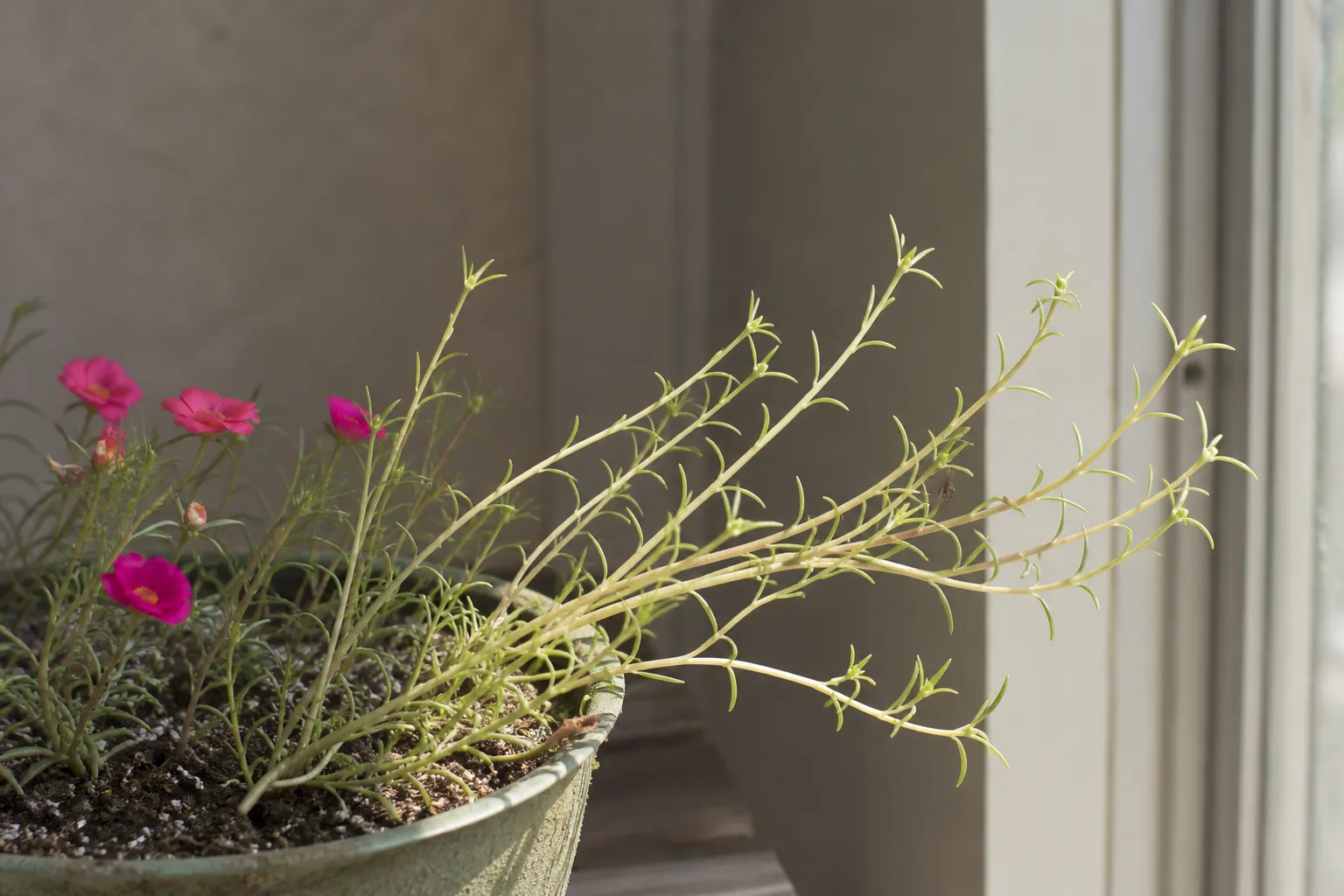
Leggy Growth on Portulaca: Causes, Checks & Fixes
This guide covers leggy growth on Portulaca. See also the general Leggy Growth guide, watering, and light pages for this plant.
Leggy Growth on Portulaca: Causes, Checks & Fixes
Quick answer
A trailing Moss Rose (Portulaca grandiflora) that looked tight at the garden center but turned into bare runners with gaps between leaf clusters usually lost pot-level direct sun, not general “brightness.” On a west-facing terrace I tracked last June, a 25 cm bowl sat under a deep eave: morning rays hit the rim, but the soil surface logged only 3.5 hours of direct sun while a neighbor’s open-rail pot logged eight. Within ten days the shaded bowl had 4 cm internodes and flowers that stayed closed through clear midday.
First fix: move the pot to unobstructed full sun (6 or more hours of direct light daily) at the soil surface, then pinch the longest stems just above a leaf node. Do not stack repotting, heavy pruning, and fertilizer on day one.
Scope on this site: This page owns stretch-specific morphology and recovery sequencing on Portulaca. For closed flowers without obvious internode stretch, see not enough light on Portulaca. For wet-soil weakness, see overwatering and root rot.
Why Portulaca gets leggy growth
Moss Rose is a heat-loving annual built for open, lean sites. NC State describes it as a low mat-forming plant for well-drained sandy or rocky soils in full sun, and Wisconsin Extension notes its origin on hot, dry plains in South America. When direct photon flux drops, the plant reallocates growth into stem extension and directional lean rather than tight branching and flower display.
Balcony obstruction patterns are the most common trigger in containers. Rail shadows, wall overhangs, and taller neighbor pots often shade the soil while shoot tips still catch late-afternoon rays-so the plant looks “in sun” from arm’s length but stretches at the crown.
Nitrogen in marginal light compounds stretch. Proven Winners warns that too little light produces leggy growth and fewer blooms that won’t stay open; pairing that with high-nitrogen feed pushes soft, fast elongation with weak flowering.
Flower closure timing matters for diagnosis. Species-type Moss Rose flowers close at night and on cloudy days. Closure through bright midday sun is a stress signal; closure only on overcast days is normal cycling.
Cultivar differences: Modern series such as Sundial are bred to open in cooler and cloudier weather, which can mask light stress on bloom display-but stems still elongate when hours of direct sun at the pot fall short.
What true leggy growth looks like on Portulaca
Leggy Moss Rose is not the same as healthy trailing spread:
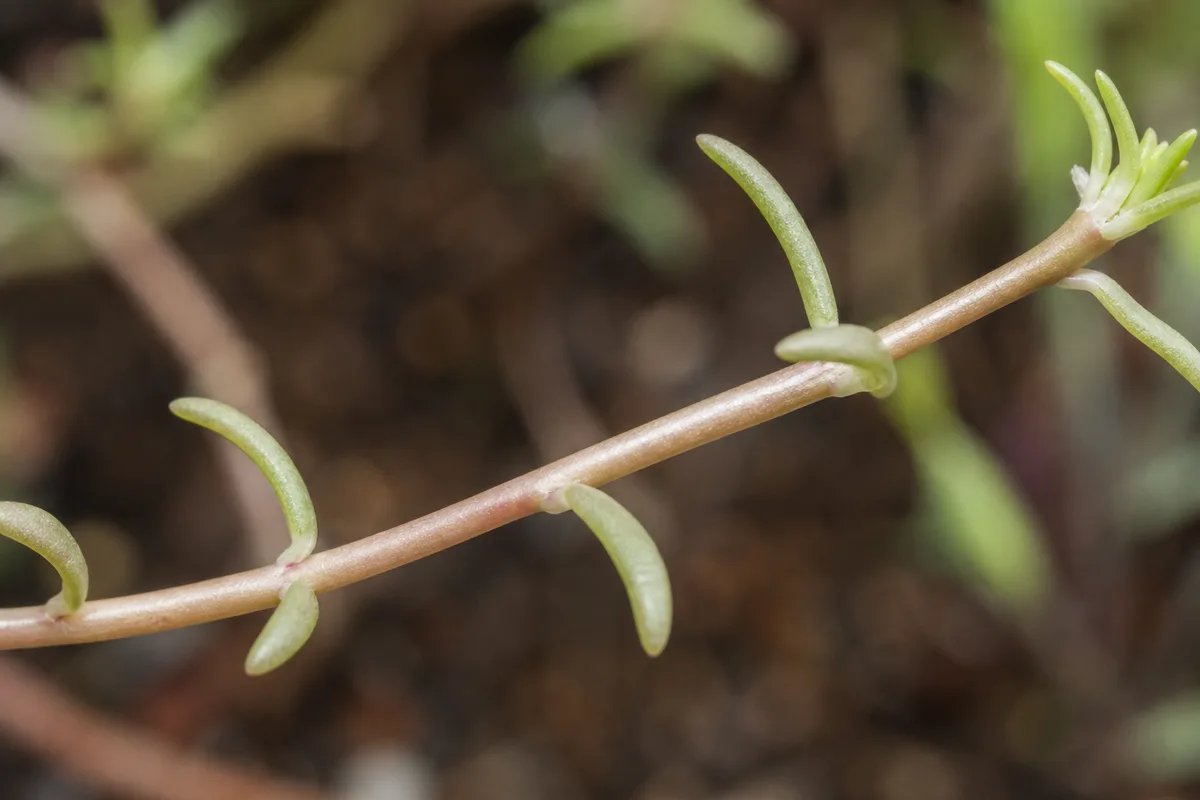
Leggy Growth symptoms on Portulaca - compare with healthy tissue on the same plant.
- Internode trend: new stem sections show visibly longer gaps between leaf clusters than older growth on the same plant
- Directional lean: stems reach toward the brightest terrace edge or railing gap
- Bare lower runners: lower sections thin out while tips stay greener
- Bloom gap: buds present but fewer flowers open, especially at midday on clear days
- Floppy mat: growth looks loose instead of dense and mounding
Healthy trailing Portulaca still spreads horizontally, but stems stay shorter between nodes, branch freely, and hold more open blooms through warm sunny stretches.
Lookalikes and differential diagnosis
Before you treat every sparse mat as light stretch, separate these patterns:
| Clue you observe | More likely cause | Stem / root feel | First move |
|---|---|---|---|
| Long internodes, lean to one bright side, firm base | Leggy growth (this page) - insufficient pot-level sun | Firm, dry-succulent | Relocate to full sun; pinch tips after 5–7 days |
| Flowers closed only on cloudy days; compact nodes | Normal nyctinastic / cloudy closure | Firm | No action unless midday closure appears on sunny days |
| Wet mix 4+ days, soft base, sour smell | Wet-root stress ± shade | Soft at soil line | Dry-down protocol - see overwatering |
| Lush green, long shoots, recent heavy feed | Nutrient push in dim light | Firm but weak | Stop fertilizer; fix sun first |
| Uneven pause 3–7 days after rough transplant | Transplant setback | Variable | Hold interventions; NC State notes seedlings do not transplant well |
| Sundial-type blooms open in cool weather but stems still gap | Marginal light masked by cultivar | Firm, elongating | Log pot sun hours; do not rely on flower display alone |
When this is not leggy-growth-only
Escalate past simple stretch correction if:
- More than one-third of stems are soft at the base
- Soil stays wet at 3–5 cm depth while stretch worsens
- Bare crown with collapse after weeks under an eave plus daily watering
- No tighter new tips after two weeks of corrected full sun and dry-down watering
Those patterns suggest compounded crown stress. Shift to root rot on Portulaca checks before aggressive pruning.
How to confirm the cause
Use this five-step confirmation sequence:
- Log direct sun on the pot surface - not ambient balcony brightness. Portulaca needs at least 6 to 8 hours of direct sun for compact flowering growth; many container sites need the upper end.
- Midday bloom check on a clear day - inspect between late morning and early afternoon. Persistent closure argues for light deficit beyond normal cloudy-day behavior.
- Internode comparison - measure or eyeball new sections against older growth on the same stem. Active stretch shows widening gaps.
- Base and moisture check - chronic wetness with soft tissue points to root-zone trouble layered on shade, not etiolation alone. NC State links poorly drained soils to crown rot.
- Feeding history - heavy fertilizer in weak light often worsens lanky shoots with few open blooms.
If three or more checks point to light deficit and the base is still firm, treat as leggy growth from insufficient sun first.
First fix for Portulaca
Relocate to the brightest unobstructed position where the pot itself receives direct rays for most of the day-outer rail, open terrace lip, or front border, not the wall-protected pocket.
Then pinch the longest stems just above a leaf node to trigger side branching. Keep day-one intervention minimal:
- relocate first
- pinch lightly (remove only the worst runners)
- pause fertilizer until new growth tightens
Do not repot hard and prune hard the same day unless you have confirmed root failure.
Sudden full-sun transition caveat
If the plant lived in deep shade or indoors for weeks, harden it off over several days. RHS guidance on tender plants recommends gradual outdoor sun exposure over about two to three weeks; for Moss Rose, start with strong morning sun and extend toward full-day exposure as foliage adapts.
Pruning intensity timing
Proven Winners suggests that if plants become leggy in mid-season, you can prune back by up to half their size and apply a very light one-time fertilizer dose to stimulate branching-but only after light is corrected. Pruning more than half while still underlit wastes tissue and slows recovery.
Step-by-step recovery
After the first fix, follow this controlled sequence:
- Give 5–7 days in improved light before additional cuts.
- Remove only the longest, weakest shoots; leave enough foliage to photosynthesize.
- Water deeply, then let the mix dry down; Missouri Botanical Garden lists Moss Rose for well-drained soil in full sun.
- Resume feeding only after new growth is compact and midday blooms reopen reliably.
- Repeat light pinching through the warm season to maintain a dense mat.
Recovery timeline and case snapshot
Old stretched sections never shorten. Judge recovery on new tissue only.
| Checkpoint | Day 0 (diagnosis) | Day 7 | Day 21 |
|---|---|---|---|
| Visible symptoms | 4 cm internodes; midday blooms closed; lean toward rail gap | Tips slightly shorter on new shoots; 2–3 flowers open at noon | Denser side branches; internodes under 2 cm on fresh growth |
| Sun logged | 3.5 h direct on pot (eave shade) | 8 h after move to outer rail | 8 h sustained |
| Base check | Firm, dry-succulent stems | Firm | Firm |
| Action taken | Moved to open rail; pinched 4 longest runners | Light tip pinch only | Resumed very light feed after bloom return |
Typical improvement windows:
- 7–14 days: tighter tips and better flower opening in strong sun
- 2–4 weeks: visibly denser branching if light stays consistent
- Rest of warm season: fuller mat if pinching and sun are maintained
If no tighter new tips appear after two weeks of corrected light and appropriate dry-down watering, reassess root health and drainage before pruning harder.
What not to do
Do not respond to stretch by watering more or feeding more while the plant remains underlit. Do not assume all flower closure means disease-many Moss Rose types close in low light and reopen with sun. Do not crowd Portulaca under taller plants where only shoot tips receive direct exposure. Do not move from deep shade to blazing afternoon wall reflection without a short acclimation period.
How to prevent leggy growth on Portulaca
Set Moss Rose up as a high-light annual from day one:
- plant only where pot-level sun is reliable through the growing season
- use lean, fast-draining media rather than moisture-retentive mixes
- space containers so mature mats do not shade their own crowns
- pinch lightly during active growth to maintain branch density
- avoid routine high-nitrogen feeding when light is marginal
Sundial and similar modern lines may improve bloom display in cooler spells, but they still need strong direct sun to stay compact.
When to escalate
Usually low urgency for firm, dry-succulent stretch-but act the same day if:
- stems collapse or blacken at the base
- tissue is soft and sour-smelling with chronically wet mix
- bare runners cover more than half the mat with no new tight tips after light correction
- decline continues 10+ days after relocation and watering reset
Use the Portulaca root rot guide when soft-base patterns dominate. Use not enough light when closure and lean are primary but internode stretch is mild.
Decision close: your next move
| If you confirmed… | Your next step |
|---|---|
| Long internodes, firm base, under 6 h pot sun | Move to full sun today; pinch longest runners after 5–7 days |
| Stretch plus wet mix and soft base | Fix light and dry-down first - see overwatering |
| Blooms closed on cloudy days only, compact nodes | Monitor; likely normal - compare on next clear midday |
| No improvement 2 weeks after sun fix | Inspect roots - root rot on Portulaca |
| Mid-season floppy mat in good light | Prune back by up to half per mid-season guidance; one light feed |
Related Portulaca guides
For overlapping symptoms, read these intent-specific pages before bigger interventions:
- Portulaca light needs - baseline sun requirements
- Not enough light on Portulaca - closure and lean without strong stretch
- No flowers on Portulaca - bloom failure with firmer habit
- Overwatering on Portulaca - wet-soil weakness mimics stretch
- Root rot on Portulaca - soft-base escalation
- Pruning Portulaca - technique context for pinching and cutback
Related tool
Use the Plant Problem Diagnosis Tool to narrow causes for leggy growth on this plant before changing multiple variables at once.