Mold on Soil on Lemongrass: Causes, Checks, and Indoor Fixes
Quick answer
Mold on lemongrass soil is usually a damp-surface issue, especially on dense indoor divisions. First fix: remove the moldy top layer and pause watering until the top 3-4 cm dries.
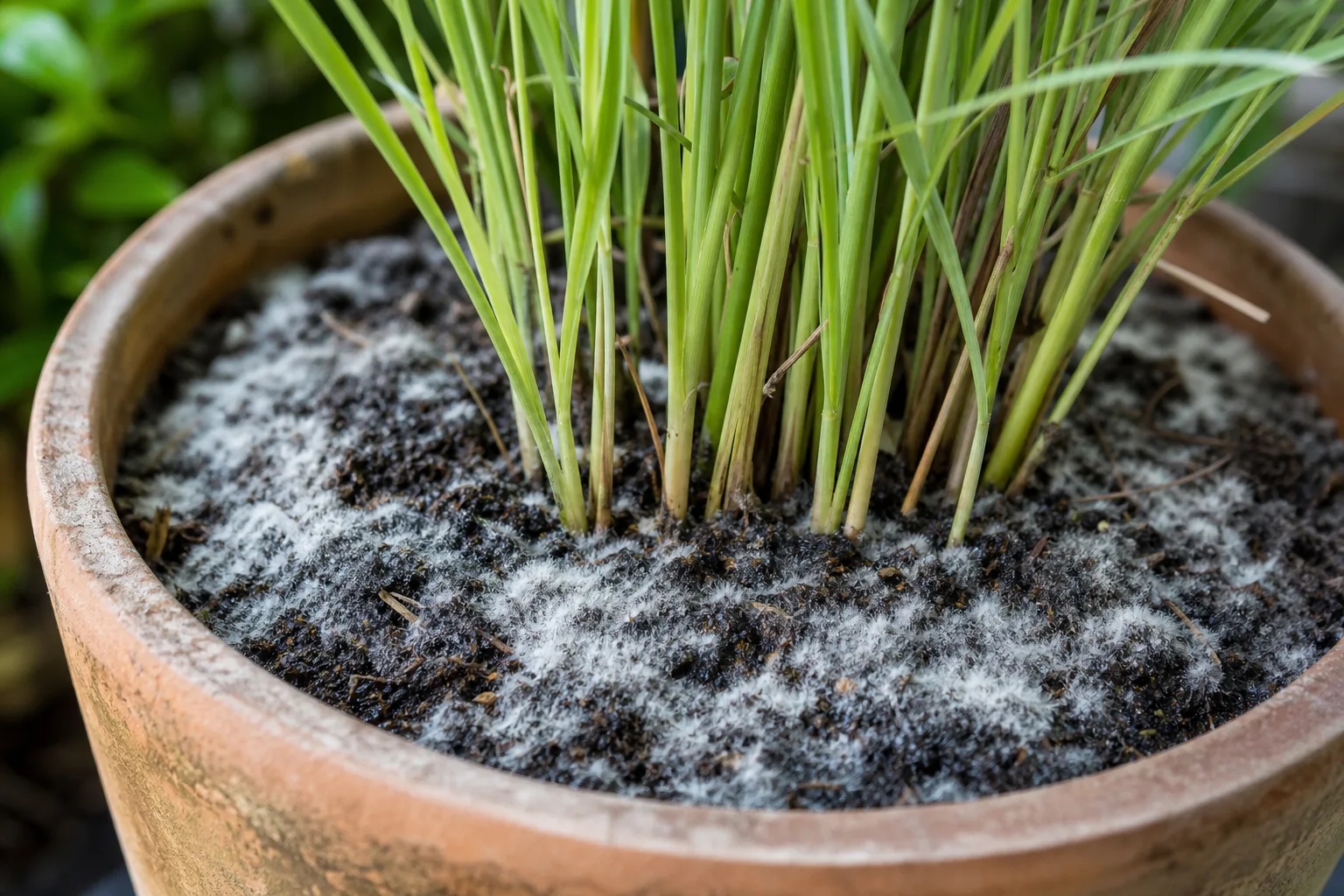
Mold on Soil on Lemongrass: Causes, Checks & Fixes
This guide covers mold on soil on Lemongrass. See also the general Mold on Soil guide, watering, and light pages for this plant.
Mold on Soil on Lemongrass: Causes, Checks & Fixes
Quick answer
Mold on lemongrass soil usually means the surface is staying wet too long, especially on dense potted divisions brought indoors for cool weather. Lemongrass (Cymbopogon citratus) is a warm-season grass that grows fastest in heat and high light, so water use drops when light and temperature drop indoors (USU Extension).
First fix: remove the top 1-2 cm of moldy mix and wait to water again until the top 3-4 cm is dry. This targets the actual trigger (persistent surface moisture) before you try sprays or Lemongrass repotting guide.
Why Lemongrass gets mold on soil
Lemongrass prefers fertile, well-drained soil and regular moisture during active growth (Missouri Botanical Garden). In containers, mold shows up when that healthy moisture target turns into constant surface dampness.
Most common causes on lemongrass:
- Dense stalk clumps shade the soil line, so the top layer dries slowly.
- Indoor overwintering reduces light and airflow while growers keep a summer Lemongrass watering guide.
- Frequent light sips keep the top wet instead of cycling the full root zone.
- Saucers left full after watering keep the pot wet from below.
- Compost-rich surface debris acts as food for saprophytic fungi.
The same wet-organic conditions also favor fungus gnats (University of Minnesota Extension), which is why mold and gnats often appear together.
What mold on soil looks like on Lemongrass
Typical appearance is white to gray fuzzy growth on the top layer, often around crowded stalk bases where humidity stays trapped. It may look patchy in the morning and fluffier after watering. Gray mold diseases are favored by humid, poorly ventilated conditions, which is why stagnant indoor air can accelerate spread on stressed tissues (RHS).
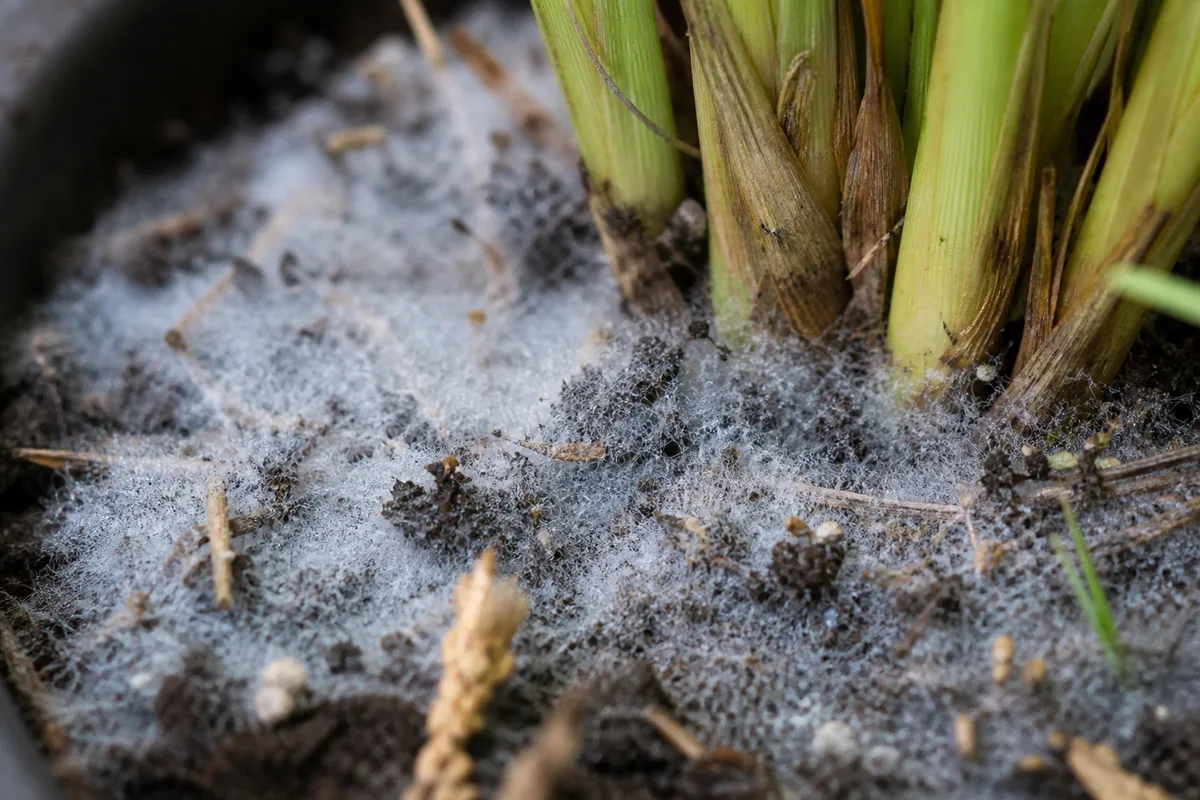
Mold on Soil symptoms on Lemongrass - compare with healthy tissue on the same plant.
On its own, this is usually a surface condition, not immediate root collapse. If stalk bases are still firm, growth is still pushing new leaves, and there is no sour odor, you are usually early enough to correct conditions without major root loss.
How to confirm the cause
Use this six-step check before treating:
- Depth check: insert a finger or probe 3-4 cm deep. If it is still moist days later, your dry-down is too slow.
- Pot weight check: lift right after watering and again 3-4 days later; little change suggests chronic wetness.
- Base firmness check: squeeze lower stalk bases gently. Firm is better; soft or mushy is escalation.
- Odor check: earthy is normal; sour or swampy smell suggests anaerobic root-zone stress.
- Gnat check: tap the pot and watch for small dark flies; wet organic top layers support breeding (University of Minnesota Extension).
- Return check: after scraping and drying, does mold return within a week? If yes, your environment or watering pattern is still driving it.
- Tissue check: inspect old leaf sheaths and dead debris at the crown; botrytis-type molds colonize decaying material first, then spread under humid conditions (RHS).
First fix for Lemongrass
Remove and discard the top 1-2 cm of moldy mix, then hold watering until the top 3-4 cm dries. University guidance for gnat and mold-prone houseplant media supports letting the surface layer dry between waterings (University of Minnesota Extension).
Then adjust conditions in order:
- Move to brighter light to speed water use.
- Space crowded stems slightly for better airflow at the soil line.
- Empty saucers after each watering.
- Resume deep watering only when the top layer is dry, not by calendar.
- If adults are flying, add yellow sticky traps while you reset moisture so new egg-laying drops (University of Wisconsin-Madison Extension).
If you want a full watering reset plan, use the lemongrass watering guide at /plants/lemongrass/watering/.
Step-by-step recovery
Days 1-3
After scraping, let the pot dry from the top down. Do not fertilize or repot immediately unless you also have rot signals.
Days 4-10
You should see less or no new surface fuzz if moisture cycling improves. If gnats were present, adult activity should begin to drop as the top layer spends more time dry (University of Minnesota Extension).
Weeks 2-4
Stable recovery means no recurring fuzz, firmer stalk bases, and normal new leaf growth from the center of the clump. At this point you can refresh only the top layer with clean mix if needed.
If mold comes back within a week
Recurring mold means one or more root causes are still active. Re-check:
- Light level (especially after moving indoors)
- Pot drainage and saucer habits
- Surface crowding from dense divisions
- Watering depth versus frequency
If recurrence comes with persistent gnats, review /plants/lemongrass/fungus-gnats/. If recurrence comes with wet wilt or soft bases, jump to /plants/lemongrass/root-rot/ and inspect roots immediately.
If mold returns after two corrected watering cycles, unpot and inspect roots and the lower crown. Keep firm, pale roots and discard black, mushy, or sour-smelling portions before repotting into fresh, fast-draining mix.
Lookalike symptoms to rule out
| Symptom | Common look | Key difference |
|---|---|---|
| Surface mold | White/gray fuzzy patches | Sits on top layer; often improves with dry-down |
| Algae | Green film or crust | More slimy/flat than fuzzy; also moisture driven |
| Mineral salt crust | White/yellow crusty residue | Hard and crystalline, not fuzzy |
| root rot on Lemongrass spillover | Mold plus sour smell and soft bases | Includes tissue decline, not just surface growth |
| Botrytis on foliage | Gray-brown fuzzy mold on damaged leaves/sheaths | Attacks plant tissue, not only the soil surface (RHS) |
Recovery timeline
- Early improvement: 3-7 days after correcting moisture and airflow.
- Clear stability: 2-4 weeks with no recurring mold and healthy new growth.
- Escalation signs: sour odor, softening stalk bases, or wilting despite wet soil.
What not to do
- Do not keep watering on a fixed summer schedule after bringing pots indoors.
- Do not treat fungicide as first-line care for a moisture-pattern problem.
- Do not leave runoff in saucers.
- Do not keep re-scraping without changing light, airflow, and watering rhythm.
- Do not ignore sour smell or soft bases; those are beyond cosmetic surface mold and may indicate overwatering on Lemongrass injury (University of Minnesota Extension).
For recurring moisture issues, also cross-check /plants/lemongrass/overwatering/.
When to worry
Escalate quickly if any of these are true:
- Stalk bases turn soft, translucent, or collapse.
- The root zone smells sour when you disturb the top layer.
- Leaves wilt while the mix is still wet.
- Mold returns repeatedly despite correct dry-down and better light.
That pattern suggests a deeper root-zone problem, not just surface fungal growth.
Lemongrass care cross-check
Lemongrass is typically grown as a warm-season crop and often moved indoors in cooler conditions (USU Extension). That seasonal move is where most mold-on-soil issues start: lower light, slower growth, and unchanged watering frequency.
Prevent recurrence by pairing your mold fix with care basics:
- keep high light whenever possible
- use a draining, organic-rich potting mix
- water deeply but less often indoors
- reduce canopy crowding on dense potted clumps
How to prevent mold on lemongrass soil
Use this simple prevention rhythm:
- Water thoroughly.
- Let the top 3-4 cm dry.
- Re-water only when that depth is dry again.
- Keep bright light and moving air around the clump base.
- Refresh the top layer if organic debris accumulates and stays damp.
Link this page with your general lemongrass hub at /plants/lemongrass/ so you can catch seasonal watering changes before mold returns.
Conclusion
Mold on lemongrass soil is usually a moisture-management warning, not a mystery disease. If you remove the moldy top layer, reset the dry-down cycle, and adjust indoor-season care, most plants recover without major setbacks. Recurrence with odor, soft bases, or wet-soil wilt is your signal to treat it as a root-zone emergency instead of a cosmetic issue.
When to use this page vs other Lemongrass guides
- Lemongrass watering guide - Use for routine moisture checks before assuming mold on soil is the main issue.
- Lemongrass problems hub - Browse all 52 common issues on this species.
- Overwatering on Lemongrass - Different entry point when symptoms overlap with mold on soil.
- Root Rot on Lemongrass - Different entry point when symptoms overlap with mold on soil.
- Slow Growth on Lemongrass - Different entry point when symptoms overlap with mold on soil.