Caterpillars on Lemongrass: Causes, Checks & Fixes
Quick answer
Caterpillars on lemongrass show up as ragged blade holes with frass or stem-borer dead-heart shoots. First step: pull out dead-heart tillers and hand-pick visible larvae before any spray on culinary clumps.
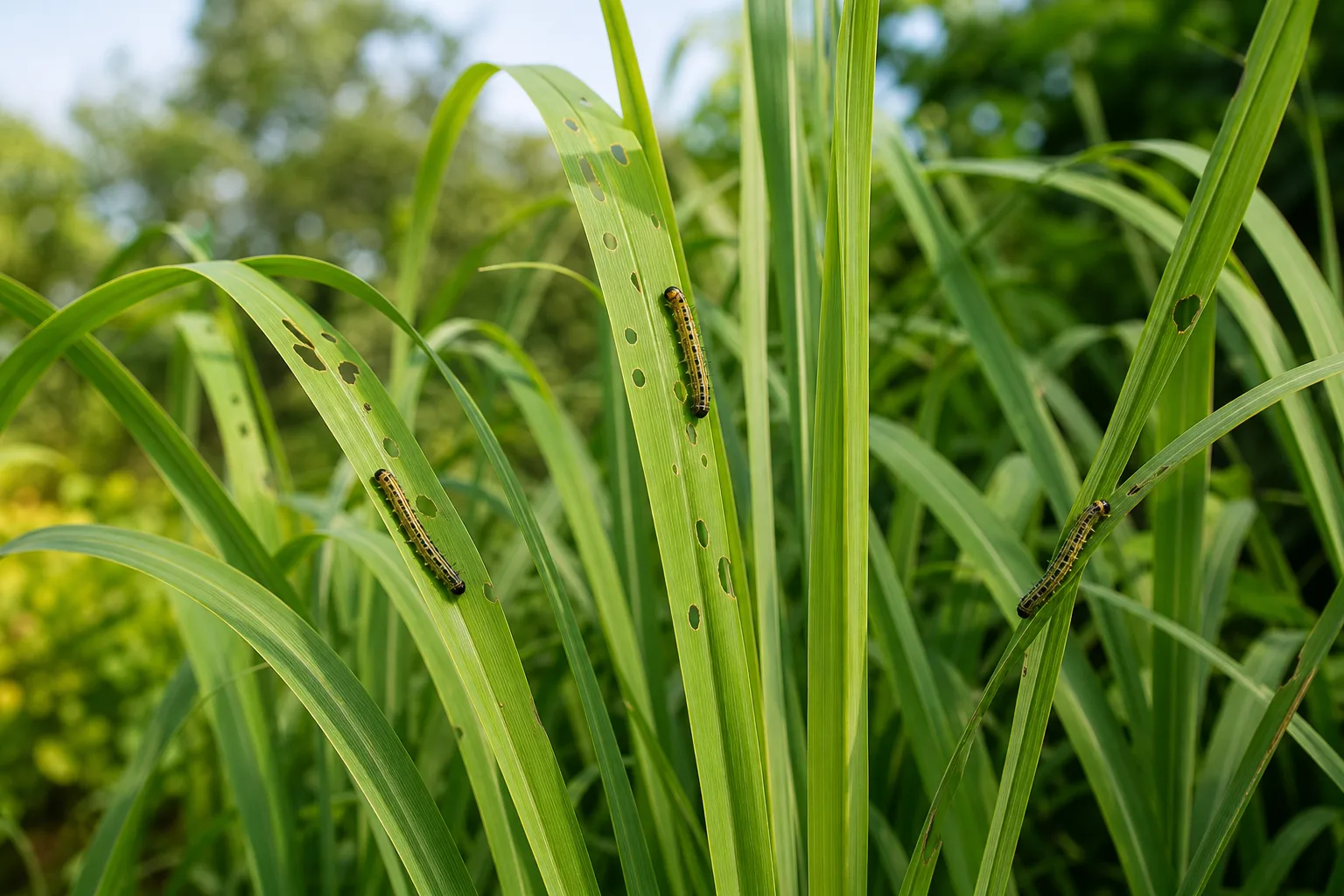
Caterpillars on Lemongrass: Causes, Checks & Fixes
This guide covers caterpillars on Lemongrass. See also the general Caterpillars guide, watering, and light pages for this plant.
Caterpillars on Lemongrass: Causes, Checks & Fixes
Quick answer
Caterpillars on lemongrass (Cymbopogon citratus) show up in two main patterns: ragged blade chewing with dark frass and stem-borer damage that creates dead-heart center shoots. On culinary clumps, the first fix is mechanical: pull out dead-heart tillers and hand-pick every visible larva before you reach for spray.
Lemongrass is a warm-season Poaceae grass, so it hosts grass-feeding moth larvae outdoors. In production literature, Chilotrea stem borers are the most important caterpillar pest on lemongrass-the larva bores low in the stem and the central leaf dries first. Foliage feeders chew exposed blade edges and leave frass in folds. Treating both the same way wastes time on tillers that will never recover.
This page is for chewing damage and stem-borer dead heart on harvest clumps. For internal blade tunnels, see leaf miners on lemongrass. For stippling without chew holes, see thrips on lemongrass.
Foliage caterpillars vs stem borers on lemongrass
Most home growers search “caterpillars on lemongrass” after seeing chewed blades-but the higher-yield threat in aromatic-crop bulletins is the stem-boring caterpillar, not edge chewing alone.
| Pattern | What you see | Where the larva feeds | Can the tiller recover? | First action |
|---|---|---|---|---|
| Foliage caterpillar | Irregular holes on blade edges; dark frass in folds | Outer and inner leaf surfaces | Yes-blade stays scarred; clump regrows new shoots | Hand-pick at dusk; Btk on remaining larvae if feeding continues |
| Stem borer (Chilotrea, Chilo spp.) | Central shoot browns and pulls out (“dead heart”); bore hole low on tiller | Inside stem base, often below harvest cut height | No-dead-heart tiller is lost | Pull and destroy entire affected shoot at the base |
| Leaf miner | Pale winding tunnel inside blade when backlit | Between tissue layers | Blade scarred; clump can regrow if mines removed | See leaf miners-not caterpillar control |
| Slug | Ragged holes plus shiny slime trails | Night feeding near soil line | Yes if slugs removed | Bait or hand-pick at night-not Bt |
The harvest-cut detail matters on lemongrass: growers typically cut stalks a few centimeters above the ground. Chilotrea larvae lodge lower in the stem, so routine kitchen harvests may miss the borer entirely while the dead heart spreads to neighboring tillers.
Why lemongrass gets caterpillars
Moths lay eggs on grassy foliage, and lemongrass gives them tender targets during warm-season flushes. UF/IFAS describes peak active growth in warm months with repeated harvest cycles that keep new soft tissue coming-each cut triggers fresh tillers that egg-laying moths prefer.
Lemongrass-specific risk factors:
- Post-harvest regrowth - Soft new shoots at the crown attract both foliage feeders and stem borers within one to two weeks of a kitchen harvest during summer.
- Dense clump architecture - Folded inner leaves hide chewing larvae; stem borers feed inside tillers where predators cannot reach them.
- Harvest height leaving borers behind - Cutting above the crown leaves low-boring larvae alive to attack the next flush.
- Nearby grassy hosts - Weedy grasses, rice, and sugarcane harbor the same borer complex; Chilo suppressalis lists lemongrass among grass hosts.
- Regional stem-borer pressure - In parts of California, the Mexican rice borer has been reported in Fresno lemongrass, with larvae boring inside stems and reducing yield; scouting matters even when a plant is “generally easy to grow.”
Indoor cases are uncommon, but patio clumps moved inside without inspection can carry eggs or tiny larvae on folded blades.
What caterpillar damage looks like on lemongrass
Foliage-feeding pattern
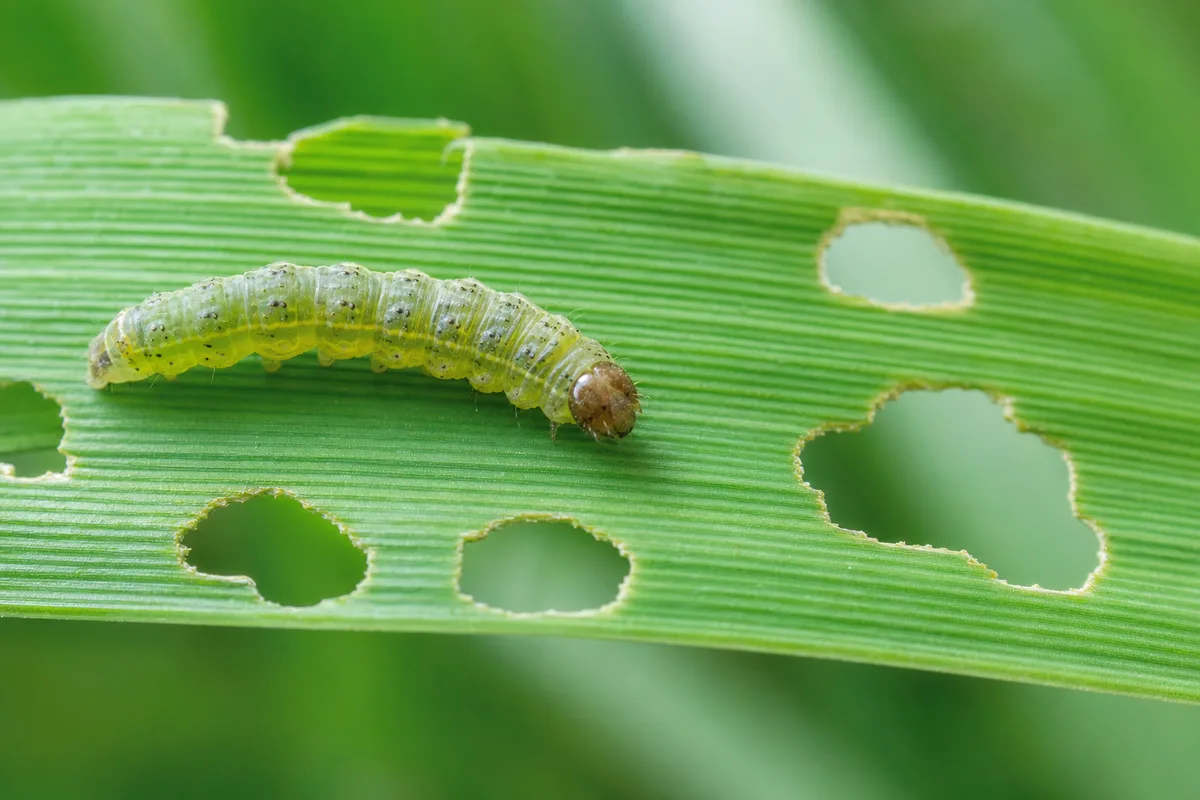
Caterpillars symptoms on Lemongrass - compare with healthy tissue on the same plant.
- Irregular chewed blade edges or holes across the leaf
- Dark frass pellets in leaf folds and around the crown
- Larvae visible at dusk or early morning on inner blades
- Damage spreads across multiple exposed blades while center shoots stay green
Stem-borer pattern (higher risk)
- A central shoot that dries, browns, and pulls out easily (“dead heart”)
- Small bore holes low on the tiller with frass near the entry point
- White larva with dark head or spots when you split the base lengthwise-typical of Chilotrea on lemongrass
- New tillers collapsing before they size up for harvest
- Yield loss on production clumps when multiple shoots die in sequence
This distinction matters because a dead-heart tiller will not recover no matter how much you spray the outer blades.
How to confirm the cause
Work through these checks before spraying anything on a culinary clump:
- Classify the damage pattern - Edge holes plus crown frass = foliage feeder. Central dry shoot that pulls out = stem borer. Internal winding line on backlight = leaf miner, not caterpillar.
- Check for fresh frass - Dark pellets in new leaf folds mean active feeding within the last day or two. Old scars without frass suggest a past generation.
- Split one suspect tiller - Cut lengthwise through the base of a dead-heart shoot. Internal feeding channels, bore holes, or a live larva confirm stem-borer activity.
- Pull-test dead center shoots - Easy pull-out with a hollow base strongly supports stem-borer damage over drought or rot.
- Re-check at dusk - Foliage feeders often feed more openly in low light; a flashlight at the crown catches larvae you missed by day.
- Cooking safety check - Do not harvest stalks with visible larvae, heavy frass, or bore holes for soup or tea. Treat infested culinary clumps as a food-safety issue, not only cosmetic damage.
If you only see old scars and no fresh frass or larvae after several days, active caterpillar pressure is likely over.
First fix for lemongrass
Remove infested tillers and hand-pick visible larvae first.
Cut heavily damaged or dead-heart shoots at the base, bag them, and discard away from the clump-do not compost active infested tillers on small patios where pests recycle quickly. Aromatic-crop extension advice for Chilotrea emphasizes pulling and destroying affected shoots as a primary control step.
After removal:
- Inspect inner folded blades at dusk and drop larvae into soapy water.
- If fresh feeding continues on outer blades, apply a label-approved Btk product to upper and lower blade surfaces. Bt works when larvae eat treated tissue and most Bt products have no preharvest waiting period-but confirm your exact label before spraying culinary clumps.
- Rinse harvestable stalks before cooking if any treatment was applied.
Do not do broad-spectrum “just in case” spraying on culinary clumps before you confirm active larvae. Stem-borer tillers need physical removal, not foliar Bt alone on outer blades.
Step-by-step recovery
After the initial removal and hand-pick:
- Days 1–3 - Inspect crown and new shoots daily at dusk. Pull any new dead-heart tillers the moment the center leaf browns.
- Days 4–10 - If foliage feeding persists, repeat Btk at label intervals (often every five to seven days while larvae are active). Bt is not absorbed into tissue-multiple applications may be needed until frass stops.
- After feeding stops - Trim torn blades that block airflow or hide new frass so you can spot reinfestation quickly.
- After one clean week - Resume normal harvest from clean shoots only. Split the base of any suspect tiller before it enters the kitchen.
During recovery, avoid heavy nitrogen pushes that create extra-soft tissue attractive to new egg-laying. Judge success by clean new tillers, not by old chewed blades greening up-they will not.
Recovery timeline
You should see cleaner new shoots within 7–14 days in warm active growth once larvae are gone. Chewed leaves stay damaged until removed. Dead-heart tillers never recover and should be cut out completely.
| Stage | What to expect |
|---|---|
| Day 1 | Hand-pick and shoot removal stop most active feeding immediately when caught early |
| Days 3–7 | New frass should slow; repeat Btk only if label allows and larvae are still present |
| Days 7–14 | Fresh unchewed tillers at the crown signal recovery on outdoor summer clumps |
| Beyond 2 cycles | Escalate if fresh dead hearts or daily frass continue after two inspection-and-removal rounds |
If fresh frass and new shoot damage continue beyond two treatment cycles, contact your local extension office with photos of dead-heart tillers and crown frass-especially in regions with documented grass-stem borers.
Lookalike symptoms to rule out
- Leaf miners - Pale serpentine tunnels inside blades visible only when backlit; no pellet frass on the surface. See leaf miners on lemongrass.
- Slugs - Slimy trails, feeding at night near the soil line; no bore holes inside tillers.
- Mechanical damage - Clean cuts from harvest tools; no frass, no larvae, damage matches blade angle.
- Thrips - Silvery stippling and black specks; not large irregular chew holes. See thrips on lemongrass.
- Aphids - Clustered soft-bodied insects and sticky honeydew, not frass pellets. See aphids on lemongrass.
What not to do
- Do not ignore dead-heart symptoms while only treating chewed blade edges-stem borers kill tillers from inside.
- Do not spray unlabeled products on edible lemongrass; read harvest intervals on the exact product label.
- Do not compost active infested tillers in small patio systems where pests can recycle quickly.
- Do not cook heavily infested or bore-damaged stalks-remove them from the clump and the kitchen.
- Do not assume one hand-pick pass is enough; re-inspect at dusk for three to five days after any outdoor harvest season flush.
How to prevent caterpillars on lemongrass
- Scout weekly during warm active growth - June through September in many U.S. zones when UF/IFAS notes vigorous summer growth.
- Remove suspect tillers quickly - Pull dead-heart shoots before larvae move to neighboring tillers.
- Manage stubble and debris - In production settings, off-season stubble management destroys larvae in old stems; home growers can remove pulled tillers and trim nearby weedy grasses instead of leaving dry grass litter at the crown.
- Quarantine new divisions - Inspect patio plants before bringing them indoors for winter.
- Keep clumps in open sun with airflow - Easier scouting than shaded, crowded pots.
For related diagnosis paths, use the hub section below rather than searching symptom by symptom.
When to worry
Escalate fast if you see:
- More than one dead-heart tiller in the same clump
- Fresh frass daily despite removal and Btk cycles
- Harvestable shoots repeatedly collapsing before maturity
- Bore holes at the base of multiple tillers after a recent kitchen harvest
Not urgent: a few cosmetic edge holes on outer blades with no frass for several days; one foliage feeder removed at first dusk inspection; old chew scars on hardened lower blades while new center shoots stay green.
For persistent outbreaks or commercial-scale plots, contact your local extension office with photos of dead-heart tillers and crown frass to confirm the pest complex before stronger interventions.
Related lemongrass problems
Use this page when chew holes, frass, or dead-heart shoots are the main question. Drill down by symptom:
- Leaf miners on lemongrass - internal serpentine tunnels, not edge chewing
- Thrips on lemongrass - silvery stippling without frass pellets
- Aphids on lemongrass - honeydew and clustered sap feeders
- Mealybugs on lemongrass - white cottony clusters at the crown
- Lemongrass overview - species context, harvest rhythm, and seasonal care
- Lemongrass watering - moisture rhythm after pest-stressed recovery
When to use this page vs other Lemongrass guides
- Lemongrass watering guide - Use for routine moisture checks before assuming caterpillars is the main issue.
- Lemongrass problems hub - Browse all 52 common issues on this species.