Not Enough Light on Lavender: Causes, Checks & Fixes
Quick answer
Lavender without enough direct sun stretches toward windows, flowers poorly, and stays weak. First step: audit direct sun hours on the pot, then move to full sun-six or more hours of direct light daily-and acclimate over 7–14 days before pruning.
Not Enough Light on Lavender: Causes, Checks & Fixes
This guide covers not enough light on Lavender. See also the general Not Enough Light guide, watering, and light pages for this plant.
Not Enough Light on Lavender: Causes, Checks & Fixes
Quick answer
Not enough light on English lavender (Lavandula angustifolia) shows as etiolated stretch, sparse narrow grey-green leaves, and poor flowering-the plant cannot thrive on bright indirect light alone. First step: count direct sun hours on the pot, not room brightness. If totals fall below six hours, move to full outdoor sun and acclimate over 7–14 days before any hard pruning. This page is the light-deficiency triage hub; if the plant already sits in full sun but still looks open and woody, see leggy growth for prune-neglect diagnosis.
What not enough light looks like on English lavender
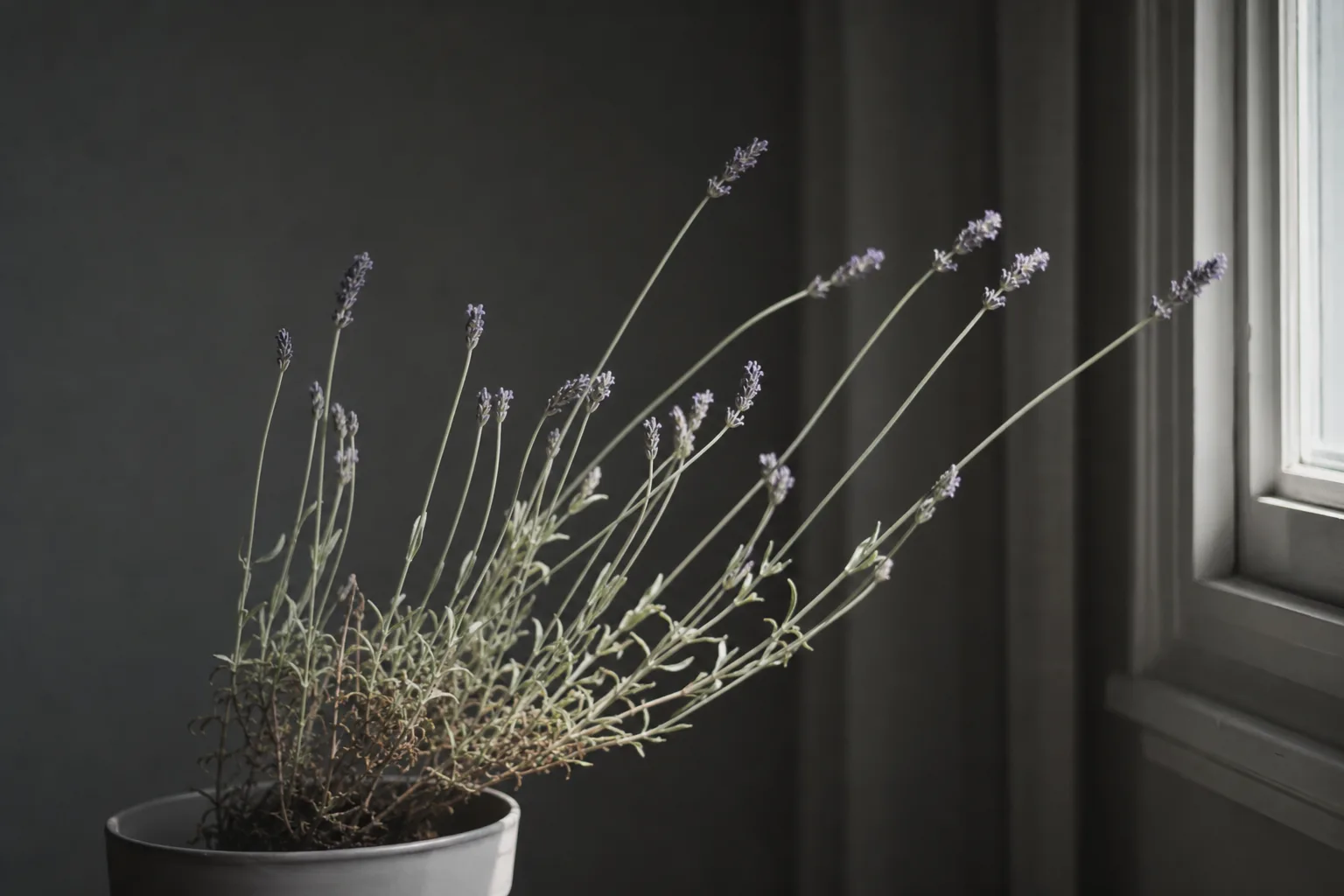
Insufficient light produces long bare woody stems with narrow grey-green leaves clustered at the tips-not true needles. Stems lean strongly toward the brightest direction. Flower wands are small or absent on wood that bloomed in previous seasons. New growth may look pale silvery-green and soft compared with a dense outdoor mound.
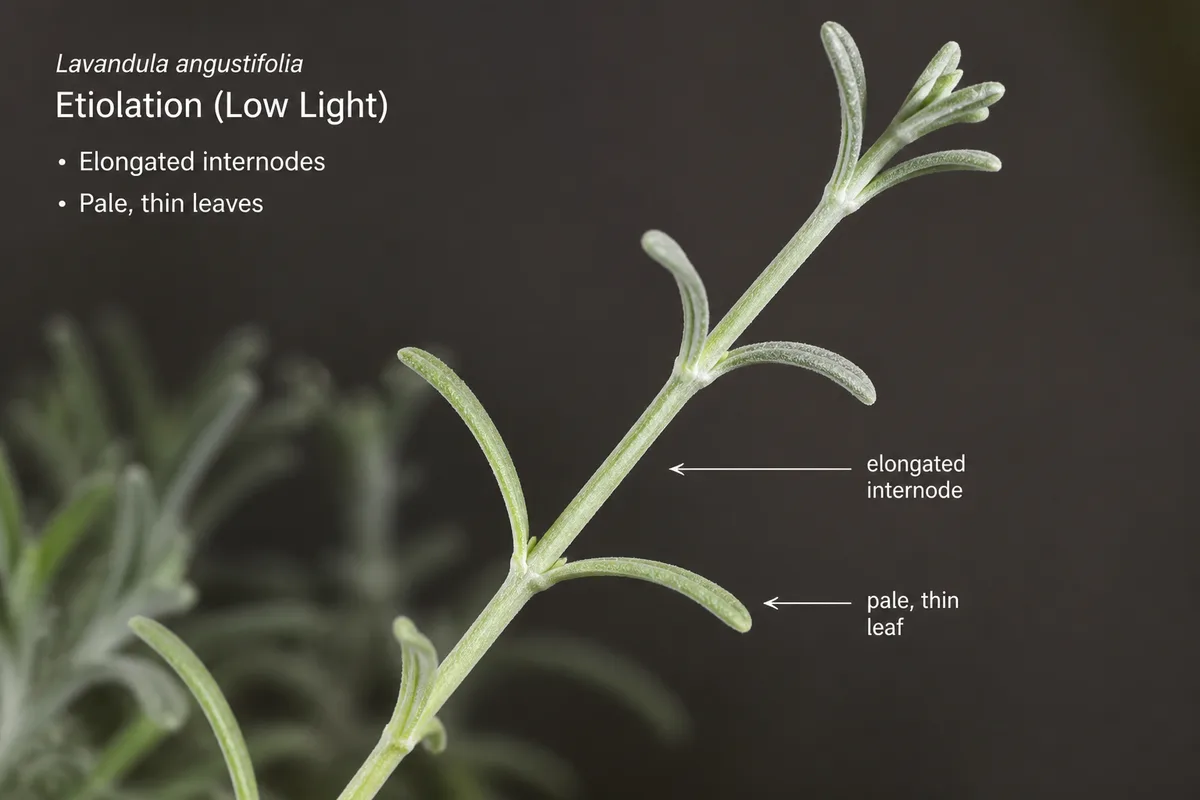
Not Enough Light symptoms on Lavender - compare with healthy tissue on the same plant.
Indoor “bright” shelves, north-facing balconies, and pots tucked under deep eaves often deliver fewer than two hours of true direct sun on the foliage while the room still feels luminous. Lavender may survive briefly there but will not build fragrance, bloom, or compact form.
Etiolation signals vs. normal winter slowdown
Etiolation means stems elongate and internodes stretch because the plant searches for photons. In cool months with adequate outdoor sun, growth slows but old wood stays firm and grey-green-that is dormancy, not light failure. Suspect insufficient light when stretch happens in warm active growth or when an indoor pot leans all winter despite a south window.
Why lavender needs more light than most houseplants
Lavender is a full-sun Mediterranean xerophyte that thrives in full sun and well-drained soil. Grow in average, dry to medium, well-drained, alkaline soil in full sun-partial shade produces stretched, flower-poor plants. NC State lists full sun as six or more hours of direct sunlight daily for English lavender.
Without strong light, photosynthesis cannot fund the terpenes, fragrance, and compact branching lavender is grown for. Illinois Extension notes lavender is demanding of full sun and extremely well-drained soil. Shade also keeps crowns damp longer-dampness kills lavender more reliably than cold in many gardens.
Mediterranean full-sun biology
English lavender evolved on open, sun-baked slopes with sharp drainage and low humidity. Container growers sometimes buy it for indoor display; L. angustifolia is a poor long-term indoor foliage plant in most homes-it wants outdoor sun and dry air. Spanish (L. stoechas) and French (L. dentata) types tolerate marginally lower daily totals in warm zones but still decline below six direct hours-French and tender lavenders are less hardy than English types; see the species table on the lavender light guide.
Why indoor bright indirect fails long-term
A sunny windowsill rarely delivers six hours of direct rays on the leaves-glass filters intensity, overhangs shorten the beam, and winter photoperiod drops total energy. English lavender can be difficult where winter stress and high summer humidity combine; humid indoor winter culture often fails on light alone even when the window looks bright.
How to confirm the cause
Run this checklist before Lavender repotting guide or fertilizing:
- Direct sun hours on the foliage-not general room brightness. Track when sharp shadows first hit leaves and when a building or eave blocks them.
- Lean direction - strong tilt toward one vector confirms phototropism from weak light.
- Flower history - no blooms on mature wood in season strongly implicates light, not age alone.
- Neighbor comparison - rosemary or sage thriving in the same spot rules out general neglect.
- Root and crown check - firm roots on dry mix point to light; soft crown on wet shaded mix means escalate to crown rot protocols.
- Acclimation need - if moving from deep shade, plan a 7–14 day hardening schedule (below) before judging recovery.
Light vs. other causes
| What you see | Sun hours on pot | Crown | Most likely cause | Next page |
|---|---|---|---|---|
| Lean, pale tips, no bloom | Under 6 | Firm | Insufficient light | This page |
| Upright long bare wood, old spikes still attached | 6+ | Firm | Missed post-bloom prune | Leggy growth |
| Wilting on wet mix in shade | Any | Soft base | Crown or root rot on Lavender | Crown rot |
| Slow tips only in cool months | 6+ | Firm | Winter dormancy | Lavender overview |
First fix for lavender
Move the pot to maximum feasible direct sun-open balcony, sunny terrace, or south-facing unobstructed edge where rays hit leaves, not just the pot rim.
Do not prune heavily on day one unless rot is confirmed. Light correction comes first; shaping cuts follow once new compact shoots appear. Full sun means six to eight or more direct hours during active growth-Iowa State Extension recommends six to eight hours for compact growth and abundant flowers.
Seven-day acclimation from deep shade
Sudden jumps from dim shelves to blazing patio sun scorch tender leaves. Use a stepped move:
- Days 1–3: 3–4 hours direct morning sun, bright open shade otherwise.
- Days 4–6: Increase to 5–6 hours including midday when temperatures stay moderate.
- Days 7–10: Reach the final spot or add afternoon hours until full placement.
- Days 11–14: Hold at full sun; judge new growth only for firm grey-green color and short internodes.
During acclimation, water when the mix is dry 7 cm deep-more sun increases transpiration. Do not fertilize until compact shoots appear. Full protocol detail lives on the lavender light guide.
Step-by-step recovery (light-first)
This sequence differs from leggy growth recovery, which assumes sun is already adequate and pruning was skipped.
- Audit and relocate using the acclimation steps above.
- Recalibrate watering for two weeks-full sun dries pots faster than shade. Check moisture at 7 cm per the watering guide; do not keep a shaded-watering schedule on a sun-moved plant.
- Remove spent flower wands only-no one-third heading cut until new firm shoots show the site passes the light test.
- Prune one-third above healthy nodes after flowering or in spring once compact regrowth proves placement works-Illinois Extension recommends removing one-third to one-half after flowering to keep compact shape; see lavender pruning for old-wood limits.
- Hold fertilizer until new shoots are firm and closely spaced.
Stretched old sections never compact without cuts-only forward growth looks bushy.
Recovery timeline
Expect denser silver shoots within two to four weeks in warm full sun after light correction and timely pruning. Flower wands return on healthy wood the next bloom cycle, not necessarily the same season if relocation happened mid-summer. If nothing sprouts after a month in warm sun with a firm crown, inspect roots for rot before cutting harder.
Causes to rule out
- Normal slow growth on Lavender - firm wood in full sun with modest tips during cool weather.
- Prune neglect - plant in 6+ hours sun but upright with old spikes on bare wood; see leggy growth.
- Root rot - wilting on wet shaded soil with sour smell; light fix alone will not save mushy roots.
- Winter dormancy - reduced growth outdoors with adequate sun is seasonal, not etiolation.
What not to do
Do not keep English lavender on bright indirect shelves indefinitely. Do not compensate with heavy fertilizer in shade-that produces soft weak shoots with reduced fragrance; over-fertilized lavender grows more foliage but fewer flowers. Do not repot on day one unless roots are mushy or mix has failed drainage.
Grow lights: when they work and when they fail
Decorative LEDs and weak lamps fail lavender because intensity and duration fall short of outdoor photon budgets. If outdoor sun is impossible short term, use a full-spectrum vegetative LED roughly 12–16 hours daily, positioned so new growth stays compact-stretch under the lamp means lower it or extend duration. Window-only culture is temporary overwintering, not a long-term display. PPFD targets and fixture setup are covered on the lavender light guide.
How to prevent light problems next time
Buy lavender only if six or more hours of direct outdoor sun are available on the foliage. Place pots on the sunniest feasible railing, not the prettiest shaded corner. Remove faded flowers and prune to shape in spring once sun and drainage are correct.
If your site cannot deliver six direct hours, choose a sun-loving alternative-Russian sage, catmint, or rosemary in similar grit-rather than replacing dead lavender every two seasons. Species minimums are summarized on the light guide.
When to worry
Escalate when shaded lavender also has wet soil and crown softness-weak light culture plus humidity invites rot within days. Low light alone is slow decline; the combination is urgent. Move to sun and dry the root zone before heavy pruning if the crown is still firm; if the base is mushy, follow crown rot rescue the same day.
Moving a recovered plant to a brighter patio accessible to pets? Lavender is toxic to dogs and cats if chewed-place pots accordingly when upgrading exposure.
When to use this page vs other Lavender guides
- Lavender watering guide - Use for routine moisture checks before assuming not enough light is the main issue.
- Lavender problems hub - Browse all 51 common issues on this species.
- Leggy Growth on Lavender - Different entry point when symptoms overlap with not enough light.
- Slow Growth on Lavender - Different entry point when symptoms overlap with not enough light.
- Yellow Leaves on Lavender - Different entry point when symptoms overlap with not enough light.