Scale Insects on Janet Craig Dracaena: Causes, Checks &
Quick answer
Scale insects on Janet Craig Dracaena show up as small tan or brown bumps glued to cane joints, leaf sheaths, and crown tissue-not cottony wax. First step: isolate the plant and scrape every visible bump with a cotton swab dipped in 70% isopropyl alcohol before starting repeat oil or soap sprays.
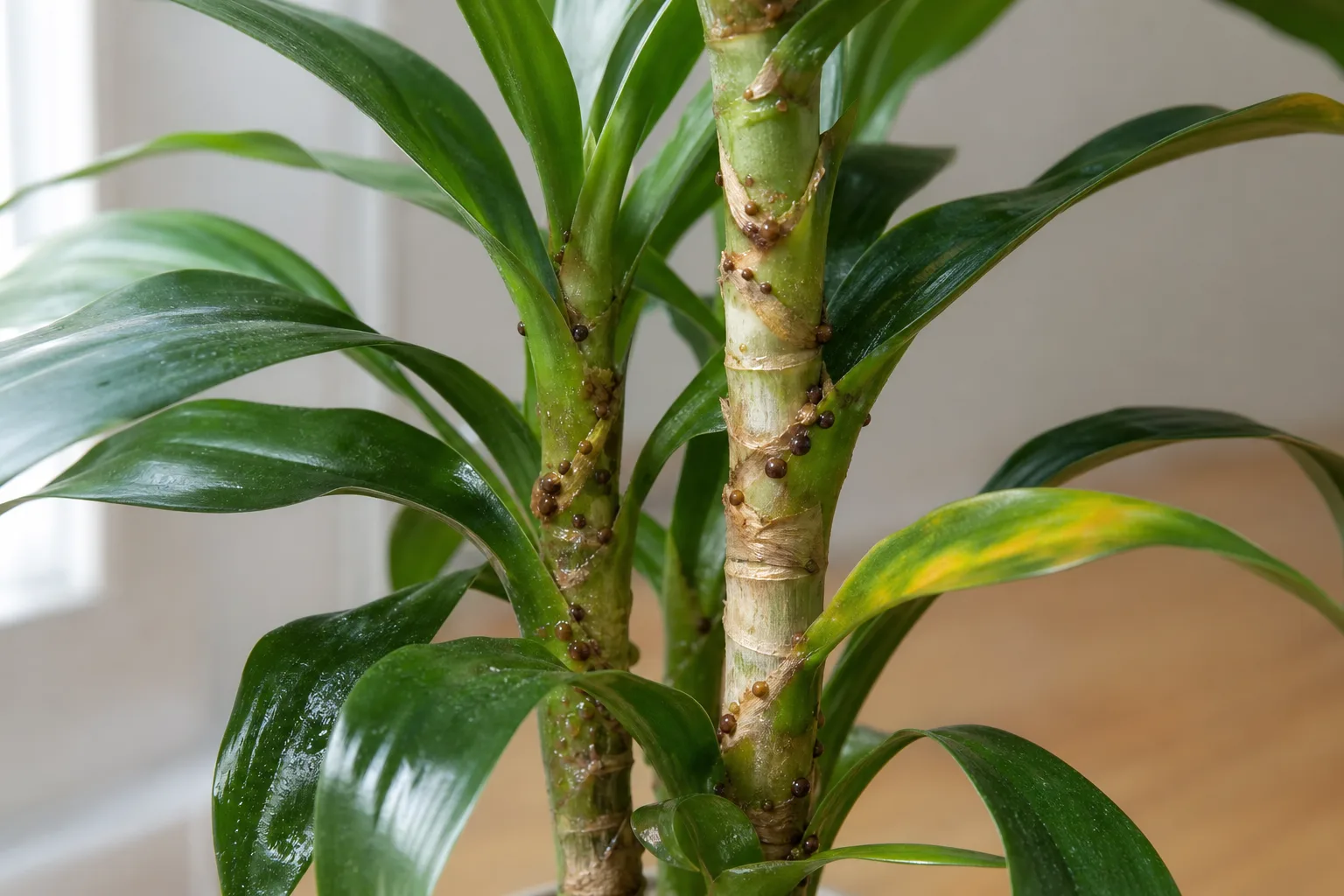
Scale Insects on Janet Craig Dracaena: Causes, Checks & Fixes
This guide covers scale insects on Janet Craig Dracaena. See also the general Scale Insects guide, watering, and light pages for this plant.
Scale Insects on Janet Craig Dracaena: Causes, Checks & Fixes
Quick answer
Scale insects on Janet Craig Dracaena (Dracaena deremensis ‘Janet Craig’) appear as small, immobile tan, brown, or bark-colored bumps glued to thick cane joints, leaf sheath bases, crown tissue, and sometimes leaf undersides along midribs. They pierce phloem sap, weaken slow-growing foliage, and-on soft scale species-excrete sticky honeydew that can lead to black sooty mold on the glossy strap leaves below.
First step: isolate the plant and scrape every visible bump with a cotton swab dipped in 70% isopropyl alcohol. On this upright floor plant, contact removal beats a single blanket spray because sheltered cane crotches and dense crown clusters hide adults that foliar mists never reach. Work cane by cane from soil line to crown before starting repeat oil or soap treatments.
What scale insects look like on Janet Craig
Janet Craig’s upright cane habit creates dozens of protected hiding spots where scale colonies build quietly. Scale favors exactly those joints: where a broad strap leaf wraps the stem, inside the crown where new leaves emerge, and along the lower cane near the soil line.
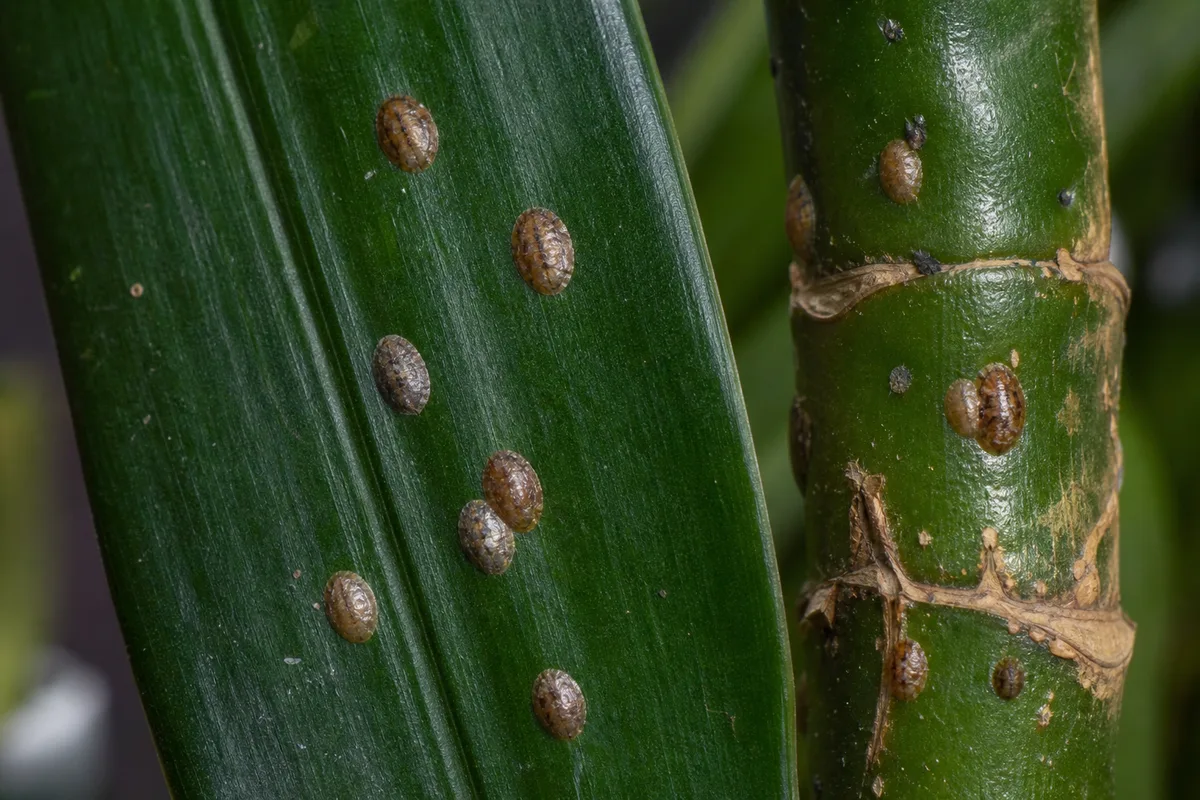
Scale Insects symptoms on Janet Craig Dracaena - compare with healthy tissue on the same plant.
Typical signs include:
- Flat or dome-shaped bumps on tan cane tissue, leaf petiole bases, and along leaf undersides near midribs
- Tan, brown, or gray disks that blend with stem color until you look closely and see individual scales in rows or clusters
- Shiny, sticky honeydew on lower glossy strap leaves and on saucers beneath floor specimens (typical of soft brown scale)
- Black sooty mold on sticky leaf surfaces; it wipes off but returns until insects are controlled
- Ant trails on pot rims, saucers, or floor tiles-ants harvest honeydew and protect scale colonies
- Yellowing, stunting, or leaf drop on heavily infested sections when sap loss outpaces this cultivar’s slow replacement rate
On Janet Craig, honeydew on lower glossy leaves is often the first visible sign from across the room-bumps at sheltered cane crotches stay hidden until colonies grow. New crown leaves may look smaller or twisted when feeding is heavy, but a few isolated bumps on one cane are easier to clear than a plant ringed at the growing tip.
Unlike mealybugs, scale looks like smooth raised disks without fluffy wax. Unlike fluoride tip burn-a common Janet Craig issue-scale sits as immobile bumps at joints and leaf bases; brown tips stay fixed at margins without honeydew or raised shells. Press a suspect bump with a fingernail or toothpick. Scale should flake off with gentle pressure; mealybugs smear waxy cotton instead.
Why Janet Craig gets scale insects
Scale insects are common sap-sucking pests on houseplants that usually arrive on new nursery plants, reused pots, or nearby infested specimens-not because Janet Craig is uniquely prone, but because its architecture gives pests protected hiding spots at every cane crotch.
North Carolina Extension notes that corn plant cultivars including Janet Craig are susceptible to insect pests alongside thrips and mealybugs-especially in warm indoor settings where pests reproduce year-round.
Several Janet Craig habits make infestations easier to miss and harder to clear:
Architecture. Wide leaves spiraling up thick canes mean scale can feed in leaf crotches and the shoot apex while the plant still looks fine from across the room. UC IPM notes scale often hides in tight crevices such as behind or inside leaf bases and in stem joints-all abundant on a floor-sized Janet Craig.
Slow growth. Janet Craig is a slow-growing interior plant. Heavy feeding removes sap faster than this cultivar replaces leaves, so damage looks sudden even though colonies built quietly for weeks.
Low-light office culture. Janet Craig tolerates deep shade, but plants kept in dim corners with chronically wet mix stay stressed without growing out of injury. Stressed specimens attract pests; overwatering while treating makes recovery worse, not better.
Introduction from nursery stock. Brown soft scale is the most common scale on houseplants and produces honeydew. Infestations often begin with infested plant material brought indoors rather than scale flying in from outdoors.
Warm indoor rooms. Indoor ornamentals are especially vulnerable because mild temperatures favor overlapping generations and natural enemies are absent indoors.
How to confirm the cause
Work through these checks before buying spray or Janet Craig Dracaena repotting guide:
- Isolate first - Move the Janet Craig away from other floor plants before handling so crawlers do not walk to neighboring pots or shared saucers.
- Crown and upper cane joints - Inspect with bright light held at leaf level. Janet Craig’s dense leaf clusters hide the worst colonies.
- Leaf sheath bases and midribs - Check where each strap leaf meets the cane and along undersides near veins-soft scales often concentrate along veins and stem joints.
- Soil line and pot rim - Lift outer leaves and check where stems enter the mix and along unglazed terracotta rims where wax clings to porous surfaces.
- Scrape test - Pry a bump with a knifepoint or toothpick. Scale shells lift to reveal insects or eggs beneath; natural stem texture stays green and attached. WSU Pestsense recommends scraping gently and examining with a magnifying glass-plant tissue appears green beneath; scale shells lift to reveal insects or eggs.
- Look for ants or sooty mold on lower leaves and the pot exterior-secondary signs of sap-feeding pests. Persistent ants often point to hidden scale or mealybugs on Janet Craig.
- Rule out lookalikes: fluffy white wax in axils (mealybugs); chalky mineral crust on pot rims; uniform brown leaf tips from tap water fluoride without raised bumps; perlite specks on soil that wipe off dry.
If canes are firm, soil smells neutral, and the only issue is immobile bumps with stickiness, soft scale fits. If the pot stays heavy for days, soil smells sour, and cane bases soften while mix stays wet, rule out overwatering on Janet Craig before spraying-that is a different problem from bumps glued to cane joints.
Lookalike symptoms
| Sign | Scale insects | Mealybugs | Fluoride tip burn | Mineral crust |
|---|---|---|---|---|
| Appearance | Tan/brown raised disks on cane | White cottony wax in axils | Brown crisp margins, no bumps | Chalky film on pot rim |
| Stickiness | Honeydew on leaves below | Honeydew possible | No stickiness | Wipes off dry |
| Scrape test | Shell lifts; insect beneath | Waxy smear | Fixed leaf tissue | Powder on finger |
| First visible from distance | Shiny lower leaves | White wax at crown | Brown tips at margins | White on pot, not plant |
First fix for Janet Craig
Move the plant away from other Dracaenas and houseplants, then scrape every visible scale with a cotton swab dipped in 70% isopropyl alcohol.
Clemson HGIC notes that early scale infestations can be removed by scraping; alcohol dissolves the waxy cover on contact. Test alcohol on one lower leaf first and wait 24 hours before treating the whole crown-Janet Craig’s thick waxy leaves are generally tolerant, but a patch test is still wise.
Press the swab into each bump until you see wet insect tissue-not just a surface wipe. Work systematically down each cane, including the crown and soil-line joints. Bag swabs and dropped shells in the trash, not the compost pile indoors.
Do not shower the whole plant as your opening move if that soaks an already heavy pot in a low-light office-Janet Craig roots hate stale moisture. See Janet Craig watering for dry-down checks during treatment. Do not apply fertilizer to a pest-stressed plant. Do not return the plant to its display spot until you finish at least one full follow-up inspection cycle.
Step-by-step recovery
After isolation and alcohol scraping, continue in this order based on severity:
-
Repeat scrapes every five to seven days for at least three cycles to catch newly hatched crawlers before they settle under a new shell. Adult scales are relatively protected from insecticides by their waxy covering, so physical removal plus repeat treatment matters.
-
Apply horticultural oil or insecticidal soap if bumps persist after several scrape rounds. Cover leaf undersides, cane crotches, and crown tissue thoroughly; oils suffocate insects by blocking their breathing pores and must contact the pest directly. Repeat weekly for at least two to three cycles to catch newly hatched crawlers.
-
Shower or wipe foliage carefully. Rinse upper leaves and cane crotches in a sink, tilting the pot so water runs off without flooding cold, slow-drying soil. Cover the mix with foil if needed. Good airflow after rinsing helps glossy leaves dry-Janet Craig is prone to leaf problems when foliage stays wet in dim corners.
-
Manage ants if they protect colonies on pot rims or saucers. Treat the underlying sap feeders-scale or mealybugs-rather than only chasing ants. See ants on Janet Craig when ant trails persist after pest treatment begins.
-
Inspect the collection. Check other floor plants, shared saucers, and stakes. Crawlers walk between pots on the same bench.
-
Consider a systemic drench only for persistent soft scale after manual and spray efforts fail. Mississippi State Extension notes that soil treatments containing imidacloprid usually control brown soft scale but are less effective on armored scales-honeydew presence helps confirm soft scale before choosing this route.
-
Hold fertilizer until new crown growth looks normal for two weeks. Sap loss, not nutrient lack, is the immediate problem.
-
Monitor two extra weeks after you think you are clear. One missed adult or crawler restarts the cycle on slow Janet Craig canes.
Keep the plant isolated until you see no new scale for at least two weeks after the last treatment.
Recovery timeline
Because Janet Craig grows slowly, pest recovery is measured in weeks, not days.
- First seven to ten days: Active colonies should shrink after isolation and repeated alcohol scraping; fresh bumps on old sites mean keep going.
- Two to four weeks: With weekly soap or oil follow-ups, new crawlers should become rare; honeydew stickiness dries up.
- Four to eight weeks: Judge success by clean new crown leaves, not by old yellowed foliage-which will not fully green again.
- Two to three months: A large floor plant may still look thin until enough new strap leaves fill gaps; that is normal for this cultivar.
Worsening signs: bumps return at the crown despite treatment, ants intensify, lower leaves drop in clusters, or the cane feels soft while soil stays wet-soft cane points to rot or severe stress, not scale alone, and needs separate assessment.
What not to do
Do not stop after one scrape or one spray-eggs and crawlers hatch on a staggered schedule. Do not soak the pot repeatedly while treating; Janet Craig in deep shade already risks overwatering, and wet roots plus pest stress compound damage.
Avoid broad-spectrum indoor sprays that harm beneficial predators if you later move plants outdoors. Do not return the plant from quarantine until you have gone two weeks without finding new bumps.
Do not confuse fluoride tip burn with scale-brown margins without raised bumps need filtered water, not pest spray. Do not increase watering when leaves yellow during treatment in dim offices.
Keep pet safety in mind during treatment-Janet Craig Dracaena is toxic to cats and dogs. Keep alcohol swabs, treated leaves, and pruned material away from pets; contact your veterinarian if a pet ingests treated foliage or sap.
Do not fertilize a recovering plant to “push growth”-feed only after pests are controlled and watering rhythm is stable.
How to prevent scale insects next time
Quarantine every new Janet Craig or mixed floor plant for at least two to three weeks before it joins your collection. Inspect cane joints with a light during weekly care-the same pass you use to dust broad leaves.
Buy from sources with clean understock when possible, and reject plants with bumps on cane tissue even if top leaves look glossy. UMN Extension advises isolating plants as soon as pests are detected and examining all parts before bringing plants indoors.
Keep Janet Craig in bright to moderate filtered light with a dry-down watering rhythm matched to placement. Clemson HGIC notes Dracaena problems spike with poor drainage and insect pests when culture slips.
Use filtered water for Janet Craig’s fluoride sensitivity, but still inspect joints-good water quality does not prevent hitchhiking scale.
After treatment, sterilize stakes and saucers or replace them; scale and crawlers hide on pot rims and supports. Separate floor specimens so canes do not touch neighboring pots-uninfested plants become infested when leaves touch those of an infested plant.
When to worry
Escalate or consider discarding the plant if:
- Bumps cover most of the crown and new leaves cannot emerge clean
- Ants persistently farm honeydew despite repeated contact treatments
- The same plant has failed two full treatment cycles spanning six to eight weeks
- A multi-cane floor specimen is mostly defoliated with scale on every joint
UC IPM advises discarding severely infested houseplants rather than endless retreatment-economical when a slow-growing Janet Craig is already defoliated and neighboring office plants are at risk.
For moderate infestations on an otherwise healthy cane, persistence usually wins if you combine isolation, alcohol contact kills, and repeated soap or oil coverage of every joint.
Practical checks
Urgency check
Treat as urgent when bumps encircle multiple cane sections, ants swarm stems or saucers, new crown tips stall for more than a week despite adequate light, or sticky residue coats floor tiles beneath a specimen. A single small cluster on one cane with firm tissue elsewhere is manageable with isolation and scrapes-not an emergency, but act within days before crawlers spread.
Best inspection order
Crown and newest leaves → upper cane crotches → leaf sheath bases and midribs → soil line and pot rim → neighboring floor plants and shared saucers. Work top to bottom with a phone light at leaf level so sheltered joints are not missed.
Related Janet Craig problems
- Mealybugs on Janet Craig - fluffy white wax in axils vs. hard scale bumps on cane tissue
- Ants on Janet Craig - honeydew farming when scale or mealybugs feed overhead
- Brown tips on Janet Craig - fluoride margins without raised bumps or stickiness
- Overwatering on Janet Craig - yellow leaves and soft cane when soil stays wet, not pest bumps
- Janet Craig care overview - light, watering, and fluoride constraints during pest recovery
Conclusion
Scale insects on Janet Craig Dracaena exploit the same sheltered cane joints that make this plant architectural indoors. Confirm immobile tan or brown bumps-not tip burn or mealybug wax-then isolate and alcohol-scrape first, follow with weekly contact sprays until crawlers stop, and judge recovery by new crown growth on this slow cultivar. Quarantine new floor plants, inspect joints during routine care, and keep watering matched to low-light dry-down so pests meet a healthy plant, not a stressed one.
When to use this page vs other Janet Craig Dracaena guides
- Janet Craig Dracaena watering guide - Use for routine moisture checks before assuming scale insects is the main issue.
- Janet Craig Dracaena problems hub - Browse all 50 common issues on this species.
- Ants on Plant on Janet Craig Dracaena - Different entry point when symptoms overlap with scale insects.
- Yellow Leaves on Janet Craig Dracaena - Different entry point when symptoms overlap with scale insects.
- Mealybugs on Janet Craig Dracaena - Different entry point when symptoms overlap with scale insects.