Spider Mites on Hoya: Causes, Checks & Fixes
Quick answer
Spider mites on Hoya show as fine stippling and delicate webbing at leaf axils-often in dry winter air near sunny glass or heating vents. First step: move the plant away from neighbors and rinse leaf undersides with lukewarm water before applying any spray.
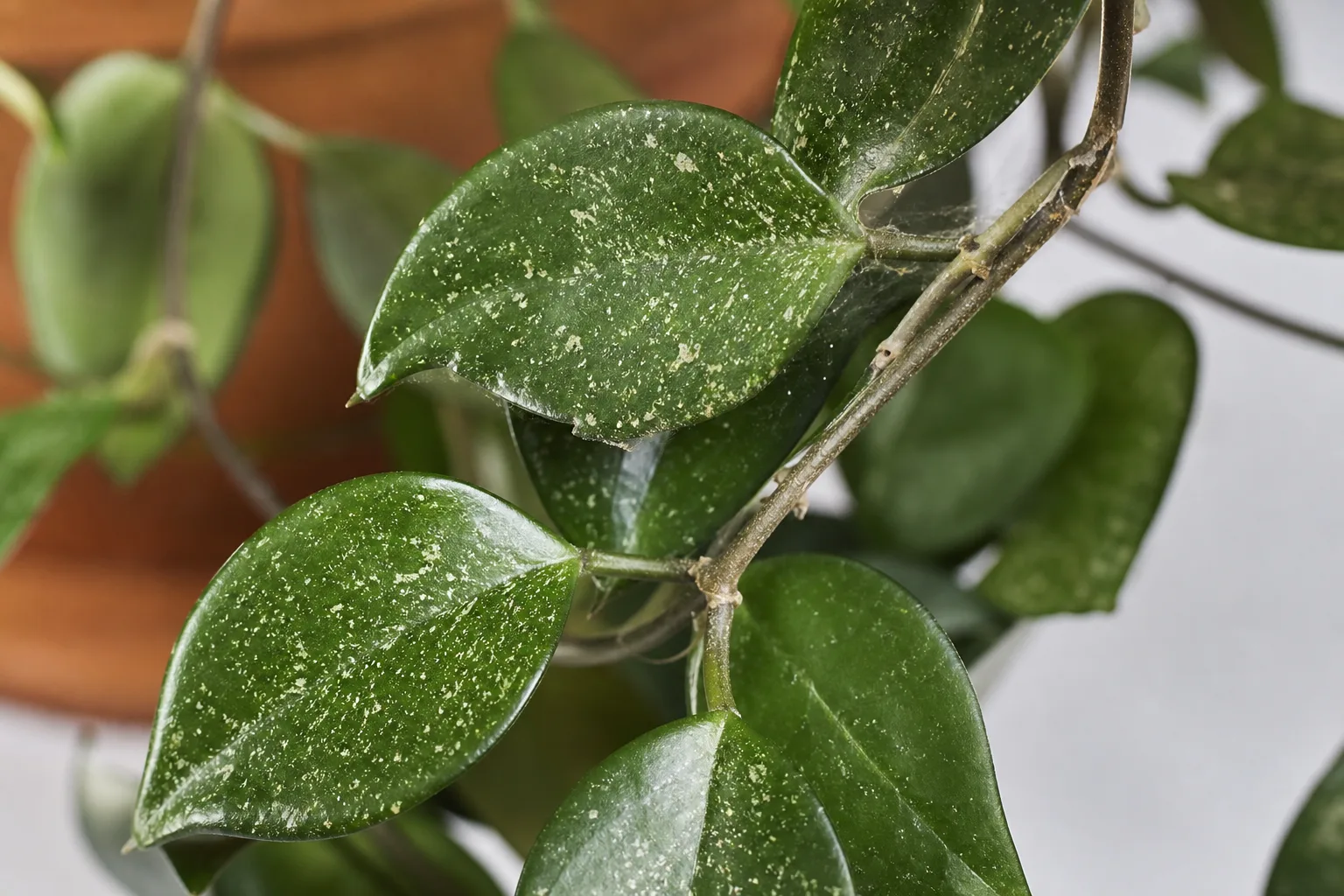
Spider Mites on Hoya: Causes, Checks & Fixes
This guide covers spider mites on Hoya. See also the general Spider Mites guide, watering, and light pages for this plant.
Spider Mites on Hoya: Causes, Checks & Fixes
Quick answer
Spider mites on Hoya are tiny arachnids that pierce leaf cells on undersides, leaving fine yellow or white stipples that read differently on thick waxy leaves than on thin-leaf species. They thrive in the warm, dry pockets around a hanging basket near winter sun or a heating vent-the same placement that keeps Hoya blooming but drops humidity toward the mite-friendly range.
First step: isolate the plant from your collection and rinse leaf undersides with lukewarm water-especially along trailing stems where dense waxy foliage hides axil colonies from a top-down glance. Confirm active mites with a paper tap test before stacking sprays. On this epiphytic wax plant, that rinse comes before horticultural oil or insecticidal soap, and it must respect crown drainage in bark-heavy mix.
Diagnostic photos: Compare fine yellow stippling scattered across a waxy H. carnosa leaf face (mite feeding from below), delicate silk at a leaf axil on a trailing vine (not corner-spider webbing), and slow-moving specks on white paper from a tap test beneath a bronzed leaf. Original symptom photos will be added to this guide in a future update.
This genus-level guide covers spider mites across common indoor Hoya types-thick-leaf H. carnosa, H. obovata, and H. pubicalyx, plus thin-leaf H. linearis and related trailing species. Cultivar-specific care pages on this site point here for mite diagnosis and treatment.
Why Hoya gets spider mites in dry winter rooms
Hoya is not uniquely prone to mites, but its indoor placement and leaf architecture create conditions mites exploit. Trailing vines in hanging baskets sit in the warm, dry layer of air below ceiling heat and above sunny winter glass. Twospotted spider mites prefer hot, dry weather and reproduce quickly when humidity falls-exactly what forced-air heating does from late fall through early spring. UC IPM notes that low indoor humidity favors mite development on houseplants, and dusty leaf surfaces give mites additional cover on broad waxy paddles.
Thick, waxy leaves store moisture, so a H. carnosa or H. obovata can look firm while mites build on undersides and in leaf axils. Thin-leaf species such as H. linearis show stippling sooner when room RH drops below about 30%-the same threshold that triggers low humidity stress without any pest present.
Common outbreak triggers on Hoya:
- South- or west-facing winter window plus heat register below the hanger
- Grouped plants touching leaves-mites use silk to move between pots on the same shelf or wall hook
- New plants without quarantine-mites hitchhike from nurseries and spread before stippling is obvious on waxy foliage
- Chronic underwatering stress-weak vines recover slowly; see underwatering on Hoya if leaves wrinkle on dry mix without stippling
Raising humidity helps prevention, but it is not a substitute for contact treatment once webbing appears. Target 40–60% RH near the canopy per the Hoya overview-pebble trays and humidifiers beat misting, which wets waxy surfaces briefly without lasting effect.
What mite damage looks like on thick waxy leaves (and thin-leaf species)
On Hoya, spider mite feeding shows up in stages:
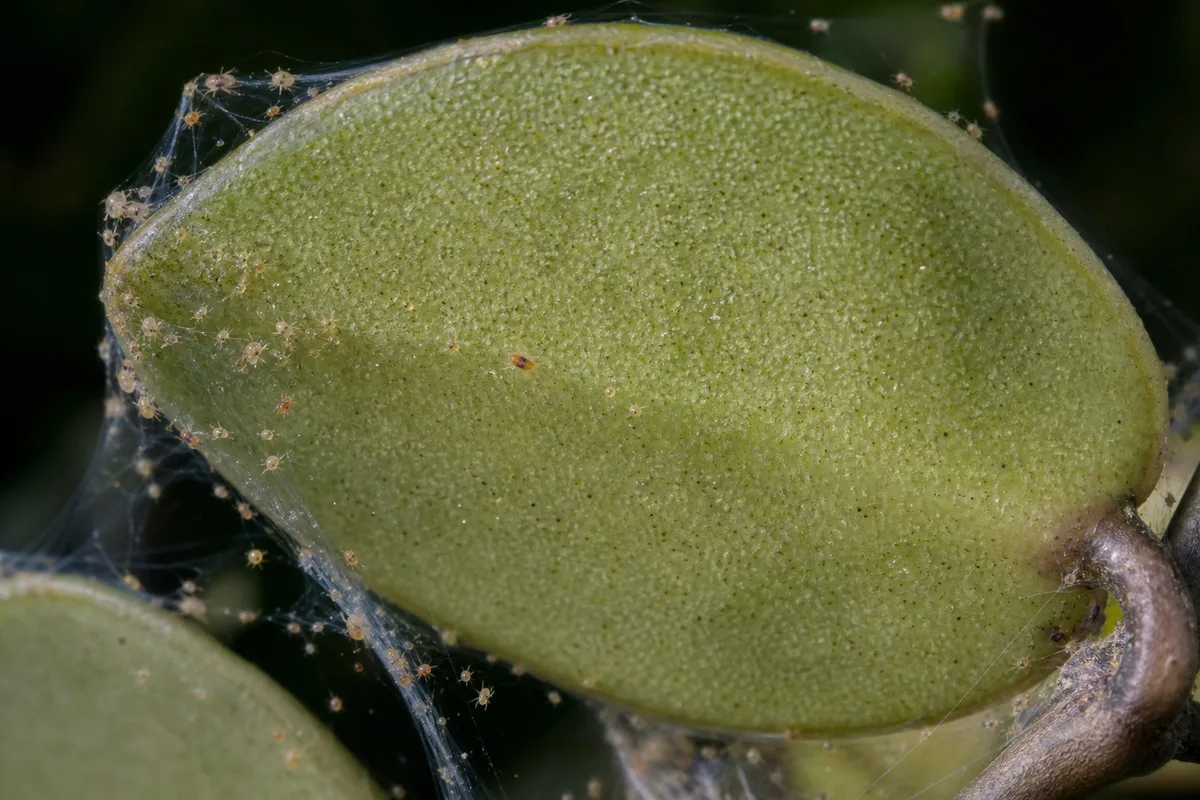
Spider Mites symptoms on Hoya - compare with healthy tissue on the same plant.
- Fine yellow or white stipples scattered across the leaf face-each spot is a collapsed feeding site
- Bronzing or graying as feeding continues across waxy tissue
- Delicate silk webbing at leaf bases, stem nodes, and axils where vines fold-not the heavy webs of a corner spider
- Crisp, dropped leaves only when populations are heavy and untreated
Stippling appears on the upper leaf surface while mites feed underneath. On thick-leaf Hoya, early stippling is easy to miss until bronzing spreads because the waxy cuticle masks contrast. On thin-leaf types, damage shows faster and can be confused with low humidity edge crisping until you flip the leaf.
Variegated cultivars such as H. carnosa ‘Tricolor’ may show damage first on pale sections where chlorophyll is already sparse. Peduncles (flower spurs) can carry webbing without obvious leaf stippling-inspect woody spurs when hunting survivors, and do not cut them during treatment.
Waxy cuticle and treatment coverage: Hoya’s thick cuticle does not repel horticultural oil the way some hairy-leaf houseplants do, but the wax layer can shed rinse water from upper surfaces while mites remain tucked in axils. That is why parting vines and wetting undersides directly matters more than product strength-and why thin-leaf H. linearis often shows oil burn sooner if you spray in hot afternoon sun on drought-stressed tissue.
Spider mites vs. low humidity, thrips, mealybugs, and drought wrinkling
Several Hoya problems overlap in winter dry air. Use this table before committing to sprays:
| What you see | Likely cause | Key check |
|---|---|---|
| Scattered pinprick stipples + fine webbing at axils | Spider mites | Paper tap shows moving specks; webbing at leaf bases |
| Uniform brown leaf edges, no stippling, firm stems | Low humidity | Hygrometer below 30% RH; no webbing or moving specks |
| Silvery streaks on new growth, no axil webbing | Thrips | Shake leaf over paper; elongated insects, not round mites |
| White cottony clusters in axils, sticky honeydew | Mealybugs | Crush test smears pink; clusters lift with alcohol |
| Soft wrinkled leaves on light, dry pot | Underwatering | Pot weight low; no stippling or webbing |
| Soft-bodied insects on tender new tips | Aphids | Clustered on fresh growth, not old waxy leaves |
Getting the diagnosis right matters because humidity fixes alone will not clear mites, and miticides wasted on dry air delay the real fix. Mites and mealybugs both hide in Hoya axils, but mealybugs stay cottony and stationary while mites stipple leaf faces and spin silk.
How to confirm spider mites (six-step checklist)
Work through these checks in order-on a trailing Hoya, lift vines aside instead of inspecting from above only:
- Leaf undersides and axils - Look for stippling on the upper face and mites, cast skins, or webbing underneath. A 10× hand lens helps.
- Paper tap test - Hold white paper under a suspect leaf and tap sharply. Slow-moving green, yellow, or red specks confirm mites.
- Webbing location - Fine silk at leaf bases and stem joints points to mites; thrips rarely produce axil webbing.
- Humidity cross-check - Place a hygrometer near the canopy. Edge crisping without stippling at RH above 40% suggests low humidity, not mites.
- Neighbor inspection - Check plants on the same hook or shelf. Mites spread on silk threads between touching leaves.
- Soil moisture - Firm leaves on damp mix without stippling may be overwatering on Hoya stress; wrinkled leaves on dry mix suggest underwatering. Mites can coexist with either-confirm pests before blaming water alone.
Confirmed mites mean isolation and repeated treatment-not a single rinse.
First fix: isolate neighbors, rinse trailing vine undersides, and treat on a schedule
Move the Hoya away from other plants first. Isolation limits spread on silk threads between hanging baskets and shelf neighbors.
Then rinse leaf undersides with lukewarm water:
- Take hanging plants down; tilt the pot so rinse water runs off leaves and away from the crown center
- Work along each trailing stem, parting vines to reach axils where mites harbor
- Rinse in bright indirect light so waxy leaves dry the same day-avoid rinsing into dense shade where foliage stays wet overnight
- Let bark-heavy epiphytic mix dry at the surface between rinses; do not soak the crown. See Hoya watering for dry-down rhythm during recovery
After the first rinse, apply horticultural oil or insecticidal soap labeled for mites (not general insecticides-many do not kill mites). UC IPM recommends washing leaf surfaces, then applying horticultural oil or insecticidal soap as a last resort when mite infestations persist. Soaps and oils kill on contact with little residual effect, so coverage on undersides matters more than product strength.
Widely available options include insecticidal soap products (potassium salts of fatty acids, such as Safer Brand Insecticidal Soap) and paraffinic horticultural oil sprays-both must be labeled for spider mites on ornamental plants. Patch-test one leaf for 24 hours before treating the whole plant; waxy foliage can burn if oil is applied in direct sun or on drought-stressed vines.
Treatment cadence for indoor Hoya:
- Rinse undersides + apply oil or soap - day 1
- Repeat rinse + spray - every 5–7 days for three cycles minimum
- Extend to a fourth cycle if webbing reappears within a week of the third
- Keep the plant isolated until no new webbing for two weeks after the last treatment
Patch-test one leaf for 24 hours before treating the whole plant-waxy foliage can burn if oil is applied in direct sun or on drought-stressed vines. Ventilate the room during indoor sprays.
Pet-accessible homes: Hoya is listed as non-toxic to cats and dogs by the ASPCA-the plant itself is safer than many trailing houseplants, but inhaled spray drift from horticultural oil or soap can still irritate pets. Move animals to another room during application and until surfaces dry.
Do not repot, fertilize, or prune peduncles on day one. Those steps can wait until mite pressure drops-same principle as the mealybugs and aphids protocols on this slug.
Recovery timeline and what “clean new growth” looks like
Expect stippling spread to stop within one to two weeks of consistent rinse-and-spray cycles. Because mites lay hundreds of eggs across overlapping generations, three weekly cycles are typical before calling a plant clear.
Recovery case (editorial, March 2026): A 10-inch H. carnosa hanging basket above a west-facing radiator showed axil webbing and scattered stippling at roughly 28% RH. Underside rinse every five days plus horticultural oil on treatment days 1, 8, and 15 cleared webbing by week three; new tips emerged without stippling by day 22. Older bronzed leaves stayed visible but no fresh damage appeared on new growth.
Signs recovery is working:
- No fresh webbing at axils or stem tips
- New leaves at vine ends emerge without stippling
- Paper tap test shows fewer or no moving specks
- Bronzing stops advancing on older leaves (old damage stays visible)
Signs the problem is worsening:
- Webbing sheets covering multiple vines or neighboring pots
- Increasing leaf drop despite treatment
- Stippling reaching variegated sections or peduncles you cannot rinse without damage
Stippled tissue does not fully reverse-cells are already collapsed from feeding. Judge success by clean new growth, not by old leaves re-greening. Heavily bronzed leaves may eventually drop; that is normal once the plant redirects energy to pest-free tips.
What not to do
- Using insecticides labeled for insects only - Mites need miticides, horticultural oil, or insecticidal soap labeled for mite control. Standard insecticides often miss mites.
- Soaking the epiphytic crown during repeated rinses - Waterlogged bark at the stem base invites rot on an epiphytic Hoya. Rinse leaves, not the crown center.
- Leaving waxy foliage wet overnight in stagnant air - Rinse in bright indirect light with airflow so leaves dry the same day.
- Confusing winter edge crisping with mite stippling - Brown margins without pinprick spots usually mean low humidity, not pests.
- Stacking Hoya repotting guide, pruning, and pesticide on one day - Spread stress across weeks; protect peduncles from unnecessary cuts during mite fights.
- Returning the plant to the collection after one rinse - Isolation should last until two webbing-free weeks after the last treatment.
Hoya care cross-check during recovery
While fighting mites, keep baseline care steady-not stacked with extra changes:
- Light: Maintain bright indirect light per the light guide so vines transpire evenly; dim corners slow leaf dry-down after rinses.
- Water: Let bark-heavy mix dry at the surface between drinks per the watering guide. Soggy crowns do not deter mites and invite rot during repeated rinses.
- Humidity: Target 40–60% RH at canopy height; run a humidifier when winter air drops toward 30%.
- Fertilizer: Hold feeding until two weeks after the last live mite is gone-stressed vines do not need nitrogen while colonies are active.
- Airflow: Gentle circulation helps waxy leaves dry after rinses; avoid blasting heat vents directly on wet trailing stems.
Prevention: humidity, underside scouting, and hanging-basket placement
Prevention on Hoya is mostly catching colonies before webbing sheets form:
- Scout leaf undersides weekly in heating season-lift trailing stems, do not glance from above
- Keep RH near 40–60% at canopy height; run a humidifier when winter air drops toward 30%
- Space hanging baskets so vines from different pots do not touch
- Quarantine new Hoya for two weeks and inspect axils before grouping with collection plants
- Avoid placing hangers directly above heat vents or in the dry microclimate of sunny winter glass without airflow
When buying Hoya, inspect leaf bases and axils on trailing specimens-cosmetic top-leaf gloss matters less than hidden stippling underneath.
When to escalate or call it quits
Escalate or consider discarding the plant if:
- Multiple collection plants show stippling and webbing at once
- A multi-foot trailing hanger is bronzed throughout and unreachable for thorough underside coverage
- Three to four full treatment cycles fail to reduce webbing
- Predatory mites may help enclosed grow-tent or cabinet setups where humidity stays above 50% and neighboring plants cannot be isolated on an open shelf-release according to supplier rates, keep foliage lightly misted for predator survival, and monitor with sticky traps alongside contact sprays. Biological control works best alongside monitoring, not as a single rescue on an open living-room shelf with forced-air heat.
Bagging and discarding a severely infested houseplant before mites walk to neighbors is sometimes cheaper than months of failed treatment-especially when a large collection hangs on one wall.
Hoya is resilient when enough firm stem tissue remains. A small infested starter may be worth replacing to protect a mature trailing specimen with years of peduncles.
Related Hoya problems
- Mealybugs - cottony wax in axils, not pinprick stippling across leaf faces
- Aphids - soft clusters on tender new growth, sticky honeydew
- Low humidity - uniform edge crisping without webbing or moving specks
- Underwatering - wrinkled leaves on light dry pot, no stippling pattern
- Fungus gnats - adult flies over wet mix, not leaf stippling
- Hoya overview - species hub, humidity targets, and general wax-plant care
Conclusion
Spider mites on Hoya are a hiding problem on waxy trailing vines, not a watering mystery. The pests feed where casual inspection fails-leaf undersides, axils, and stem nodes in the dry air of a winter hanging basket. Isolate first, rinse undersides second, repeat oil or soap on a five-to-seven-day schedule third. Raise humidity to the 40–60% range to reduce reinfestation pressure, but do not skip contact treatment once webbing is confirmed. With three consistent cycles and weekly underside checks along trailing stems, most Hoya push clean new growth and keep their peduncles for the next bloom season.
When to use this page vs other Hoya guides
- Hoya watering guide - Use for routine moisture checks before assuming spider mites is the main issue.
- Hoya problems hub - Browse all 17 common issues on this species.
- Low Humidity on Hoya - Different entry point when symptoms overlap with spider mites.
- Slow Growth on Hoya - Different entry point when symptoms overlap with spider mites.