Low Humidity on Hoya: Causes, Checks & Fixes
Quick answer
Most thick-leaf Hoya species tolerate average home humidity of 40–60%, but forced-air heating can drop indoor air below 30% and stress thin-leaf types or invite spider mites. First step: place a hygrometer near the canopy and run a humidifier or pebble tray-do not add extra water to compensate for dry air.
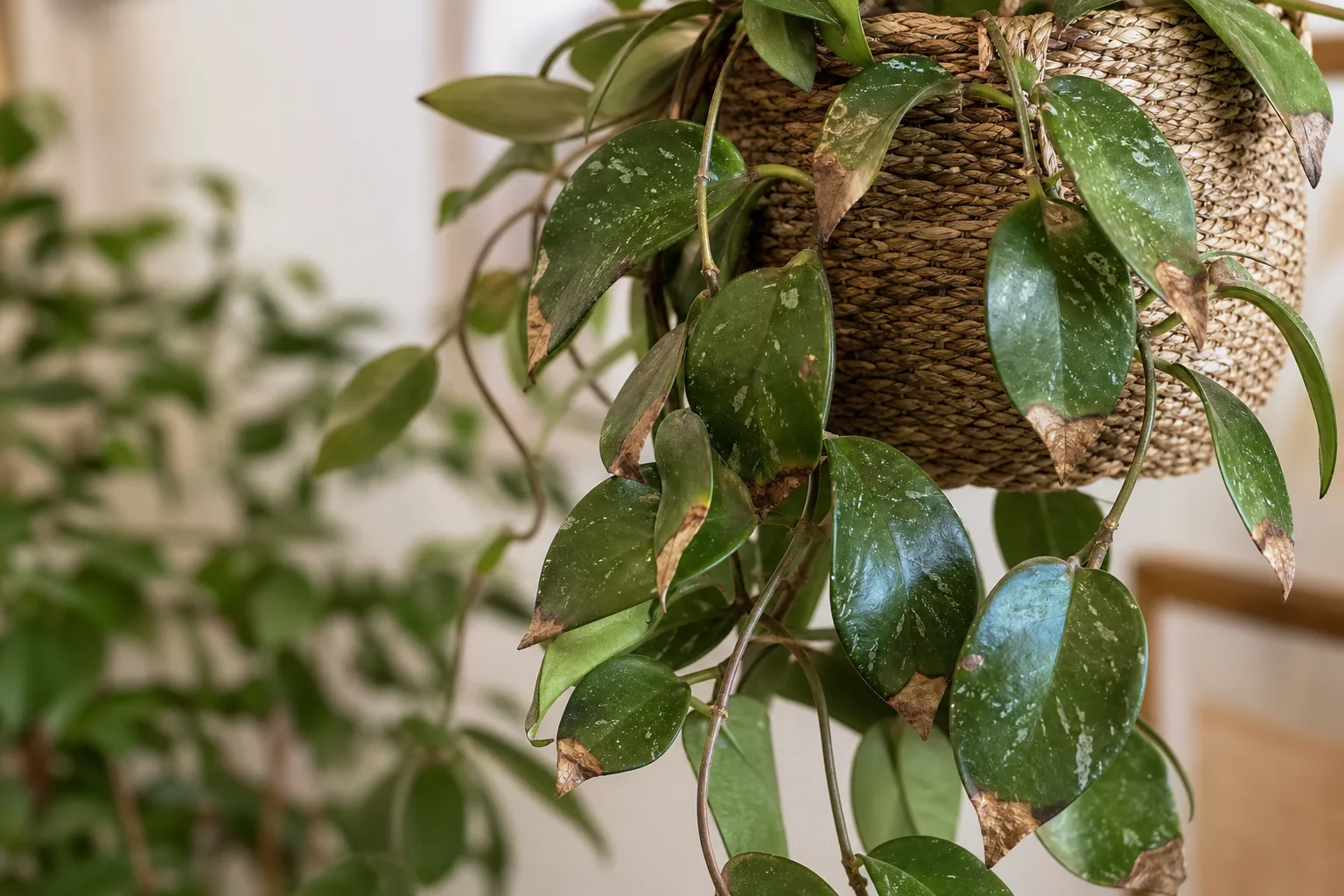
Low Humidity on Hoya: Causes, Checks & Fixes
This guide covers low humidity on Hoya. See also the general Low Humidity guide, watering, and light pages for this plant.
Low Humidity on Hoya: Causes, Checks & Fixes
Quick answer
Hoya (Hoya spp., wax plant) evolved as a tropical epiphyte on tree branches, absorbing moisture from humid air and rainwater-not from constantly wet ground soil. Indoors, that biology means humidity matters, but less than it does for calatheas or ferns for the thick-leaf species most people own.
Iowa State Extension recommends 40–60% relative humidity for best growth and bloom. Average homes often sit in that range, and thick, waxy leaves on Hoya carnosa slow moisture loss compared with thin-leaved tropicals. Problems appear when forced-air heating from late fall through early spring drops room RH toward 20–30%, especially above radiators or near sunny winter glass. Thin-leaf species crisp first; thick-leaf types may show stippling and spider mites before obvious leaf damage.
First step: place a hygrometer within 12 inches of the canopy and read RH at plant level. If the gauge shows below 40% in winter with firm leaves and appropriate soil moisture, dry air is a likely stressor-start a humidifier or pebble tray in the same room. If the pot is light and leaves feel soft, fix underwatering first. Full genus context: Hoya overview.
What humidity Hoya actually needs indoors
Humidity is helpful but secondary to bright light and correct watering for most hoya species in average homes-the same priority stated in the Hoya overview Temperature and Humidity section. That surprises growers who assume every tropical vine needs greenhouse fog. In practice, H. carnosa, H. obovata, H. pubicalyx, and similar thick-leaf types perform well without calathea-level humidity when light and dry-down watering are right.
The gap between “tolerates average air” and “shows no stress” widens in very dry heated rooms. NC State notes spider mites can appear when air is too dry on wax plant, and Iowa State Extension flags spider mites in very dry indoor air as a common hoya pest trigger. Dry air rarely kills a mature H. carnosa overnight, but chronic low RH slows thin-leaf growth, encourages mites, and can cause bud blast on peduncles developing in bone-dry conditions.
Thick-leaf vs. thin-leaf species tolerance
Leaf thickness is the fastest species-level predictor for how urgently you need humidity hardware.
| Species type | Examples | Humidity tolerance | When dry air bites |
|---|---|---|---|
| Thick-leaf | H. carnosa, H. obovata, H. pubicalyx, H. kerrii | Tolerates 40–60%; often fine at average home RH | Below ~30%: mite stippling, slow growth; H. kerrii more sensitive |
| Thin-leaf | H. linearis, H. curtisii, H. lanceolata subsp. bella | Prefers 50–60%; crisp edges fast in dry heat | Below ~40%: margin crisping within days; new growth shrivels |
| Trailing hanging baskets | Any species in open air below vents | Microclimate drier than room average | Leaves nearest heater or AC path fail first |
Iowa State Extension notes sweetheart hoya (H. kerrii) is less vigorous and more particular about light and humidity than common wax plant-treat it closer to a thin-leaf species for winter RH.
How low humidity shows up on Hoya
Hoya does not wilt dramatically from dry air the way a fern might. Symptoms build on waxy, semi-succulent foliage and often mimic other problems-which is why a hygrometer belongs in the first check, not the last.
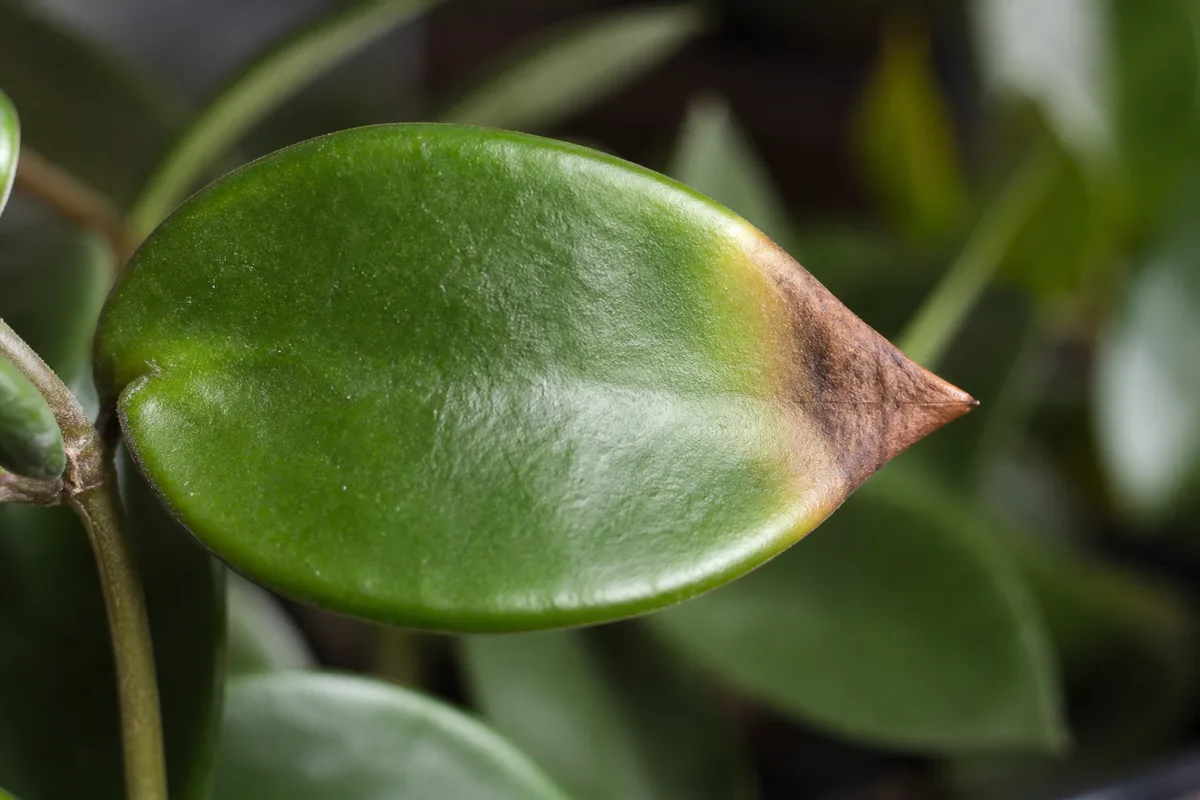
Low Humidity symptoms on Hoya - compare with healthy tissue on the same plant.
Stippling and dull foliage (thick-leaf types in dry heat):
- Fine yellow or white speckles on upper leaf surfaces
- Leaves lose glossy sheen and look slightly dull
- Often worse on vines nearest radiators, forced-air vents, or single-pane winter windows
- Soil moisture normal; leaves still firm when gently squeezed
- May precede visible spider mite webbing-mites thrive in dry, warm conditions on stressed houseplants; inspect undersides weekly in heating season
Crisp margins on thin-leaf species:
- Tan-to-brown bands at leaf edges on H. linearis, H. curtisii, and similar fine foliage
- Papery texture on otherwise turgid leaves
- New growth may emerge smaller or wrinkled when RH stays low for weeks
- Peaks when indoor humidity drops below about 30% with heating running
When waxy leaves tolerate dry air without damage:
- Thick H. carnosa in a stable 45% room with Hoya light guide often shows no humidity symptoms at all
- Firm, plump leaves and steady internode spacing mean RH is adequate for that species
- Do not buy a humidifier for a healthy thick-leaf hoya in mid-range RH-fix light or watering first if growth stalls
Unlike underwatering, low-humidity damage usually appears when soil moisture is appropriate and stems stay firm. Unlike brown tips from sun scorch, humidity crisping is not tied to one sun-facing leaf face.
How to confirm low humidity is the cause
Work through these checks in order. One hygrometer reading at canopy height beats guessing from symptom photos.
- Hygrometer at canopy height - Place a digital gauge within 12 inches of the top leaves, not on the opposite wall. Readings below 40% in winter with firm leaves and crisp thin-leaf margins strongly support low humidity. Below 30% with stippling raises spider mite risk immediately.
- Seasonal context - Is central or forced-air heat running? Dry-air symptoms cluster from late fall through early spring when outdoor air exchange drops indoor RH.
- Draft and heat-source map - Note distance to radiators, registers, fireplaces, and exterior doors. A plant in a 45% room can sit in a 25% microclimate directly above a register-especially in a hanging basket with open air circulation below the pot.
- Soil moisture cross-check - Probe the top half of mix. Evenly moist soil with firm stems and only margin crisping points to atmospheric dryness. A light, dusty-dry pot with soft wrinkled leaves means address water before humidity hardware.
- Pest inspection - Hold white paper under a leaf and tap. Moving specks plus stippling mean spider mites exploiting dry air-not humidity alone. Crisp edges without stippling or webbing fit pure RH stress on thin-leaf types.
- Leaf type - Thick versus thin foliage changes which branch of the checklist fits first, per the species table above.
| Symptom pattern | Soil moisture | Most likely cause | First action |
|---|---|---|---|
| Firm leaves, even crisp margins | Moist appropriately | Low humidity | Humidifier or pebble tray |
| Soft wrinkled leaves, light pot | Dry through top half | Underwatering | One thorough soak |
| Stippling + fine webbing | Normal | Spider mites in dry air | Isolate, rinse, treat; raise RH |
| Bleached sun-facing patches | Normal | Sun scorch | Reduce direct light |
First fixes for Hoya
First fix: run a small room humidifier in the same room as the plant for several hours daily-or set up an elevated pebble tray-then recheck RH at canopy height in three to five days. Do not water more to compensate for dry air; overwatering in poorly drained mix is the quickest path to root decline on epiphytic hoyas while leaves still crisp from low RH.
Humidifier placement for hanging baskets
Trailing hoyas in hanging baskets lose moisture to open air below the pot and often sit closer to ceiling heat stratification than floor plants.
- Place the humidifier in the same room, raised toward canopy level if possible-not pointed directly at leaves
- Run it several hours daily during heating season until RH at the plant reads 40% or above for thick-leaf types, 50% or above for thin-leaf species
- Keep the unit several feet from the pot so foliage does not stay continuously wet
- Pair with moving the basket away from heat registers and drafty winter glass
A humidifier changes ambient RH reliably; it is the first hardware choice when RH is confirmed low and symptoms match.
Pebble trays and plant grouping
For mild winter dryness or a single thick-leaf hoya:
- Set the pot on a tray of pebbles and water with the pot bottom above the water line-NC State recommends pebble trays for wax plant humidity
- Group plants slightly to raise local humidity a few percentage points
- Expect modest gains compared with a humidifier; pebble trays help more in small rooms than in open floor plans with constant air exchange
Misting: why it fails on waxy hoya leaves
Misting raises humidity briefly and does not sustain the ambient RH a hanging epiphyte needs through a heating season. Water beading on waxy cuticles evaporates in minutes. In stagnant air, wet foliage can invite fungal spotting when leaves stay wet without airflow-Iowa State Extension recommends pebble trays, grouping, and humidifiers over occasional misting. Reserve shower rinsing for confirmed pest outbreaks, not daily humidity.
Recovery timeline
Thin-leaf crisping - New leaves unfurl with clean margins within one to three weeks once RH stabilizes above 50%. Existing brown edges remain cosmetic.
Thick-leaf dullness or early stippling - Foliage sheen often returns within two to four weeks after RH reaches 40–60% and any mite colony is treated. Stippled old leaves do not fully revert; judge success by clean new growth.
Spider mite damage - Stippling stops spreading within one to two weeks of consistent treatment plus higher humidity. See spider mites on Hoya for the full treatment path.
Peduncle bud blast - If dry air caused buds to drop, the plant may not rebloom until the next season once RH and light stabilize-avoid moving the pot after new buds form.
What not to do
- Do not increase watering to fix dry air-wet mix on epiphytic roots invites rot while leaves still crisp from low RH
- Do not mist daily as your only humidity strategy on waxy leaves in poor airflow
- Do not assume all hoyas need rainforest humidity-thick-leaf species tolerate average home air better than most tropicals
- Do not fertilize a stressed plant before confirming RH, light, and soil moisture
- Do not stack Hoya repotting guide, heavy pruning, and pesticide on the same day as a humidity correction
- Do not place the pot directly in pebble-tray water-roots need air, not a standing bath
How to prevent dry-air damage next winter
Prevention follows species-aware RH targets, not a calendar:
- Keep a hygrometer near the canopy from October through March in heated homes
- Run a humidifier or pebble tray when RH trends below 40% for thick-leaf types, 50% for thin-leaf species
- Group plants away from heat registers and leaky winter windows
- Inspect leaf undersides weekly during dry heat-early mites are easier to stop than webbed colonies
- Match watering to dry-down, not atmospheric guilt-Hoya watering guide for seasonal rhythm
- Accept that most common hoyas rarely need calathea-level humidity, but dry winter air below 30% still warrants a humidifier or pebble tray-not more water
When to worry
Act within a week if:
- Stippling spreads and fine webbing appears on multiple vines in dry heat
- Thin-leaf new growth shrivels while RH stays below 30%
- Peduncles yellow and drop during bud development in a bone-dry room
- Multiple plants in the same dry microclimate show mite symptoms at once
Lower urgency: a few cosmetic crisp edges on outer leaves of an otherwise firm thick-leaf hoya-raise RH before mites establish, not after the canopy dulls.
Related Hoya problems
- Hoya overview - Temperature and Humidity section for genus-wide targets
- Spider mites - dry-air pest pressure and treatment
- Underwatering - soft wrinkled leaves on dry soil
- Brown tips - sun scorch, salts, drought, and humidity overlap
- Hoya watering - dry-down rhythm; do not water for humidity
When to use this page vs other Hoya guides
- Hoya watering guide - Use for routine moisture checks before assuming low humidity is the main issue.
- Hoya problems hub - Browse all 17 common issues on this species.
- Brown Tips on Hoya - Different entry point when symptoms overlap with low humidity.