Fittonia Pruning: Pinch Tips & Shape Nerve Plant Mats
Fittonia Pruning: Pinch Tips & Shape Nerve Plant Mats
Fittonia Pruning: Pinch Tips & Shape Nerve Plant Mats
Fittonia Pruning: Pinch Tips & Shape Nerve Plant Mats
A nerve plant that has stretched into one long floppy stem with leaves only at the tip does not need more fertilizer first - it needs a clean cut above a node and better light. Start by removing any dead, yellow, or damaged leaves at their base with sterilized scissors. That clears the view and costs the plant almost nothing. Once you can see the stem structure, address the tallest shoot: pinch or cut 5–10 mm above a node at the height of the surrounding mat. That single cut breaks apical dominance at the tip and tells lateral buds at the node below to branch.
Fittonia (Fittonia albivenis), also called nerve plant or mosaic plant, is a low-spreading perennial from the humid rainforest understory of Peru and Colombia. Missouri Botanical Garden describes mature plants reaching about 8 inches tall with a creeping habit suited to terrariums and wide shallow pots. Indoors it grows moderately, not like a fast vine, so cut placement and timing matter more than aggressive removal. For general culture - humidity, watering rhythm, and terrarium placement - see the Fittonia overview.
Why Fittonia Needs Pinching More Than Heavy Pruning
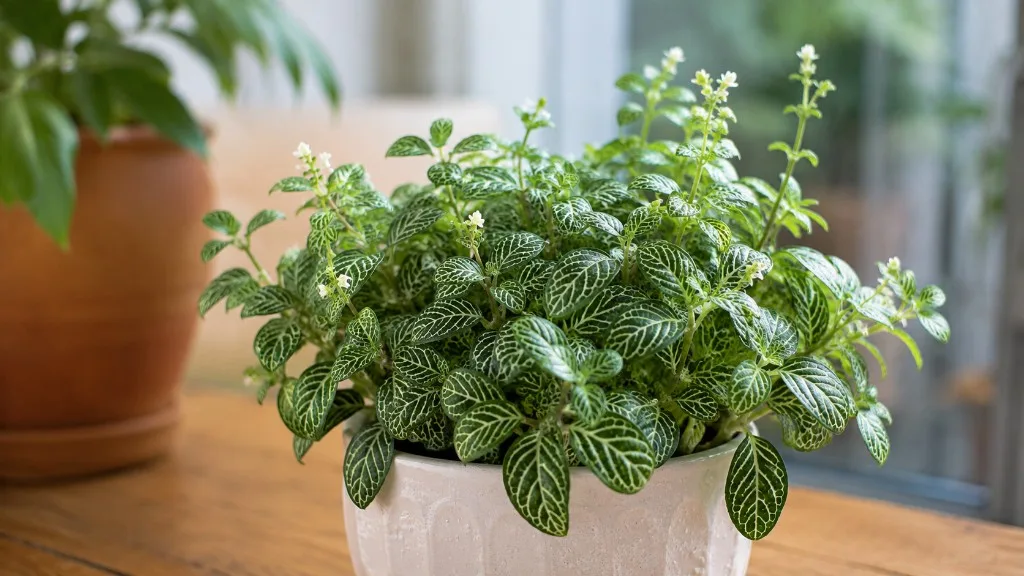
Fittonia is grown for dense, colorful foliage pressed close to the soil - not for height or long trailing display. Its stems are soft, internodes lengthen when light is weak, and the visual goal is a cushion-like mat rather than a single runner. What keeps that shape is regular interruption of the leading shoot so lateral buds along the stem can develop.
Without pinching, the apical bud at each tip produces auxin that suppresses side branches. The tip extends, internodes stretch, and you get a leggy nerve plant with bare stem below clustered leaves at the ends. Missouri Botanical Garden recommends pinching off growing stem ends to shape plants and promote denser foliage - a low-stress fix repeated every few weeks during active growth.
Heavy pruning is for correction: a stem that has run six inches past its neighbors with bare tissue below, or a plant neglected in a dim corner that needs structural reset. Pruning manages architecture; it does not replace adequate light, humidity, or watering. If the plant is wilting from drought, waterlogged, or was repotted within the past two weeks, stabilize care before structural cuts - the same rule applies on the watering guide.
What to Check Before You Cut
Walk the plant once before blades touch tissue. Look for leggy growth - stems extending beyond the mat with long smooth internodes and leaves clustered at tips. Note which direction the plant leans; uneven light often produces taller shoots on one side. Check leaf axils and soft stems for mealybugs and aphids, which hide where you will cut and can spread via tools or propagation jars.
Separate three cut categories in your head. Cleanup removes dead, yellow, or damaged leaves - always appropriate. Maintenance pinching shortens soft tips on stems slightly ahead of the rest - low stress, often year-round in warm terrariums. Corrective cutbacks shorten long bare stems to lower nodes - reserve for spring and summer when the plant can push new shoots quickly.
If multiple leaves are yellowing, soil smells sour, or the whole plant is collapsed, pruning is secondary. Fix watering, drainage, or root health first, then trim damaged foliage after firmness returns. When legginess is the main complaint, inspect whether light levels are actually adequate before you blame pinching technique.
When to Prune Fittonia
Fittonia can survive a trim any time, but it will not always respond quickly outside active growth. The plant performs best when temperatures stay in the 65–80°F (18–27°C) range with steady humidity. Late spring through early summer is the strongest window for structural cuts - shortening long stems, reshaping an uneven mat, or recovering from serious legginess.
During that period new shoots emerge faster and internodes stay shorter because the plant has light and warmth to support compact growth. Pair major shaping with propagation if you plan to root trimmings; Missouri Botanical Garden lists stem cuttings as the standard propagation method alongside routine pinching.
Year-round pinching works when conditions stay stable: a humid terrarium, bright bathroom, or shelf with supplemental grow lights. Snip the top 1–2 inches off any stem that outpaces its neighbors every two to four weeks. Avoid heavy cutbacks in late autumn and winter unless you are removing diseased material - shorter days and cooler rooms slow bud break. Remove pest-infested or rotting stems immediately regardless of season.
Terrarium vs Open-Pot Pruning
The technique is identical; the constraints differ. In a closed terrarium, humidity stays high and soft tips recover quickly, so light maintenance pinching can continue through winter if temperatures remain warm. Watch overall layer height - keep the Fittonia mat below taller neighbors so it still receives filtered light without blocking the glass.
In an open pot, winter air is drier and recovery after a hard cutback slows noticeably. Reserve structural shortening for spring and summer unless you are removing diseased tissue. Open-pot plants also show internode stretching sooner when light is marginal, so pairing corrective cuts with a light adjustment matters more than in a bright terrarium.
Where to Cut: Nodes, Internodes, and Cut Height
Every pruning decision on a nerve plant comes down to the node - the joint where opposite leaves attach to the stem. Fittonia creeps along the soil surface and, in humid conditions, can root at nodes, which tells you how important that tissue is. Meristematic cells at the node produce new stems and leaves when the dominant tip is removed.
On Fittonia, a node appears as a slight swelling where leaf pairs meet the stem. Smooth sections between pairs are internodes. When light is insufficient, the plant lengthens internodes to reach brighter conditions, leaving bare stem below leaves at the tip. No amount of tip pinching fixes bare internode tissue - you need a cutback to a lower node closer to the soil.
Position your blade 5–10 mm (about ¼ inch) above the node, not through it and not halfway up a bare internode. The node must remain intact on the remaining stem. A slight angle helps moisture run off. Fittonia does not need wound sealant; clean cuts heal well in humid air. If unsure which point is the node, follow the leaf petiole to its base - that junction is your target.
Pinch vs Scissors on Soft Tips
Tender new growth at stem tips can be pinched between thumb and forefinger just above the uppermost node - quick, clean, and ideal for weekly maintenance. Use fine floral snips or bypass shears for tougher stem tissue, corrective cutbacks, or when you need a precise angle.
Never cut in the middle of a bare internode with no leaves below unless you intend to remove that entire bare section down to the next node. Bare tissue has no buds except at nodes; a mid-internode cut leaves a brown stub and no branching.
Sanitize Tools Before the First Cut
Fittonia stems are soft and pest-prone at leaf axils, so tool hygiene matters. Iowa State University Extension recommends wiping visible sap or debris from blades, then disinfecting with 70% isopropyl alcohol for at least 30 seconds before the first cut. Re-wipe between plants and after touching visibly infested stems. Dull blades crush tissue and invite rot on humid nerve plant stems - sharpen or replace snips that tear rather than slice.
Step-by-Step Fittonia Pruning
Work on a healthy plant in active growth unless you are removing diseased tissue. Examine the plant from above and from the side. Identify the tallest stems, bare internode sections, yellow leaves, and any flower spikes. Decide whether you need maintenance pinching only or corrective cutbacks.
Sanitize tools. Remove dead and yellow material first. Address the tallest leggy stems one at a time, cutting 5–10 mm above a node at the height you want that shoot to restart. After each major cut, step back and assess balance. When pinching for maintenance, remove the top 1–2 inches of soft growth just above the uppermost node on any stem outpacing its neighbors.
After pruning, return the plant to stable conditions. Do not increase watering or fertilizer immediately. If legginess came from low light, improve bright indirect exposure gradually over seven to ten days. Hold fertilizer for two to three weeks after moderate to heavy pruning until new growth appears.
Maintenance Pinching for Bushier Growth
Pinching leggy tips is the first-line fix when a stem has not yet developed long bare internodes - or when only the very end has run ahead. Remove the apical bud and one to two immature leaves, redirecting growth to buds beside the node below. On a healthy Fittonia in spring, new side shoots often appear within two to four weeks under warm, bright, humid conditions - a range consistent with RHS propagation timing for stem-tip cuttings in spring and summer.
Repeat on every outlier stem. The goal is an even low mat, not a single long trailer flopping over the pot rim. In terrariums, keep the Fittonia layer below taller neighbors while still allowing some light penetration.
Correcting Leggy Stems and Bare Internodes
When stems bend under their own weight with leaves only at the ends and bare internodes near the soil, tip pinching is not enough. Cut the worst stems back to nodes two-thirds of the way toward the soil, staying within the one-third rule - remove no more than one-third of total foliage in one session.
For severely leggy plants, stage cutbacks over two or three sessions spaced several weeks apart. Wait for new shoots to appear before the next round. If light was the root cause, improve exposure during this process; otherwise new growth will simply stretch again. Count roughly before you cut: thirty leaves total and twelve removed stays within one-third; twenty removed needs a second session after the first flush of regrowth.
Shaping a Compact Low Mat
Shaping means managing height and spread so the plant reads as one continuous cushion. Work from the highest stems downward: shorten tall shoots first, then medium ones, then pinch soft tips on stems already at the right height. Rotate wide pots as you prune so one side does not stay longer than the other.
Avoid shearing the top flat like a hedge. Fittonia leaves are large relative to stem thickness, and blunt horizontal cuts leave damaged leaf edges that brown. Selective node cuts produce natural-looking branching instead.
Removing Flower Spikes During Maintenance
Fittonia rarely blooms indoors, but small tubular flowers may appear on spikes in summer when humidity, warmth, moisture, and light are excellent. Most growers remove flower spikes as soon as they appear - Missouri Botanical Garden notes flowers are not particularly showy and many growers pinch off flower buds.
Bloom production diverts resources from leaf and stem development. On a plant you are shaping for density, flowers work against that goal. Removing spikes is low-stress - similar to pinching a soft tip - and keeps energy in the colorful foliage that makes nerve plants worth growing.
Pinch vs Cutback vs Flower-Spike Removal
| Task | Best season | Stress on plant | Typical response |
|---|---|---|---|
| Maintenance pinch (top 1–2 in.) | Spring–fall; year-round in bright terrariums | Very low | Side shoots in 2–4 weeks in active growth |
| Corrective cutback to lower node | Late spring–early summer | Moderate | New branching in 4–8 weeks; stage if >⅓ foliage |
| Flower-spike removal | Whenever spikes appear | Minimal | Immediate; foliage stays priority |
Use the table to decide whether today’s grooming session needs only finger pinches or a staged structural reset.
Using Trimmings for Propagation
Healthy trimmed sections can become new plants. Stem-tip cuttings taken during pruning are the most reliable propagation method - more dependable than seed indoors. Sort clippings as you cut: viable sections go into water or soil; damaged or node-free debris goes to compost.
A good cutting is 3–4 inches (7–10 cm) long with at least two leaf nodes. Remove lower leaves to expose one or two nodes, leaving two to four leaves at the top. Make the bottom cut at an angle just below a node. Late spring and early summer align propagation with pruning because warm temperatures and active parent growth produce faster root initiation. For humidity-dome setup, water-jar timing, and same-pot rooting detail, see the dedicated Fittonia propagation guide.
Water propagation submerges the bottom node in a clear glass of room-temperature water; refresh every few days and keep in bright indirect light. RHS describes rooting stem-tip cuttings in a humid propagator or sealed bag; roots often appear in two to three weeks during active growth. Soil propagation inserts the bare node into moist peat-based mix under a humidity dome. You can also root a cutting in the same pot as the parent by burying a node at the soil surface.
Dispose of trimmings from mealybug- or aphid-infested stems in sealed household waste, not on the compost pile or propagation tray, until pests are under control. Fittonia is non-toxic to cats and dogs per ASPCA, but curious pets may still chew dropped leaves - bag trimmings if pets access your grooming area.
After Pruning: Light, Humidity, and Recovery
Pruning redirects growth but does not manufacture energy. Fittonia relies on remaining leaves and stored reserves to push new buds, and indoor recovery takes longer than on fast vines. Keep bright, indirect light and high humidity after trimming. RHS emphasizes consistent moisture and humidity for nerve plants recovering from any stress.
Avoid direct afternoon sun on fresh cuts. Water when the top inch of soil approaches dryness - fewer leaves need less water, so do not overcompensate. Expect visible buds within two to four weeks during spring and summer in warm, bright, humid conditions; meaningful compact fullness often takes six to eight weeks in open pots. Terrarium specimens in stable warmth may branch sooner; winter pruning without supplemental light can add several weeks before you see new shoots. If nothing breaks after six weeks in warm, bright, humid conditions, check cut placement and root health before cutting again.
Common Fittonia Pruning Mistakes
The most common errors: pruning without fixing light (new growth stretches again within weeks), overwatering on Fittonia after a hard prune (yellow, limp leaves from soggy soil), cutting mid-internode (brown stubs with no branching - correct with a second cut 5–10 mm above the nearest node), pruning a stressed plant (wait until wilt, root rot on Fittonia, or repot shock resolves), ignoring flower spikes, pinching a plant that already has long bare internodes (tip pinches cannot fill empty stem - cut back to a lower node instead), and discarding viable cuttings instead of rooting them.
Fittonia Pruning Checklist
If you remember only three things after grooming:
- Cut just above the node - never through a bare internode - on the tallest stem first, then pinch outliers.
- Match cut weight to season - light pinches anytime conditions are stable; heavy cutbacks in late spring through early summer with no more than one-third of foliage per session.
- Pair every structural trim with light and humidity - pruning cannot fix legginess that comes from a dim corner; improve light and keep humidity steady while new shoots fill in.
When to use this page vs other Fittonia guides
- Fittonia overview - Start here for whole-plant context before deep-diving this topic.
- Fittonia problems hub - Jump to symptom-specific fix guides when this care topic does not resolve the issue.
- Leggy Growth on Fittonia - Escalate here when pruning adjustments are not enough.
- Slow Growth on Fittonia - Escalate here when pruning adjustments are not enough.
- Brown Tips on Fittonia - Escalate here when pruning adjustments are not enough.