Brown Leaf Tips and Edges on Echeveria: Causes, Checks &
Quick answer
Brown tips and edges on Echeveria usually mean sun scorch after a sudden window move, underwatering crisp, fertilizer salt burn, or harmless corking on old outer leaves-not generic houseplant stress. First step: note which leaves browned and when, then check soil moisture at depth and recent sun exposure before watering, repotting, or moving the pot again.
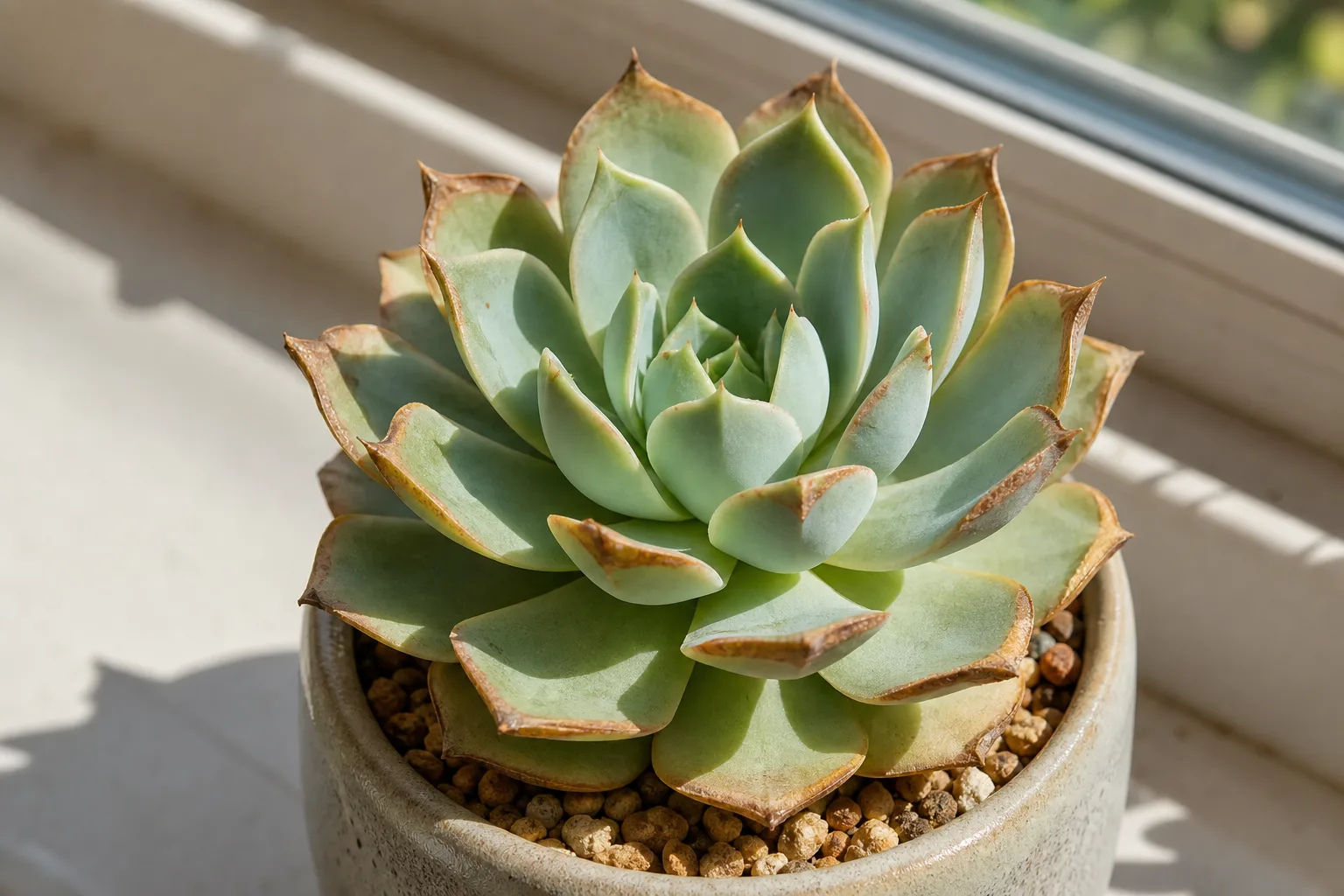
Brown Leaf Tips and Edges on Echeveria: Causes, Checks & Fixes
This guide covers brown tips on Echeveria. See also the general Brown Tips guide, watering, and light pages for this plant.
Brown Leaf Tips and Edges on Echeveria: Causes, Checks & Fixes
Quick answer
Echeveria stores water in thick rosette leaves built for bright highland sun. When margins brown, the damage is almost always localized stress at the leaf edge-not a mystery illness. The common culprits on this genus are unacclimated direct sun (tan crispy patches on the sun-facing side), prolonged drought (dry crispy tips when the pot has been bone-dry too long), fertilizer or salt buildup (brown dry edges after feeding or tap-water minerals), physical bumps, or harmless corking on the oldest outer leaves.
First step: pause and diagnose before you water, repot, or move the plant again. Note which leaves browned and whether the damage appeared right after a window change. Insert a dry skewer two inches into the mix and lift the pot-heavy wet soil versus very light dry soil points in opposite directions. One correction at a time; watch new center leaves for two to three weeks before stacking fixes.
Why Echeveria gets brown tips and edges
Echeveria is a Crassulaceae rosette succulent from semi-arid Mexico and Central America. Each leaf is a water tank with a thin margin that dries first when the plant cannot balance water loss and uptake. That is why tip and edge browning shows up before the whole rosette collapses on many stressors-but the pattern differs by cause.
Indoors, brown margins usually trace to care mismatches this genus is sensitive to, not low humidity alone. Echeveria wants bright light with several hours of direct sun once acclimated, gritty fast-draining mix, and soak-and-dry watering. Push any one variable too far-sudden intense sun, weeks without water, heavy fertilizer, or chronic wet roots-and the leaf margins register the problem first.
Rosette shape matters for reading damage. Outer leaves take the most sun and age out first; center leaves reflect current conditions. Brown only on bottom outer leaves while the crown stays firm often means normal aging or corking. Brown on upper leaves facing the window after a recent move usually means sun scorch. Even browning around the whole rosette with a very light pot fits drought better than random bad luck.
What brown tips look like on Echeveria
Margin damage on Echeveria falls into a few recognizable patterns:
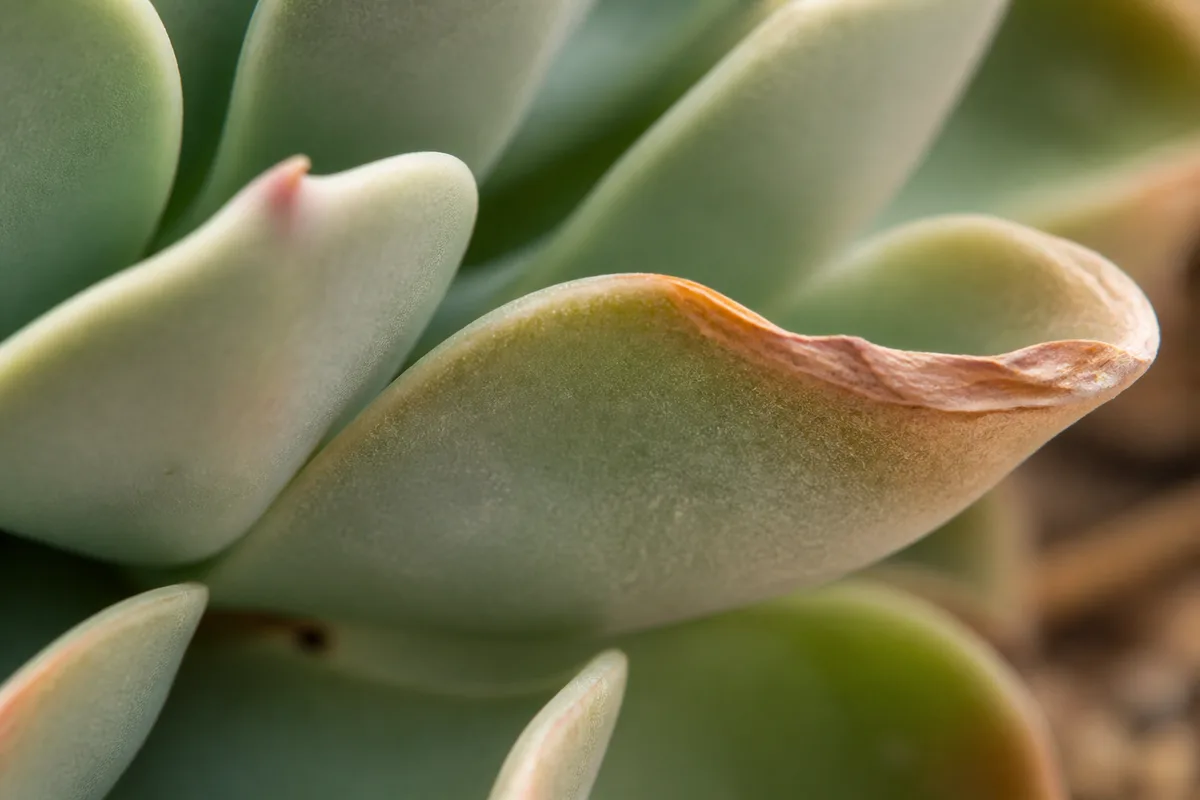
Dry tan-brown scorched edge on a sun-facing Echeveria leaf while the center tissue stays firm and plump - typical sun scorch or drought crisp on outer rosette leaves.
- Sun scorch - Tan, bleached, or brown dry patches on leaves that face the brightest window, often after the pot moved from a dim shelf to strong direct sun. Iowa State Extension describes brown or tan patches from sun scald when succulents jump from low light to bright direct sunlight too fast. Damage may start at tips or upper leaf surfaces exposed to midday glass.
- Underwatering crisp - Dry, papery brown tips on multiple leaves, often with wrinkled or deflated outer leaves while the center may still feel firm. The pot feels very light and mix is dry throughout. Iowa State notes that underwatered succulent leaves shrivel and brown before dropping when drought goes too far.
- Salt or fertilizer burn - Brown, dry leaf margins on otherwise firm leaves, sometimes with white crust on the pot rim or soil surface after repeated feeding or hard tap water. Minnesota Extension recommends diluting fertilizer to half strength or less for succulents that need only modest nutrients.
- Natural corking - Oldest lowest leaves develop dry brown bases or edges while the rest of the rosette stays compact and plump. Iowa State Extension notes that dried lower leaves on healthy rosette succulents are normal-simply remove the dead leaf.
- Physical damage or pests - A single snapped tip, mealybug feeding at a leaf axil, or hot dry air from a radiator can brown one leaf locally without the uniform pattern of sun or drought.
Whole-leaf yellowing with mushy bases belongs on the yellow leaves or overwatering pages-not classic tip burn.
Sun scorch vs. underwatering crisp vs. natural corking
| Pattern | Typical look | Soil / pot | Recent history |
|---|---|---|---|
| Sun scorch | Tan-brown dry patches on sun-facing leaves | Can be moist or dry | Moved to stronger sun within days |
| Drought crisp | Dry brown tips, wrinkled outer leaves | Bone-dry throughout; very light pot | Skipped waterings for weeks |
| Corking | Brown only on 1–2 lowest outer leaves | Normal soak-and-dry cycle | No sudden care change |
| Salt burn | Dry brown margins, firm leaves | May be dry; white rim crust | Recent fertilizer or hard tap water |
| Crown rot (not tips) | Soft brown at stem base, collapsing rosette | Wet, sour soil | See overwatering |
Common causes
Unacclimated direct sun
Echeveria needs strong light, but leaves grown in nursery shade or on a dim shelf burn when thrust into harsh midday sun through south glass. Sun damage shows on the exposed side first-bleached white patches may darken to permanent brown scars. Missouri Botanical Garden advises moving plants to direct light gradually so foliage does not scorch.
Underwatering and drought stress
Even drought-tolerant Echeveria has limits. When roots cannot supply water, the plant sacrifices leaf tips first. Outer leaves wrinkle; tips turn crispy brown. Chronic drought can shrink the root mass so that when you finally water, uptake stays poor-a reason to check soil at depth, not just the surface. Full drought workflow: underwatering on Echeveria.
Fertilizer or salt burn
Succulents need little food. Concentrated fertilizer or mineral buildup from tap water pulls moisture from leaf margins and leaves dry brown edges on firm tissue. Feed only during active growth at low strength, and flush the pot occasionally if salts accumulate.
Physical damage and pests
Bumping a plump leaf, pet traffic, or mealybugs at the base can brown one tip without a rosette-wide pattern. Inspect leaf axils for white cottony masses before assuming environmental burn.
Harmless corking on old outer leaves
As rosettes grow, the lowest leaves age out. A dry brown margin on one or two bottom leaves while new center growth stays tight is often normal senescence-not a crisis. Remove the dead leaf when it pulls away easily.
How to confirm the cause
Work through these checks in order before Echeveria repotting guide, feeding, or heavy pruning:
- Sun history - Did the pot move closer to glass, go outdoors, or rotate into stronger sun in the past week? Sun-facing leaf damage with firm plump tissue elsewhere strongly suggests scorch.
- Soil moisture at depth - Insert a dry wooden skewer two inches into the mix. Iowa State Extension recommends checking soil moisture with a chopstick or skewer before watering succulents. If it emerges clean and dry and the pot feels feather-light, drought is likely. If it emerges dark and damp with a sour smell, look to overwatering or rot-not tip drought.
- Leaf age and position - Browning only on the lowest one or two leaves points to corking. Browning on upper sun-facing leaves points to light. Even margin browning on many leaves with a light pot points to drought.
- Fertilizer and water quality - Note recent feeding and white crust on the pot. Salt burn keeps leaves firm but crisps margins.
- Leaf texture - Scorched and drought tissue feels dry and papery. Rot at the base feels soft and translucent.
- New growth check - Healthy tight leaves emerging from the center mean the plant is still viable whatever the outer damage looks like.
If the rosette was etiolated in low light before sunburn, address light history holistically-see not enough light alongside this page.
First fix for Echeveria
Identify the most likely cause from sun history and soil moisture, then make exactly one correction-do not water, shade, and repot on the same day.
- If sun scorch after a recent move: Shift the pot to bright light with filtered or morning sun only for one to two weeks, then increase direct exposure gradually. Do not plunge back into a dark corner-that triggers stretch. See the light guide for acclimation.
- If bone-dry soil and light pot with crispy tips: Water thoroughly until excess drains, empty the saucer, then resume soak-and-dry only after the mix dries throughout the root zone again. Do not mist leaves.
- If salt crust after feeding: Skip fertilizer for two to three months. Water deeply once to flush salts through drainage holes (with a saucer you empty). Resume quarter-strength feed only in active growth if needed.
- If only lowest outer leaves are dry brown and firm: Gently remove the dead leaves. No other treatment required if center growth is healthy.
Do not repot on day one unless roots are mushy and soil is waterlogged. Do not fertilize stressed brown-tipped rosettes hoping to green them up.
Step-by-step recovery
After the first targeted fix:
- Wait two to three weeks before a second major change so you can read the plant’s response.
- Watch new center leaves, not old scars-sun-scalded dead tissue does not recover and drought-damaged tips do not revert green.
- Rotate the pot a quarter turn every few days once light is stable so future sun exposure stays even.
- Remove only fully dead leaves that twist off cleanly; leave firm damaged tissue until the plant reabsorbs or dries it.
- Adjust watering seasonally-pots dry faster in summer sun than in winter cool rest.
- Re-inspect roots if crispy tips persist on wet soil; failed roots mimic drought while mix stays damp.
Recovery timeline
Expect stable new growth without fresh browning within two to four weeks after the correct single fix. Drought-recovered leaves may re-plump within days of a proper soak if roots are still healthy. Sun-scorched patches remain visible on old leaves permanently; success means unblemished new leaves emerging from the crown.
Severe scorch across most of the rosette may require beheading and rerooting once light is acclimated-same principle as recovery from etiolation on the not enough light page. Mild tip crisp on one or two leaves is cosmetic once care stabilizes.
Lookalike symptoms to rule out
Overwatering and crown rot show soft translucent lower leaves, wet heavy soil, and a collapsing base-not dry crispy tips alone. Fix drainage and drying before assuming sun or drought.
Etiolation from low light produces stretch and pale leaves, not margin burn-unless you then moved the plant into harsh sun. Pair with not enough light if the stem lengthened first.
Whole-leaf yellowing with spreading mush fits rot or nutrient issues better than isolated tip burn-see yellow leaves.
Spider mites cause fine stippling and webbing, not uniform dry margin crisp-check spider mites if stippling appears.
Mistakes to avoid
Do not soak immediately when tips brown without checking soil-root rot symptoms are often confused for underwatering and wet roots plus more water worsen the problem.
Do not move a scorched plant into deep shade-that invites stretch. Reduce intensity, not total light.
Do not increase fertilizer on brown-tipped rosettes; salt burn and soft growth follow.
Do not mist the rosette to fix dry tips-surface moisture does not rehydrate leaves and can encourage fungal problems at the crown.
Do not confuse harmless bottom-leaf corking with active scorch and overhaul care when only one old leaf is drying.
Do not strip half the rosette on day one-remove only leaves that are fully dead and pull away easily.
Echeveria care cross-check
Brown margins almost always tie back to how this genus handles light, water, and salts together. In strong acclimated sun the pot dries predictably and soak-and-dry works. In dim corners the same watering schedule keeps soil wet too long-then root failure produces crispy tips on damp mix, the confusing overlap between drought appearance and overwatering.
Temperature and season matter. Echeveria slows in cool winter rest with reduced water needs. Summer sun through south glass intensifies scorch risk for plants fresh from a greenhouse. The overview care guide soak-and-dry rhythm is the backbone for preventing repeat tip burn once you identify the first cause.
How to prevent brown tips next time
Acclimate light increases over one to two weeks whenever moving to a brighter window or outdoors-especially after winter indoors.
Water on soil dryness, not a calendar-check depth, lift the pot, and follow soak-and-dry through active growth and dormancy.
Fertilize sparingly at quarter to half label strength during spring and summer only; skip winter feeding on indoor rosettes.
Use gritty fast-draining mix and pots with drainage holes so salts flush instead of concentrating at the root zone.
Accept bottom-leaf aging-remove corked outer leaves when dry rather than fighting normal senescence.
Keep Echeveria where several hours of direct sun is realistic year-round, supplementing with grow lights in winter if windows weaken-prevents the low-light-to-blast-sun cycle that causes scorch.
When to worry
Treat as urgent when the rosette crown softens, base leaves turn translucent and mushy, or damage spreads to the center within days-unpot and inspect for rot immediately while drying the mix.
Also act when crispy tips persist on constantly wet soil-roots may be dead and the plant needs root surgery or propagation, not another soak.
Mild brown tips on a few outer leaves with firm center growth and stable new leaves is not an emergency-correct care and wait.
Conclusion
Brown tips and edges on Echeveria are readable once you separate sun scorch, drought crisp, salt burn, and harmless corking. Check sun history and soil moisture before you water, shade, or repot. Old damaged margins do not heal, but tight new rosette leaves prove you found the right fix. For the full care baseline-light acclimation, watering rhythm, and soil-start with the Echeveria overview and adjust one variable at a time until margins stay clean on fresh growth.
When to use this page vs other Echeveria guides
- Echeveria watering guide - Use for routine moisture checks before assuming brown tips is the main issue.
- Echeveria problems hub - Browse all 16 common issues on this species.
- Low Humidity on Echeveria - Different entry point when symptoms overlap with brown tips.
- Underwatering on Echeveria - Different entry point when symptoms overlap with brown tips.
- Overwatering on Echeveria - Different entry point when symptoms overlap with brown tips.