Not Enough Light on Dwarf Umbrella Tree: Causes, Checks &
Quick answer
When Schefflera arboricola lacks light, internodes stretch between leaf whorls and new leaflets arrive smaller and paler. First step: move the pot to the brightest safe indirect spot in your home-typically within one to three feet of an east window-or add a full-spectrum grow light above the canopy.
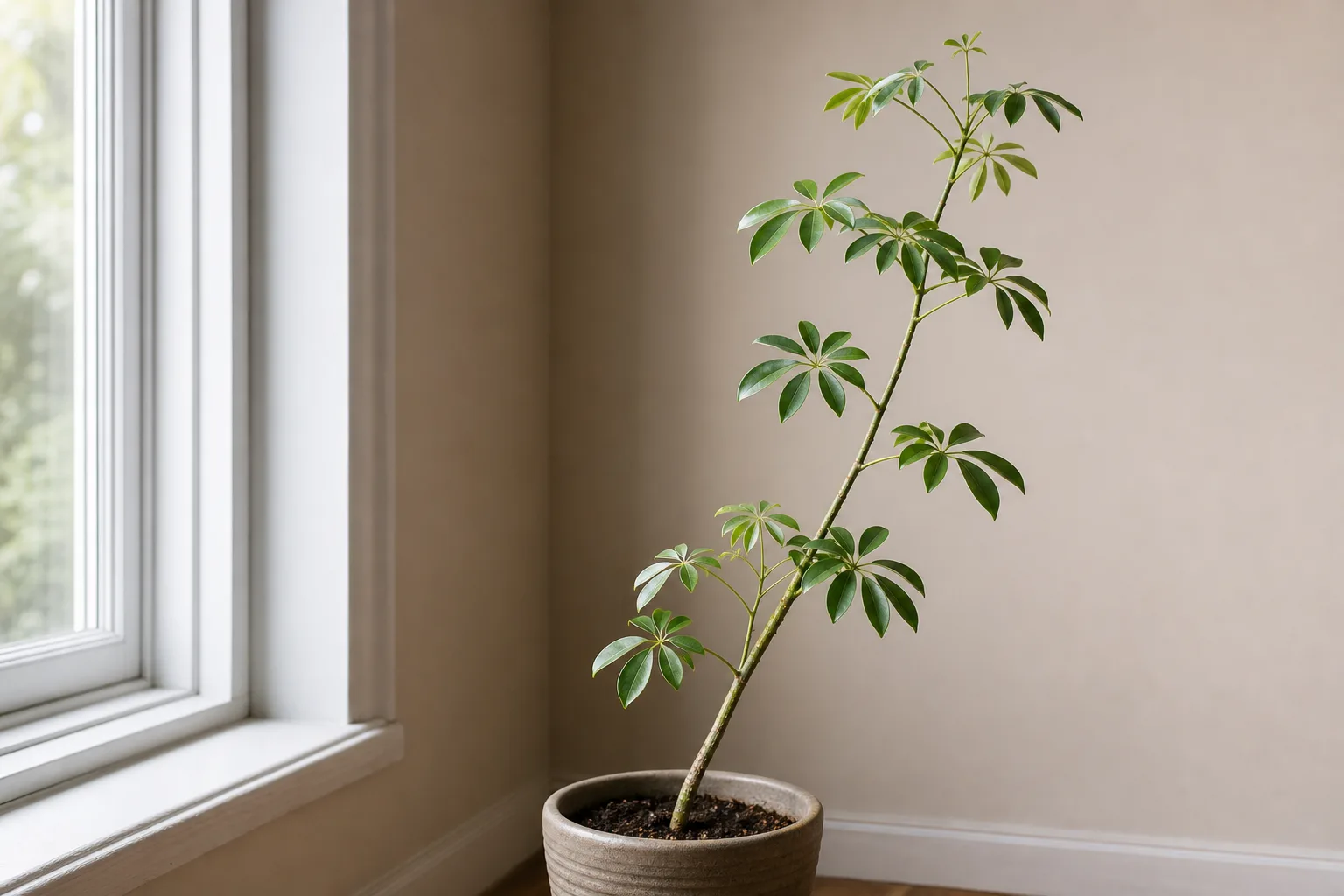
Not Enough Light on Dwarf Umbrella Tree: Causes, Checks & Fixes
This guide covers not enough light on Dwarf Umbrella Tree. See also the general Not Enough Light guide, watering, and light pages for this plant.
Not Enough Light on Dwarf Umbrella Tree: Causes, Checks & Fixes
Quick answer
A dwarf umbrella tree (Schefflera arboricola) without enough light does not die overnight-it stretches. Internodes lengthen between whorls of glossy leaflets, the canopy leans hard toward the nearest window, and new leaves arrive smaller and duller. Variegated cultivars lose gold or cream sectors on fresh growth first.
First step: move the pot to the brightest safe indirect location you have-usually within one to three feet of an east-facing window, or a filtered south or west window behind sheer curtain. If no window delivers strong indirect brightness at the leaf canopy, add a full-spectrum LED grow light six to twelve inches above the top whorls for 10 to 12 hours daily.
Do not repot, fertilize, or prune heavily on day one. Light is the throttle; fix placement first and read the next whorl of leaves before stacking other changes.
What not enough light looks like on Dwarf Umbrella Tree
Schefflera arboricola grows in clusters of leaflets arranged like small umbrellas at each node. In adequate light those whorls sit close together on firm stems. Under low light the pattern shifts:
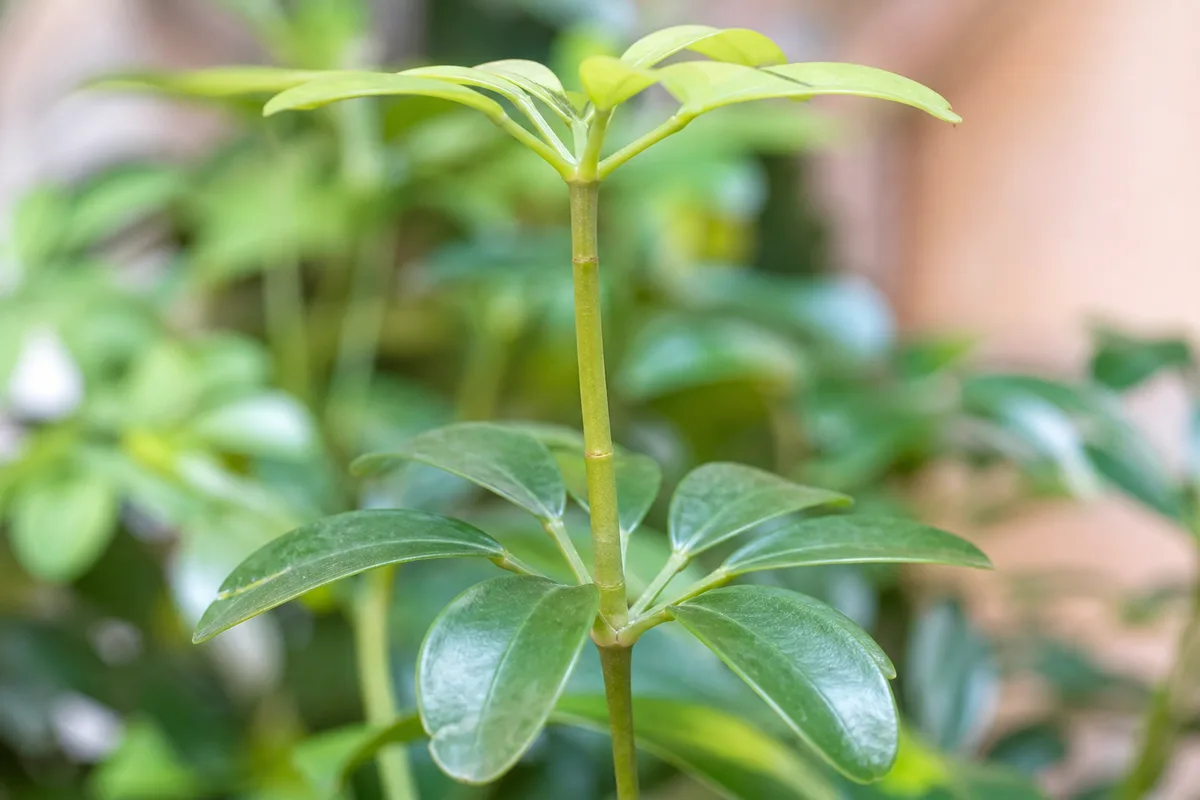
Long naked stem section between leaf whorls with smaller paler new leaflets - classic etiolation when Schefflera arboricola lacks bright indirect light.
- Long naked stem sections between whorls-the classic leggy silhouette
- Smaller new leaflets than the whorls from when you bought the plant
- Persistent lean toward the brightest vector in the room
- Gradual yellowing and drop of lower and inner leaves as the plant sheds foliage it cannot support
- Darker, thinner new growth that feels less firm than older leaves
- Variegation fade or reversion on Gold Capella, Trinette, and other cream- or gold-splashed cultivars
- Slow or stalled new whorls even when watering and temperature seem fine
These signs develop over weeks, not hours. One pale leaflet after Dwarf Umbrella Tree repotting guide is different from a plant whose newest three whorls are all spaced farther apart than the ones below them.
Office fluorescents across a room rarely count as bright indirect for Dwarf Umbrella Tree overview. The plant may survive there, but the whorled canopy thins until only a tuft of leaves remains at the top-exactly the look Clemson HGIC links to low light and spindly, weak stems on scheffleras.
Why Dwarf Umbrella Tree runs out of light indoors
Nursery tags call arboricola “low-light tolerant,” which many readers hear as “any dim corner is fine forever.” The reality is narrower. Compared with true high-light specialists, dwarf umbrella tree persists in soft light longer-but it still behaves like a moderately light-hungry tropical shrub when you want dense, glossy display.
The species evolved in subtropical regions where brightness is filtered by canopy and cloud cover rather than blocked by walls six feet from a single north window. NC State Extension lists partial shade and dappled sunlight among suitable exposures outdoors. Indoors, that translates to Dwarf Umbrella Tree light guide for most of the day, not a bookshelf across the room from glass.
Common home situations that under-light arboricola:
- Interior placement more than six to eight feet from the nearest window, even in a visually bright living room
- North-facing rooms at distance, especially for variegated cultivars
- Winter day-length drop in the same spot that worked in June
- Dirty or obstructed glass, heavy sheers, or furniture blocking the light cone that reaches leaf whorls
- Competing plants shading the lower whorls on a multi-species shelf
Low light also slows metabolism. Soil stays wet longer because the plant uses less water. That secondary effect is why yellow leaves and drop in a dark corner are often misread as root rot on Dwarf Umbrella Tree when photons were the primary limiter.
Variegated leaf zones lack chlorophyll and cannot photosynthesize. On a solid-green plant every leaflet pulls its weight; on Gold Capella or Trinette the green tissue must work harder. Variegated schefflera cultivars need brighter exposure than solid-green plants in the same spot to hold pattern contrast-so the same dim shelf that barely sustains a green arboricola may fail a variegated one.
How to confirm the cause
Work through these checks before you change watering or reach for fertilizer:
- Internode spacing on new growth - Measure the gap between the last two whorls. If each new flush sits farther from the last than whorls from six months ago, light is likely low regardless of how “bright” the room feels to you.
- Window distance at the canopy - Light is read at the leaf whorls, not the pot rim. Stand where the top whorls sit and note compass direction and feet from glass. Indoor light intensity drops sharply with distance from windows.
- Lean direction - Strong tilt toward one window confirms the plant is actively seeking photons.
- Variegation on newest whorls only - Fade or reversion starting on fresh leaves while older variegated whorls still look fine points to recent insufficient brightness, not nutrient deficiency.
- Soil moisture pattern - Push a finger into the top half of the mix. Chronic wetness with yellowing in a dim spot suggests slow uptake from low light plus too-frequent watering-not necessarily dead roots. Confirm roots only if smell, mush, or persistent wet soil after you cut back water.
- Pest check on undersides - Spider mites favor dry, stagnant corners. Stippling and fine webbing mean a pest issue layered on top of or instead of light stress. Clean leaf undersides with no mites support a light diagnosis.
Confirmation test: Move the plant to the brightest safe indirect spot you can offer (or switch on a grow light) and wait 10 to 14 days without other major care changes. If the next whorl shows shorter internodes and fuller leaflets, light was the limiter.
First fix for Dwarf Umbrella Tree
Move the pot so the leaf canopy sits in bright indirect light-within one to three feet of an east window, or filtered south or west glass-and rotate it a quarter turn so all sides receive similar brightness.
That single placement change addresses the root cause. East exposure is often the safest default: morning sun is bright but cooler than afternoon rays, and the following hours of indirect light suit both green and variegated arboricola. If east is unavailable, use south or west with sheer curtain or several feet of setback to avoid scorch.
If your brightest window still produces stretching after two weeks, add a full-spectrum LED grow light six to twelve inches above the upper whorls on a timer for 10 to 12 hours daily. Ceiling room lights help your eyes more than the plant; the fixture must illuminate the canopy directly.
Do not jump from a dark corner to harsh unfiltered west-afternoon sun in one move-bleached patches and crisp brown leaflet tips mean pull back and acclimate over 7 to 14 days instead.
Step-by-step recovery
After the initial move or grow-light setup:
- Hold watering steady for one week - Brighter light increases dry-down speed; dim light kept soil wet. Check the top half of the mix before each drink rather than keeping an old calendar schedule.
- Rotate the pot weekly - Even indirect rooms deliver uneven brightness. Regular rotation prevents one-sided lean and lopsided variegation fade.
- Skip fertilizer until new growth looks firm - Plants in reduced light need less frequent feeding than those in bright exposure. Feeding a stressed, etiolated plant pushes soft tissue without fixing the energy deficit.
- Prune leggy tops only after light improves - Cut elongated stems just above a node once the next whorl arrives compact. Arboricola tolerates pruning and branches from nodes below the cut; pruning before light is adequate produces more weak stretch.
- Acclimate if you increase intensity sharply - Move six inches closer every three to four days, or open sheers gradually, watching for new bleaching-not old blemishes-as the stop sign.
- Adjust winter expectations - The same window delivers fewer photons December through February. If stretch resumes seasonally, add LED hours rather than assuming the plant has “failed.”
Recovery timeline
Expect to read the next one or two whorls, not overnight change. Within 10 to 14 days of correct placement, new internodes should stay shorter than the leggy section above them. Variegation on fresh leaves may take three to six weeks to sharpen if the cultivar was reverting.
Old elongated stem sections do not shorten-they remain as historical record of dim months. Stretched growth does not revert once formed; success means compact new umbrellas of leaflets and slowed leaf drop.
Lower leaves that yellowed from energy rationing will not green up again. They can be removed once the plant holds stable new growth. Full canopy density after severe legginess may take two to three months of adequate light plus optional pinching-not one weekend fix.
Lookalike symptoms to rule out
overwatering on Dwarf Umbrella Tree - Multiple mid-canopy leaves yellow at once while soil smells sour or stays wet for weeks. Roots may be soft. Fix drainage and dry-down; light alone will not save saturated roots.
underwatering on Dwarf Umbrella Tree - Crisp brown leaflet edges and lightweight pot with bone-dry mix. Stretch from drought alone is uncommon; wilting dominates.
Cold draft or sudden move - Leaf drop after chilling or relocation can follow HVAC vents or a dark new room after shipping. Stabilize temperature and light together; drop from draft often clears within two weeks if roots are sound.
Spider mites - Fine stippling and webbing on undersides in hot dry corners. Rinse and raise humidity; mites are not solved by brighter light alone if colonies are active.
Nutrient deficiency - Uniform whole-leaf yellowing on old and new foliage alike, with compact internodes and good window placement, points elsewhere. Light-starved arboricola almost always shows spacing and size change on new whorls first.
Mistakes to avoid
Do not treat “low-light tolerant” as permission for a permanent dim hallway display.
Do not compensate with extra fertilizer in a dark spot-that produces soft, pest-friendly shoots without fixing etiolation.
Do not overwater because leaves look tired. Low light slows water use; soggy soil compounds stress.
Do not blast a shade-grown plant onto a west sill in midsummer without acclimation-sun scorch is a different problem with bleach and crisp necrotic patches, not long internodes.
Do not prune the entire leggy top before light improves-you may remove the only tissue still photosynthesizing while waiting for the placement change to register.
Do not assume a variegated plant needs the same spot as a solid-green neighbor. Give variegated types one step brighter.
Dwarf Umbrella Tree care cross-check
Light sets the pace for every other routine on this species. In bright indirect exposure, allow the top half of soil to dry before watering-roughly every 7 to 10 days in active summer growth and every 14 to 21 days in cooler months. In low light the same volume of water lasts longer; sticking to a summer schedule in a dark winter corner keeps roots wet while leaves drop.
Average room humidity (40 to 60 percent) is adequate when light is correct. Dim corners with stagnant air still favor spider mites-another reason placement and airflow matter together.
Temperature comfort runs roughly 16°C to 27°C (60–80°F). Cold below about 50°F damages schefflera leaf tissue independently of light; do not confuse chill injury with insufficient photons.
How to prevent not enough light next time
Place green S. arboricola where the canopy receives roughly four to six hours of strong indirect brightness daily, or the equivalent from supplemental LED. Variegated cultivars need a step closer to glass or longer LED run time.
Rotate the pot weekly. Clean windows seasonally. Reassess placement when furniture moves or when outdoor trees leaf out and shade a formerly bright sill.
Use a grow light proactively in north rooms, windowless offices, and from late autumn through early spring if new whorls begin spacing out again.
When buying, choose plants with tight whorl spacing and firm leaflets-not already stretched from shop shade unless you have a bright recovery spot ready.
When to worry
Low light alone is rarely an emergency, but combined stress is. Treat as urgent when:
- Leaves drop weekly while soil stays wet in a dark room-reduce water immediately and improve light within days
- The plant collapses entirely after a move into deep shade with no new whorls for a month
- Variegated cultivars revert completely on successive whorls despite your best window-LED supplementation is required, not optional
- Leggy stems flop and snap because tissue is too weak to support the canopy-stake only as temporary support while light and optional pruning rebuild structure
A plant that has only a few leaves at the top of three feet of bare stem can recover with light and pinching, but recovery takes months. Replacement is reasonable if roots are also failing or pests have colonized weak growth.
Conclusion
Not enough light on a dwarf umbrella tree shows up in the spacing between whorls, not in mystery wilt. The species will hang on in dim corners longer than many houseplants, but compact glossy umbrellas of leaflets require real brightness at the canopy-bright indirect as the default, extra intensity for variegated cultivars, and grow lights when windows fall short.
Move to the brightest safe indirect spot first, read the next whorl of new leaves, then adjust water and consider pruning. Old stretch does not undo itself; new firm leaflets with normal spacing mean you solved the problem. Match placement to how the plant actually grows in your home, not where the pot looks best on the shelf.
When to use this page vs other Dwarf Umbrella Tree guides
- Dwarf Umbrella Tree watering guide - Use for routine moisture checks before assuming not enough light is the main issue.
- Dwarf Umbrella Tree problems hub - Browse all 17 common issues on this species.
- Leggy Growth on Dwarf Umbrella Tree - Different entry point when symptoms overlap with not enough light.
- Slow Growth on Dwarf Umbrella Tree - Different entry point when symptoms overlap with not enough light.
- Yellow Leaves on Dwarf Umbrella Tree - Different entry point when symptoms overlap with not enough light.