Dwarf Umbrella Tree Light Needs: Best Window, Sun & Warning
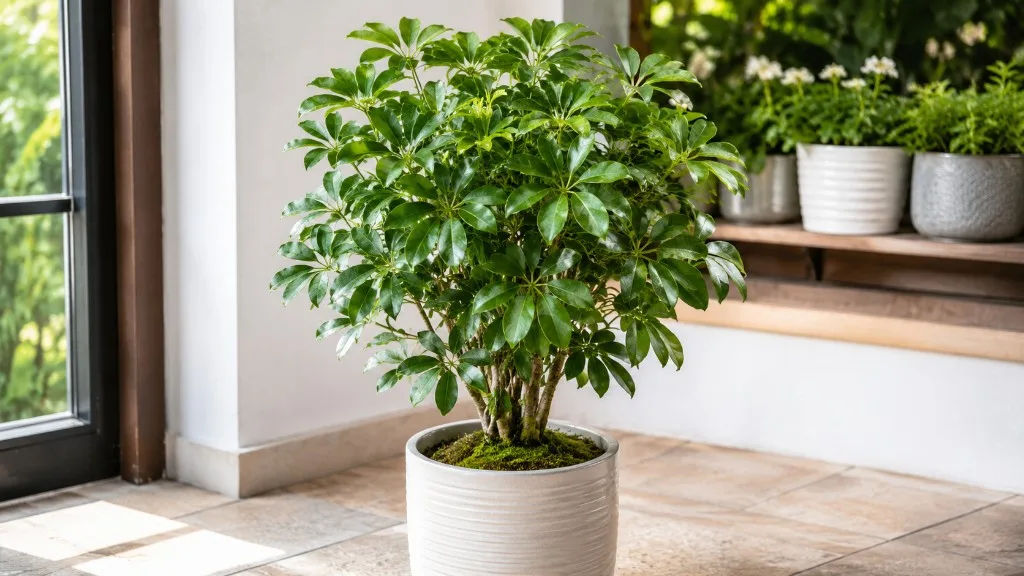
Dwarf Umbrella Tree Light Needs: Best Window, Sun & Warning Signs
Dwarf Umbrella Tree Light Needs: Best Window, Sun & Warning Signs
The dwarf umbrella tree (Schefflera arboricola) is sold as an easy, adaptable houseplant - and that reputation is mostly fair. It handles average humidity, forgives an occasional missed watering, and survives in less-than-perfect light longer than many fussy tropicals. But “survives” is not the same as looks full, holds its leaf count, and keeps crisp variegation. Light is the variable that separates a dense, glossy shrub from a thin, leaning silhouette with pale leaves dropping one by one.
The practical target for most homes is bright indirect light - strong ambient brightness where leaves read clearly across the room, but without harsh sunbeams landing on the foliage for hours. Medium indirect light can work for solid-green plants when growth stays compact and new leaves match the size and color of older ones. Low light is a temporary compromise, not a long-term plan: S. arboricola will hang on in a dim corner, but vigor fades, internodes stretch, and variegated cultivars lose the patterns you paid for. The other boundary matters just as much: avoid harsh direct sun, especially hot afternoon rays through south or west glass, which bleach and crisp leaves faster than most beginners expect.
This guide covers how much light the dwarf umbrella tree actually needs, where low-light tolerance ends, why variegated types need a brighter budget, how to place the pot by window direction, when a sliver of morning sun is acceptable, how to use grow lights without cooking the canopy, and how to read warning signs before damage becomes habit.
How Much Light Schefflera arboricola Actually Needs
Schefflera arboricola evolved as an understory-to-edge shrub in tropical and subtropical regions - Taiwan and Hainan are central to its native range - where light is bright but filtered by canopy, cloud cover, or morning angle rather than beating down all day from open sky. That history explains the species’ sweet spot indoors: bright indirect light for most of the day, with tolerance for slightly softer exposure if other conditions (water, temperature, humidity) stay stable.
NC State Extension lists partial shade (direct sunlight only part of the day, 2–6 hours) and dappled sunlight among suitable exposures. Clemson HGIC notes that low light can cause leaf yellowing with spindly, weak stems, while harsh direct sun scorches foliage - problems often fixed simply by moving to brighter or filtered exposure. Those two statements frame the whole care puzzle: the plant wants real brightness, not a dark room with a lamp on nearby, but it does not want unfiltered midday sun on the leaf surface.
Think in terms of hours of usable brightness at the leaf, not whether you can read a book in the room. A pot on a side table six feet from a window may sit in a visually “bright” living room while receiving a fraction of the photons a plant on the sill gets. For S. arboricola, aim for a location where the canopy receives roughly four to six hours of strong indirect light daily, or the indoor equivalent spread across a longer bright day. More is often fine if it stays indirect; less works short-term if you accept slower growth.
The Short Answer for Busy Growers
If you want four rules without the botany lecture, use these. Default placement: within one to three feet (30–90 cm) of an east-facing window, or a south/west window softened by sheer curtain or partial obstruction. Variegated cultivars (Gold Capella, Trinette, Dazzle, and similar) need brighter indirect light than solid-green plants - treat them like a step closer to the glass or add a grow light sooner. Low light is a stopgap: survival for weeks to a few months is possible; healthy long-term display is not. Never jump from shade to blazing afternoon sun without acclimation - bleached patches and crisp brown spots mean pull back immediately.
Judge success by new growth only. Old scorched or stretched leaves will not repair. After any move, wait 10 to 14 days and inspect the newest leaf clusters for size, color, firmness, and internode length before changing water or fertilizer.
Light is not an isolated dial. Brighter exposure increases transpiration and dry-down speed; dimmer exposure slows metabolism and keeps soil wet longer. A dwarf umbrella tree that moves from a dark hallway to a east window will need more frequent moisture checks even if the watering volume stays the same. Conversely, a plant pushed into low light will use less water - and is more vulnerable to root stress if you keep the old schedule. Treat light as the throttle for the whole care system.
Understanding Low-Light Tolerance and Its Real Limits
Nursery tags and shop descriptions often call S. arboricola “low-light tolerant.” That phrase creates more disappointment than almost any other houseplant label because readers hear “low light is fine forever.” What growers mean is narrower: compared with true high-light specialists (ficus in direct sun, succulents, herbs), arboricola does not collapse immediately when placed away from the brightest window. It will persist, sometimes for months, while slowly reallocating energy toward stem elongation and leaf shedding.
Low-light tolerance is relative, not unlimited. The plant compensates for insufficient photons by stretching internodes - the gaps between leaf whorls lengthen - so each new umbrella of leaflets sits farther from the last. Leaves may arrive smaller, thinner, and paler. Lower and inner leaves yellow and drop because the plant cannot support the same foliage mass on a reduced energy budget. The result is the classic “office plant” look: a thin trunk with a tuft of leaves at the top, leaning hard toward the nearest window or fluorescent panel.
This is etiolation, the same survival response shade plants use to reach a light gap in the forest. Indoors, there often is no gap to reach - only endless dim distance - so the plant keeps stretching until you intervene or it exhausts itself. Unlike a ZZ plant (Zamioculcas) or snake plant (Sansevieria) built for prolonged low photosynthetic flux, Schefflera arboricola still behaves like a moderately light-hungry tropical shrub when you want compact, glossy display.
What “Tolerates Low Light” Really Means Indoors
In practical home terms, low light means a north-facing window at a distance, a room with a single small window obstructed by buildings, or a desk more than eight feet (2.4 m) from the nearest glass. Medium light might be a bright north room in summer, a few feet back from an east window, or filtered south light behind sheers. Bright indirect is an east sill, close south/west placement with diffusion, or open sky brightness without sunbeams on leaves.
S. arboricola in low light typically shows:
- Leggy, sparse branching with long naked stem sections
- Smaller new leaflets compared with when the plant was purchased
- Gradual leaf drop on Dwarf Umbrella Tree, often starting with older lower whorls
- Persistent lean toward the brightest vector
- Slower recovery from watering mistakes or pest stress because growth energy is already limited
In medium indirect light, solid-green plants often stabilize: internodes stay shorter, new whorls match old ones in size, and leaf drop slows to normal senescence. In bright indirect light, you get the densest habit, fastest recovery from pinching, and the best platform for variegated color - provided you still avoid harsh direct sun.
If low light is your only option, reduce water frequency, skip heavy fertilizer, and accept a thinner silhouette - or install a full-spectrum grow light. A spot that reads as medium light in June may slide toward low light by December as day length and sun angle drop; winter legginess on a south sill usually means check light first, not roots.
Variegated Cultivars Need More Light Than Solid Green Types
Variegation is not paint on the surface - it is patchwork tissue where some cells lack chlorophyll and cannot photosynthesize. On a solid-green S. arboricola, every leaflet pulls its weight converting light into sugar. On a variegated plant, white, cream, and yellow zones are dead weight energetically. The green sections must work harder to support the whole leaf and the rest of the plant. That is why variegated dwarf umbrella trees need more light than green ones to maintain the same size, density, and pattern contrast.
When light is insufficient, variegated scheffleras do not merely grow slowly - they lose the variegation you bought them for. New leaves emerge more green, margins creep inward, and cream sectors shrink or disappear entirely. Sometimes the plant looks healthy enough by generic houseplant standards while failing the specific reason you chose that cultivar. Low light is the most common cause of variegation fade indoors, ahead of fertilizer issues or pot size.
Clemson HGIC classifies schefflera among high-light houseplants that grow well near windows with western or southern exposures - variegated cultivars like Gold Capella need that brighter tier to maintain pattern contrast. NC State Extension notes the species tolerates dappled sunlight and partial shade, but variegated forms need more light to maintain coloring than solid-green plants in the same spot.
Popular Variegated Varieties and Their Light Demands
Named variegated selections differ in pattern contrast, but the light rule is consistent: place them one step brighter than a solid-green arboricola and watch new whorls, not old ones.
Gold Capella - green leaflets with bold yellow-to-gold splashes - is among the most common variegated dwarf umbrella trees in trade. It needs bright indirect light to keep gold sectors wide and vivid. In medium or low light, new growth often reads mostly green with thin gold edges, and the plant may drop leaves faster than its green counterpart in the same spot.
Trinette - cream-to-yellow variegation on compact leaflets - shows fade quickly when pushed into north rooms or distant shelves. Trinette performs best close to an east window or under supplemental LED if your brightest window is still south/west with risk of afternoon scorch - solve scorch with sheers, not by retreating to a dark corner.
Dazzle, Janine, and other cream-variegated lines share the same physiology: pale tissue scorches first in too much sun and reverts first in too little light. If you own green and variegated plants, split placements are normal - a green schefflera may stay compact two feet from a west window while Gold Capella bleaches on the glass-facing side.
Why White and Cream Zones Fail First in Dim Rooms
Chlorophyll-free tissue cannot photosynthesize, but it still consumes water and structural support from the rest of the leaf. In low light, the plant’s economics favor more green surface area per leaf - so new leaves shift toward solid green because that is the highest-return investment when photons are scarce. This is reversion, and on schefflera it often starts on the newest whorls while older variegated leaves hang on for months looking like ghosts of better days.
In too much direct sun, the same pale zones fail differently: bleaching, papery brown crisping, and dry tan patches appear where tissue overheats and chlorophyll breaks down. Green sections may tolerate brief morning rays while cream sectors scorch the same day. That asymmetry is why variegated plants need bright indirect rather than “as much direct sun as possible” or “shade because variegated means delicate.”
If variegation is fading, increase brightness gradually - closer to the window, open sheers during morning hours, or add a grow light - before assuming the plant needs feed or Dwarf Umbrella Tree repotting guide. If scorch appears on pale zones, reduce intensity (sheer curtain, move back from west glass) rather than dumping the plant into low light and trading one problem for reversion.
Best Window Placement for Dwarf Umbrella Tree
Compass direction is a starting guess, not a guarantee. A “south window” shaded by a porch roof may deliver less usable light than an unobstructed east window. What matters is how many hours of strong indirect brightness reach the leaf whorls and whether direct sunbeams hit the canopy during the hottest part of the day. Your job is to match the window you actually have to the plant’s tolerance band - and to adjust seasonally when summer sun angle intensifies.
For most homes, the best default is an east-facing window: morning sun is bright but cooler than afternoon sun, and the transition to indirect brightness for the rest of the day suits both green and variegated arboricola well. A spot one to two feet (30–60 cm) from the glass on the east sill or adjacent table usually qualifies as bright indirect without scorch risk for acclimated plants.
Filtered south or west windows are the second-best tier when east light is unavailable. South delivers strong winter sun - excellent for compact growth if you manage summer heat - while west pushes hot afternoon rays that scorch leaflets through glass even when air-conditioned room temperature feels mild. Use sheer curtains, blinds, or three to four feet of setback from west panes in summer.
North windows can maintain a green dwarf umbrella tree in a bright room at high latitude during summer, but variegated types and long-term display quality usually need supplementation. Treat north as short-term display or survival placement, not the permanent home for Gold Capella unless you add LED.
East, South, West, and North Windows Compared
An east-facing window is the most forgiving premium placement. One to three hours of direct morning sun often does not scorch established leaves, especially in cooler seasons, and the following hours of bright indirect light support compact growth. Variegated cultivars frequently look their best here because they receive intensity without the west-window heat spike.
A south-facing window offers the strongest natural indoor light in the northern hemisphere, especially October through March when sun angle is lower and rays penetrate deeper. Solid-green arboricola often thrive close to south glass in winter. From May through August, watch for bleached or curled leaflets on the glass-facing side - pull back, diffuse, or rotate before damage spreads. South is ideal paired with a grow light in winter if you also move the plant away from the pane in midsummer.
A west-facing window is high risk for scorch, high reward for brightness if managed. Late-day sun through west glass can raise leaf surface temperature far above ambient room readings, producing crisp brown patches on variegated sectors within days. If west is your only strong exposure, use sheers during peak hours, place the pot three to four feet back, or accept only green types with careful monitoring. Never place a plant straight from a nursery shade bench onto a west sill in July without acclimation.
A north-facing window supplies soft, low-angle light - acceptable for green plants that already look compact, but rarely enough for variegated pattern retention year-round. If leaves stretch and drop through two weeks on north, believe the plant and upgrade light rather than waiting for spring.
Why Distance From the Glass Matters More Than Room Brightness
Human eyes adapt to indoor dimness; plants do not. A room that feels adequately lit to you may deliver less than one-tenth the photon flux at a dining table compared with the window sill. Schefflera arboricola reads light at the canopy, not at your eye level when you walk past.
Place the pot so leaf whorls, not just the pot rim, sit in the brightness cone. For floor plants, raise on a stand if lower whorls fall into shadow. Rotate a quarter turn every week to prevent permanent lean and one-sided variegation fade. If you cannot move closer to glass because of pets or furniture, that is a signal to use a grow light rather than accepting slow decline.
Distance rules of thumb for bright indirect without scorch:
- East glass: sill to two feet back - usually safe for green and variegated types
- South glass: sill in winter; one to three feet back or sheered in summer
- West glass: three feet back minimum or diffused; variegated types especially cautious
- North glass: close as possible; supplement if new growth shrinks
Direct Sun: What Is Safe and When to Avoid Harsh Rays
Schefflera arboricola is not a full-shade fern and not a desert succulent. It occupies a middle ground: bright light yes, harsh direct sun no as a default indoor rule. Outdoors in tropical climates it often grows in partial shade or dappled light, protected from intense afternoon exposure. Indoors, unfiltered midday sun through south or west windows behaves like a magnifying lens on leaf tissue - especially variegated tissue - and causes photobleaching and necrotic crisp spots faster than many beginners expect.
Brief early-morning direct sun - the first hour or two after sunrise through east glass - is often tolerable for acclimated green plants and sometimes beneficial for compact growth. That is not permission for all-day sunbathing. The danger zone is midday through afternoon, when sun angle and heat load peak. NC State Extension recommends partial shade rather than full-day direct sun for Dwarf Umbrella Tree overview, and Clemson HGIC links excessive light exposure to leaf damage on scheffleras.
How to Acclimate Schefflera to Brighter Light Safely
Plants grown in nurseries under shade cloth arrive soft-leaved for low-to-medium indoor light. Jumping them to a west sill or outdoor patio without transition produces sudden scorch, leaf curl, and sometimes wholesale drop of the most exposed whorls. Acclimation is gradual exposure increase over 7 to 14 days, reading new damage daily.
A reliable protocol:
- Start in bright indirect at the target window but three feet back or behind a sheer curtain.
- After three to four days with no new bleaching, move six inches closer or open sheers for morning hours only.
- Repeat until the plant sits at the desired distance or receives the intended morning direct window.
- Stop or retreat immediately if new bleached patches, crisp margins, or widespread curl appear - old damage is irrelevant; new damage is the stop sign.
Foliage formed in low light never hardens retroactively; only new whorls after gradual exposure tolerate more intensity. Turn the pot weekly after acclimation to prevent one-sided fade on variegated types.
Summer Afternoon Sun Through South and West Glass
Summer shifts the risk profile even when you never moved the pot. Higher sun angle, longer day length, and hotter glass change the same window from perfect to scorching between seasons. Many schefflera problems labeled “mystery leaf drop in August” trace to silent summer scorch on the glass-facing side while the room thermostat still reads 72°F (22°C).
Watch for:
- Bleached yellow-white patches on upper whorls facing the window
- Dry brown crisp spots at leaflet tips and variegated margins
- Upward curling during peak hours, flattening overnight
- Sudden leaf drop on the sunward side three to seven days after heat spike
Mitigations include sheer curtains and moving back six to twelve inches from June through August. Outdoor summer placement should mimic morning sun, afternoon open shade, not west-facing railing on dark decking where reflected heat doubles stress.
Grow Lights When Natural Light Is Not Enough
When the brightest window in your home still produces stretching, small new leaves, or variegation fade, a full-spectrum LED grow light is the most reliable fix - especially for office desks, north rooms, and winter months when outdoor photons drop. S. arboricola responds well to supplemental light because it is a active foliage shrub, not a dormant-season specialist that sleeps through dim winters unchanged.
Grow lights replace missing daily light total, not just clock hours of human-visible brightness. A lamp on the ceiling six feet above the pot helps your eyes more than the plant. Position fixtures six to eighteen inches (15–45 cm) above the upper whorls, angled to cover the whole canopy evenly rather than spotlighting one stem.
Fixture Distance, Hours, and Spectrum for Compact Growth
Start conservatively and adjust by new growth, not by manufacturer marketing photos.
Distance: Begin at 18 inches (45 cm) with a modern full-spectrum LED panel rated for houseplants. If new internodes stay short and leaf size matches expectations after two weeks, hold steady. If growth still stretches, lower to twelve inches (30 cm). If leaflets look dull olive with slight curl and soil dries extremely fast, raise the fixture - you may be overheating or overdriving.
Hours: 10 to 12 hours daily on a timer mimics a useful indoor day extension. Clemson HGIC notes that indoor light levels vary sharply by season and window exposure - supplemental LED fill helps when natural photons fall short. Avoid 24-hour light - plants need dark respiration periods, and irregular manual on/off schedules stress consistency-loving tropicals.
Spectrum: Full-spectrum white LEDs (roughly 4000K–6500K labeled “daylight” or “full spectrum”) support compact foliage without the purple-only panels designed for seed starting. Variegated types benefit from adequate blue-range quality for tight internodes, not just red-heavy bloom spectrums irrelevant to foliage shrubs.
Combine window light with LED fill in mornings and evenings when flux drops; in windowless rooms, run 12 hours with the pot directly under the panel. Success shows as upright new whorls and restored variegation on fresh leaves.
Warning Signs Your Dwarf Umbrella Tree Has the Wrong Light
Read the newest whorls after any change, allow 10 to 14 days, and adjust one variable at a time. Light moves should not coincide with repotting, fertilizer spikes, or watering overhauls.
Too Little Light - Leggy Stems, Leaf Drop, and Faded Variegation
Under-lighting symptoms develop over weeks. Common signs:
- Long internodes - visible empty stem between leaf whorls increasing each flush
- Smaller new leaflets than older, established whorls
- Lean or asymmetric growth toward the brightest source
- Gradual yellowing and drop of lower and inner leaves not explained by overwatering on Dwarf Umbrella Tree
- Variegation fade or reversion on Gold Capella, Trinette, and cream-variegated types
- Thin, soft new growth that feels less firm than older foliage
- Slow recovery after pinching or pest cleanup
Fix path: move closer to the brightest suitable window, add grow light hours, or prune leggy tops after light improves. Do not compensate with extra fertilizer in dim conditions. Reduce water slightly until growth pace picks up - low light plus overwatering often masquerades as root rot on Dwarf Umbrella Tree when photons were the real limit.
Too Much Light - Bleach, Brown Crisp Spots, and Sudden Collapse
Over-lighting, especially sudden direct sun, can damage variegated tissue within 24 to 72 hours. Common signs:
- Bleached white or yellow patches on sun-exposed leaflets, not uniform whole-leaf yellow from nitrogen
- Crisp brown necrotic spots at tips and along variegated margins
- Leaflet curling upward during brightest hours
- One-sided damage on the window-facing canopy
- Sudden drop of scorched whorls after an unacclimated move
- Wilting appearance despite moist soil when leaf tissue is damaged but roots remain fine
Fix path: move back from glass, add sheer diffusion, or shift to east exposure. Wait for new whorls before returning toward brightness. Do not interpret sun stress as thirst - damaged leaves transpire less, and soggy soil compounds stress.
Conclusion
The dwarf umbrella tree rewards a simple light contract: bright indirect exposure as the default, honest limits on low-light tolerance, extra brightness for variegated cultivars, and firm boundaries against harsh direct sun - especially hot afternoon rays through south and west glass. Schefflera arboricola will endure dim corners longer than many plants, but endurance is not the glossy, whorled silhouette you bought. Solid-green types may look acceptable in medium indirect light when new leaves stay full-sized and internodes short; Gold Capella, Trinette, and other variegated selections need a step closer to the window or supplemental LED to keep their pattern.
Place the pot where leaf whorls, not your reading chair, receive strong brightness - usually one to three feet from an east window, or filtered south and west with seasonal pullback in summer. If you want slightly more intensity, acclimate toward morning sun over one to two weeks rather than jumping to a west sill. When windows fail, a full-spectrum LED at 10 to 12 hours with the fixture six to eighteen inches above the canopy restores compact growth faster than fertilizer ever will.
Judge every placement by new growth: firm leaflets, stable whorl spacing, and cultivar-appropriate color mean you got it right. Leggy stems, fading variegation, and slow leaf drop mean brighten gradually; bleach and crisp brown patches mean soften exposure immediately. Change light alone first, adjust watering to match the new pace second, and let the plant show you the answer on the next umbrella of leaves.
When to use this page vs other Dwarf Umbrella Tree guides
- Dwarf Umbrella Tree overview - Start here for whole-plant context before deep-diving this topic.
- Dwarf Umbrella Tree problems hub - Jump to symptom-specific fix guides when this care topic does not resolve the issue.
- Not Enough Light on Dwarf Umbrella Tree - Escalate here when light adjustments are not enough.
- Leggy Growth on Dwarf Umbrella Tree - Escalate here when light adjustments are not enough.
- Leaf Drop on Dwarf Umbrella Tree - Escalate here when light adjustments are not enough.
Related Dwarf Umbrella Tree guides
- Dwarf Umbrella Tree overview
- Dwarf Umbrella Tree watering
- Dwarf Umbrella Tree soil
- Dwarf Umbrella Tree propagation
- Dwarf Umbrella Tree fertilizer
- Dwarf Umbrella Tree repotting
- Not Enough Light on Dwarf Umbrella Tree
- Leggy Growth on Dwarf Umbrella Tree
- Leaf Drop on Dwarf Umbrella Tree
- Dwarf Umbrella Tree problems
Related tool
Try the Plant Problem Diagnosis Tool with dwarf-umbrella-tree pre-selected to estimate needs for your setup.