Dwarf Umbrella Tree Fertilizer: When and How to Feed
Dwarf Umbrella Tree Fertilizer: When and How to Feed
Dwarf Umbrella Tree Fertilizer: When and How to Feed
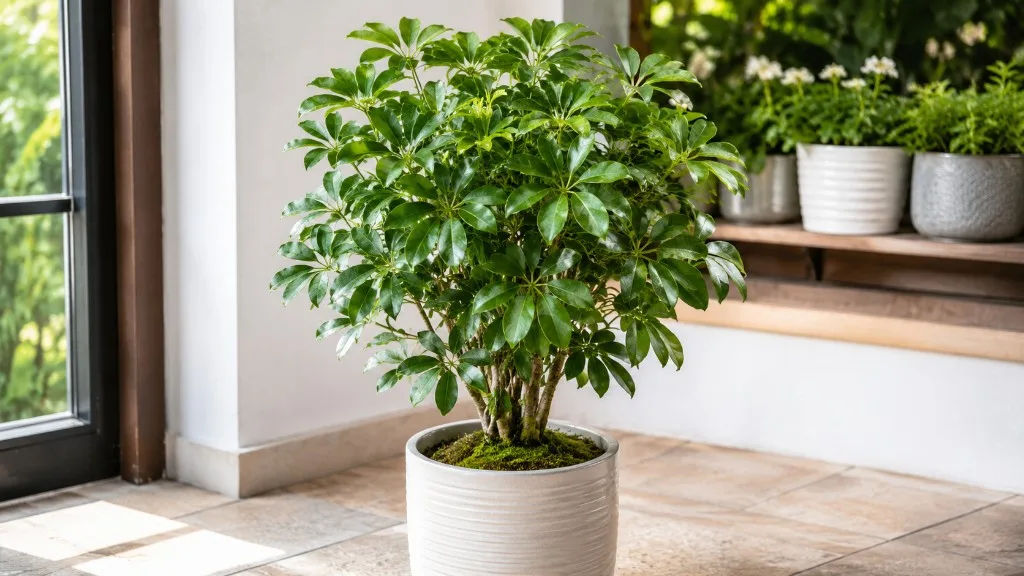
Schefflera arboricola - the dwarf umbrella tree sold as umbrella plant, octopus tree, or compact schefflera - tells you whether feeding is working on its newest palmate leaf clusters, not on leaves that unfurled last season. Each whorl of seven to nine glossy leaflets radiates from a central stem like a tiny umbrella; when salts build or light is too low, the smallest unfurling leaflets brown at the margins first while older foliage can look fine for weeks. That growth pattern is why dwarf umbrella tree fertilizer advice should stay conservative: half-strength balanced liquid during active growth, moist soil only, and a full pause when days shorten - not full label doses on a calendar that ignores your window and pot size.
This page owns cultivar-specific detail for container S. arboricola - variegated ‘Gold Capella’ and ‘Trinette’ salt sensitivity, bonsai shallow-pot intervals, propagation withholding, and palmate-cluster diagnostics. For cross-species Schefflera comparisons and the broader genus feeding framework, see the genus Schefflera fertilizer guide. For the full care map, start with the dwarf umbrella tree overview.
Quick answer: moderate feeding tied to palmate cluster growth
Feed dwarf umbrella tree with balanced liquid fertilizer at half the label strength during active spring and summer growth when you see new palmate leaf clusters unfurling at stem tips. Default interval for most indoor setups: once a month (roughly every four weeks). In bright indirect light with fast-drying pots and steady new leaves, every two to four weeks at the same half strength is appropriate - that matches the genus Schefflera guide frequency for active growers. In moderate light or with slow-release already in the mix, stretch to every four to six weeks. Pause entirely in late fall and winter for typical room-grown plants. Water first so soil is moist, never pour concentrate onto dry roots. Wait four to six weeks after repotting before the first feed. If white salt crust appears on the soil surface, flush with plain water and skip the next scheduled feed. Fertilizer cannot fix low light or overwatering - correct those before you chase nutrients.
Why Schefflera arboricola rewards restraint
The dwarf umbrella tree is an evergreen shrub in the Araliaceae family native to Taiwan and Hainan, where leaf litter and organic matter recycle nutrients in humid forest understory. Indoors in a finite pot, every watering leaches nitrogen, potassium, and trace elements through drainage holes, and root growth consumes what remains. Clemson HGIC classifies dwarf schefflera among medium-light houseplants and notes that fertilizer applications should be more frequent when plants are actively growing - typically spring and summer - and withheld during winter rest when many indoor plants grow little. S. arboricola is a moderate feeder: faster than succulents and snake plants, less salt-tolerant than heavy-feeding vegetables in full sun, but still vulnerable to concentrated doses in small containers.
Think of feeding as maintenance for healthy active growth, not a rescue for yellow leaves caused by too little light or soggy soil. Overwatering remains the top cause of decline in home collections; fertilizing stressed roots adds salt injury on top of oxygen deprivation. Fix water and placement first, then add nutrients on a conservative schedule.
Native range, taxonomy, and moderate-feeder biology
NC State Extension describes Heptapleurum arboricola (formerly Schefflera arboricola) as reaching 4 to 6 feet as a houseplant with palmate compound leaves of seven to nine leaflets arranged in a circle on each leafstalk. Outdoors in USDA zones 9b through 12b, it may grow taller; indoors, compact habit and moderate metabolism mean light feeding beats aggressive doses. Named cultivars include ‘Gold Capella’ (gold-green variegation), ‘Trinette’ (cream-green), and ‘Dazzle’ (heavy white variegation) - all share the same half-strength baseline but often need the longer end of the feeding interval because variegated tissue shows salt burn sooner.
Dwarf umbrella tree vs Australian umbrella tree feeding
Do not confuse Schefflera arboricola with Schefflera actinophylla, the larger Australian umbrella tree that can exceed 15 feet indoors. Both are moderate feeders with similar half-strength logic, but pot volume, growth rate, and salt concentration differ.
| Factor | S. arboricola (dwarf) | S. actinophylla (Australian) |
|---|---|---|
| Typical indoor size | 2–6 ft, bushy | Up to 15 ft, tree-like |
| Default feed interval (moderate light) | Monthly half strength | Every 2–4 weeks half strength |
| Fast bright-light interval | Every 2–4 weeks half strength | Every 2–3 weeks half strength |
| Salt risk in small pots | High - compact root zone | Moderate in large floor pots |
| Primary diagnostic | Newest palmate cluster margins | Newest whorl leaflet tips |
| This site’s deep dive | This page (cultivars, bonsai) | Genus Schefflera fertilizer |
What fertilizer does for palmate leaf cluster growth
Fertilizer replaces macronutrients and micronutrients the plant extracts from potting mix. Nitrogen supports green tissue and new leaflet expansion; phosphorus supports root function at modest levels; potassium supports overall vigor and stress tolerance. On S. arboricola, the payoff shows up as firm new palmate clusters, reasonably short internodes, and stable variegation on cultivars - not as flowers, since indoor specimens rarely bloom.
How NPK supports foliage and root health
A balanced 10-10-10 or 20-20-20 water-soluble formula at half strength is the default across extension and production guidance for schefflera. Avoid high-phosphorus bloom boosters - they add salt load without benefit for a foliage plant. Micronutrients on the label (iron, magnesium, manganese) matter when pale new growth appears on otherwise well-watered plants in adequate light; before increasing nitrogen, confirm watering rhythm and brightness.
Choosing the best fertilizer for dwarf umbrella tree
The best dwarf umbrella tree fertilizer for most homes is a complete water-soluble balanced houseplant formula. Liquid concentrates win for control: you mix, dilute, and apply a known dose to moist soil rather than dumping slow-release granules that stack unpredictably in a 20 cm pot.
Balanced liquid, organic, and slow-release compared
| Type | Best use on S. arboricola | Caution |
|---|---|---|
| Balanced liquid 10-10-10 or 20-20-20 | Monthly (or 2–4 weeks bright light) at half strength | Never full label rate in containers |
| Slight nitrogen lean 3-1-2 / 24-8-16 | Acceptable for foliage-forward growth | Still half strength |
| Organic fish emulsion / compost tea | Monthly in growing season only | Odor indoors; easy to over-apply |
| Slow-release granules | Light dose at repot only | Stacks with liquid feeds - skip one or the other |
| Bloom booster high-P | Skip | Salt without foliage benefit |
| Foliar sprays | Skip routine use | Roots absorb nutrients; wet leaves invite spotting |
Pet note: NC State Extension and the ASPCA list Schefflera species as toxic to cats and dogs, with calcium oxalate crystals causing oral irritation, drooling, vomiting, and difficulty swallowing if leaves are chewed. Concentrated fertilizer solution and crusty soil are not safe for pets either. Keep plants and runoff out of reach; contact your veterinarian promptly if a pet ingests liquid fertilizer concentrate or shows mouth irritation after chewing plant tissue.
The half-strength rule for Schefflera arboricola
If you remember one number, make it half the label strength. Houseplant labels assume a range of species and pot sizes; S. arboricola in a 20–30 cm container punishes full-strength bursts with tip burn on the next palmate cluster.
Example: label says 1 teaspoon per gallon for houseplants → use ½ teaspoon per gallon. Label says 1 tablespoon per gallon for outdoor annuals → use 1½ teaspoons per gallon for container schefflera. Measure with a spoon or syringe - “eyeballing” concentrates errors.
Clemson HGIC notes that water-soluble fertilizers are often preferred indoors because dilute solutions reduce fertilizer burn compared with heavy granular applications. Clemson HGIC also warns that white film on soil or white crust on pot rims may indicate overfertilizing and/or overwatering, with salt buildup leading to reduced growth, brown leaf tips, and wilting.
When dwarf umbrella tree needs fertilizer - and when it does not
Fertilize when three conditions align: the plant is in active growth, soil is evenly moist (not drought-dry or waterlogged), and no recent major stress has shut down roots.
Pause feeding when:
- You repotted within the last four to six weeks (fresh mix often contains starter charge)
- The plant shows root rot, pest damage, cold draft injury, or drought wilt
- Soil is bone dry or the plant is limp on wet mix
- White mineral crust covers the soil surface (flush first)
- It is late fall through winter in a typical dim room with no new shoots
Reading active growth vs winter slowdown
A dwarf umbrella tree kept indoors through winter often looks alive - old palmate leaves stay glossy - which tricks growers into summer feeding through December. Lower light and shorter days reduce new shoot production even when foliage stays upright. Unused nutrients accumulate as soluble salts while roots absorb water more slowly. University of Maryland Extension explains that excessive fertilizer is a primary cause of high soluble salts indoors, with symptoms including brown leaf tips and marginal necrosis - the pattern many growers see after off-season feeding.
Exception: under strong grow lights with continuous new palmate clusters through winter, feed lightly at half strength every six to eight weeks and watch for salt crust. Skipping winter feeds remains safer for most homes.
A practical spring and summer feeding schedule
Start feeding when fresh leaflets unfurl at stem tips - usually mid-spring through late summer (roughly April–September in temperate climates, adjusted for your room).
| Month (temperate climate) | Growth phase | Feeding guidance |
|---|---|---|
| March–April | Waking up | Start half-strength if new clusters visible |
| May–August | Peak foliage | Every 4 weeks default; every 2–4 weeks in bright light |
| September | Slowing | Every 6 weeks or taper |
| October | Wind-down | Final light feed if still growing, then pause |
| November–February | Low growth | No fertilizer for typical setups |
Pair every feed with a moisture check from the watering guide: allow the top half of soil to dry between plain-water drinks, but moisten before fertilizer so salts do not concentrate at dry root surfaces.
Reducing and stopping feed in fall and winter
Taper in early to mid-fall as day length drops. One practical approach: a final half-strength feed in early fall if new growth continues, then stop from late fall through winter. Most indoor S. arboricola need no fertilizer November through February, especially in cooler rooms or north-facing windows.
How to fertilize dwarf umbrella tree step by step
- Confirm active growth - new palmate clusters or stem extension visible; not winter pause.
- Inspect for salt crust or tip burn - if present, skip feed and flush (see below).
- Water with plain water if the top layer is dry - bring the root zone to evenly moist before fertilizer.
- Mix fertilizer at half strength in room-temperature water.
- Apply slowly across the soil surface, away from the leaf crown and stem base.
- Stop when a little water drains; discard saucer runoff within 30 minutes.
- Record the date so you do not double-feed in an enthusiastic week.
Visual diagnostic - clean vs salt-burned palmate clusters (what to compare): On a healthy S. arboricola, the newest unfurling cluster shows firm glossy leaflets with margins matching the cultivar - solid green, or crisp gold/cream edges on ‘Gold Capella’ and ‘Trinette’. After salt stress, the smallest leaflets in the newest whorl develop dry brown margins while the previous whorl may still look acceptable; white crystalline crust on the soil surface often appears at the same time. Hard-water spotting on the outer pot rim without soil crust usually points to irrigation minerals, not fertilizer alone (see FAQ). Photograph the newest cluster and soil surface together when diagnosing - that pair answers most “feed more or flush?” questions.
Adjusting dose for light, variegation, and water quality
Bright indirect light (four or more hours daily per the light guide) increases nutrient use - justify the every two to four weeks end of the schedule at half strength. Moderate light slows metabolism; monthly to every six weeks is enough.
Variegated cultivar callout: ‘Gold Capella’, ‘Trinette’, and ‘Dazzle’ grow slightly slower than solid-green forms. Feed at the longer interval (every five to six weeks) unless the plant pushes steady new clusters without tip burn. White or gold sections on new leaflets brown before green tissue on the same leaflet - that pattern usually means pull back on dose or frequency, not add more nitrogen.
Hard tap water carries calcium and magnesium that accumulate with fertilizer salts. If tip burn appears while feeding modestly, test or switch to filtered or rainwater before increasing food.
Bonsai callout: Schefflera trained in shallow bonsai trays has a tiny root volume and salt accumulates fast. Feed at half strength every six to eight weeks during active growth only, and flush more often than you would a standard nursery pot. Never combine monthly liquid with slow-release in a shallow tray.
Propagation cuttings need no fertilizer until roots are several centimeters long and new leaves appear; then quarter to half strength at wide intervals.
Signs your fertilizer routine is working
Healthy feeding shows on new growth:
- Steady production of firm palmate clusters through spring and summer
- Appropriate green or variegation for the cultivar on the newest leaflets
- Reasonably short internodes - not weak leggy extension
- No white salt crust on soil or heavy rim deposits
- Older leaves holding color while the plant builds new whorls above
Under-fertilizing is less common than over-fertilizing on container schefflera, especially in fresh mix. True hunger shows as uniformly paler new leaves and smaller new clusters over a full growing season - after ruling out not enough light and water stress. Increase frequency (four weeks instead of six) before increasing concentration.
Over-fertilizing: symptoms, visual cues, and recovery
Over-fertilizing is the dominant fertilizer mistake on dwarf umbrella trees. Symptoms often appear one to two weeks after a too-strong feed or gradually when winter feeding, hard water, and never flushing stack salts.
Watch for:
- Brown crispy tips and margins on newer leaflets, especially after a recent feed
- White or yellowish crust on soil surface and drainage holes
- Sudden leaf curl, wilt, or drop despite moist soil - osmotic root damage
- Weak rapid extension with thin stems
- Stunted new growth with burnt edges on unfurling leaflets
University of Maryland Extension notes high soluble salts reduce water uptake - burn looks like drought even when soil is wet. Many growers water more and compound the problem. Cross-check brown tips for humidity and water-quality causes before you feed again.
Flushing fertilizer salts from the root zone
If you suspect burn, stop fertilizing and leach the soil:
- Move the pot to a sink or tub where drainage is free.
- Water slowly with plain room-temperature water until it runs from drainage holes; let drain fully.
- Repeat two to three times over 30–60 minutes with full drainage between passes.
- Pause all feeding 4–6 weeks while monitoring new clusters.
- Resume at half strength only when new leaflets emerge without burnt margins and crust is gone.
Badly burned old leaves will not green up - judge recovery on new palmate clusters. Consider a quarterly preventive flush during the growing season: three to four plain-water passes every three months even when feeding correctly.
Feeding after repotting, stress, and propagation
After repotting into fresh mix with starter nutrients, wait four to six weeks before the first liquid feed. After drought, cold, or pest stress, hold food until stable new growth returns. After division or air layering, treat rooted sections like new cuttings - wide-interval quarter to half strength only after several new leaves.
Common dwarf umbrella tree fertilizer mistakes
The failures that show up most: full label strength in containers, feeding onto dry soil, winter feeding on a plant that only looks active, ignoring white crust, feeding stressed or newly repotted plants, bloom boosters on a foliage plant, stacking slow-release with monthly liquid, and adding fertilizer when leaves yellow from overwatering or low light. Match the schedule to actual growth rate in your room - a bright kitchen specimen and a dim office plant are not the same plant.
Fertilizer and other dwarf umbrella tree care
Fertilizer only works when light, watering, and soil are already in range. S. arboricola in bright indirect light uses nutrients faster than one in deep shade, where leggy growth and pale color are usually light problems. Well-draining mix targeting pH 6.0–6.5 supports uptake; compacted soggy mix mimics deficiency. Humidity above 40% supports healthy foliage and reduces spider mite stress that makes nutrient uptake less efficient.
When to use this page vs other Dwarf Umbrella Tree guides
- Dwarf Umbrella Tree overview - Start here for whole-plant context before deep-diving this topic.
- Dwarf Umbrella Tree problems hub - Jump to symptom-specific fix guides when this care topic does not resolve the issue.
Related Dwarf Umbrella Tree guides
- Dwarf Umbrella Tree overview
- Dwarf Umbrella Tree watering
- Dwarf Umbrella Tree light
- Dwarf Umbrella Tree soil
- Dwarf Umbrella Tree propagation
- Dwarf Umbrella Tree repotting
- Dwarf Umbrella Tree problems
Conclusion
Dwarf umbrella tree fertilizer success is reading new palmate clusters, not the calendar. Use half-strength balanced liquid during active growth - monthly by default, every two to four weeks in bright light - and pause through winter unless grow lights keep new leaves coming. Water onto moist soil, flush when crust appears, and fix light and watering before you chase yellow leaves with nitrogen. Schefflera arboricola forgives a skipped month far better than a double dose after pale foliage - when the next whorl opens firm and clean, your rhythm is right.