How to Propagate Dwarf Umbrella Tree: Cuttings Guide
How to Propagate Dwarf Umbrella Tree: Cuttings Guide
How to Propagate Dwarf Umbrella Tree: Cuttings Guide
A healthy dwarf umbrella tree can become two, three, or more full plants without a trip to the nursery - but only if you propagate from the right tissue. Schefflera arboricola roots from stem cuttings that include nodes and from air layering on stems still attached to the parent. Those are the two reliable methods. What does not work, despite what social media shortcuts suggest, is rooting a single leaflet pulled from the compound leaf. The leaflet may sprout water roots and look promising for weeks, but it lacks the meristematic tissue needed to grow a new shoot and become a real plant.
This guide covers dwarf umbrella tree propagation from start to finish: how to identify nodes on a compound-leaf plant, when to choose stem cuttings versus air layering, how to root cuttings in water or soil, and how to wrap and separate an air layer on a leggy stem. You will also get the aftercare that turns a rooted piece into a bushy young plant and the failure fixes that save you from repeating the same mistakes.
What Dwarf Umbrella Tree Propagation Actually Requires
Compound leaves, nodes, and why single leaflets fail
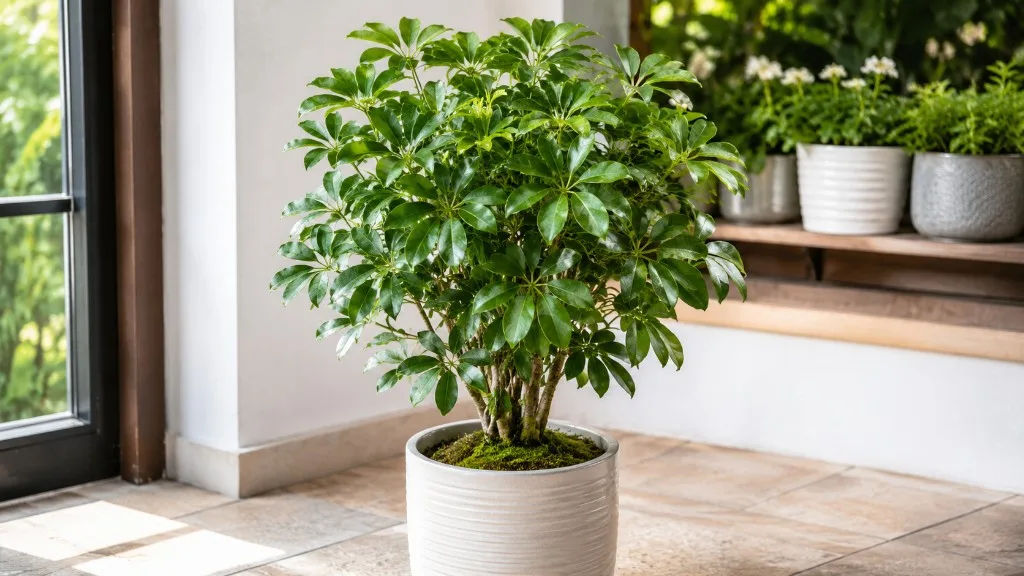
Dwarf umbrella tree belongs to the Araliaceae family - the same family as ginseng and English ivy - and is native to Taiwan and Hainan. Its signature feature is the compound leaf: a central stalk called a petiole that fans out into seven to nine glossy leaflets, giving the plant its umbrella-like silhouette. That visual complexity is exactly what trips up new propagators. The leaflets look like individual leaves, so it feels logical to pluck one, stick it in water, and wait. It is not logical botanically, and it will not produce a new plant.
A node on Schefflera arboricola is the joint on the main stem where the petiole attaches - not any point along the petiole and not any individual leaflet. Nodes contain meristematic tissue: specialized cells that can differentiate into new roots and shoots when stimulated by a clean cut, moisture, warmth, and auxin accumulation at the wound site. The space between two nodes is an internode, and internode tissue alone cannot restart growth. Cut a stem section with no node and it may stay green briefly on stored energy, then yellow and collapse without ever becoming a rooted plant.
A single leaflet detached from the compound leaf has even less regenerative capacity. It may root in water - adventitious roots can form on almost any living plant tissue under the right conditions - but without stem or node tissue, it cannot produce the bud that becomes a new stem, branches, and additional leaves. The result is a rooted leaf that never progresses, similar to the single-leaf “Sweetheart” hoyas sold around Valentine’s Day that stay as one leaf indefinitely. For dwarf umbrella tree propagation, you need a stem segment with at least one node, or you need to air layer a node while it is still attached to the parent plant’s vascular system.
Understanding this anatomy prevents the most common beginner mistake: watching a floating leaflet develop white roots, assuming success is imminent, and waiting months for a shoot that will never come. If you want a new plant, work from the stem.
How Schefflera arboricola stems regenerate after cutting
Schefflera arboricola is an evergreen shrub or small tree that grows upright indoors, typically reaching 4 to 8 feet in cultivation with a moderate growth rate when conditions are good. Its stems are flexible when young and gradually become woodier as the plant ages. That woodiness changes which propagation method works best: soft green stem tips root quickly as cuttings, while thick lower stems on a leggy plant respond better to air layering than to being severed and stuck in a jar.
When you cut a stem just below a node, auxin accumulates at the wound and promotes root initiation when the node contacts moist medium or water. The parent plant often responds by pushing new growth from buds at lower nodes - which is why propagation and shaping frequently happen in the same session.
Stem Cuttings vs Air Layering: Which Method to Choose
Use this framework before you touch a pair of pruners:
- Take a stem cutting when you have healthy green or semi-woody growth you can spare, especially from the top or side of a plant you want to shorten anyway. Stem cuttings are the best default for most indoor growers. Iowa State Extension lists Schefflera arboricola (Dwarf Schefflera) among houseplants best propagated by 3- to 6-inch stem tip cuttings with at least two nodes. They work in water or soil, require minimal equipment, and produce a well-shaped young plant in four to six weeks under warm, bright conditions.
- Use air layering when the stem you want to propagate is thick, woody, and far from the tip - common on leggy plants that have grown toward the ceiling without branching. Penn State Extension notes that dwarf Schefflera (Heptapleurum arboricola) is easily propagated by air layering, which lets roots form while the stem is still attached to the parent.
If your plant is young and bushy with soft green stems, start with cuttings. If your plant is a single tall trunk with a leafy crown and bare lower stem, air layering on the woody section gives you a rooted top you can pot separately while the base regrows side shoots. Both methods clone the parent - useful for variegated cultivars like ‘Gold Capella’ or ‘Trinette’ where seeds would not preserve the pattern.
Best Timing, Temperature, and Light for Rooting
The best window for Schefflera arboricola propagation is spring through early summer, when daylight lengthens and the plant is pushing active growth. NC State Extension lists stem cutting as a recommended propagation strategy for Dwarf Umbrella Tree overview. Warmth and Dwarf Umbrella Tree light guide speed root initiation and new leaflet production. Calendar season is not the only factor, however. A warm, bright indoor shelf can support propagation outside that window, while a cold windowsill in March can still stall it even if the calendar says spring.
Avoid propagating during a stress period - right after shipping, during an active pest outbreak, while the parent is recovering from root rot on Dwarf Umbrella Tree, or immediately after a harsh Dwarf Umbrella Tree repotting guide that left the plant wilted. Propagation is a way to multiply healthy plants, not a rescue tactic for a failing one. If the parent is struggling, stabilize it first and take cuttings or air layers only from clearly healthy tissue.
Temperature drives speed. Cuttings and air layers root fastest at 65 to 80°F (18 to 27°C). Below 60°F (16°C), rooting slows dramatically and rot risk rises. A heat mat set to about 72°F (22°C) is the single most useful propagation upgrade in a cooler home, especially for soil-rooted cuttings that you cannot visually inspect.
Light should be bright and indirect. East-facing windowsills, shelves a few feet from a south or west window, or gentle grow lights all work. Direct hot sun cooks cuttings in sealed humidity setups and bleaches leaves on newly potted plants. Too little light produces pale, stretched cuttings that root slowly and look leggy from day one.
Tools, Supplies, and Rooting Setup
You do not need a propagation lab. The essentials are sharp pruning shears or a knife, 70% isopropyl alcohol for blade sterilization, small pots with drainage holes, a clear glass or jar for water rooting, sphagnum moss and clear plastic wrap for air layering, and optionally IBA rooting hormone powder or gel.
Sterilize blades before every cut and between plants. A contaminated blade drags bacteria and fungi into fresh wounds on schefflera tissue, which is one of the fastest routes to stem rot. Wash your hands, clean the tool, and avoid reusing old soggy potting mix from a previous failed attempt.
For rooting medium, use a light, airy, fast-draining blend. A practical home mix is equal parts perlite and peat-based potting mix, or a commercial indoor potting mix amended with extra perlite to roughly 40 to 50 percent perlite by volume. The target pH is slightly acidic, around 6.0 to 6.5 - NC State Extension lists acid (<6.0) to neutral (6.0–8.0) among suitable soil pH conditions - which matches what established dwarf umbrella trees prefer. Pre-moisten the mix before you pot cuttings so you are not watering dry peat into a floating mess afterward.
Containers should be small - 4-inch pots for cuttings, slightly larger for separated air layers with substantial root balls. Oversized pots hold surplus moisture around unrooted stems and make it harder to judge when the medium is actually drying. For water rooting, a clear glass lets you monitor root development and spot cloudy water before rot spreads.
For air layering, gather long-fiber sphagnum moss, clear plastic wrap, waterproof tape or twist ties, a toothpick, and rooting hormone. Soak the moss and squeeze out excess until it is damp but not dripping.
How to Propagate Dwarf Umbrella Tree From Stem Cuttings
Taking a clean cutting below a node
Stem cuttings are the most accessible dwarf umbrella tree propagation method for home growers. Choose a healthy stem 4 to 6 inches long with at least two or three compound leaves and two or more nodes on the portion that will be buried or submerged. More nodes mean more rooting sites and a higher chance of success, though a single-node cutting can work if the stem is otherwise healthy.
Make a clean cut with sterilized shears just below a node - about one-quarter inch beneath the swelling where the petiole meets the main stem. Iowa State Extension recommends cutting stems with at least two nodes that are 3 to 6 inches long and removing lower leaves so one or two nodes can be inserted into the medium. Angle the cut slightly if you prefer, but cleanliness matters more than angle. Remove the lower compound leaves so at least one or two nodes are fully exposed for rooting. Strip leaflets carefully: you are removing entire petioles from the stem, not individual leaflets. Every leaf that would sit below the waterline or bury in medium should come off, because submerged petioles and leaflets rot within days and contaminate the rooting environment.
A brief callus period helps on thicker stems. Set the cutting on a clean paper towel for two to four hours so the cut surface dries slightly. Soft green tip cuttings can move to water or medium immediately; semi-woody stems benefit from the short dry period. Do not leave cuttings out so long that they wilt - the goal is a dry wound edge, not a dehydrated stem.
Rooting hormone is optional but useful, especially on woodier cuttings. A light dusting of IBA powder on the cut end and the exposed node surfaces can increase root density and speed initiation. Tap off excess powder - a heavy coating holds moisture against the stem and works against you.
Rooting stem cuttings in water
Water rooting is the most visible method because you can watch roots form day by day. Fill a clean glass or jar with room-temperature filtered or rainwater. Hard tap water can leave mineral deposits on delicate new roots, though scheffleras are generally tolerant.
Submerge one or two nodes while keeping all remaining compound leaves above the waterline. Use a narrow-necked bottle or a piece of tape across the jar mouth to hold the stem upright if it wants to slide. Only the nodes need contact with water - do not submerge the entire stem, because roots may then emerge too high on the cutting and complicate later potting.
Place the jar in bright, indirect light. Change the water every five to seven days in a warm home, or sooner if it turns cloudy or develops a sour smell. If the water fouls, replace it immediately and trim any soft tissue back to firm green or brown stem. A stem that stays firm and green at the cut end is still viable; a mushy base is not.
Roots typically appear in three to four weeks, sometimes faster in warm, bright conditions. Wait until new roots reach at least 1 to 2 inches long with white or cream-colored tips before transplanting. Shorter roots snap during handling and often fail after potting.
The water-to-soil transition is the most fragile moment. Pot into pre-moistened, well-draining mix and keep the soil lightly moist - not saturated - for the first one to two weeks. Water rooting works best on green to semi-woody tip cuttings; fully woody sections often rot before they root in water.
Rooting stem cuttings directly in soil
Soil propagation hides the roots but produces a plant that is already adapted to its permanent medium, which means less transition shock than water rooting. Pre-moisten your perlite-heavy mix, insert the cutting so at least one node is buried an inch deep, and firm the medium lightly around the stem without compacting all the air out.
A clear plastic bag propped on stakes or a small propagation dome can raise humidity around the compound leaves while roots form. Vent the cover for 15 to 30 minutes daily once condensation builds heavily, because a sealed swamp invites fungal problems on schefflera foliage.
Keep the medium lightly and evenly moist - never waterlogged. Check weekly by tugging gently on the stem. Resistance usually means roots are forming. Roots in soil typically appear in four to six weeks at warm indoor temperatures. Once you feel a firm anchor and see new growth at the tip - a fresh leaflet cluster or visible lengthening of the petiole - gradually open the humidity cover over several days so the cutting acclimates to normal room air.
Soil rooting is the better choice when you want fewer steps and a stronger finish, or when you are working with slightly woodier stems that tend to stall in water. Water rooting is the better choice when you are learning, want visual confirmation, or are rooting several cuttings in one jar to save space.
How to Propagate Dwarf Umbrella Tree by Air Layering
Choosing the right stem and making the wound
Air layering is the right dwarf umbrella tree propagation method when you want to root a thick, woody section of stem - typically on a leggy plant where the lower trunk is bare and the foliage sits in a crown at the top. Select a healthy stem one-quarter to one-half inch thick or larger, with active growth above the layering point.
Choose a spot on the stem below a node, ideally 12 to 18 inches below the leafy crown so the rooted section will have enough stem to look proportional in a pot. Remove any leaves or side shoots from a 4-inch zone around the layering point so the moss wrap has clean contact with the bark.
Make a wound to stimulate root formation. The standard approach is a ring cut: use a sterilized knife to remove a narrow ring of bark, about one-half to one inch wide, all the way around the stem, exposing the green cambium layer beneath. An alternative is an upward-angled slice one-quarter to one-half deep into the stem, about one to one-and-a-half inches long, just below a node. Either method interrupts the flow of auxin down the stem and encourages root initials to form at the wound site.
Apply a light dusting of rooting hormone to the exposed cambium. Insert a toothpick or small twig into an upward slice to hold the wound open, or gently scrape the cambium ring with the knife tip to stimulate cell division. Do not cut more than halfway through the stem - you want to wound, not sever.
Wrapping, monitoring roots, and separating the new plant
Soak long-fiber sphagnum moss in water and squeeze until damp but not dripping. Wrap a generous handful around the wounded section, covering the entire exposed area and extending an inch above and below the cut. The moss should form a ball around the stem, not a thin smear.
Cover the moss with clear plastic wrap or a small plastic bag, securing the top and bottom with waterproof tape or twist ties so the moss stays enclosed but not compressed into a sodden brick. The wrap should be tight enough to hold moisture in and loose enough that you can peek inside without destroying the setup.
Keep the moss consistently moist throughout the process. Unwrap and mist or soak the moss whenever it feels dry to the touch - typically every three to five days in a warm home. Do not let the moss dry out completely, because developing root initials die quickly without moisture. Also avoid soaking it to the point of waterlogging, because stagnant wet moss against bark invites rot.
Place the plant in its normal bright, indirect light location. The leaves above the wrap continue photosynthesizing and feeding the developing roots below. Roots typically become visible through the plastic in four to eight weeks, depending on temperature, stem thickness, and wound size. Wait until you see a solid network of white roots filling the moss ball before separating.
To harvest the air layer, remove the plastic and moss carefully. Use sterilized shears to cut the stem just below the new root mass, leaving the roots intact. Pot into a container with drainage holes using well-draining mix with perlite, burying the roots and lowest inch of stem while keeping compound leaves above the soil line. The parent usually pushes new shoots from nodes below the cut within a few weeks.
Aftercare While Cuttings and Layers Root and Establish
Humidity, watering, and when to fertilize
Whether you soil-rooted a cutting, potted a water-rooted cutting, or separated an air layer, the first six to eight weeks are about restraint. Do not overwater, overfeed, repot again, or move the plant repeatedly while it is finding its footing.
Humidity matters most for unrooted cuttings under a dome. Target the range where leaflet edges stop crisping but condensation does not run down the bag unchecked. Established rooted plants and separated air layers tolerate normal indoor humidity of 40 to 60% without complaint, though grouping plants or a pebble tray can help in very dry homes below 30 percent.
Watering should follow the actual dryness of the medium, not a calendar. A freshly potted cutting has few roots and uses water slowly. An air-layered plant with a full root ball may dry faster in a small pot. Check the top inch of mix with your finger. Water thoroughly when it approaches dry, then let excess drain completely. Never leave a dwarf umbrella tree standing in a saucer full of runoff - root rot develops quickly in stagnant water, and young plants have less root mass to recover from damage.
Skip fertilizer for six to eight weeks after rooting or separation. Fresh roots are sensitive to salt burn, and scheffleras are moderate feeders even at maturity. When you do feed, start at half strength of a balanced liquid fertilizer during active growth, ramping to full strength only when the plant pushes new firm leaflet clusters consistently.
Watch for new growth at the tip - that is the clearest sign propagation succeeded. On a stem cutting, the first new compound leaf may be slightly smaller than mature parent leaves; that is normal while the root system catches up. If the plant holds green leaves but produces no new growth for ten weeks, inspect the roots: white, firm tips mean progress; brown, mushy tissue means trim, fresh mix, and a smaller pot.
Keep propagated plants away from pets during establishment. Schefflera arboricola is toxic to cats and dogs, causing vomiting and oral irritation if chewed, according to the ASPCA. That does not change propagation technique, but it matters for where you place newly potted plants while they recover from the process.
Transplanting Rooted Cuttings and Layers Into Permanent Pots
Moving a rooted cutting or separated air layer from its propagation container into a long-term home is a small but important decision. Choose a pot with drainage holes that is only one size larger than the root mass - for most dwarf umbrella tree cuttings, that means a 4- to 6-inch pot, not an 8-inch statement container. Excess soil holds moisture the young roots cannot use, which is the most common cause of post-propagation rot.
Use the same well-draining mix with perlite the parent thrives in: peat or coco coir with generous perlite, slightly acidic around pH 6.0 to 6.5. Pre-moisten before potting. Set the cutting or air layer at the same depth it rooted at, with no leaflets buried. Firm the mix gently to remove large air pockets without compressing it into a brick.
Water once to settle, then place the plant in bright indirect light. Avoid direct afternoon sun for the first two to three weeks. Transplant water-rooted cuttings when roots are 1 to 2 inches long with multiple branches - shorter roots snap and often fail after potting.
Common Propagation Failures and How to Fix Them
The most common failure is a stem cutting with no node, or worse, a single leaflet with no stem at all. A pretty leaflet may develop roots in water and stay green for weeks, then slowly yellow without ever producing a shoot. Always cut just below a node on the main stem and verify that at least one node will contact water or moist medium. If you already have a rooted leaflet, treat it as a learning experiment, not a future plant.
Rot follows predictable causes: submerged leaves or petioles, stagnant water, medium that stays too wet, or a sealed humidity dome with no daily venting. Cold below 60°F slows rooting and invites decay. Woody stems in water are a method mismatch - switch to air layering or take a greener tip cutting. Transition shock after water rooting shows up as wilt within days of potting; ease the shift with pre-moistened mix and lighter watering. overwatering on Dwarf Umbrella Tree after success kills more young scheffleras than failed rooting - allow the top half of soil to dry before the next drink.
Shaping the Parent Plant After Propagation
Propagation and shaping are often the same job on a dwarf umbrella tree. When you remove a leggy top as a stem cutting or harvest an air layer from the upper trunk, the parent plant is left with a shorter stem and an opportunity to branch. New shoots typically emerge from nodes below the cut within a few weeks to a few months, depending on light and season.
Give the parent bright indirect light after cutting. Dim corners produce weak, sparse regrowth. If the remaining stem looks bare and unbalanced, you can pinch or cut back to a lower node to encourage a more compact silhouette, but wait until you see active bud swell at existing nodes before making additional cuts.
Do not fertilize the parent immediately after a major cut. Let it recover for four to six weeks, then resume light feeding during active growth. Water on the same schedule as before - the root system is unchanged even though the top is smaller.
Conclusion
Dwarf umbrella tree propagation comes down to working from stem tissue with nodes, not from individual leaflets. Healthy green stems want cuttings rooted in water or well-draining soil. Thick, woody, leggy stems want air layering while still attached to the parent. Both methods produce genetic clones of the parent plant, which is especially valuable for variegated cultivars.
Sterilize your tools, include at least one node on every stem cutting, keep submerged leaves out of water, maintain warm bright conditions, and wait for 1- to 2-inch roots before potting up water-rooted cuttings. For air layers, keep the moss moist and wait for a visible root network before separating. Once you have propagated one Schefflera arboricola successfully, the process becomes intuitive - you will recognize firm healthy stems, spot rot before it spreads, and know when a new plant is ready to grow on its own. That is when one umbrella-shaped pot on a shelf starts to feel like the beginning of a small collection rather than a single purchase.
When to use this page vs other Dwarf Umbrella Tree guides
- Dwarf Umbrella Tree overview - Start here for whole-plant context before deep-diving this topic.
- Dwarf Umbrella Tree problems hub - Jump to symptom-specific fix guides when this care topic does not resolve the issue.
Related Dwarf Umbrella Tree guides
- Dwarf Umbrella Tree overview
- Dwarf Umbrella Tree watering
- Dwarf Umbrella Tree light
- Dwarf Umbrella Tree soil
- Dwarf Umbrella Tree fertilizer
- Dwarf Umbrella Tree repotting
- Dwarf Umbrella Tree problems
Related tool
Try the Propagation Success Calculator with dwarf-umbrella-tree pre-selected to estimate needs for your setup.