Root Rot on Dwarf Umbrella Tree: Causes, Checks & Fixes
Quick answer
Root rot on dwarf umbrella tree (*Schefflera arboricola*) starts when soggy mix starves woody roots of oxygen-leaf whorls wilt despite wet soil, lower leaflets yellow, and the stem base may turn mushy. First step: stop watering, empty the saucer, and confirm the top inch of mix is still damp before you unpot.
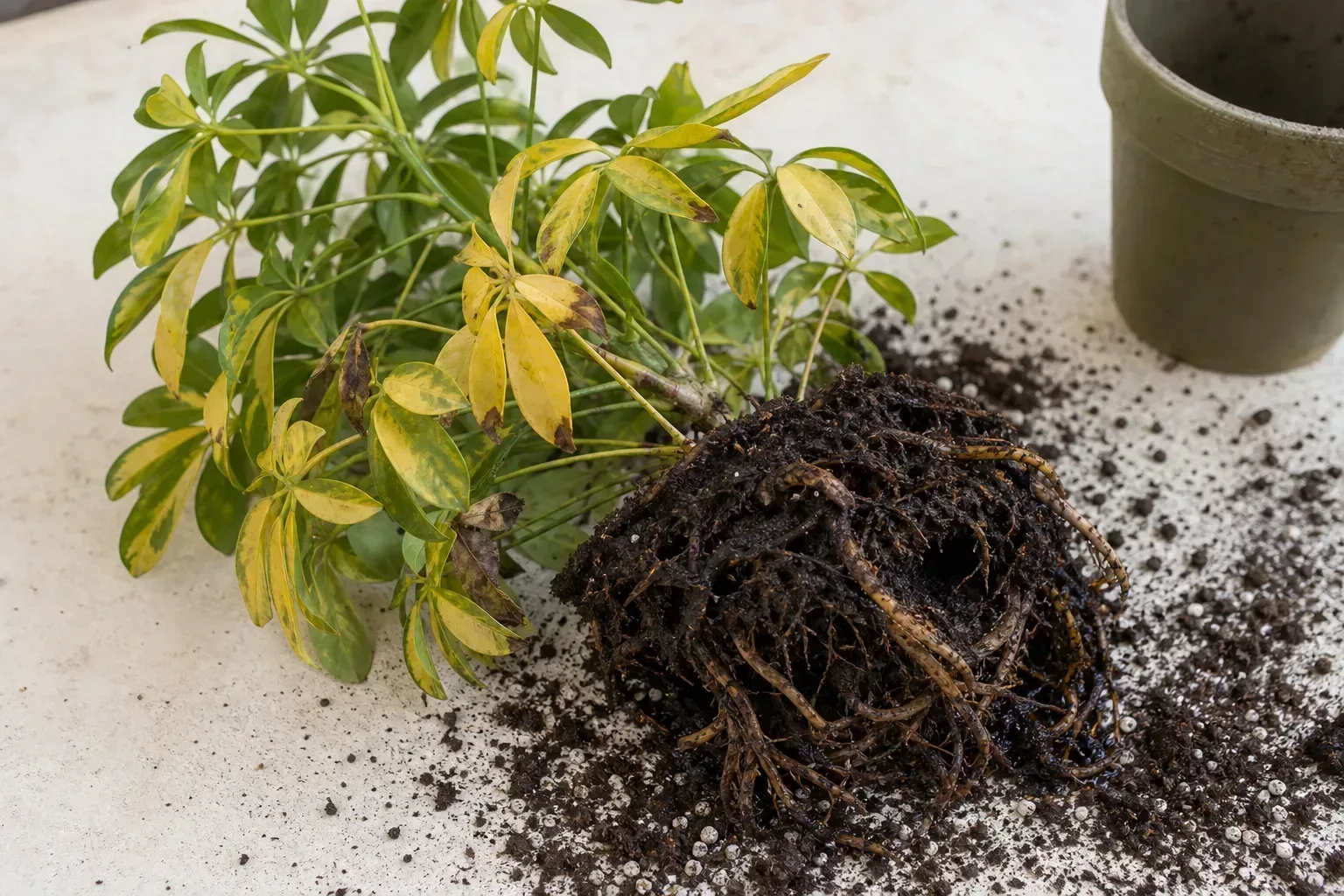
Root Rot on Dwarf Umbrella Tree: Causes, Checks & Fixes
This guide covers root rot on Dwarf Umbrella Tree. See also the general Root Rot guide, watering, and light pages for this plant.
Root Rot on Dwarf Umbrella Tree: Causes, Checks & Fixes
Quick answer
Root rot on dwarf umbrella tree (Schefflera arboricola) is almost always a watering-and-drainage failure, not a mysterious indoor disease. This woody evergreen shrub grows compound leaf whorls at nodes along upright stems-not a rosette crown-so symptoms show up as limp umbrella clusters on wet soil, yellowing lower leaflets, sudden mass leaf drop, and eventually soft brown tissue at the woody stem base.
First step: stop watering immediately. Lift the pot out of any cachepot, empty standing water from the saucer, and confirm the top inch of mix is still damp. If leaf whorls are wilted while soil feels heavy and cool, treat root stress as likely before you add fertilizer, mist leaves, or repot on impulse. Full rescue starts with inspection-see the numbered workflow below-but pausing water is the single action that prevents further oxygen loss tonight.
For prevention rhythm and seasonal dry-down, start with the dwarf umbrella tree watering guide.
Root rot vs. other schefflera problems - why wilt on wet soil matters
The counterintuitive pattern that sends most owners down the wrong path is wilting with wet soil. On S. arboricola, entire compound leaf whorls hang limp even though you watered recently. The instinct is to pour again. That extra water keeps the root zone anaerobic and accelerates decay.
Clemson HGIC notes that root rot on schefflera usually results from soil that does not drain quickly or overly frequent watering, and that leaf drop can follow excessive watering. NC State Extension adds that if soil is too wet or too dry, leaves will drop off-wet-soil drop on an otherwise healthy-looking woody stem strongly points to root failure, not drought.
This page focuses on post-confirmation rescue after you suspect rotting roots. Early intervention before roots turn mushy overlaps with overwatering on dwarf umbrella tree. Acute turgor collapse without confirmed rot is covered in the wilting guide.
What root rot looks like on Dwarf Umbrella Tree
Schefflera arboricola carries seven to nine glossy leaflets in each terminal whorl. Root rot symptoms read differently than on soft-rosette plants like African violets-the architecture here is woody stems with alternate whorls, and decay often climbs the stem base before the whole canopy collapses.
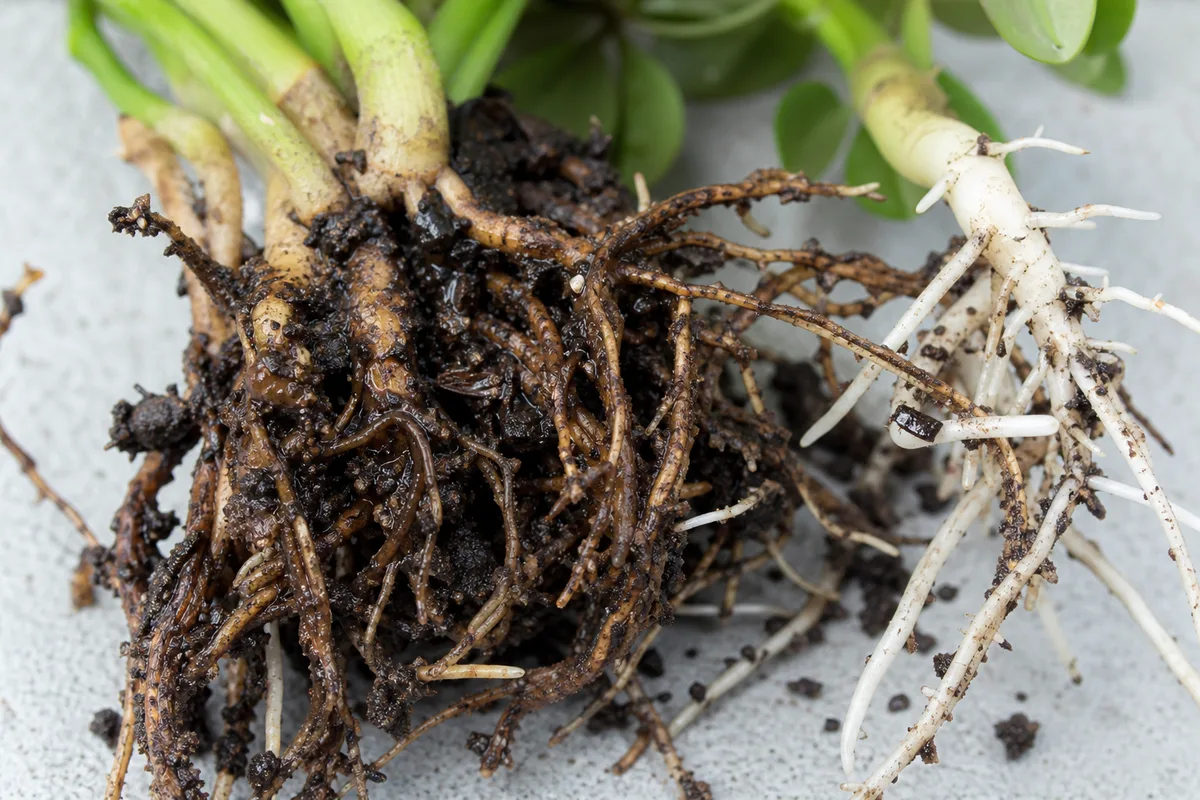
Root Rot symptoms on Dwarf Umbrella Tree - compare with healthy tissue on the same plant.
Early signs (limp whorls, yellow lower leaflets, sour mix)
- Limp compound leaf clusters while the top inch of mix still feels damp or the pot lifts heavy
- Yellowing lower whorls first-the oldest umbrellas lose color while mid-canopy whorls may still look green briefly
- Stalled new terminal whorls even though you have been watering on schedule
- Dark cool surface soil that does not lighten for many days after the last drink
- Faint sour or stagnant smell from drain holes when you lift the pot
- Fungus gnats hovering at the soil line-chronically wet houseplant mix favors fungus gnats
Variegated cultivars such as Gold Capella and Trinette may show cream or gold sectors fading on new whorls faster under wet soil in dim offices, because reduced chlorophyll already limits the plant’s ability to use excess moisture.
Advanced signs (stem mush, sudden mass leaf drop)
- Sudden mass leaf drop-multiple whorls shed within days after a wet cycle, a classic schefflera stress signature when roots fail
- Mushy brown or black tissue girdling the woody stem at or just above soil level
- Soft crown where multiple stems meet the mix-press gently; firm wood should not give
- Translucent, slimy roots that pull away from the root ball when you rinse the mix
- Persistent wilt into the next morning despite wet soil-unlike same-day recovery after genuine drought
Compare with underwatering: a lightweight pot, dry top 1–2 inches, and slightly curled but firm leaflets point to thirst, not rot. See underwatering on dwarf umbrella tree when the dry-down story fits.
Why Dwarf Umbrella Tree gets root rot
Overwatering, poor drainage, oversized pots, and cachepots
Dwarf umbrella tree evolved in subtropical Taiwan and Hainan with frequent rainfall but excellent drainage through rocky organic soil. Indoors, the species is somewhat drought tolerant yet intolerant of chronically saturated mix. The pairing Clemson HGIC names-slow-draining soil plus frequent watering-is the dominant cause.
Common failure modes:
- Calendar watering every week regardless of top-inch dryness
- Decorative cachepots that trap runoff with no exit path
- Oversized pots after repotting-unused mix holds water like a sponge around a small root ball
- Blocked drainage holes from roots, gravel myths, or compacted peat
- Heavy peat-only mix without perlite or bark in a dim room that dries slowly
Standing water in saucers re-wets the bottom root zone where oxygen is scarcest. Clemson HGIC is explicit: never let a schefflera sit with water in its saucer.
Low light and cool rooms slowing dry-down
Nursery tags call arboricola “low-light tolerant,” which many readers translate into “water weekly in a dim office.” Low light slows photosynthesis and water use. The same pour that worked in a bright summer window keeps mix wet for two to three weeks in a north-facing winter room-and roots suffocate while leaflets wilt. This pairs often with not enough light on dwarf umbrella tree; fix placement and watering together, not water alone.
Cooler temperatures further slow evaporation-Clemson HGIC recommends keeping schefflera nighttime temperatures above 60°F. Winter overwatering is the silent pattern because the surface looks merely “not dusty” while the center stays soggy.
How to confirm the cause
Work through these checks in order before you trim roots or reach for fungicide.
Top-inch dry, pot weight, and drainage check
- Finger probe - Press one inch into mix near the pot wall. Cool clinging dampness with a heavy pot plus wilted whorls means pause water; do not “help” with another drink.
- Pot weight - Lift immediately after your last thorough watering to learn the heavy baseline. A wilted plant in a still-heavy pot is not thirsty.
- Drainage holes - Confirm water exits freely; poke gently if blocked. Lift inner pots out of cachepots to inspect standing water.
- Saucer check - Empty all runoff within thirty minutes of every watering session.
- Smell - Sour or stagnant notes from drain holes support rot over drought.
These checks mirror the watering guide’s top-inch dry rule-root rot confirmation starts with the same moisture logic that prevents it.
Root and woody stem inspection
When multiple early signs align, unpot the plant:
- Slide the root ball out gently-do not yank by the stem.
- Rinse away old mix under lukewarm water so you can see root color and texture.
- Healthy roots are firm, pale tan to white, and hold their shape when touched.
- Rotted roots are brown to black, soft, slimy, or hollow- they may smell sour.
- Stem base - Press woody tissue at soil line. Firm bark is good; mushy brown girdling is advanced rot.
Clemson HGIC’s houseplant disease guide notes that with root rot, leaves and stems show noticeable wilt, stems may be girdled at soil level by brown or black tissue, and infected roots are brown to black and soft. If most roots are mush and the crown is soft, salvage shifts to stem cuttings rather than hoping the stump rebounds-see dwarf umbrella tree propagation.
Lookalike symptoms to rule out
| Pattern | Soil / pot | Stem / roots | Likely cause |
|---|---|---|---|
| Limp whorls, heavy wet pot, sour smell | Top inch damp for days | Soft brown roots; mushy stem base | Root rot - this page |
| Limp whorls, light dry pot | Top 1–2 in dry; pot light | Firm roots; firm stem | Underwatering - underwatering guide |
| Gradual yellow lower whorls, wet soil, no sudden drop | Slow dry-down in dim room | Roots still firm on spot check | Early overwatering - overwatering guide |
| Rapid wilt after cold night; soil moisture normal | Normal dry-down | Firm roots; no sour smell | Cold draft - stabilize temperature first |
| Slow yellow + stretch; soil dries normally | Normal rhythm | Firm roots | Low light - not enough light guide |
| Lowest one whorl yellows over months | Normal watering | Firm roots; healthy new terminal whorl | Natural aging - not rot |
Yellow leaves without confirmed mushy roots may still trace to moisture stress-use the yellow leaves guide for color patterns before assuming full rot rescue.
First fix for Dwarf Umbrella Tree
Stop watering and stabilize the environment. Move the pot out of any sealed outer container, empty the saucer, and place the plant in bright indirect light with gentle airflow-not a cold window ledge. Do not fertilize, mist heavily, or repot until you have inspected roots and trimmed mushy tissue.
That single pause prevents the most common escalation: adding water to wilted leaflets when roots are already drowning.
Step-by-step rescue after confirmation
Once unpotting confirms soft roots or stem girdling, work through these steps in order:
- Stop all watering until you finish root surgery and repot-typically several days to a week depending on trim volume.
- Unpot and rinse the root ball so damaged tissue is visible.
- Trim mushy roots with clean, sharp scissors or pruners sterilized with rubbing alcohol. Cut back to firm white tissue; it is better to remove all doubtful material than to leave hidden decay.
- Air-dry cut surfaces for one to four hours on clean newspaper in shade-do not bake in direct sun.
- Inspect the stem base. If woody tissue above the crown is still firm, proceed. If the stem is mushy above soil line, take healthy cuttings from upper nodes before discarding the base.
- Repot into fresh well-drained mix-see dwarf umbrella tree soil guide for perlite-amended structure. Choose a pot only slightly larger than the trimmed root mass; oversized containers re-create the wet-center problem.
- Confirm drainage holes are open. Water once lightly to settle mix, then empty the saucer completely.
- Resume watering only when the top inch dries-often seven to fourteen days after repot depending on light and season. Judge recovery by new firm terminal whorls, not by old leaflets re-greening.
Clemson HGIC notes that if only a few roots are infected, cut out those roots and repot in sterile soil-but also that fungicides often cost more than a replacement plant for typical indoor rot. Focus on drainage correction and root removal rather than chemical sprays unless you are preserving a large specimen with substantial healthy root mass remaining.
When to try stem-cutting salvage
If roots are mostly gone but firm green stems remain six inches or more above a sound node:
- Take four- to six-inch cuttings from healthy sections with at least one node.
- Remove lower leaflets that would sit below the mix line.
- Root in fresh moist (not soggy) mix per the propagation guide.
- Keep humidity moderate and bright indirect light; avoid saturated soil while new roots form.
Arboricola roots readily from cuttings when stems are still turgid-this is often the practical save when the original root ball is more mush than root.
Recovery timeline
Root rot recovery on dwarf umbrella tree is measured in weeks, not days. Expect:
- Days 1–7: No new watering until repot settles; old wilted leaflets may drop further-this is normal shedding of tissue roots can no longer support.
- Weeks 2–4: First firm new terminal whorl or side shoot from a node below a trim point signals roots are re-establishing. Old yellow leaflets will not green up; remove them once new growth looks stable.
- Weeks 4–8: Canopy density slowly rebuilds if enough root mass and stem tissue survived. Severe cases may leave bare woody stems with tufts of new umbrellas at nodes-acceptable interim structure.
- Beyond 8 weeks: If no new whorls appear and the stem base softens further, discard or propagate remaining firm cuttings.
Lower whorls sacrificed during stress rarely recover cosmetically. Success means stable new growth and firm roots on the next inspection, not a instantly lush plant.
What not to do
- Do not keep watering because leaflets look wilted when soil is already wet-overwatering decreases oxygen available for root growth and favors root disease.
- Do not repot into dense garden soil or a pot without drainage holes.
- Do not fertilize until new whorls look firm-salts stress damaged roots.
- Do not mist heavily in stagnant air; wet foliage in low airflow does not fix root oxygen loss.
- Do not assume fungicide alone saves a plant still sitting in soggy mix inside a cachepot.
- Do not confuse natural aging of the lowest whorl with rot-one slow yellow whorl on an otherwise healthy dry-down rhythm is normal senescence.
How to prevent root rot next time
Prevention is the same rhythm as the watering guide:
- Water when the top inch of mix is dry, not on a calendar-Clemson HGIC advises letting schefflera soil dry to half an inch deep before watering again.
- Use well-drained perlite-amended mix in a pot with open drainage-details in the soil guide.
- Empty saucers within thirty minutes; never let the pot stand in runoff.
- Lift out of cachepots to water and drain, then return.
- Slow winter frequency in cool dim rooms-often every 14–21 days after the top inch dries.
- Repot before mix collapses into a water-holding brick-see repotting guide for timing and pot sizing.
- Improve light in dark offices so the plant actually uses the water you give it.
When several prevention signs appear together-sour smell, gnats, yellow lower whorls on wet soil-pause and inspect before the stem base girdles.
When to worry
Treat as urgent when:
- The stem base feels soft at soil line-girdling spreads upward quickly on woody schefflera.
- Most roots are mush on inspection and the crown is still firm-start stem cuttings the same day while upper nodes are healthy.
- Mass leaf drop continues weekly while soil stays wet-do not wait for “spring recovery.”
- The plant collapses entirely with black stem tissue above the pot-salvage cuttings only; the main specimen is unlikely to recover.
Replacement is reasonable for a small nursery plant with no firm roots and a soft crown. Larger trained specimens with partial healthy root mass justify the trim-and-repot workflow above.
Conclusion
Root rot on dwarf umbrella tree is a drainage and oxygen problem expressed through limp umbrella whorls on wet soil, yellow lower leaflets, and eventually mushy woody stem tissue-not a rosette-center disease and not fixed by watering wilted leaves again. Pause water, confirm with top-inch checks and root inspection, trim mush, repot into well-drained mix, and judge recovery by new terminal whorls emerging weeks later.
Match watering to dry-down in your room and light level using the watering guide so this rescue page stays a last resort, not a recurring routine.
Related Dwarf Umbrella Tree guides
- Watering dwarf umbrella tree - top-inch dry rhythm and root-rot prevention
- Soil for dwarf umbrella tree - drainage structure for Araliaceae roots
- Repotting dwarf umbrella tree - pot sizing after root trim
- Overwatering on dwarf umbrella tree - early intervention before roots turn mushy
- Wilting on dwarf umbrella tree - wet-vs-dry emergency diagnosis
- Yellow leaves on dwarf umbrella tree - color patterns with moisture stress
- Fungus gnats on dwarf umbrella tree - co-symptom of chronically wet mix
- Dwarf umbrella tree propagation - stem salvage when roots are gone
- Dwarf umbrella tree care overview - species biology and troubleshooting hub