Yellow Leaves on Dwarf Umbrella Tree: Causes, Checks & Fixes
Quick answer
Yellow leaves on Dwarf Umbrella Tree are a symptom, not one diagnosis. First step: feel whether the pot is heavy and wet or light and dry, and check the top 1–2 inches of mix-wet heavy soil with limp yellow clusters points to overwatering; a light dry pot with bright yellow crisp leaflets points to drought. Cold drafts below about 55°F and dim light on variegated cultivars cause their own patterns.
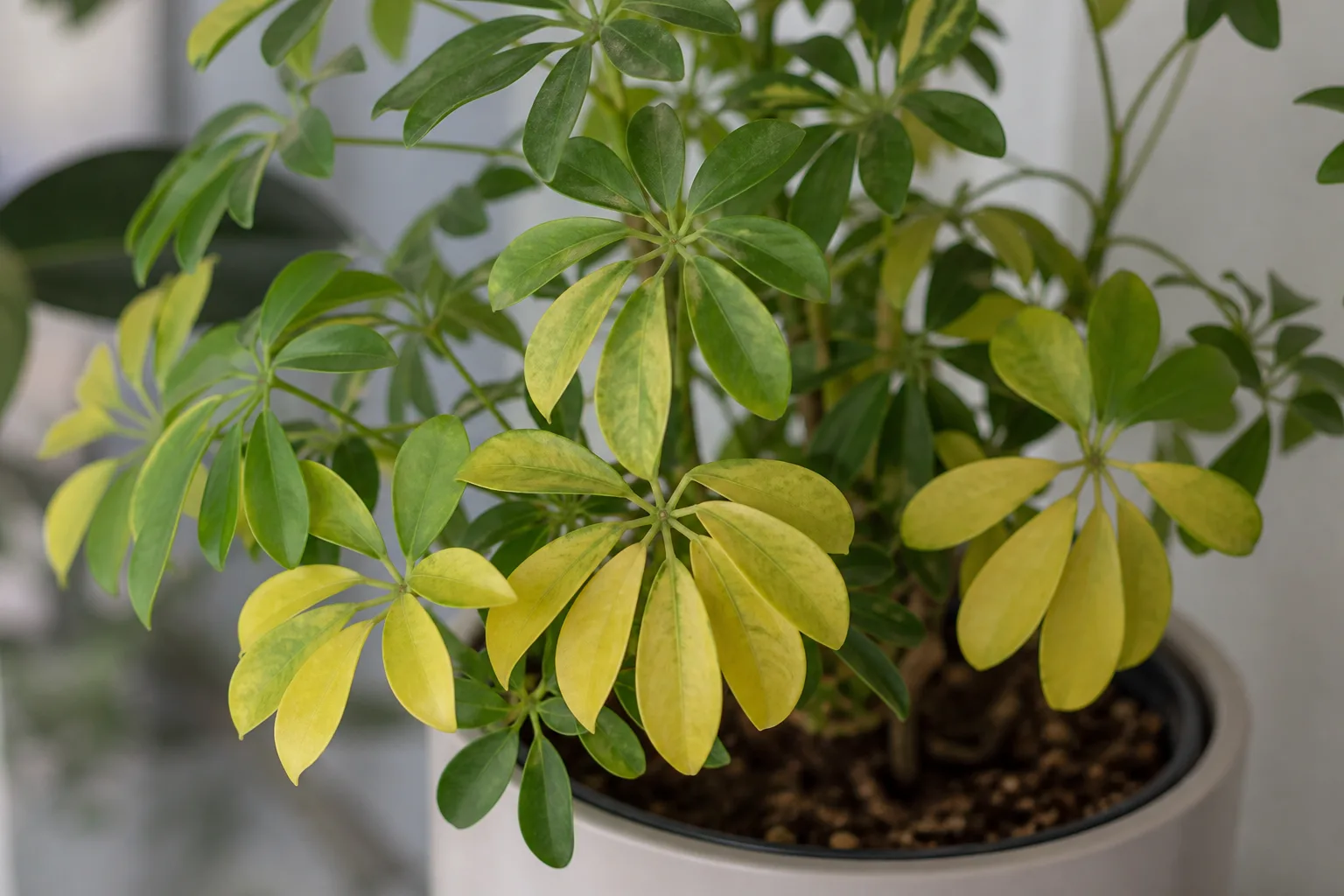
Yellow Leaves on Dwarf Umbrella Tree: Causes, Checks & Fixes
This guide covers yellow leaves on Dwarf Umbrella Tree. See also the general Yellow Leaves guide, watering, and light pages for this plant.
Yellow Leaves on Dwarf Umbrella Tree: Causes, Checks & Fixes
Quick answer
Yellow leaves on Dwarf Umbrella Tree (Schefflera arboricola, also sold as Heptapleurum arboricola) are a symptom, not a single diagnosis. This is a woody Araliaceae shrub with compound leaf clusters-seven to nine glossy leaflets radiating from a shared petiole on branching stems-not a rosette plant with basal crown leaves.
First step: check pot weight and moisture at the top 1–2 inches of mix before you change anything else. Push your finger or a wooden skewer into the soil near the pot edge, lift the pot to feel weight, and note whether cold air hits the plant at night. A heavy wet pot with soft limp yellow clusters often means overwatering or root stress. A light dry pot with bright yellow crisp leaflets often means underwatering. Multiple mid-canopy clusters yellowing together on wet soil strongly suggests overwatering. One or two lower clusters fading slowly while tip growth stays green often means normal aging.
Do not fertilize, repot, or move the plant into harsh sun on day one. Match the first fix to what you find. Full species context: Dwarf Umbrella Tree overview.
What yellow leaves look like on Dwarf Umbrella Tree
Yellowing on Schefflera arboricola follows patterns tied to its compound-leaf architecture. Entire umbrella-shaped clusters yellow and drop from lower stems during stress or aging-not individual basal rosette leaves.
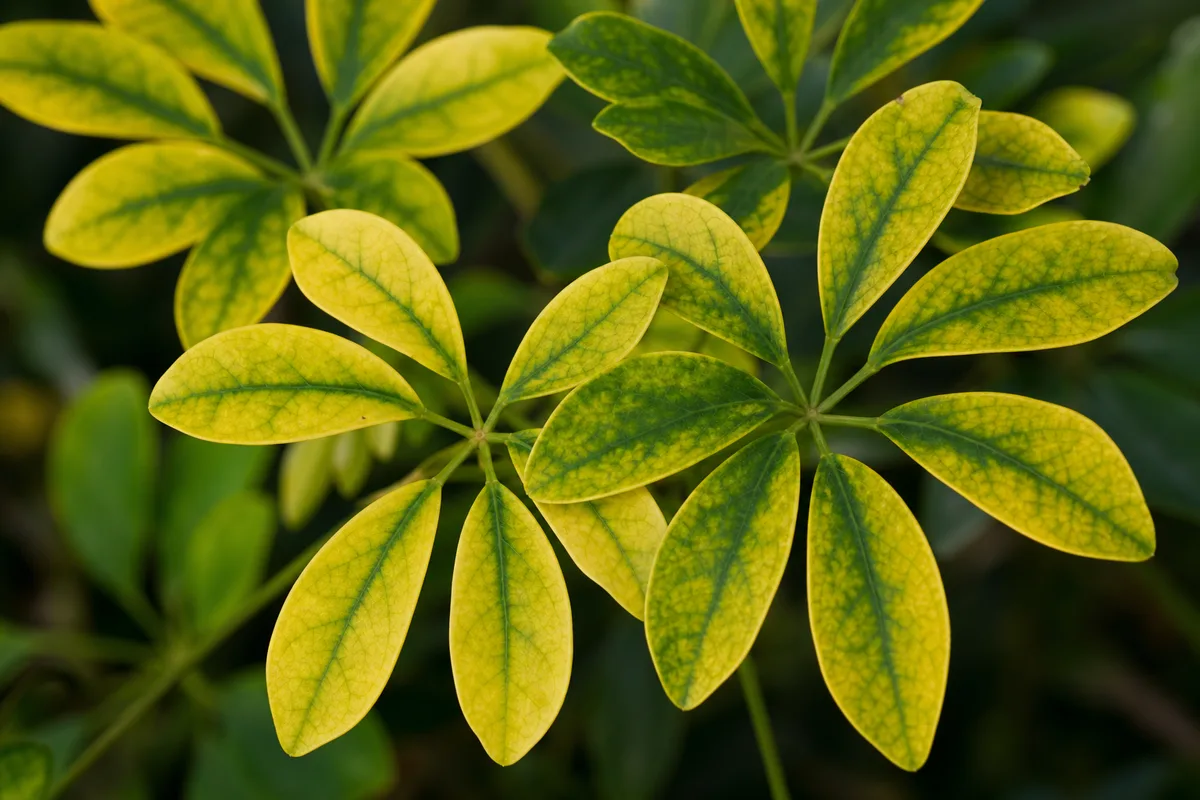
Yellow Leaves symptoms on Dwarf Umbrella Tree - compare with healthy tissue on the same plant.
Yellow lower compound clusters only (normal aging)
- One or two oldest clusters on the lowest stems fade from green to yellow over weeks to months
- New compound leaves at branch tips and nodes stay glossy green and firm
- Soil moisture looks normal; pot weight is neither persistently heavy nor bone-dry
- No sour smell, fungus gnats, or soft tissue at the crown
This pattern is common on mature upright stems. Schefflera drops entire leaf clusters from lower branches as it grows taller-a natural part of the plant’s upright habit.
Mid-canopy clusters yellowing together on wet soil (overwatering / root stress)
- Several compound clusters in the middle of the plant turn yellow within one to two weeks
- Leaves feel soft and limp while mix is wet or cool at depth
- Pot stays heavy for days; surface may stay dark long after watering
- Fungus gnats, sour smell, or black mushy roots on inspection point to advancing damage-see overwatering on Dwarf Umbrella Tree and root rot
Overwatering is among the most common causes of yellow foliage on indoor scheffleras, especially in cool dim rooms where the mix dries slowly.
Bright yellow leaflets on a light dry pot (underwatering)
- Leaflets turn bright yellow with crisp or curled edges
- Pot feels very light; top 2 inches of mix are dusty dry
- Stems may look slightly limp but leaf texture is dry, not mushy
- Yellowing often appears on outer clusters first because they are farthest from remaining moisture
Schefflera is somewhat drought-tolerant once established but prolonged dry spells still yellow foliage. See underwatering on Dwarf Umbrella Tree.
Rapid yellow-and-drop after cold draft or window chill
- Entire clusters yellow and drop within days after a cold night
- Plant sits on a winter window sill, under an AC vent, or near an frequently opened door
- Soil moisture may look fine-this is temperature injury, not thirst
- Clemson HGIC advises maintaining temperatures above 50°F for scheffleras; sustained exposure below about 55°F (13°C) triggers leaf drop on this Taiwan-native species
Pale stretched upper clusters in dim light (especially variegated cultivars)
- Upper stems stretch with widely spaced clusters; leaflets look pale yellow-green, not crisp
- Variegated forms such as Trinette and Gold Capella lose cream or gold margins first
- Soil may stay damp longer than expected because slow metabolism in low light mimics overwatering symptoms
- No mushy petioles or sour wet mix-light is the primary issue. See not enough light on Dwarf Umbrella Tree
Why Dwarf Umbrella Tree leaves turn yellow
Dwarf umbrella tree yellows when something disrupts its baseline rhythm: Dwarf Umbrella Tree light guide, dry-down watering, and stable warm temperatures. As an Araliaceae member native to Taiwan and Hainan, it tolerates average indoor humidity but punishes soggy roots, bone-dry root balls, cold drafts, and dim corners.
The five most common indoor causes:
- Overwatering - Calendar watering in winter, oversized pots, heavy peat mix, or cachepots holding runoff keep roots oxygen-starved. Damaged roots cannot move water or nutrients even when soil feels wet, so leaves yellow from the inside out.
- Underwatering - Small pots in hot bright windows or forgotten dry spells desiccate roots. Outer clusters yellow first; prolonged drought weakens the whole plant.
- Cold stress - Sudden drops below about 55°F accelerate ethylene production and cluster abscission. Winter window sills and AC blasts are the usual culprits.
- Low light - Dim rooms produce pale, stretched growth. Variegated cultivars need more brightness than solid-green plants because their colored tissue photosynthesizes less efficiently.
- Normal aging - Lower compound clusters on mature stems naturally senesce while tip growth continues. This is harmless when isolated to one or two old clusters over months.
Less common but worth ruling out: spider mites (fine stippling and webbing on leaflet undersides in dry air), nutrient deficiency (only after light and moisture are correct), and repot shock after a recent move.
Wet soil vs. dry soil: symptom matrix
Use this table before choosing a fix. Pot weight beats leaf color alone on schefflera.
| Signal | Wet soil / overwatering | Dry soil / underwatering |
|---|---|---|
| Pot weight | Heavy for many days | Very light |
| Top 1–2 inches | Cool, dark, damp | Dusty dry |
| Leaf texture | Soft, limp, sometimes edema | Crisp, curled edges |
| Yellow pattern | Multiple mid-canopy clusters at once | Outer clusters first; bright yellow |
| Crown / stem base | Firm early; soft if rot advances | Usually firm |
| Smell / pests | Sour mix; fungus gnats possible | None |
| New tip growth | Stalls or opens small and pale | Resumes after a thorough soak |
If mid-canopy yellowing pairs with wet heavy soil, treat as overwatering first-not drought.
Lookalike symptoms to rule out
Drooping without yellow - Wilting on wet soil still points to root damage; on dry soil it points to thirst. Yellow and droop together are common on schefflera under water stress either direction. See drooping leaves on Dwarf Umbrella Tree.
Spider mites - Yellow stippling and bronzing on leaflet undersides with fine webbing at petiole bases, not whole-cluster uniform yellow. Mites surge when humidity drops below 40% near heaters.
Brown tips only - Edge burn from salt buildup, low humidity, or fluoride differs from whole-leaf yellowing. See brown tips on Dwarf Umbrella Tree.
Leaf drop without prior yellow - Cold shock or sudden light change can drop green clusters. Note recent placement history.
How to confirm the cause
Work through this checklist in order:
- Pot weight - Lift the pot. Heavy and wet vs. light and dry narrows the two most common causes immediately.
- Top-inch moisture - Push a finger or skewer 1–2 inches deep near the edge. Water when this zone dries in small and medium pots-not on a fixed calendar.
- Which clusters yellow - Lower only, slowly = aging. Mid-canopy many at once on wet soil = overwatering. Outer on dry soil = underwatering. All over after cold night = draft.
- Light at the plant - Long sparse stems and pale upper clusters mean more brightness needed, especially on variegated forms.
- Temperature history - Was the plant on a cold sill, near AC, or moved from a warm porch in the last week?
- Crown firmness - Press the base of main stems gently. Soft mushy tissue with wet soil means advancing rot-not a watering tweak alone.
- Root spot-check - If wet soil pairs with widespread yellowing, slide the plant partly out of the pot. Healthy schefflera roots are firm and pale; black mushy roots confirm root decline.
Write down your findings before changing care. One variable at a time prevents turning a simple watering mistake into repot shock plus fertilizer burn.
First fix for Dwarf Umbrella Tree
Match your first action to the confirmed cause-not a bundle of treatments at once.
If soil is wet and crown is still firm
Stop watering until the top 1–2 inches of mix dry completely. Move the pot to brighter indirect light if it sits in a dim corner-evaporation slows in shade and keeps mix waterlogged longer. Empty any saucer or cachepot water. Do not fertilize. Re-check moisture in three to five days before the next drink.
If soil is dry and pot is light
Water thoroughly until a little runs from the drainage hole, then empty the saucer within 30 minutes. One full soak beats repeated tiny sips that wet only the surface. Wait one week, then resume checking the top 1–2 inches before the next watering.
If crown is soft or mix smells sour
Do not water. Treat as urgent root decline-see root rot on Dwarf Umbrella Tree. Trim black mushy roots, repot into fresh well-draining mix only after removing rot, and reduce watering going forward.
If plant sits in a cold draft
Move it away from the window, vent, or door to stable room temperatures between 60 and 80°F (16–27°C). Hold watering changes until you see whether clusters stop dropping. Do not prune heavily while the plant is cold-stressed.
If only lower clusters fade slowly over months
No emergency fix needed. Snip off fully yellow clusters at the petiole base if they look unsightly. Keep your normal dry-down Dwarf Umbrella Tree watering guide and bright indirect light.
Step-by-step recovery by cause
After the first fix, escalate only as needed:
Overwatering recovery
- Let mix dry to the correct depth before every future watering.
- Confirm drainage holes are open; drill or repot if water pools.
- If yellowing continues two weeks after soil dries, inspect roots and trim any black sections.
- Resume watering only when the top 1–2 inches are dry-not on the old calendar schedule.
Underwatering recovery
- Soak thoroughly once, then establish a check-before-you-water habit.
- If the plant is root-bound in a tiny pot, step up one pot size in spring with fresh airy mix-not mid-crisis in winter unless roots are circling badly.
- Mist or humidify if edges crisp in dry heated air, but fix watering first.
Low-light recovery
- Move gradually to brighter indirect light over one to two weeks.
- Rotate the pot every two to three weeks for even growth.
- Variegated plants may need a spot closer to the window or a supplemental grow light.
Cold-stress recovery
- Stabilize temperature above 60°F (15°C).
- Reduce watering slightly until new buds appear-cold-stressed roots absorb less.
- Wait for new compound clusters at stem tips before judging success.
Recovery timeline
Fully yellow compound clusters will not turn green again-they drop or can be trimmed once mostly yellow. Judge recovery by new glossy clusters at branch tips, not old leaf color.
| Cause | Typical first sign of improvement | Full visible recovery |
|---|---|---|
| Overwatering (early) | Soil dries evenly; no new yellow clusters | 2–4 weeks for new tip growth in warm bright conditions |
| Underwatering | Leaflets re-firm within days of a good soak | 1–3 weeks for new clusters |
| Cold draft | Leaf drop stops within days of warm placement | 2–6 weeks for new flush |
| Low light | New clusters open closer together and greener | 4–8 weeks; variegation returns slowly |
| Normal aging | N/A-ongoing lower-cluster turnover | Continuous on mature stems |
Winter recovery in cool dim rooms takes longer than summer recovery near a bright window. Judge success by stable new growth, not by old yellow tissue.
Mistakes to avoid
- Fertilizing yellow leaves on wet soil - Salt buildup and stressed roots yellow foliage further. Fix moisture and light first.
- Increasing watering when soil is already wet - The most common escalation error after misreading limp leaves as thirst.
- Dwarf Umbrella Tree repotting guide into a larger pot to “help drying” - Extra soil volume holds moisture longer and worsens overwatering.
- Assuming all yellow lower clusters are aging - Check pot weight. Multiple clusters yellowing fast on wet soil is stress, not senescence.
- Moving straight into harsh south sun - Leaflets scorch easily. Brighten gradually over one to two weeks.
- Pruning the whole canopy - Schefflera needs photosynthesizing leaves to recover. Remove only fully yellow clusters.
- Ignoring cold placement - Watering adjustments will not fix draft-induced yellow-and-drop.
How to prevent yellow leaves on Dwarf Umbrella Tree
- Check moisture, don’t calendar-water - Allow the top 1–2 inches to dry in small and medium pots before soaking again. Stretch intervals in winter when growth slows.
- Use well-draining mix and drainage holes - Never leave the pot sitting in a full saucer.
- Provide bright indirect light - Four or more hours of strong ambient daylight; brighter for variegated cultivars.
- Avoid cold sills and AC blasts - Keep temperatures above about 55°F (13°C); 60–80°F is the active-growth comfort zone.
- Remove spent lower clusters promptly - Reduces pest hiding spots and keeps the plant looking tidy.
- Reduce watering after seasonal moves - Plants brought indoors from a porch or moved to a dimmer winter window need fewer drinks even if your calendar says otherwise.
When to worry
Most dwarf umbrella trees recover from yellow leaves when the underlying cause is corrected early. Escalate promptly if:
- Crown tissue feels soft or mushy with wet soil-advancing root rot, not a simple dry-down fix
- Half or more of the canopy yellows within two weeks despite corrected watering
- Black mushy roots fill more than a third of the root ball on inspection
- No new tip growth appears six to eight weeks after fixing light, water, and temperature
- Yellowing spreads upward while soil stays wet and heavy-overlap with root rot is likely
Replacing a severely rotted specimen is sometimes safer than risking fungal spread to neighboring pots on the same shelf.
Dwarf Umbrella Tree care cross-check
Yellow leaves often expose a baseline care mismatch:
- Light - Bright indirect exposure supports compact glossy clusters. Leggy pale stems mean increase brightness before fertilizer.
- Watering - Dry-down rhythm is the core skill. Schefflera tolerates brief dry spells better than chronic soggy soil.
- Temperature - Stable warmth matters as much as water. Draft protection prevents rapid cluster drop.
- Pot and mix - Oversized nursery pots in heavy peat are a common hidden cause of mid-canopy yellowing in dim offices.
- Humidity - Average indoor 40–50% is acceptable; very dry air invites spider mites that yellow leaflets differently.
If several problems overlap-winter calendar watering in a cool dim room with a heavy peat mix-fix light and watering together, not one at a time across months.
Related Dwarf Umbrella Tree problems
- Overwatering - Primary overlap when wet soil pairs with limp yellow clusters
- Underwatering - Bright yellow crisp leaflets on a light pot
- Root rot - Soft crown, sour smell, black roots
- Drooping leaves - Wilting with or without yellow
- Not enough light - Pale stretched growth and variegation loss
- Dwarf Umbrella Tree overview - Full care hub
When to use this page vs other Dwarf Umbrella Tree guides
- Dwarf Umbrella Tree watering guide - Use for routine moisture checks before assuming yellow leaves is the main issue.
- Dwarf Umbrella Tree problems hub - Browse all 17 common issues on this species.
- Overwatering on Dwarf Umbrella Tree - Different entry point when symptoms overlap with yellow leaves.
- Underwatering on Dwarf Umbrella Tree - Different entry point when symptoms overlap with yellow leaves.
- Not Enough Light on Dwarf Umbrella Tree - Different entry point when symptoms overlap with yellow leaves.