Mold on Soil on Dwarf Umbrella Tree: Causes, Checks & Fixes
Quick answer
Surface mold on dwarf umbrella tree soil is a warning that the top layer stays damp-risky for Schefflera arboricola, which needs the top 2 inches to dry between drinks. First step: pause watering, let that layer dry, and scrape off the fuzzy surface.
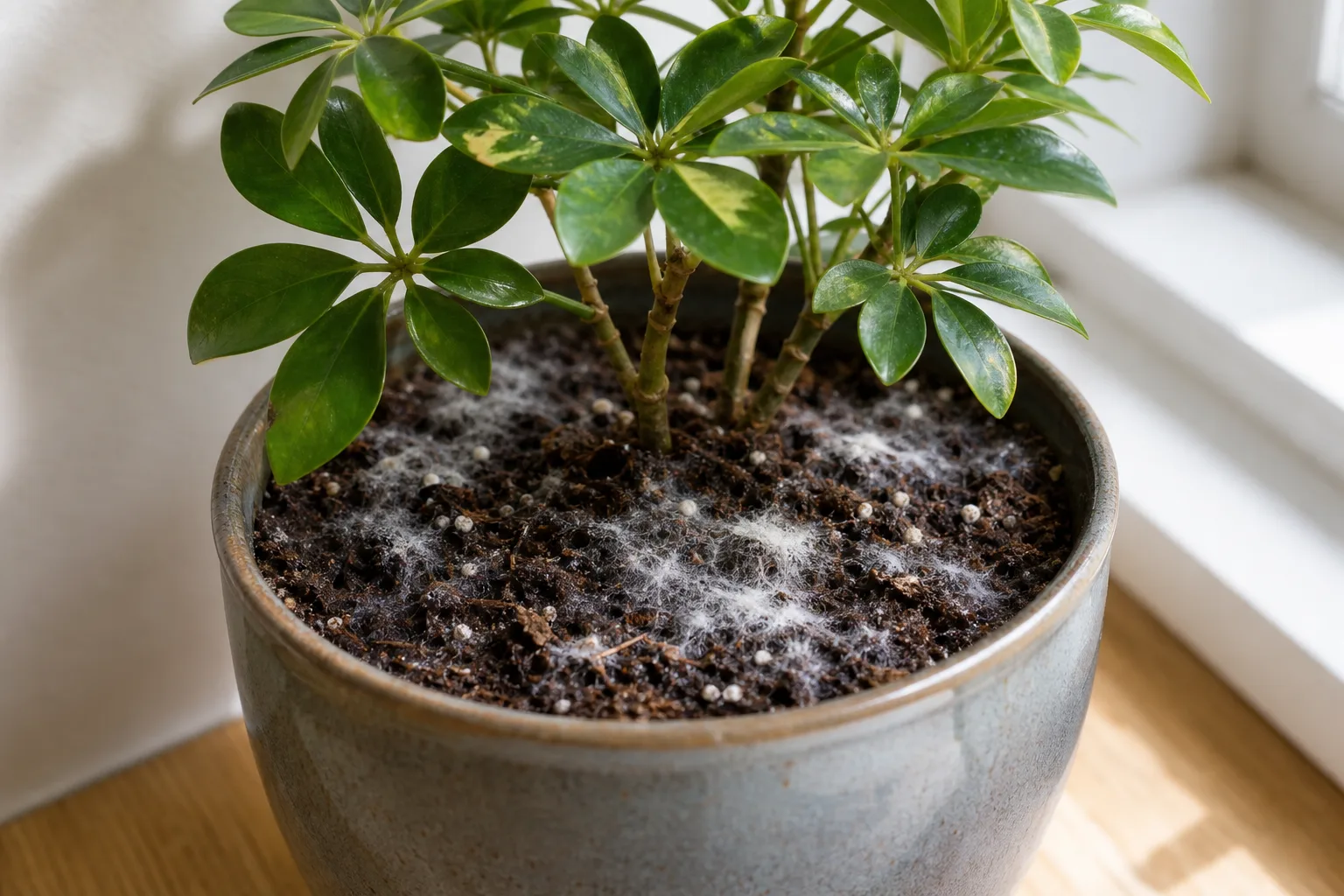
Mold on Soil on Dwarf Umbrella Tree: Causes, Checks & Fixes
This guide covers mold on soil on Dwarf Umbrella Tree. See also the general Mold on Soil guide, watering, and light pages for this plant.
Mold on Soil on Dwarf Umbrella Tree: Causes, Checks & Fixes
Scope: This page covers white or gray fuzz on potting mix in potted dwarf umbrella tree (Schefflera arboricola). The same species is also published under the botanical slug mold on soil on Schefflera-use whichever URL matches how you searched. For chronic wet-soil stress before surface fungus appears, see overwatering on dwarf umbrella tree. For mushy roots or soft stems at the soil line, open root rot on dwarf umbrella tree instead.
Quick answer
White or gray fuzz on the soil surface of your dwarf umbrella tree (Schefflera arboricola) almost always means the top layer has stayed damp too long. This tropical woody shrub wants a peaty well-drained mix and a rhythm where you deeply water and then allow soils to nearly dry before the next drink-not a fixed calendar schedule.
The mold itself is usually harmless saprophytic fungus breaking down organic particles in the mix, but it is an early flag that you are keeping the surface wetter than this plant can tolerate without root stress. Leaves will drop if soils become too moist or too dry; surface mold often appears just before that wet-soil pattern shows in the foliage.
First fix: stop watering until the top 2 inches of mix feel dry to the touch, then scrape off the fuzzy top centimeter with a spoon and discard it. Do not repot, spray fungicide, or drench with cinnamon on day one.
Retail name note: dwarf umbrella tree = Schefflera arboricola
Nursery tags use several names for the same plant: dwarf umbrella tree, dwarf schefflera, umbrella plant, and ivy tree. Botanically it is Schefflera arboricola-a compact woody shrub with whorled compound leaves, distinct from the larger Schefflera actinophylla umbrella tree with fewer, much longer leaflets.
If you own a tall floor specimen labeled only “umbrella tree,” confirm the species before copying watering advice. S. arboricola is pickier about wet mix at the surface; S. actinophylla tolerates drier conditions between drinks but still molds when overwatered. This guide targets S. arboricola under its most common retail name. The parallel Schefflera mold page covers the same species from the botanical slug.
What mold on soil looks like on Dwarf Umbrella Tree
On dwarf umbrella tree pots, mold most often appears as a thin white, gray, or occasionally yellowish fuzzy film across the top of the mix. It may show up in patches near the base of woody stems or cover the entire surface. Sometimes you notice it alongside a musty smell, dark wet-looking soil, or small flies hovering when you water.
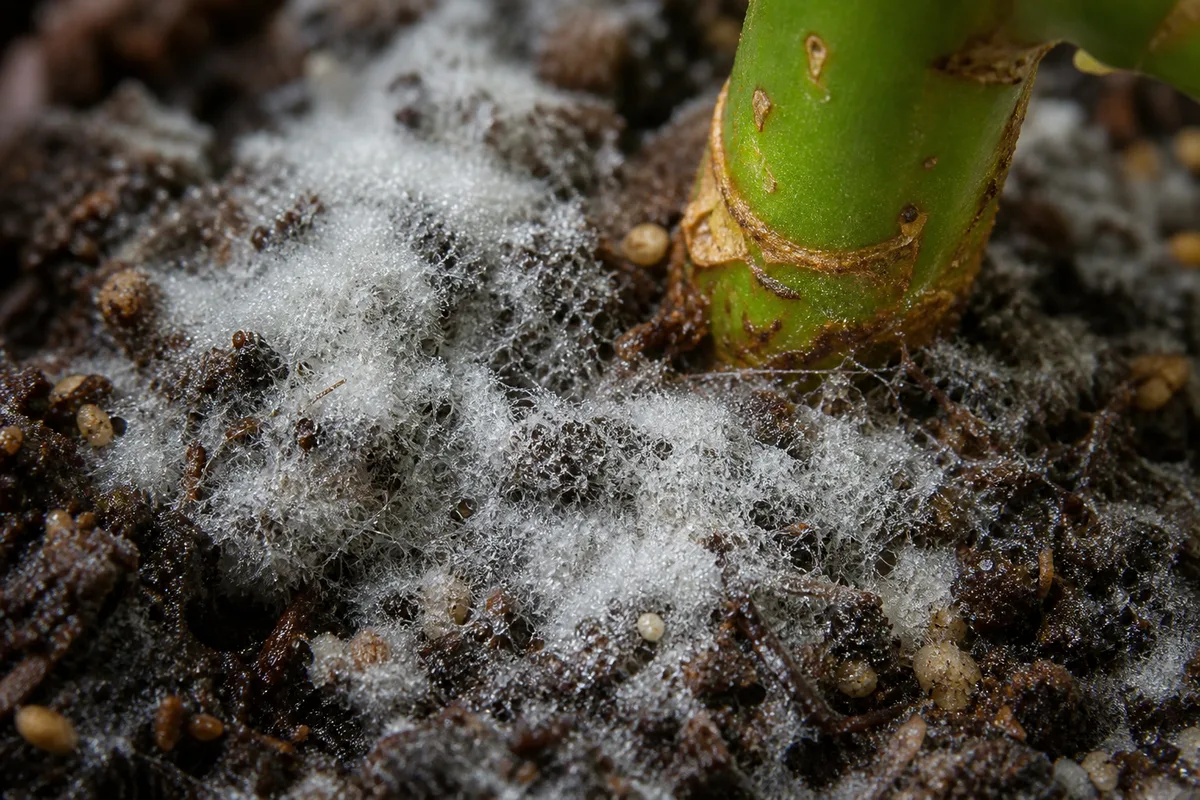
Mold on Soil symptoms on Dwarf Umbrella Tree - compare with healthy tissue on the same plant.
Healthy Schefflera arboricola in active growth should have a soil surface that dries within a few days of watering. If the top stays cool, dark, and soft to the touch for a week or more-especially in a dim corner-the fuzzy layer is a predictable follow-up. The glossy palmate whorls may still look fine at this stage, which is why surface mold catches growers off guard. The risk is not the fuzz itself but the wet conditions feeding it.
Dense whorled compound leaves shade the pot rim, creating a microclimate where surface moisture evaporates more slowly than on an upright plant with sparse foliage. That self-shading effect is especially noticeable on tabletop specimens where the leaf canopy hangs directly over a small pot.
Photo check (what to compare at home): Surface mold = fluffy white-gray sheet across damp mix with firm woody stems at the soil line. Green algae = slick green sheen, not cottony fuzz. Mineral crust = hard gritty white on the pot edge, not soft fuzz. Mealybugs = cottony clumps on stems or leaf axils, not a uniform soil film.
Why Dwarf Umbrella Tree gets mold on soil
Dwarf umbrella tree is grown indoors in warm, humidified areas in a peaty well-drained soil mix. Spores of saprophytic fungi are everywhere; they germinate when the surface stays moist and organic matter-peat fines, bark, fallen leaflets from whorled compound leaves-is available to break down. The plant does not “catch” mold from bad luck. The combination of how Schefflera arboricola is usually potted, watered, and placed creates ideal surface conditions when any step slips.
Several care patterns trigger mold on dwarf umbrella trees more predictably than on drought-tolerant succulents:
Watering before the top 2 inches dry. Dwarf umbrella tree tolerates some drought but dislikes sitting in wet mix. Many owners water on a calendar instead of checking soil depth-the same mistake that drives overwatering on dwarf umbrella tree. Each extra drink keeps the surface moist long enough for fungal colonies to establish.
Peaty, organic potting mix that holds surface moisture. Schefflera arboricola grows well in peaty well-drained media, but peat-rich blends stay damp at the top even when lower layers have dried somewhat. That upper moisture is exactly where surface mold and fungus gnat larvae that prefer damp potting soil with a high percentage of peat live-see fungus gnats on dwarf umbrella tree when small flies appear.
Low light slows drying. Dwarf umbrella tree accepts medium indirect light but dries much faster in bright light at east, west or southern windows in curtain filtered sun. A large plant in a dim corner may take a week or more to lose surface moisture-long enough for mold to spread across the pot. Pair light checks with the not enough light guide when lower whorls stretch or pale.
Fall and winter overwatering. Water use drops when days shorten and indoor temperatures cool. Growth slows, yet many owners keep the same summer watering frequency, leaving the top layer chronically damp through heating season.
Oversized pots and full saucers. A pot much larger than the root ball holds excess wet mix around the edges. Water pooling in a saucer re-wets the bottom and keeps humidity high at the surface-Clemson HGIC notes to never let a plant sit with water in its saucer.
Debris on the soil surface. Fallen leaflets from the dwarf umbrella tree’s whorled compound leaves add organic food for fungi when they sit on damp mix instead of being cleared promptly.
Tabletop vs. floor specimens: dry-down timing
Pot volume and canopy size change how fast the top 2 inches dry-not the rule itself.
| Specimen type | Typical pot | Top 2 inches dry after thorough watering | Mold risk factor |
|---|---|---|---|
| Tabletop dwarf (8–14 in. tall) | 4–6 in. plastic or ceramic | 4–7 days in bright filtered light; 10–14 days in dim winter corner | Dense whorls shade a small rim; surface stays damp longer than owners expect |
| Mid-size bush (2–4 ft.) | 8–10 in. | 5–10 days in active growth | Larger root mass uses water faster, but canopy still shades rim |
| Floor specimen (4–6 ft.) | 12–14 in. or larger | Top may dry in 7–10 days while lower half of pot stays wet | Heavy pot + deep mix = surface can mold while roots sit in chronically damp lower zone |
Always check moisture at your finger depth rather than assuming a calendar interval. A tabletop plant in a 4-inch pot under whorled leaves often needs a longer dry-down than a floor plant in a bright atrium-but an oversized floor pot can mold at the surface while the root ball drowns below.
How to confirm the cause
Work through these checks before Dwarf Umbrella Tree repotting guide or reaching for fungicide:
- Stem firmness at soil line. Pinch the lowest woody stems. Firm and upright is reassuring. Soft, limp, or collapsing tissue suggests rot-not just surface mold.
- Top 2 inches moisture. Push your finger to the second knuckle. If it comes away cool and clinging days after watering, overwatering is confirmed. Dwarf umbrella tree should be watered when this layer dries, not while it is still damp-the watering guide uses the same depth check.
- Pot weight. Lift the container. A pot that feels heavy days after a drink is holding too much moisture. Confirm drainage holes are open and the saucer is empty.
- Leaf pattern. Yellowing lower whorls while the mix is still wet points to overwatering and root stress, not a separate leaf disease-see yellow leaves on dwarf umbrella tree. Mass leaf drop after a cold draft or watering binge also ties back to moisture and placement stress on this plant.
- Companion signs. Fungus gnats flying when you water, green algae on the pot rim, or springtails on the surface all share the same wet-soil habitat.
- Season context. Mold appearing in November through February while you still water weekly often means the plant is not using water at summer rates-adjust before assuming the mix is fine.
Firm-stem vs. soft-stem decision table
| What you find | Urgency | First action | Escalate if |
|---|---|---|---|
| Surface fuzz only; firm woody stems; neutral smell; glossy whorls | Low | Scrape top layer; dry top 2 inches; resume watering only when dry | Mold returns within 7 days despite dry surface |
| Surface fuzz + fungus gnats; firm stems; mix damp at top only | Low–medium | Scrape; dry-down; yellow sticky traps; see fungus gnat guide | Gnats persist 3+ weeks after dry surface culture |
| Fuzz + yellow lower whorls on wet mix; stems still firm | Medium | Stop watering; full dry cycle; review overwatering | Yellowing spreads up stem or new whorls stall |
| Soft stems at soil line; sour smell; wet mix throughout | High - same day | Stop watering; inspect roots if repot already necessary; see root rot | Stems collapse or mass leaf drop within 48 hours |
| Fuzz returns within days after scraping; pot heavy for weeks | Medium–high | Second full dry cycle; bottom-water once (steps below); consider repot with fresh mix | Sour smell or soft stems appear during second cycle |
If stems are firm, new whorled growth looks normal, and only the top centimeter is fuzzy after one overwatering episode, you likely caught it early. Soft stems plus sour-smelling mix mean escalate toward root-rot checks, not just scraping.
First fix for Dwarf Umbrella Tree
Let the top 2 inches of potting mix dry completely, then scrape off the moldy surface layer.
Do not repot on day one. Pausing surface moisture gives you a clear read on whether the problem was a single overwatering event. In warm active growth with decent light, the top 2 inches often dry within five to ten days depending on pot size, mix, and season-resist watering “just a little” mid-cycle.
Once that layer is dry:
- Scrape off the top 1–2 cm of fuzzy soil with a spoon and discard it in the trash-not an indoor compost bin where spores can spread.
- Move the pot to brighter filtered light if it has been sitting in deep shade, which speeds drying without shocking the plant.
- Resume watering only when the top 2 inches are dry again-then water thoroughly until it runs from drainage holes, and empty the saucer within an hour.
That single correction resolves most first-time mold cases on dwarf umbrella tree. Wear gloves when handling moldy soil if sap irritates your skin, and keep the pot out of reach of pets while you work-dwarf umbrella tree is toxic to cats and dogs if chewed.
Step-by-step recovery
After the first dry-down and scrape, continue based on severity:
Mild case (surface fuzz, firm plant)
- Maintain the top-2-inch dry-down rule at every watering
- Remove fallen leaflets from the soil surface promptly-whorled umbrella plants shed compound leaflets that decay quickly on damp mix
- Expect the fuzzy layer not to return once the surface dries between drinks
Mold returns within a week
When scraping alone does not hold, roots may still need moisture while the surface must stay dry. Bottom-watering breaks that cycle:
- Let the top 2 inches dry completely after scraping-do not skip this step.
- Place the pot in a basin or sink with 1–2 inches of room-temperature water.
- Sit the pot in the water for 15–20 minutes so mix wicks moisture from below.
- Lift the pot, let excess drain fully, and empty the saucer-never leave standing water.
- Confirm the top inch stays dry to the touch while lower mix is moist; that is the goal.
- Repeat bottom-watering only when the top 2 inches are dry again-not on a calendar.
- Top-dress with a thin layer of dry airy mix (perlite-heavy blend) if scraping removed a lot of material.
Add yellow sticky traps at soil level if small flies appear-mold and fungus gnats share the same wet habitat.
Chronic case (repeated fuzz, sour smell, yellow lower leaves)
- Confirm no pot in the same room is still overwatered-spores travel, but moisture keeps them alive
- Repot only if mix is degraded, compacted, or smells sour; use fresh well-draining mix with added perlite and a pot only slightly larger than the root ball-see the soil guide
- Trim clearly rotted roots if inspection during necessary repotting reveals mushy tissue
- Hold fertilizer until new whorled growth looks stable for two weeks
Avoid spraying leaves with fungicide for soil mold-the issue is in the mix, not the glossy foliage.
Editorial recovery example
January 2026 - Tabletop Schefflera arboricola ‘Gold Capella’ in a 5-inch ceramic pot under dense whorled leaves. White fuzz covered the surface five days after a winter watering while the plant sat in a north-facing corner. Stems at the soil line remained firm; no yellow whorls. Grower scraped the top centimeter, moved the pot to a bright east window, and withheld water for eleven days until the top 2 inches felt dry. Resumed bottom-watering for two cycles. Surface fuzz did not return within three weeks; a new leaflet whorl opened at the tip in week four.
Recovery timeline and warning signs
Surface mold should not return once the top 2 inches dry between drinks on a healthy dwarf umbrella tree. Improvement usually shows within one dry-down cycle-roughly one to two weeks depending on pot size, light, and season.
Signs the fix is working:
- Firm woody stems at the base
- Top 2 inches dry before each watering
- No new fuzz on the surface
- Fresh whorled leaf sets opening at stem tips
Signs the problem is worsening:
- Stem softening near the base
- Repeated yellow lower whorls with wet mix
- Mass leaf drop after continued heavy watering-see leaf drop on dwarf umbrella tree
- Sour smell from drainage holes
- Mold returning within days of scraping
Damaged old leaflets on dwarf umbrella tree do not re-green; judge success by stable stems, dry surface cycles, and new growth-not by older leaves recovering.
Lookalike symptoms
| What you see | Likely cause | How to tell apart |
|---|---|---|
| White fuzzy film on wet soil surface | Saprophytic mold on organic mix | Confined to soil; scrape away; stems stay firm if caught early |
| Green algae on soil and pot rim | Constant surface moisture and low light | Slimy green film, not cottony white fuzz |
| Small flies from soil when watering | Fungus gnats | Flies emerge from pot, not from leaf undersides |
| White powder on leaf surfaces | Powdery mildew or pest residue | On foliage, not soil; check leaf undersides |
| Hard white crust on soil | Mineral or salt buildup | Gritty, not fuzzy; flush and adjust water source |
Mistakes to avoid
Do not drench with fungicide, vinegar, or cinnamon as a substitute for drying the soil-dwarf umbrella tree roots need oxygen, not another wet treatment layered on top.
Do not increase watering because leaves droop while the mix is still damp. Wilting with wet soil means root stress, not thirst on this plant-see wilting on dwarf umbrella tree when turgor collapses on soggy mix.
Do not keep the same summer watering frequency through a dim winter without checking the top 2 inches first.
Do not assume mold is harmless and ignore softening stems at the base. Surface saprophytes and root rot share the same cause: too much moisture for too long in a mix that does not dry at the surface.
Do not mist the soil surface to raise humidity-that adds moisture exactly where mold thrives. Humidity for dwarf umbrella tree comes from room air or a pebble tray beneath the pot, not wet topsoil.
Do not repot immediately on finding mold unless the mix clearly smells sour or stays wet for more than ten days after corrected watering-unnecessary repotting can trigger the dramatic leaf drop Schefflera arboricola is known for.
Do not leave fallen leaflets from whorled umbrella plants piled on damp soil-they are not rosette crowns, but shed compound leaflets that decay quickly and feed surface fungi.
How to prevent mold next time
Prevention is mostly habitat management:
- Check soil depth before every watering-never assume the same interval works year-round
- Match pot size to the root ball; oversized containers stay wet at the edges
- Improve light before increasing water in winter
- Empty saucers after every watering
- Keep the soil surface free of dead leaves and flowers; remove dropped dwarf umbrella tree leaflets promptly
- Leave space between grouped plants so the pot rim can dry
- Quarantine new plants for two to three weeks before placing them near dwarf umbrella tree-spores can arrive in nursery media
A dwarf umbrella tree in bright filtered light, an appropriately sized pot, and a strict top-2-inch dry-down routine rarely supports lasting surface mold.
When to worry
A patch of white fuzz on an otherwise healthy dwarf umbrella tree with firm stems is a moisture warning-not a death sentence. Act more aggressively when:
- Mold returns weekly despite dry surface cycles
- Soil smells sour or stems soften near the base
- Mass leaf drop follows a period of heavy watering
- Lower whorls yellow and drop while the mix stays wet
- Fungus gnat swarms increase alongside recurring mold
When soft stems appear, inspect roots within twenty-four hours before another dry cycle alone-dwarf umbrella tree forgives dry topsoil more willingly than chronic saturation at the root zone.
In severe cases, inspect roots when repotting is already necessary, trim clearly rotted tissue, and repot into fresh fast-draining mix. Mature dwarf umbrella trees with solid root systems recover slowly but reliably once wet conditions end-new whorled growth at the tips is the signal that you turned the corner.
Related dwarf umbrella tree problems
- Dwarf umbrella tree care overview - species hub and culture basics
- Mold on soil on Schefflera - same S. arboricola species, botanical slug
- Overwatering on dwarf umbrella tree - wet-soil habit before or without surface fuzz
- Root rot on dwarf umbrella tree - mushy roots and soft stems
- Fungus gnats on dwarf umbrella tree - wet media companion pest
- Yellow leaves on dwarf umbrella tree - lower whorl yellowing on damp mix
- Leaf drop on dwarf umbrella tree - mass drop after moisture stress
- Wilting on dwarf umbrella tree - droop on soggy mix, not thirst
- Not enough light on dwarf umbrella tree - slow dry-down in dim corners
- Watering dwarf umbrella tree - top-2-inch dry-down prevention
- Dwarf umbrella tree soil - peaty well-drained mix and repot timing
When to use this page vs other Dwarf Umbrella Tree guides
- Dwarf Umbrella Tree watering guide - Use for routine moisture checks before assuming mold on soil is the main issue.
- Dwarf Umbrella Tree problems hub - Browse all 17 common issues on this species.
- Fungus Gnats on Dwarf Umbrella Tree - Different entry point when symptoms overlap with mold on soil.
- Overwatering on Dwarf Umbrella Tree - Different entry point when symptoms overlap with mold on soil.
- Root Rot on Dwarf Umbrella Tree - Different entry point when symptoms overlap with mold on soil.