Mealybugs on Dieffenbachia Camille: Causes, Checks & Fixes
Quick answer
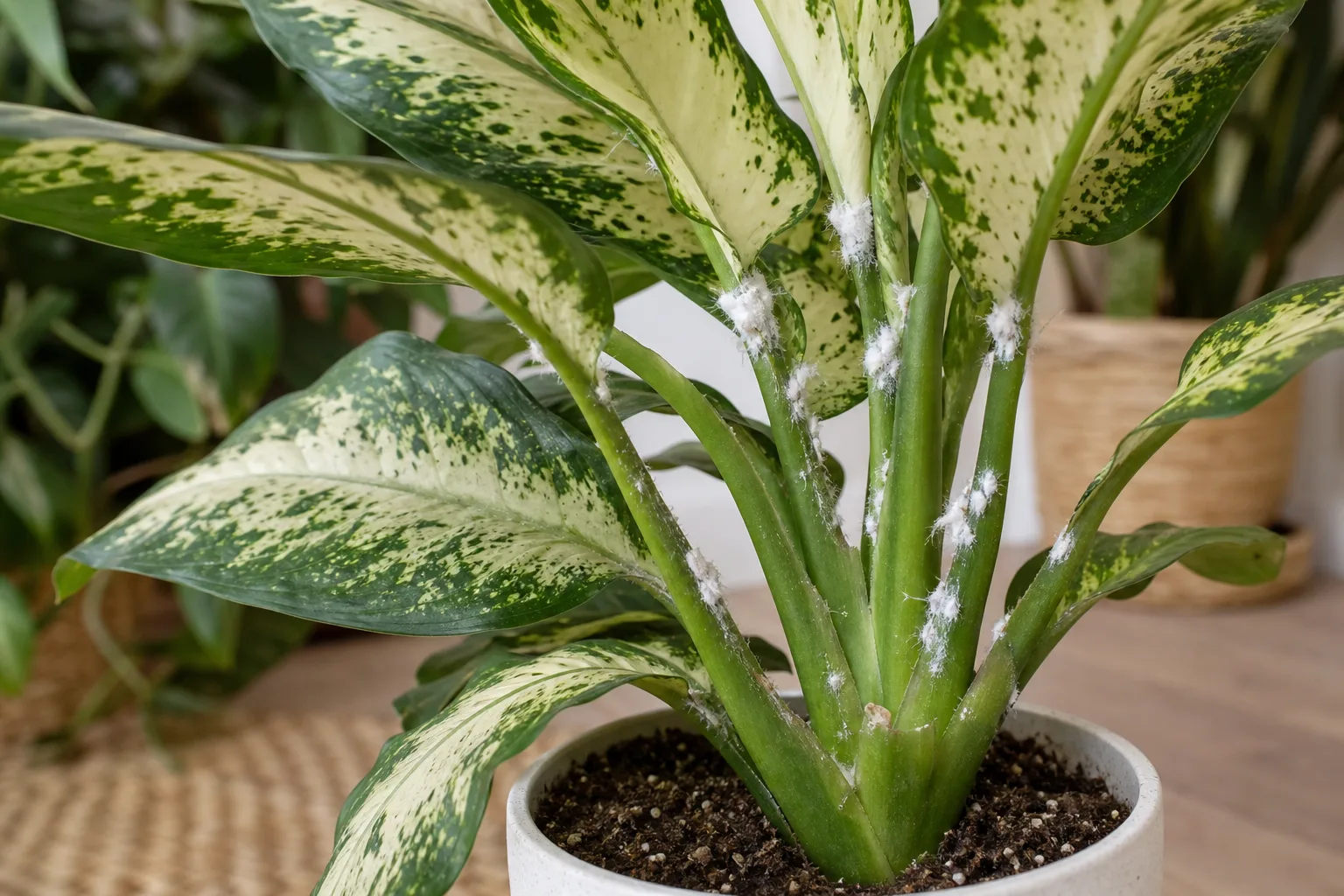
Mealybugs on Dieffenbachia Camille hide in the crown where new leaves unfurl and along upright cane joints. First step: isolate the plant, wear gloves, and dab visible cottony clusters with 70% alcohol on a cotton swab after a spot-test on one cream-centered leaf.
Mealybugs on Dieffenbachia Camille: Causes, Checks & Fixes
This guide covers mealybugs on Dieffenbachia Camille. See also the general Mealybugs guide, watering, and light pages for this plant.
Mealybugs on Dieffenbachia Camille: Causes, Checks & Fixes
Quick answer
Mealybugs on Dieffenbachia Camille (Dieffenbachia seguine ‘Camille’) are sap-sucking insects that cluster in protected crevices on houseplants, especially where broad leaves meet upright canes and inside the central crown. On Camille, pale cream variegation makes sticky honeydew obvious before cottony wax stands out against the green margins.
First step: isolate the plant, put on gloves, and dab every visible cottony cluster with 70% isopropyl alcohol on a cotton swab - but only after a spot-test on one hidden cream-centered leaf waits 24–48 hours with no burn. Camille’s large variegated blades and tight crown give mealybugs shelter that a single spray misses; direct contact kills adults while you plan weekly repeats for newly hatched crawlers.
What mealybugs look like on Dieffenbachia Camille
On Camille, mealybugs rarely announce themselves on old lower leaves first. They concentrate where the plant architecture creates hidden feeding sites:
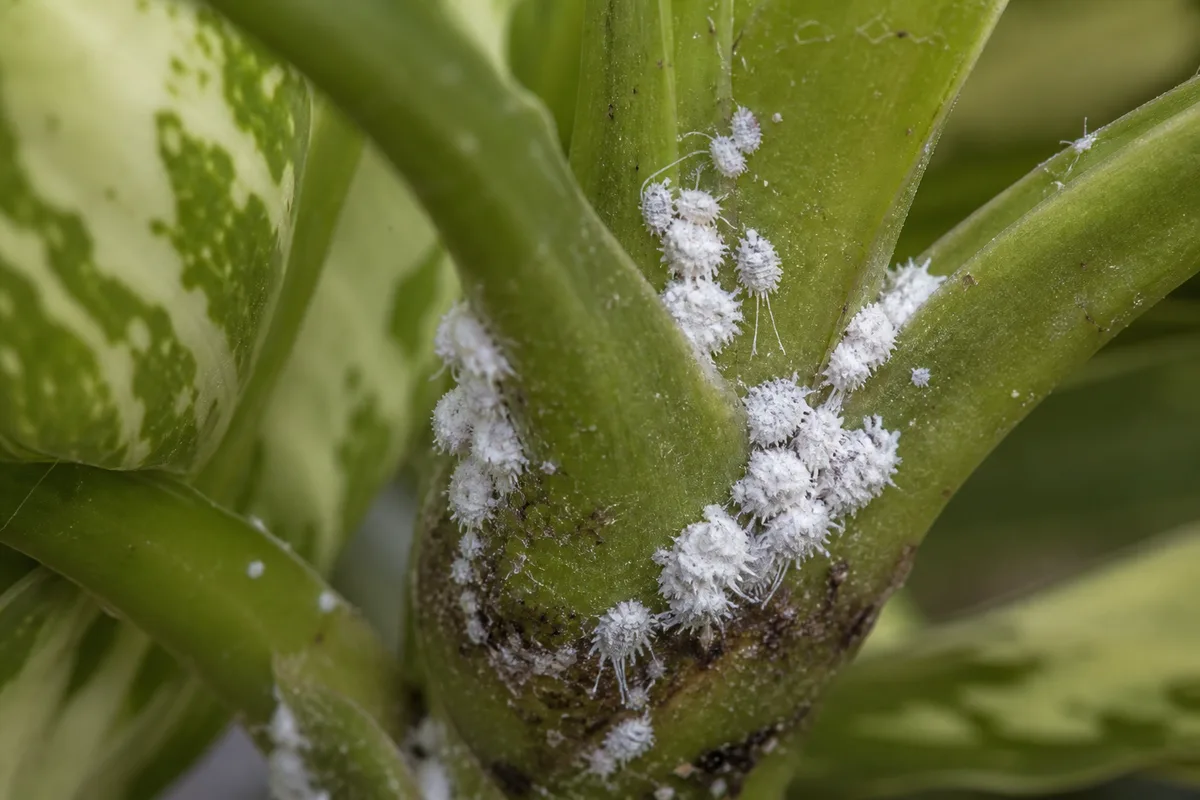
Mealybugs symptoms on Dieffenbachia Camille - compare with healthy tissue on the same plant.
- The central crown where new cream-and-green leaves unfurl
- Cane joints where each petiole meets the upright stem
- Leaf axils and the underside midrib on younger blades
- Pot rims and drainage holes when colonies have been present for weeks
You will see white, cottony or powdery wax masses clumped along stems - not a uniform leaf pattern like variegation. Mealybugs excrete sticky honeydew that shines on Camille’s pale cream centers before sooty mold turns those spots black. Heavy feeding causes yellowing, curling, or drop on the leaves they occupy; the cane itself usually stays firm unless a separate rot problem is also present.
A single colony can look like dust or dried water spots until you touch it. By the time honeydew spreads across several broad blades, the population has usually been building in the crown for days - mealybugs reproduce on soft, actively growing tissue, and Camille pushes fresh crown leaves fast in spring and summer.
Why Dieffenbachia Camille gets mealybugs
Camille invites mealybugs for reasons tied to how this cultivar grows indoors, not random bad luck.
Shelter in upright cane architecture. Dieffenbachia Camille grows as an upright cane with large, smooth, cream-centered variegated blades - not a tight rosette or fuzzy foliage. Each cane joint and the crown where new leaves emerge offers a crevice that casual watering and quick leaf wipes miss. UMN Extension notes mealybugs hide in tight crevices such as leaf bases and folds - on Camille, that means the crown and petiole bases first.
Soft crown growth in active seasons. During warm months with good light, new growth is where mealybugs prefer to feed and lay eggs. Each unfurling leaf gives crawlers a protected site behind the still-rolled tip.
Introduction routes. Mealybugs hitchhike on new nursery plants, shared tools, and pots moved between collections. Skipping quarantine beside an established Camille on the same stand is the fastest way they spread - especially when a new Dieffenbachia arrives with early colonies hidden in the crown.
Nitrogen-rich, tender shoots. Camille is fed monthly in spring and summer on many care routines. Over-fertilization combined with regular watering stimulates tender growth where mealybugs concentrate. Stressed plants can also be easier targets, but the main driver on Camille is timing: active crown growth during warm months.
Indoor conditions without predators. Houseplant collections lack the natural enemies that keep mealybug numbers down outdoors. Ants farming honeydew on cane stems remove what little control exists near a windowsill grouping.
Lookalike symptoms to rule out
| What you see | Mealybugs | Scale insects | Aphids | Hard-water or mineral crust | Camille variegation |
|---|---|---|---|---|---|
| Texture | Cottony, powdery wax clumps | Hard or waxy bumps fixed to cane | Soft pear-shaped bodies, no wax | Dry white crust, wipes off dry | Smooth color pattern in leaf tissue |
| Location | Crown, axils, cane joints | Older canes and petioles | Soft crown tips | Upper leaf surfaces after tap water | Follows blade from base to tip |
| Movement | Slow; smears pink when crushed | Does not move when scraped | Crawls slowly | None | None |
| Stickiness | Honeydew present with live insects | Honeydew possible | Shiny honeydew | Not sticky | Not sticky |
| On Camille | Wax contrasts with cream centers | Brown shells on lower cane | Green/yellow clusters at crown | On exposed cream areas | Fixed cream-and-green pattern |
If you see firm bumps that never move and no cottony fringe, you may be dealing with scale on older cane tissue rather than mealybugs - inspect with a hand lens before choosing alcohol versus scraping.
How to confirm the cause
Work through these checks before treating:
- Location on the plant - Mealybugs sit in crown crevices, leaf axils, and cane joints. Check carefully behind leaf bases and inside folds where Camille’s broad petioles meet the cane.
- Pink-crush wax test - Press a damp cotton swab into a white clump. Mealybug wax smears pink or red when crushed; mineral dust or variegation tissue does not.
- Movement - Disturb the cluster with a toothpick. Mealybugs are slow; thrips jump or vanish; spider mites are tiny dots with webbing on older leaves in dry heat.
- Honeydew test - Sticky shine on stems or cream variegation with live insects confirms active sap feeding. Sticky leaves with no insects may mean mealybugs were already wiped off or ants are farming a colony higher on the cane.
- Variegation check - Wipe the blade dry. Variegation stays in the leaf pattern; wax sits on top as separate clumps.
- Root and soil line - Lift the pot edge and inspect the soil surface and drainage holes. Mealybugs can infest roots as well as shoots; white wax at the soil line without crown colonies suggests root mealybugs.
- Nearby plants - Scan every broad-leaf tropical in the same room. Crawlers walk to neighboring pots when a Camille crown becomes crowded.
If you find clean cane joints, a wax-free crown, and no honeydew, you may be past the active infestation or misreading pale variegation or dried hard-water spots.
First fix for Dieffenbachia Camille
Isolate the plant, wear gloves, spot-test alcohol on one leaf, then dab every visible colony with 70% isopropyl alcohol on a cotton swab.
Move Camille away from other pots. UF/IFAS recommends gloves when handling Dieffenbachia because sap contains calcium oxalate crystals that irritate skin. The plant is toxic to cats and dogs if chewed - keep pets and children clear until foliage dries after treatment.
Before full treatment, UC IPM advises testing alcohol on a small part of the plant one to two days beforehand to check for leaf burn on variegated tissue. Dab one hidden cream-centered leaf, wait 24–48 hours, and look for brown scorch before touching the whole crown.
Once the spot-test passes, press the alcohol swab directly onto each cottony mass at cane joints, leaf axils, and the crown. CSU Extension recommends dabbing mealybugs with 70% isopropyl alcohol on a cotton swab - the alcohol dissolves the wax coating on contact. Work in good light so you can see cream variegation versus white wax. Repeat weekly for at least three to four weeks to catch newly hatched crawlers.
Do not jump to whole-plant sprays on day one. Direct dabs on visible colonies are the first fix; broader treatments come only if live insects remain after several weekly passes.
Step-by-step recovery
Once isolation, gloves, and alcohol dabs are underway, continue in this order based on severity:
- Manual removal - Wipe heavily infested crown tips with a damp cloth or prune leaves that are more insect than tissue. Bag and discard prunings; do not compost active colonies indoors.
- Weekly alcohol passes - Repeat alcohol dabs every week until the infestation is gone. Miss one week and eggs hatch into a fresh generation tucked inside unfurling crown leaves.
- Insecticidal soap - with caution - If live mealybugs remain after three alcohol cycles, spray leaf undersides, petioles, and crown growth until runoff. These are contact killers; they only affect insects hit directly. Dieffenbachia is among houseplants sensitive to insecticidal soap - patch-test a hidden leaf and wait 48 hours before treating the whole plant, as noted on the aphids guide for this cultivar.
- Root mealybugs - If wax appears at the soil line with few crown colonies, unpot Camille, discard old mix, rinse roots under lukewarm water, and repot into fresh medium in a cleaned pot. Root mealybugs require soil replacement, not crown dabs alone.
- Ant management - Ants on canes often mark a mealybug colony above them. Control ants or isolate the pot so ants cannot protect crawlers from your treatment.
- Hold fertilizer - Skip nitrogen boosts until new crown growth looks clean for two weeks. Feeding during an active infestation produces more tender shoots for the next generation.
- Collection-wide check - Inspect every broad-leaf houseplant in the same room weekly until two weeks pass with zero live mealybugs on the isolated Camille.
Dieffenbachia Camille repotting guide is rarely necessary for foliage mealybugs alone. If insects cluster only at the soil line with a clean crown, inspect roots instead of only dabbing tops.
Recovery timeline
First alcohol pass: many adults die on contact; honeydew stops accumulating within days if colonies are gone.
One to two weeks: with weekly dabs, wax clumps should shrink. Look for clean new leaves unfurling from the crown without cottony residue or stickiness.
Three to four weeks: three to four weekly passes cover most crawler hatch cycles. Distorted or yellow leaves present before treatment stay damaged - trim them for appearance once the plant is stable. Camille replaces crown foliage steadily in warm months; lower old leaves are not the recovery signal.
Ongoing: a single missed egg sac can restart a colony in the crown. Weekly checks through spring and summer growth flushes matter more than a one-time rescue.
Worsening signs: sooty mold spreading despite dabs, crown leaves collapsing, or white wax on multiple plants mean escalation - consider removing the worst crown leaves entirely and treating the whole group, not just one pot.
What not to do
Do not apply alcohol to the whole plant without a spot-test - variegated and tender tissue can burn from alcohol or soap sprays. Camille’s cream-centered blades show scorch faster than all-green foliage.
Do not treat bare-handed - sap irritation is real on Dieffenbachia, and pruning infested tissue releases sap at cut points.
Avoid one treatment and done - mealybug eggs and crawlers hatch continuously. A single pass misses protected colonies inside unfurling crown leaves.
Do not apply alcohol to sun-stressed leaves in hot direct light or open wounds from fresh pruning cuts.
Do not compost infested prunings indoors where crawlers can spread to other pots.
Do not return an isolated Camille to a plant grouping until you have seen no live mealybugs for at least two weeks after the last treatment cycle.
Skip high-nitrogen fertilizer while colonies are active; soft regrowth feeds the next wave.
Do not soak the crown overnight after wiping - Camille crowns rot easily if water sits in tight growth points for hours in low light.
Dieffenbachia Camille care cross-check during treatment
While fighting mealybugs, keep baseline care steady without adding stress:
- Water when the top inch dries - detailed in the watering guide. overwatering on Dieffenbachia Camille does not cause mealybugs, but soggy crowns plus wet treatment residue invite rot at the same growth points where insects hide.
- Light - Camille needs Dieffenbachia Camille light guide for recovery growth. Dim corners slow crown replacement after you clear insects.
- Yellow lower leaves - Some yellowing follows heavy sap feeding on specific blades; distinguish pest damage from normal lower-leaf drop in the yellow leaves guide.
- Post-treatment monitoring - After two clean weeks, resume normal feeding only when new crown growth looks wax-free. A weekly crown check matches the scouting rhythm used for aphids on Camille.
How to prevent mealybugs next time
Quarantine new plants for two weeks before placing them beside Camille on a shared stand. Inspect crown growth and cane joints at purchase - retail Dieffenbachia often arrives with early colonies hidden in unfurling tips.
Scout weekly during spring and summer active growth. A ten-second crown and cane-joint check catches most Camille infestations before honeydew spreads across cream variegation.
Balance nitrogen - Camille needs feed during active growth, but excess produces soft shoots mealybugs prefer. Match feeding to actual growth rate rather than a fixed calendar when the plant is already pushing large leaves.
Wipe dust off foliage during dry spells; clean leaves make pest clusters easier to spot during routine care.
Space plants for airflow on stands and windowsills. Crowded tropical rows make crown colonies harder to see and crawlers easier to spread.
Inspect at repot time - root mealybugs are frequently overlooked because growers do not look below the soil line until wax appears at the drainage holes.
When to worry
Escalate quickly if the crown is coated in cottony wax during a heavy growth flush, sooty mold covers multiple cream-centered blades, ants are farming honeydew on canes, or white wax appears on several houseplants in one room. Those situations threaten the whole collection, not just a few crown leaves.
A small cluster on one cane joint after thorough alcohol dabs and weekly monitoring is manageable with patience; wax throughout the crown with mold and ants is not a wait-and-see case.
If new leaves keep emerging with wax after three full alcohol cycles with zero missed weeks, inspect for root mealybugs at the soil line or consider discarding the worst-affected pot before the collection is overrun - UC IPM notes heavy infestations may not respond to treatment and disposal can be the best option.
Conclusion
Mealybugs on Dieffenbachia Camille follow the plant’s growth rhythm - protected crown crevices and cane joints on upright canes with broad variegated blades. Confirm them by finding cottony wax that smears pink when crushed, sticky honeydew on cream tissue, and colonies at petiole bases - not by pale variegation alone. Isolate, wear gloves, spot-test alcohol on variegated foliage, dab colonies weekly, and only then add contact sprays with a patch test. Prevention is weekly crown and cane-joint inspection during the weeks Camille produces the tender shoots mealybugs want most.
Related Dieffenbachia Camille problems
- Aphids - sap-sucking pests with similar crown colonies and honeydew on cream variegation
- Spider mites - stippling and webbing on older leaves in dry heat, not cottony wax at the crown
- Yellow leaves - separating post-infestation yellowing from normal lower-leaf drop
- Watering - keeping crowns healthy during recovery without overwatering
- Dieffenbachia Camille overview - cream variegation biology and baseline care
When to use this page vs other Dieffenbachia Camille guides
- Dieffenbachia Camille watering guide - Use for routine moisture checks before assuming mealybugs is the main issue.
- Dieffenbachia Camille problems hub - Browse all 16 common issues on this species.
- Yellow Leaves on Dieffenbachia Camille - Different entry point when symptoms overlap with mealybugs.
- Slow Growth on Dieffenbachia Camille - Different entry point when symptoms overlap with mealybugs.
- Spider Mites on Dieffenbachia Camille - Different entry point when symptoms overlap with mealybugs.