Aphids on Dieffenbachia Camille: Causes, Checks & Fixes
Quick answer
Aphids on Dieffenbachia Camille cluster on soft new leaves at the crown. First step: isolate the plant and rinse leaf undersides and unfurling tips with a strong water stream before using any spray-and patch-test insecticidal soap on one cream-centered leaf for 48 hours, because Dieffenbachia can burn from soap.
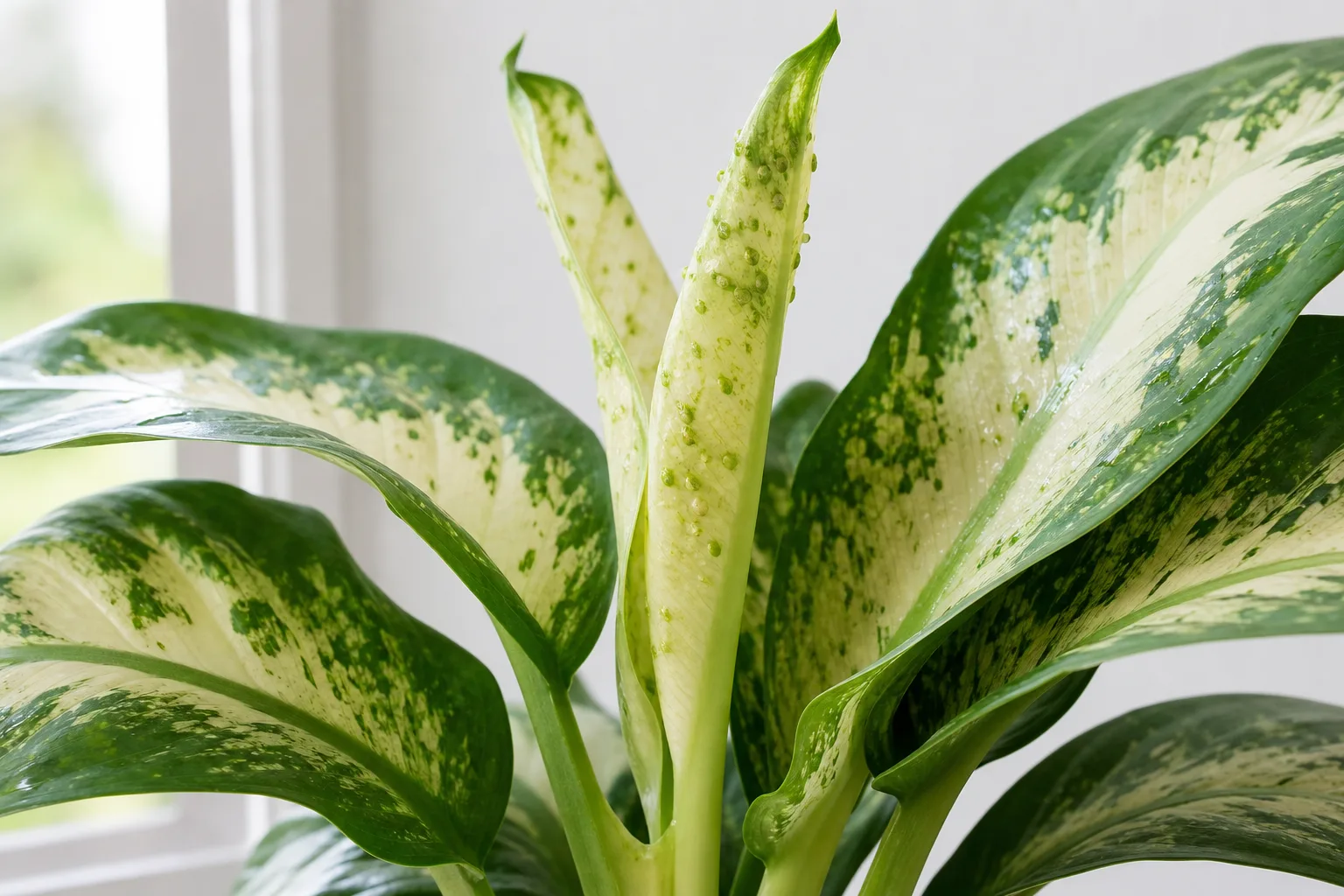
Aphids on Dieffenbachia Camille: Causes, Checks & Fixes
This guide covers aphids on Dieffenbachia Camille. See also the general Aphids guide, watering, and light pages for this plant.
Aphids on Dieffenbachia Camille: Causes, Checks & Fixes
Quick answer
Sticky cream-centered leaves at the crown of Dieffenbachia Camille (Dieffenbachia seguine ‘Camille’) usually mean sap-sucking pests, not variegation failure. Aphids are soft-bodied insects that pile onto tender new leaves where they unfurl and along fresh petioles. Green peach aphid and melon aphid are common on broad-leaf houseplants; color alone is not a reliable ID.
Before any spray: Dieffenbachia is among houseplants that can burn from insecticidal soap-always patch-test one hidden cream-centered leaf for 48 hours. Camille’s broad variegated blades hold rinse water longer than narrow-leaf species, so soap plus saturated tissue in a dim corner is a common burn scenario generic aphid pages skip.
First step: isolate the plant and rinse crown growth and leaf undersides with a strong stream of water. Hold the pot at an angle in a sink or shower, target unfurling leaf tips where aphids hide, and knock live insects off before reaching for labeled products. One pass rarely clears a colony-confirm survivors with a hand lens before adding any spray. For genus-wide dumb cane aphid basics, see the Dieffenbachia aphids hub.
What aphids look like on Dieffenbachia Camille
On Camille, aphids rarely settle on old, leathery lower leaves. They concentrate where the plant is actively growing:
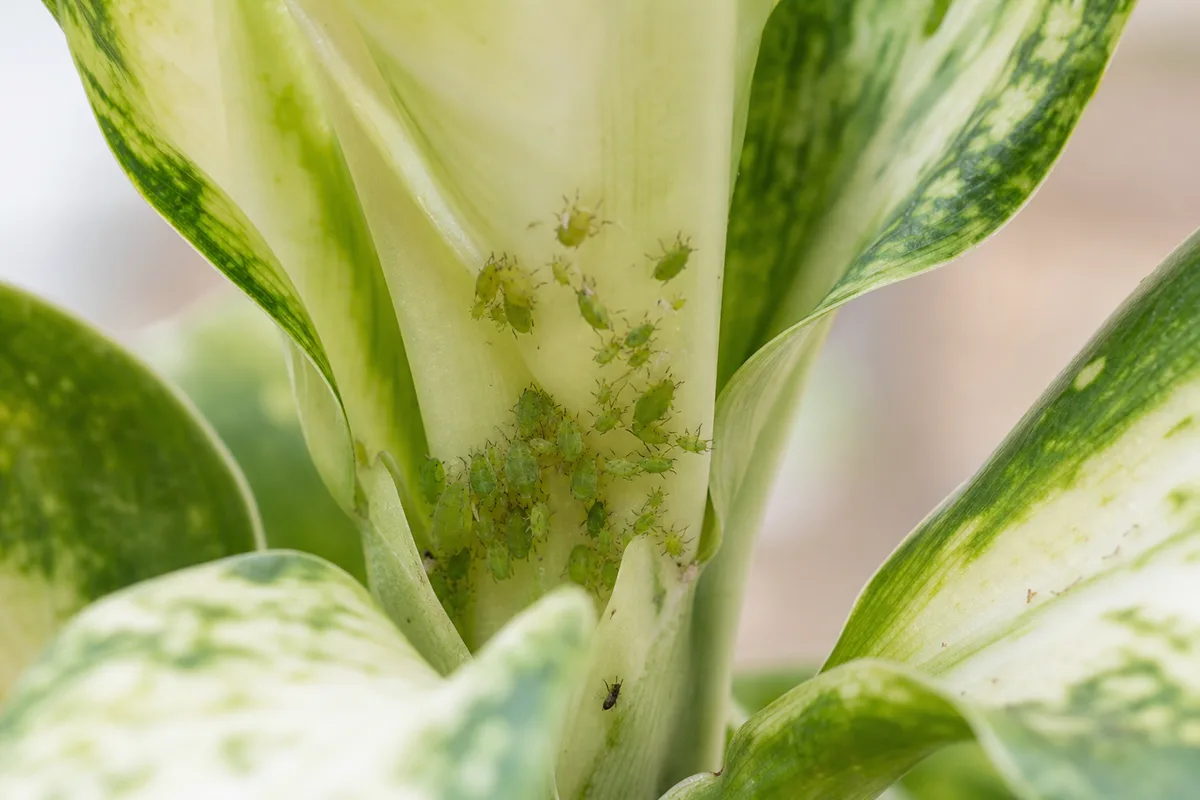
Green aphids on unfurling Camille crown growth - rinse leaf undersides before any spray, and patch-test soap on one cream leaf for 48 hours.
- The central crown where new cream-and-green leaves emerge and unfurl
- Petiole bases where soft tissue meets the upright cane
- Undersides of young leaves along the midrib before the blade fully expands
Aphids are small, pear-shaped insects about 1/16 to 1/8 inch long, often green but sometimes yellow, brown, or black. Most are wingless; winged adults appear when colonies crowd and need to disperse.
Heavy colonies look like matte clusters stacked along stems. You may also see:
- Shiny, sticky honeydew on leaf surfaces-especially visible on Camille’s pale cream variegation before it shows on solid-green Dieffenbachia cultivars
- Whitish cast skins shed as nymphs molt
- Black sooty mold growing on dried honeydew across broad blades
- Ants traveling up canes to harvest honeydew
- Curled, twisted, or stunted young leaves at the crown
A single aphid is easy to miss inside a rolled new leaf. By the time the crown looks distorted, the population has usually been building for days-aphids reproduce quickly on soft houseplant growth, and Camille pushes fresh leaves fast in spring and summer when fertilizer and bright light align.
Why Dieffenbachia Camille gets aphids
Camille invites aphids for reasons tied to how this cultivar grows indoors, not random bad luck.
Soft crown growth in active seasons. Dieffenbachia Camille produces upright shoots with large variegated leaves from a central crown. During warm months with good light, new growth is exactly the tissue aphids prefer. Each unfurling leaf offers a sheltered crevice where sprays and predators miss the first generation.
Nitrogen-rich, tender shoots. Camille is often fed monthly in spring and summer. Excess nitrogen before the plant can harden off new leaves produces soft shoots-convenient for you, ideal for aphids. Stressed plants can also be easier targets, but the main driver on Camille is timing: active crown growth during the same weeks you are watering and feeding most often.
Introduction routes. Aphids hitchhike on new nursery Dieffenbachia placed beside an established Camille on the same stand, shared cuttings, open windows near outdoor infested plants, and tools moved between pots. Skipping quarantine is the fastest way they enter a collection.
Shelter in broad-leaf architecture. Camille’s large leaf undersides and tight crown give aphids protected feeding sites that casual watering misses. Honeydew on wide cream-centered blades spreads faster visually than on narrow-leaf species, which makes infestations feel sudden even when colonies started small.
Indoor conditions without predators. Houseplant collections lack the lady beetles, lacewings, and parasitic wasps that keep aphid numbers down outdoors. Ants farming honeydew on cane stems remove what little natural control exists near a windowsill grouping.
Lookalike symptoms on Camille
| What you see | Likely cause | Quick check |
|---|---|---|
| Pear-shaped insects, sticky honeydew at crown | Aphids | Brush cluster-slow crawlers; cornicles visible with lens |
| White cottony masses in crown crevices | Mealybugs | Wax smears pink when crushed; does not follow variegation pattern |
| Hard or waxy bumps on older canes | Scale | Immobile when scraped; honeydew possible but insects fixed |
| Fine webbing, stippled older leaves in dry heat | Spider mites | Tiny dots, not stacked bodies at crown; check near vents |
| Silvery scarring on young leaves | Thrips | Slender fast insects, not clustered blobs |
| Dark green water-soaked spots, no insects | Bacterial leaf spot | Spots do not move; no honeydew piles |
| Dry white crust, no stickiness | Mineral residue | Wipes off dry; no live pests |
How to confirm the cause
Work through these checks before treating:
- Location on the plant - Aphids sit on soft crown tips and young petioles. Scale hides as immobile bumps on older stems; spider mites leave fine webbing and stippled older leaves, not glossy honeydew piles at the crown.
- Movement - Brush the cluster with a toothpick. Aphids crawl slowly; mealybugs feel waxy and cling in cottony masses; thrips jump or vanish quickly.
- Honeydew test - Sticky shine on stems or cream tissue with insects present confirms active sap feeding. Sticky leaves with no insects may mean aphids already rinsed off or ants farming a colony higher on the cane.
- Shape - Pear-shaped bodies with visible cornicles (small tail pipes) fit aphids. Cottony white masses suggest mealybugs; hard brown shells suggest scale.
- Ant trails - Ants on Dieffenbachia canes often mark an aphid colony above them; follow the line upward toward the crown.
- Nearby plants - Check all broad-leaf tropicals in the same room. Winged aphids disperse when a crown shoot becomes crowded.
- Bacterial lookalike - Water-soaked leaf spots on Dieffenbachia from bacterial pathogens do not move when touched and lack live insects at the center. Aphids always leave honeydew and clustered bodies.
If you find firm older leaves, a clean crown, and no honeydew, you may be past the active infestation or misreading old curl from mechanical damage during unfurling.
First fix: isolate, rinse, and treat safely
Isolate the plant and rinse crown growth and leaf undersides hard with water.
Move Camille away from other pots to a sink, tub, or shower. Use a sprayer on firm pressure, angling from above so water runs across leaf undersides, petiole bases, and the central crown. Support the cane so heavy wet leaves do not snap petioles-Camille blades are broad and hold water weight.
Repeat the rinse every two to three days for at least three sessions while live aphids remain visible. UMN Extension recommends washing and forceful water sprays for aphids on indoor plants before pesticides. Morning rinses let foliage dry in indirect light, which suits Camille better than leaving the crown wet overnight in a cool corner.
After each rinse, inspect with a hand lens. Do not apply soap or oil the same day as the first heavy rinse unless foliage will dry within a few hours-saturated variegated tissue plus soap burns more easily on Dieffenbachia.
Soap patch test on cream variegation (48-hour wait)
If rinsing alone does not drop live counts, the next step is a labeled insecticidal soap-not dish detergent-but only after a patch test. Dieffenbachia is listed among houseplants sensitive to insecticidal soap.
- Choose one hidden lower leaf with cream center tissue.
- Spray a small section to runoff with ready-to-use insecticidal soap or a 1–2% dilution (about 2½–5 tablespoons concentrate per gallon of water on products that allow it-always follow your label).
- Wait 48 hours in normal room light.
- Check for brown edges, pale patches, or collapse on the test area.
If the test leaf shows injury, do not spray the whole plant. Continue water rinses, dab visible aphids on petioles with a cotton swab dipped in 70% isopropyl alcohol (avoid flooding the crown), or try a plant-labeled horticultural oil on a second test leaf if soap fails.
If the test passes, spray leaf undersides, petioles, and crown growth until runoff in early morning or evening so residues dry before strong midday sun hits cream variegation. Repeat every five to seven days for two to three cycles. These are contact killers-they only affect aphids hit directly; aphids curled inside unfurling leaves may need pruning out.
Safer alternatives if soap burns
- Continue the rinse cycle every two to three days.
- Dab individual aphids on petioles with alcohol on a swab-spot-test alcohol the same way you tested soap.
- Use a plant-labeled neem oil only after a patch test; avoid applying when foliage will sit wet in strong midday sun on cream panels, which scorch more easily than solid-green tissue.
- Prune heavily infested crown leaves that are more insect than tissue; bag and discard prunings.
Step-by-step recovery
Once isolation and rinsing are underway, continue in this order based on severity:
- Wear gloves - Camille sap contains irritating calcium oxalate crystals. Gloves protect skin during rinsing, wiping, and pruning. Keep the plant away from pets and children until sprays have dried.
- Manual removal - Wipe heavily infested crown tips with a damp cloth or prune out leaves that are more insect than tissue. Bag and discard prunings; do not compost active colonies indoors.
- Insecticidal soap or horticultural oil - with caution - Apply only after the 48-hour patch test passes. Coat undersides and crown until runoff; repeat on label interval. Water the pot lightly beforehand if the plant is drought-stressed-soap and oil stress dry roots combined with hot sun worsen leaf scorch on Camille.
- Hold fertilizer - Skip nitrogen boosts until new crown growth looks clean for two weeks. Feeding during an active infestation produces more soft shoots for the next generation.
- Collection-wide check - Inspect every broad-leaf houseplant in the same room weekly until two weeks pass with zero live aphids on the isolated Camille.
Dieffenbachia Camille repotting guide is rarely necessary for foliage aphids on Dieffenbachia. Root aphids are a separate problem; if insects cluster only at the soil line with no crown colonies, inspect roots instead of only spraying tops.
When contact sprays are not enough
If three rinse cycles plus two labeled soap or oil rounds still leave live aphids in the crown during an active growth flush, escalation is reasonable-but Camille adds constraints generic aphid advice ignores.
Systemic soil drenches (imidacloprid and related actives) can reach aphids hidden in curled crown leaves, but they are more toxic than soaps and oils, persist in soil, and pose pet exposure risk if cats dig in pots or dogs chew treated foliage. Use only products labeled for the plant and application site, follow the label exactly, and keep pets away from treated pots until the label interval clears. For chronic collection-wide outbreaks, a local extension office or certified IPM professional may be safer than repeated whole-home drenches.
Foliar systemic sprays are rarely the first choice indoors where drift, residue on broad cream blades, and re-entry time matter. Exhaust contact options and crown pruning before reaching for stronger chemistry.
Disposal may be the practical call when the crown is coated, multiple pots share winged aphids, and contact treatments fail after disciplined repeats-especially on a cheap nursery Camille beside a large established specimen worth saving.
Recovery timeline
First rinse: many aphids drop immediately; honeydew stops accumulating within days if colonies are gone.
One to two weeks: with rinsing alone or careful soap cycles after a passed patch test, nymph counts should crash. Look for clean new leaves unfurling from the crown without curl or sticky residue.
Two to four weeks: distorted young leaves present before treatment stay distorted-trim them for appearance once the plant is stable. Camille replaces crown foliage steadily in warm months; lower old leaves are not the recovery signal.
Ongoing: a single missed winged female can restart a colony. Weekly crown checks through spring and summer growth flushes matter more than a one-time rescue.
Worsening signs: sooty mold spreading despite rinsing, crown leaves browning and collapsing, or winged aphids on multiple plants mean escalation-consider removing the worst crown leaves entirely and treating the whole group, not just one pot.
What not to do
Do not jump straight to insecticidal soap on the whole plant-Dieffenbachia is among species that can burn from soap sprays. Patch-test first or rely on repeated water rinses.
Do not use harsh dish soap; UMN Extension warns that homemade soap products can burn plants. Plant-labeled insecticidal soap is formulated for foliage contact.
Avoid one treatment and done-aphid nymphs hatch continuously. A single pass misses eggs and aphids curled inside unfurling leaves.
Do not return an isolated Camille to a plant grouping until you have seen no live aphids for at least two weeks after the last treatment cycle.
Skip high-nitrogen fertilizer while colonies are active; soft regrowth feeds the next wave.
Do not handle infested plants bare-handed-sap irritation is real on Dieffenbachia, and the plant is toxic to cats and dogs. Store treatment products out of pet reach.
Do not soak the crown overnight after rinsing-Camille crowns rot easily if water sits in tight growth points for hours in low light.
How to prevent aphids next time
Quarantine new plants for two weeks before placing them beside Camille on a shared stand. Inspect crown growth at purchase-retail Dieffenbachia often arrives with early colonies hidden in unfurling tips.
Scout weekly during spring and summer active growth. A ten-second check of the crown catches most Camille infestations before honeydew spreads across cream variegation.
Balance nitrogen - Camille needs feed during active growth, but excess produces soft shoots. Match feeding to actual growth rate rather than a fixed calendar when the plant is already pushing large leaves.
Wipe dust off foliage during dry spells; clean leaves support plant health and make pest clusters easier to spot.
Space plants for airflow on stands and windowsills. Crowded tropical rows trap stagnant air and make crown colonies harder to see.
Keep ants off canes if they appear-ants protect aphids from the few natural enemies that might wander indoors.
When to worry - pet safety and collection escalation
Escalate quickly if the crown is coated in aphids during a heavy growth flush, sooty mold covers multiple broad leaves, or winged adults appear on several houseplants in one room. Those situations threaten the whole collection, not just a few crown leaves.
A small cluster on one spring shoot after a thorough rinse is manageable with patience; hundreds at the crown with ants and mold is not a wait-and-see case.
If new leaves keep emerging distorted after two full treatment cycles with zero live aphids visible, look for thrips or cyclamen mites on protected crown tissue-not a continuing aphid problem.
Pet ingestion: Aphids do not make Dieffenbachia safe to chew. Camille sap still irritates mouths and throats. If your cat or dog ate leaves, stems, or soil from a treated pot, contact your veterinarian or ASPCA Animal Poison Control at (888) 426-4435 (fee may apply). Rinse sap from fur and keep the pet from chewing more tissue while you seek advice.
For chronic infestations across multiple rooms, contact your local cooperative extension office for IPM options appropriate to your state.
Related Dieffenbachia Camille problems
- Mealybugs - cottony wax in crown crevices with similar honeydew on cream variegation
- Spider mites - stippling and webbing on older leaves in dry heat, not pear-shaped clusters at the crown
- Yellow leaves - separating post-infestation yellowing from normal lower-leaf drop
- Watering - keeping crowns healthy during recovery without overwatering on Dieffenbachia Camille
- Dieffenbachia Camille overview - cream variegation biology and baseline care
When to use this page vs other Dieffenbachia Camille guides
- Dieffenbachia Camille watering guide - Use for routine moisture checks before assuming aphids is the main issue.
- Dieffenbachia Camille problems hub - Browse all 16 common issues on this species.
- Mealybugs on Dieffenbachia Camille - Different entry point when symptoms overlap with aphids.
- Spider Mites on Dieffenbachia Camille - Different entry point when symptoms overlap with aphids.
- Yellow Leaves on Dieffenbachia Camille - Different entry point when symptoms overlap with aphids.
Related Dieffenbachia Camille guides
- Dieffenbachia Camille overview
- Dieffenbachia Camille watering
- Dieffenbachia Camille light
- Dieffenbachia Camille soil
- Mealybugs on Dieffenbachia Camille
- Spider Mites on Dieffenbachia Camille
- Yellow Leaves on Dieffenbachia Camille
- Dieffenbachia Camille problems
Related tool
Use the Pest Identifier Tool to narrow causes for aphids on this plant before changing multiple variables at once.