Yellow Leaves on Dahlia: Causes, Checks & Fixes
Quick answer
On outdoor dahlias, yellow leaves usually trace to normal lower-leaf senescence, wet-tuber rot, insufficient full sun, virus mosaic, pests, or end-of-season frost-not indoor watering templates. First step: note which leaves yellow, probe soil 5 cm deep, and feel the tuber crown for firmness before fertilizing.
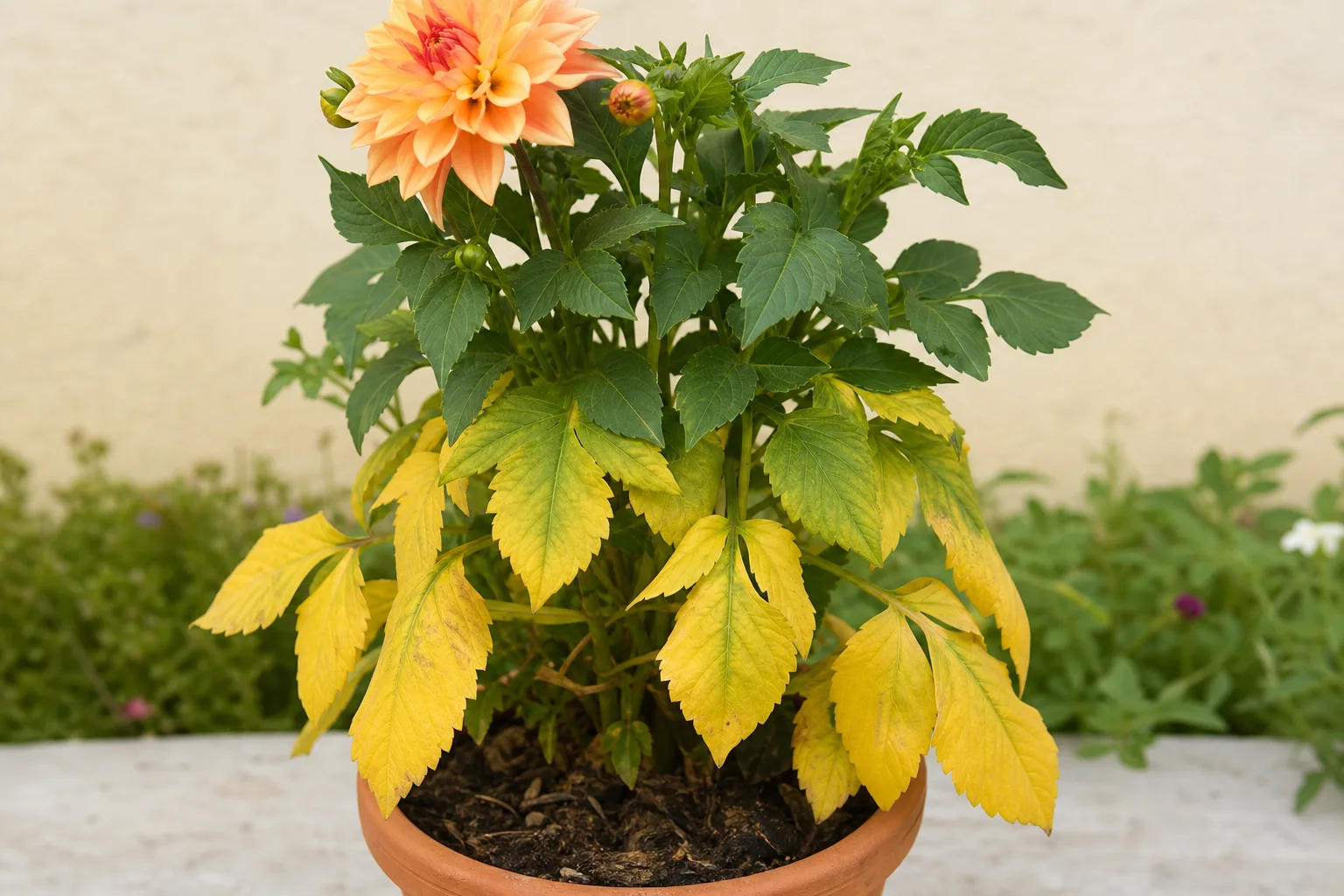
Yellow Leaves on Dahlia: Causes, Checks & Fixes
This guide covers yellow leaves on Dahlia. See also the general Yellow Leaves guide, watering, and light pages for this plant.
Yellow Leaves on Dahlia: Causes, Checks & Fixes
Quick answer
Dahlia (Dahlia spp.) is an outdoor tuberous perennial grown in Dahlia light guide for summer-to-frost bloom-not a rosette houseplant. Yellow leaves on upright stems are a symptom, not a single disease. The most common explanations are normal lower-leaf senescence during peak bloom, tuber or crown rot from wet soil, too little direct sun, viral mosaic, sap-sucking pests, nitrogen drain during heavy flowering, or end-of-season frost decline.
First step: note which leaves yellow (bottom only vs. whole plant vs. mottled new growth), probe soil 5 cm (2 in) deep, and feel the tuber crown at soil line for firmness. Firm crown + only older bottom leaves fading in August usually needs no panic. Soft crown + wet soil + rapid spread up the stem means stop watering and inspect tubers before any fertilizer. Irregular yellow streaks on young leaves with stunted growth means suspect virus and isolate the plant.
Full species context: dahlia overview. For wet-soil escalation, see overwatering and root rot. For pale leggy upper growth, see not enough light.
What yellow leaves look like on Dahlia
Dahlias grow upright hollow stems from a tuber crown, with opposite compound leaves along each stem-not a basal rosette. Yellowing therefore appears on specific nodes and stems, and the pattern tells you which branch of diagnosis to follow.
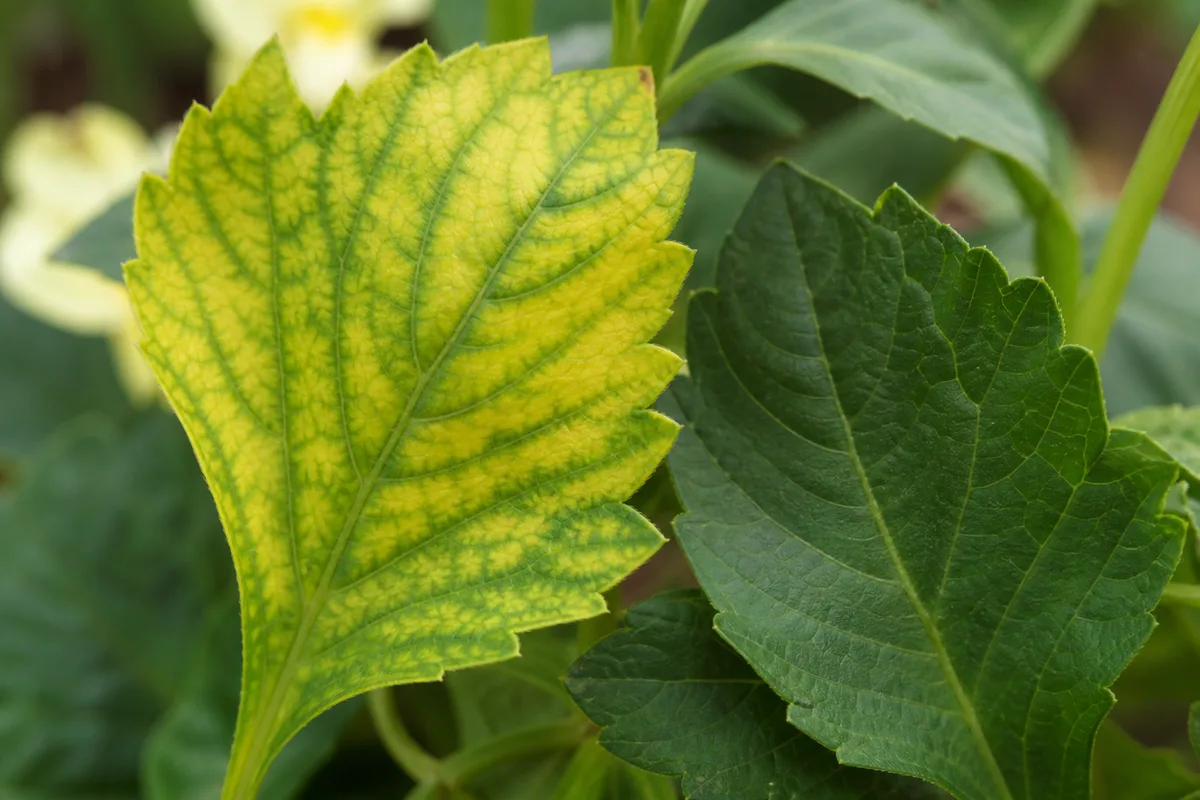
Yellow Leaves symptoms on Dahlia - compare with healthy tissue on the same plant.
Normal lower-leaf senescence (common, often harmless):
- Oldest leaves at the bottom of tall stems turn evenly yellow, then brown and papery
- Upper stems, buds, and new side shoots stay green and firm
- Progresses slowly over weeks during midsummer bloom
- Crown at soil line feels solid; soil moisture is appropriate
Tuber or crown rot (urgent):
- Yellowing starts on lower leaves but spreads upward within days to weeks
- Leaves may look limp or water-soaked while soil stays wet
- Stem base near crown may feel soft; sour smell from soil
- Whole plant may collapse despite moisture-paradoxical wilt
Insufficient full sun:
- Pale yellow-green foliage, especially on upper stems reaching for light
- Leggy, stretched stems with fewer buds
- Often worse on shaded side of a border or behind taller neighbours
Viral mosaic or ringspot:
- Irregular yellow streaks, blotches, rings, or vein clearing-not uniform bottom-up aging
- Stunted, twisted, or wrinkled young leaves and smaller blooms
- May affect one stem or the whole plant depending on infection timing
- WSU’s dahlia virus resource notes symptoms vary by strain and can mimic nutrient stress
Pest-related yellowing:
- Fine stippling and dull leaves from spider mites in hot dry weather
- Curled, sticky new growth from aphids
- Ragged holes and slime trails from slugs at the stem base-often on lower leaves first
Nitrogen deficiency during heavy bloom:
- Uniform yellowing of older lower leaves while tips stay greener initially
- Plant may look pale overall with smaller new leaves during peak flower load
- Common in sandy soil or after weeks of bloom without feeding
Frost and end-of-season decline:
- After first killing frost, foliage blackens, yellows, then browns across the plant
- Expected October–November timing in temperate zones-not a mid-season rot signal
Why Dahlia gets yellow leaves
Normal lower-leaf senescence during bloom
Dahlias push enormous energy into continuous flowering from midsummer until frost. Lower leaves on mature stems are the oldest photosynthetic tissue and naturally senesce as the plant redirects resources upward to buds and new side shoots. The RHS treats dahlias as heavy feeders that need sun and steady moisture-but a band of yellow at the stem base in peak season on an otherwise vigorous plant is often cosmetic, not pathological.
Remove fully yellow leaves to improve airflow and reduce slug cover. Do not confuse this with rapid yellowing on many stems at once.
Overwatering, poor drainage, and tuber or crown rot
Dahlias store energy in fleshy tubers connected to the crown. They need moist but free-draining soil during growth; they fail in waterlogged ground. The RHS states plainly that dahlias may rot in waterlogged soil. OSU Extension warns tubers are especially rot-prone before the first two leaves appear and that growers should not water until two leaves show after planting.
Saturated clay, low garden spots, closed pot drainage, and winter-wet in-ground storage all invite fungi such as Fusarium that block water movement up hollow stems-lower leaves yellow and die while soil feels wet. This is the same stress family as overwatering and root rot.
Insufficient full sun
Dahlias want at least six hours of direct sun daily, with six to eight hours ideal for strong stems and heavy bloom per RHS, BBC Gardeners’ World, and OSU Extension. Partial shade keeps plants alive but produces paler, weaker growth that yellows more easily and sets fewer buds. Container dahlias tucked under eaves or tree canopies show this pattern on upper reaches straining toward light.
Viral mosaic and other diseases
OSU Extension reports that stunted growth with yellow streaks or spots often indicates viral disease, with no treatment available. Dahlia mosaic virus is among the most common. Penn State Extension advises discarding infected plants and not saving tubers from virus-affected stock. Viruses are spread by aphids, thrips, and contaminated tools; they rarely rot tubers directly but render plants unproductive.
Powdery mildew on crowded plantings can cause chlorotic yellow patches on upper leaf surfaces in dry hot spells with poor airflow-distinct from uniform bottom senescence.
Pests (aphids, spider mites, slugs)
Heavy feeders in full sun still attract pests. Spider mites thrive in hot, dry microclimates and cause stippling that reads as yellow from a distance. Aphids cluster on tender shoots and distort new leaves. Slugs and earwigs chew lower leaves at night, leaving yellow halos and holes. Each needs a different fix-see linked pest guides after you confirm insects or damage patterns.
Nitrogen deficiency during heavy flowering
Dahlias are heavy feeders. OSU Extension recommends low-nitrogen fertilizer such as 5-10-10 during the season and warns that too much nitrogen promotes weak stems and tubers that shrivel in storage. Conversely, too little nitrogen during weeks of bloom drains older leaves first-the classic bottom-up uniform yellow while new growth still pushes, matching RHS nutrient deficiency guidance for nitrogen mobilization from older tissue.
Do not assume every yellow leaf needs nitrogen. Confirm soil moisture and crown firmness first.
Frost and end-of-season decline
Dahlias are frost-tender. The first hard frost kills aerial growth; remaining foliage yellows and browns as the plant shuts down. That is expected autumn physiology, not a call to fertilize. After frost, follow overwintering steps on the overview-dig, dry, and store tubers, discarding any that softened during the season.
Cold, wet spring planting shock
Planting tubers into cold, saturated soil before it warms invites rot before roots activate. WSU Extension guidance suggests planting when lilacs bloom in moderate climates-soil should be workable and warming. Yellow, stalled shoots in a wet spring bed often mean wait, improve drainage, or start indoors rather than feed.
How to confirm the cause - checklist
Work through these checks in order:
- Season and weather - Is frost imminent or just passed? Autumn whole-plant yellowing after frost is normal senescence.
- Which leaves - Bottom only on tall stems (senescence or nitrogen) vs. mottled young leaves (virus) vs. widespread rapid spread (rot).
- Soil moisture at 5 cm - Wet and heavy: rot branch. Dry with limp pale leaves: drought-see watering guide.
- Crown firmness - Gently brush soil from the stem base. Firm neck vs. mushy, sunken crown.
- Sun exposure - Count direct hours. Less than six on the planting site: light stress.
- Pest signs - Stippling, webbing, aphid clusters, slug slime on lower stems.
- Pattern speed - Weeks on a few bottom leaves (benign) vs. days on many stems (urgent).
- Neighbour plants - One plant with mosaic vs. whole wet bed yellowing (drainage).
You have likely confirmed normal senescence when only the lowest leaves on otherwise green, blooming stems yellow slowly, the crown is firm, and soil moisture is appropriate. You have likely confirmed rot when yellowing climbs fast on wet soil with a soft crown.
Symptom lookalike comparison table
| Pattern | Likely cause | First direction |
|---|---|---|
| Bottom leaves only, slow, firm crown, peak bloom | Normal senescence | Remove spent leaves; monitor |
| Bottom-up yellow, wet soil, soft crown, sour smell | Tuber or crown rot | Stop water; inspect tuber-root rot |
| Pale, leggy stems; shaded site | Insufficient sun | Relocate or prune neighbours-not enough light |
| Yellow streaks, rings, stunted wrinkled new growth | Virus | Remove plant; do not save tubers |
| Stippling, fine webbing, hot dry weather | Spider mites | Rinse; treat-spider mites |
| Uniform older-leaf yellow, heavy bloom, firm roots | Nitrogen drain | Low-nitrogen feed after soil check |
| Whole plant after frost; blackened stems | Seasonal decline | Overwinter tubers; not mid-season fertilizer |
| Yellow with white powder on leaf tops | Powdery mildew | Improve airflow; fungicide if severe |
First fix for Dahlia
Run the three-point check-soil moisture at 5 cm, crown firmness, and leaf pattern-before changing fertilizer or watering more.
If only a few bottom leaves are evenly yellow on firm stems with appropriate moisture, remove the spent foliage and watch for two weeks. No Epsom salt, no extra nitrogen unless lower yellowing spreads up the stem on an otherwise hungry plant.
If soil is wet and yellowing is spreading with a soft crown, stop all irrigation immediately. Gently clear mulch from the crown for airflow. Do not fertilize. Inspect tuber firmness per root rot before any other treatment.
If new growth shows mosaic streaks or the plant is stunted with irregular yellow patterns, dig and discard the plant (do not compost); sterilize tools. Do not divide tubers from that stock.
If the site gets less than six hours of direct sun and growth is pale and leggy, improve light-relocate pots or thin shading vegetation-before assuming disease.
If soil is appropriately moist, crown firm, and older leaves only are pale yellow during heavy bloom on sandy soil, apply a low-nitrogen fertilizer per label after ruling out rot-OSU suggests formulations like 5-10-10, not high-nitrogen lawn feed.
Make one correction at a time and judge response over seven to fourteen days of warm weather.
Recovery timeline by cause
| Situation | Realistic expectation |
|---|---|
| Normal lower-leaf senescence | Old leaves drop; new buds and green stem tips continue-no “recovery” needed |
| Mild overwatering, firm crown | One to three weeks after soil dries; lower yellow leaves may still drop |
| Advanced tuber rot | Uncertain; salvage only if firm tissue remains after trimming |
| Nitrogen deficiency | Two to four weeks after appropriate feeding; old yellow leaves do not re-green |
| Virus | No recovery-remove plant |
| Frost senescence | Terminal for the season above ground; tuber health depends on lifting and storage |
| Shade-induced pale growth | Several weeks after light improves; new growth should darken |
Judge success by new green stem tips, firm crown, and continued budding-not by old leaves turning green again. Fully yellow leaves do not re-green; they drop and are replaced from higher nodes.
What not to do
- Do not apply Epsom salt without confirming magnesium deficiency-yellow dahlias in wet clay rarely need magnesium first.
- Do not increase watering when soil is already wet and lower leaves are yellow-that deepens rot.
- Do not fertilize a plant with a soft crown or suspected virus.
- Do not save tubers from mosaic-affected plants for next year.
- Do not treat autumn frost yellowing with mid-season bloom fertilizer.
- Do not strip all lower leaves on a stressed plant-remove only fully yellow tissue.
- When removing spent foliage, keep discarded leaves away from pets-the ASPCA lists dahlias as toxic to cats and dogs with mild gastrointestinal signs if ingested.
How to prevent yellow leaves next season
- Plant in full sun with well-drained soil-raised beds or grit on clay per RHS.
- Stake tall cultivars early so lower leaves are not crushed in mud splash.
- Water when the top 5 cm dries during active growth; avoid saturated spring planting.
- Use low-nitrogen fertilizer through bloom; avoid excess nitrogen that weakens tubers for storage.
- Lift and store tubers in cool, airy conditions; discard soft or virus-suspected clumps.
- Scout for mites and aphids in hot dry spells; control slugs at the crown early.
- Rotate stock from reputable sources; rogue virus plants immediately.
When to worry (dig tubers, rogue virus, call extension)
Treat as urgent when:
- Many stems yellow within a week on wet soil with soft crown tissue
- Mosaic or ringspot patterns appear on new growth
- Whole-plant collapse in midsummer despite moisture checks
- Blackened, foul-smelling stems at soil line (bacterial stem rot-destroy plant)
Treat as seasonal, not urgent when:
- Frost has occurred and foliage is shutting down uniformly
- A few bottom leaves yellow slowly on blooming, firm plants
Contact your local county extension office if mosaic spreads through a collection, or if tubers rot repeatedly in storage despite good field culture-regional soilborne disease pressure varies.
Conclusion
Yellow leaves on dahlias are common and often benign when only the oldest lower leaves fade on firm, blooming stems in full sun. The dangerous patterns are fast spread on wet soil with a soft crown, mosaic streaking on new growth, and mid-season collapse that mimics drought but comes from rotting tubers. Probe soil, feel the crown, read the leaf pattern, and apply one fix at a time. Recovery shows in new green tips and buds, not repaired old foliage-and virus-affected plants belong in the bin, not next year’s border.
When to use this page vs other Dahlia guides
- Dahlia watering guide - Use for routine moisture checks before assuming yellow leaves is the main issue.
- Dahlia problems hub - Browse all 17 common issues on this species.
- Overwatering on Dahlia - Different entry point when symptoms overlap with yellow leaves.
- Underwatering on Dahlia - Different entry point when symptoms overlap with yellow leaves.
- Not Enough Light on Dahlia - Different entry point when symptoms overlap with yellow leaves.