Overwatering on Dahlia: Causes, Checks & Fixes
Quick answer
Dahlia overwatering usually means cold wet soil rotting tubers before sprouts, or saturated beds excluding oxygen from feeder roots during growth. First step: stop irrigation, probe moisture 5 cm at the crown, and squeeze the tuber-firm tissue with drying soil may recover; mushy tuber needs lifting.
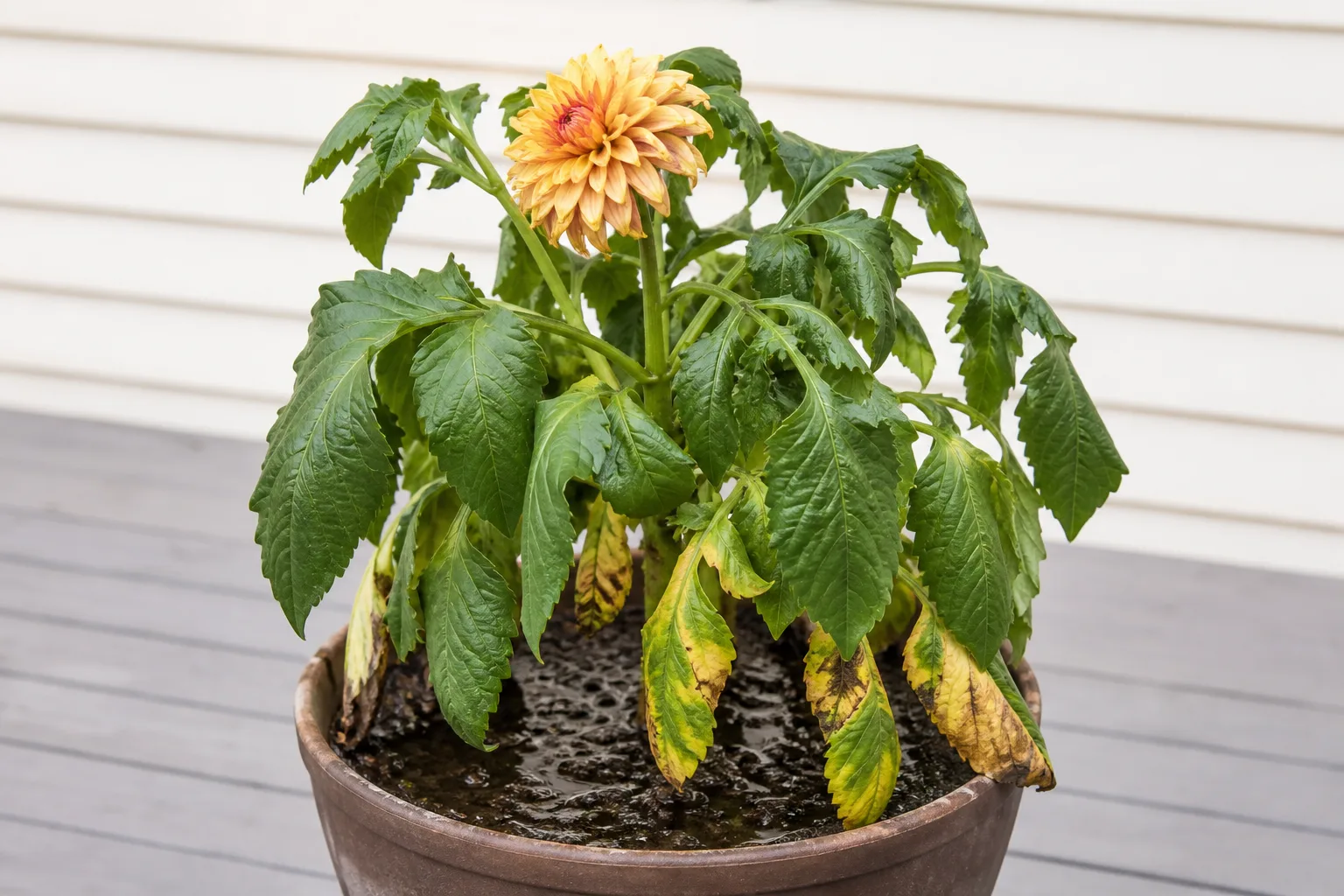
Overwatering on Dahlia: Causes, Checks & Fixes
This guide covers overwatering on Dahlia. See also the general Overwatering guide, watering, and light pages for this plant.
Overwatering on Dahlia: Causes, Checks & Fixes
Quick answer
Dahlia (Dahlia spp.) is an outdoor tuberous perennial grown in full sun for summer bloom-not a houseplant that tolerates calendar watering in cool rooms. Overwatering here means the tuber or root zone stays saturated too long, excluding oxygen and inviting rot. The damage often starts underground before leaves tell the story.
Two high-stakes patterns dominate:
- Pre-sprout tuber rot - watering a newly planted tuber in cold, wet spring soil before roots exist to move moisture
- Paradoxical wilt during growth - limp foliage in the morning while soil is wet and heavy, because rotting feeder roots cannot absorb water
First step: stop all irrigation, probe soil 5 cm (2 in) deep at the crown, and gently squeeze the tuber through soil or after careful lifting. Firm tuber tissue with soil drying toward moist-not soggy-may recover in one to two weeks. Mushy tuber or crown tissue needs immediate inspection per the root rot guide.
For seasonal watering rhythm and prevention depth, use the dahlia watering guide-this page focuses on diagnosis and rescue when wet soil has already gone wrong.
Why Dahlia gets overwatered
Dahlias need deep, consistent moisture during active growth but are unforgiving about timing and drainage at every other stage. The storage organ that fuels sprouting is the same structure roots grow from-saturation kills it faster than drought on many ornamentals.
Pre-sprout: watering before roots exist
The costliest mistake happens before you see a leaf. Gardeners plant a tuber, water on planting day, water again when the forecast looks dry, and wonder why nothing sprouts. Tubers in cold, saturated soil cannot move water actively; they simply rot.
OSU Extension is explicit: soil should be slightly moist at planting-if dry, water once lightly, then do not water until the first two leaves are present because tubers are especially susceptible to rot at that stage. Residual spring soil moisture is usually enough to start growth. Watering on a schedule before sprouts is kindness that destroys stock.
Indoor-started tubers in pots face the same rule: moist, not wet medium in a warm spot. Soggy cool potting mix before transplant is a reliable rot pathway.
Established plants: calendar watering and poor drainage
Once stems are up, dahlias transpire heavily through large leaf area and open blooms. They need a fair amount of water during active growth-roughly 2.5 cm (1 in) per week from rain plus irrigation-applied deeply at the base, not daily light sprinkles that wet only the surface while the tuber zone stays anaerobic.
Overwatering during growth usually comes from:
- Calendar irrigation without checking whether clay still holds last week’s rain
- Low spots in garden beds where water pools after storms
- Containers without drainage or saucers left full after watering
- Overhead sprinkling on open blooms, which weights flowers and can cause bloom spot while keeping surface soil constantly damp without deep oxygen exchange
- Heavy unamended clay that looks merely “dark” on top while the tuber zone is waterlogged
- Transplant soak mistakes-drenching a young plant on planting day when soil was already moist
The RHS dahlia growing guide recommends keeping soil moist during active growth without waterlogging-the failure mode is swinging from drought panic to constant sogginess rather than deep, spaced soaks.
Container vs. in-ground dry-down
Containers dry faster in July heat but trap water when drainage holes clog or cachepots have no outlet. In-ground dahlias in amended loam may need irrigation only every few days, while clay low spots stay saturated for a week after one rain. The finger test at tuber depth-not just the top inch-separates healthy moisture from chronic saturation.
What overwatering looks like on Dahlia
Symptoms depend on growth phase and how long soil has stayed wet.
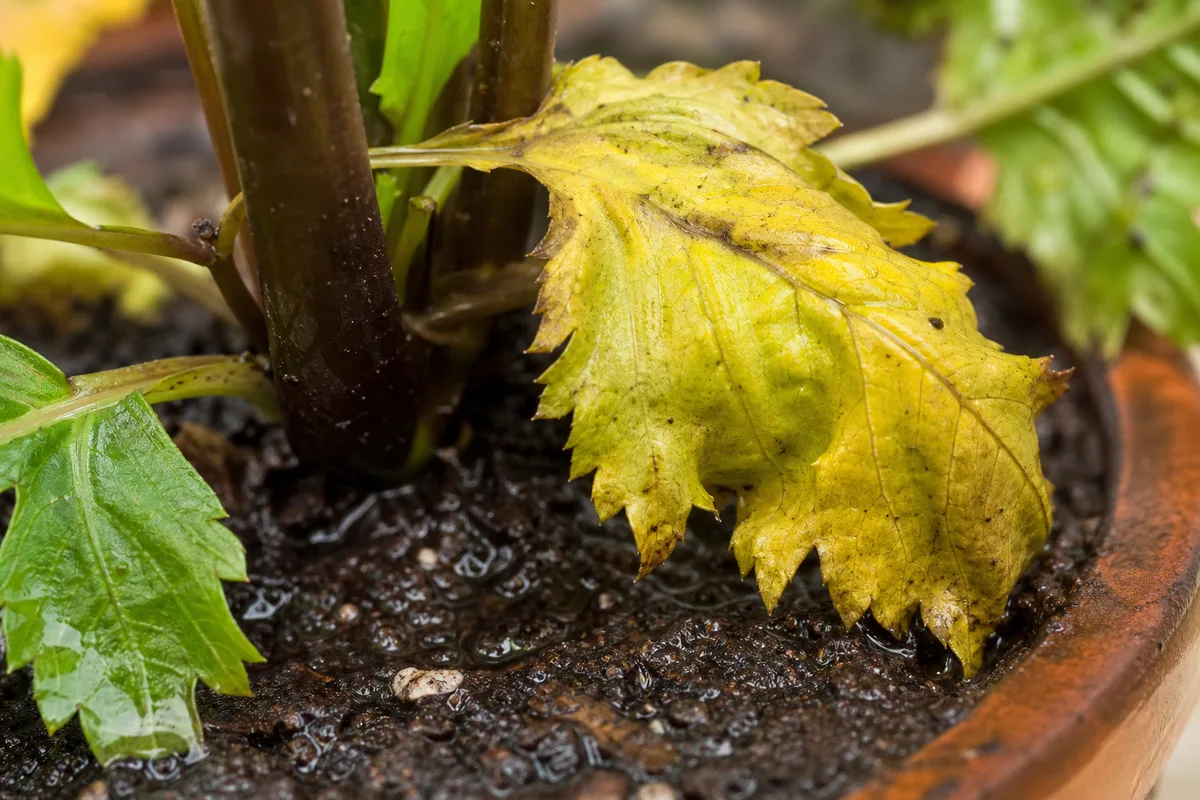
Overwatering symptoms on Dahlia - compare with healthy tissue on the same plant.
Pre-sprout (no green growth):
- Planting hole stays dark and cool for many days with no shoot
- Sour or musty smell when you scratch near the tuber
- Tuber feels soft or hollow on gentle squeeze through soil
- Sometimes fungus gnats in persistently wet potting mix indoors
Active growth (leaves and stems present):
- Lower leaves turn soft yellow while upper foliage still looks green briefly
- Morning wilt that does not match dry soil-stems limp when soil 5 cm down is wet
- Paradoxical wilt: plant looks thirsty but soil is heavy; roots failed underground
- Edema or blistering on leaf undersides in chronically wet, cool conditions
- Slow or stunted new growth despite apparent moisture
- Fungus gnats hovering at soil surface when mix never dries between waterings
- Crown tissue at soil line feels soft or smells off on advanced cases
Overwatering damage often develops before obvious foliar collapse-rot feels sudden when you finally dig, but saturation built over days or weeks.
Compare with the yellow leaves guide when only lower foliage yellows without clear wet-soil context.
Lookalike symptoms to rule out
| What you observe | Likely cause | First action |
|---|---|---|
| Morning wilt, dry soil 5 cm down, crispy edges | Underwatering | Deep soak at base-see underwatering |
| Midday fold, evening recovery, moist soil at depth | Heat wilt | Do not add water; mulch pots; see drooping leaves |
| Arches under heavy wet blooms, firm crown | Staking failure | Stake now-not a watering problem |
| Morning wilt, wet soil, soft yellow lower leaves | Overwatering / rot | Stop water; squeeze tuber; inspect crown |
| No sprout 3+ weeks, sour smell, soft tuber | Pre-sprout tuber rot | Dig tuber; discard if mushy |
| Sudden one-sided collapse, dark stem at soil line | Vascular wilt | Remove plant-see root rot differential |
Key discriminator: note time of day and soil at 5 cm depth. Afternoon slump alone with evening recovery on moist soil is often heat stress-some droop in hot midday sun is normal-not a call for more water. Morning wilt with wet soil is the classic overwatering trap.
How to confirm overwatering
Work through this checklist in order:
- Growth phase - Is the tuber pre-sprout, newly emerged, or established in bloom? Pre-sprout saturation is rot until proven otherwise; established plants need depth checks.
- Soil moisture at 5 cm - Probe at the crown, not only the mulch surface. Wet and heavy at depth after days without rain confirms saturation.
- Pot weight (containers) - Lift the pot. Waterlogged mix stays heavy for days; a healthy cycle lightens between deep soaks.
- Tuber squeeze test - Gently press the tuber through soil or after careful lifting. Firm resistance supports recovery after dry-down. Mushy give confirms rot-escalate to root rot.
- Smell - Sour, musty odor at crown or planting hole supports anaerobic rot.
- Wilt timing - Persistent morning-to-night slump in wet soil beats midday-only heat fold.
- Drainage paths - Blocked holes, full saucers, low bed spots, or sealed decorative outer pots trapping runoff.
- Secondary pests - Fungus gnats in soil that never dries suggest chronic wetness, not the primary cause alone.
If soil is dry in the morning and leaves are limp, you likely have underwatering-adding more dry-down will worsen drought stress.
First fix for Dahlia
Stop irrigation immediately-that is the single first action whether the plant is pre-sprout or in full bloom. More water on rotting roots deepens failure.
Then branch by phase:
Pre-sprout with no growth: Do not water again until you confirm sprouts or, conservatively, the first two leaves-unless soil at tuber depth is bone dry and no rain is forecast. If smell or squeeze test suggests rot, carefully dig the tuber rather than waiting.
Established plant with firm tuber: Let the top 5 cm dry while protecting bloom-stage plants from desert drought elsewhere in the bed. Clear mulch temporarily from a soggy crown for airflow. Empty saucers on containers within 30 minutes of watering events.
Established plant with soft crown or mushy tuber: Stop water, expose the crown lightly, and move to tuber inspection below-do not fertilize or repot into a larger pot “to help drying.”
Make one correction at a time and read response over three to seven days of warm weather before stacking treatments.
Tuber lift and inspection when decline continues
If leaves keep yellowing or wilt persists morning and night after a full dry-down cycle, inspect underground tissue:
- Water lightly the day before only if soil is concrete-hard-otherwise dig dry to see texture clearly.
- Lift carefully with a fork, keeping the tuber clump intact. Brush away soil without blasting with a hose.
- Squeeze test each tuber: firm, pale storage tissue may recover after trim and air-dry; brown, translucent, or slimy tissue must be cut away with a clean knife to healthy white flesh, or the clump discarded if the crown is gone.
- Air-dry cut surfaces several hours in shade before replanting into grit-amended, well-drained mix-see the soil guide.
- Hold water after replant until new growth shows stable turgor-treat it like a fresh planting.
Advanced rot that consumes the crown is usually not saveable. Prevention next season beats heroic surgery.
Recovery timeline
| Situation | Realistic expectation |
|---|---|
| Brief container overwatering, firm tuber | New growth firms within 1–2 weeks after soil dries |
| Mild lower-leaf yellowing, roots intact | Old yellow leaves do not re-green; judge by upright new shoots |
| Pre-sprout rot caught early with partial firm tuber | Delayed sprout 2–4 weeks after trim and dry replant-if eyes remain viable |
| Chronic clay-bed saturation mid-season | Recovery slow; bloom may be reduced even if plant survives |
| Mushy crown or liquefied tuber | Unlikely to recover-replace stock and fix drainage |
Judge success by firm new stems, opening buds, and stable turgor by morning-not by saving every yellow lower leaf.
What not to do
Do not keep watering because leaves look wilted when soil is already wet-that deepens paradoxical wilt.
Do not fertilize a waterlogged plant; roots cannot uptake nutrients and salts stress damaged tissue.
Do not repot into a larger container during recovery-extra wet mix volume slows drying.
Do not treat outdoor dahlias like houseplants: “water when the top inch dries” without depth checks fails when clay stays saturated at tuber level.
Do not soak transplants on planting day when soil was already moist-one thorough pass if dry, then hold.
Do not leave saucers full or plant in low spots that collect runoff.
How to prevent overwatering next time
Match water to growth phase:
- Before two leaves: damp planting soil, then hold irrigation unless tuber depth is genuinely dry-per OSU Extension pre-emergence guidance
- During active growth: deep soaks when the top 2.5–5 cm dries, aiming for consistent moisture never soggy-details in the dahlia watering guide
- Containers: water until runoff, then empty saucers; verify holes stay open through summer
- Garden beds: amend clay, use raised rows, and avoid low spots; mulch after soil warms but keep mulch off the stalk
For fungus gnat pressure from chronically wet mix, see fungus gnats on Dahlia once drainage is fixed.
When to worry
Escalate within 24 hours if:
- Crown or tuber tissue is mushy on squeeze test
- Plant stays limp all day in wet soil with accelerating yellow lower leaves
- No sprout after three weeks in cold wet soil with sour smell
- Multiple plants in the same bed fail together-suspect drainage redesign, not individual watering error
For chronic wet clay or repeated seasonal loss, contact your local cooperative extension office for a soil drainage assessment before replanting valuable stock.
Related Dahlia problems
- Dahlia watering guide - seasonal rhythm, pre-sprout rules, drought vs. rot signs
- Root rot on Dahlia - mushy tuber triage and trim protocol
- Underwatering on Dahlia - dry wilt lookalike
- Wilting on Dahlia - sharp collapse vs. gradual droop
- Drooping leaves on Dahlia - heat wilt and staking overlap
- Yellow leaves on Dahlia - lower-leaf pattern checks
- Fungus gnats on Dahlia - wet-soil secondary pest
- Dahlia overview - hub for full care cluster
When to use this page vs other Dahlia guides
- Dahlia watering guide - Use for routine moisture checks before assuming overwatering is the main issue.
- Dahlia problems hub - Browse all 17 common issues on this species.
- Root Rot on Dahlia - Different entry point when symptoms overlap with overwatering.
- Yellow Leaves on Dahlia - Different entry point when symptoms overlap with overwatering.
- Wilting on Dahlia - Different entry point when symptoms overlap with overwatering.