Spider Mites on Ctenanthe: Causes, Checks & Fixes
Quick answer
Spider mites on Ctenanthe thrive when winter heating drops humidity below what this fishbone prayer plant needs. Look for pale stippling on fishbone stripes and fine webbing tucked into folded leaf joints. First step: isolate the plant and rinse every leaf underside with lukewarm water before applying any spray.
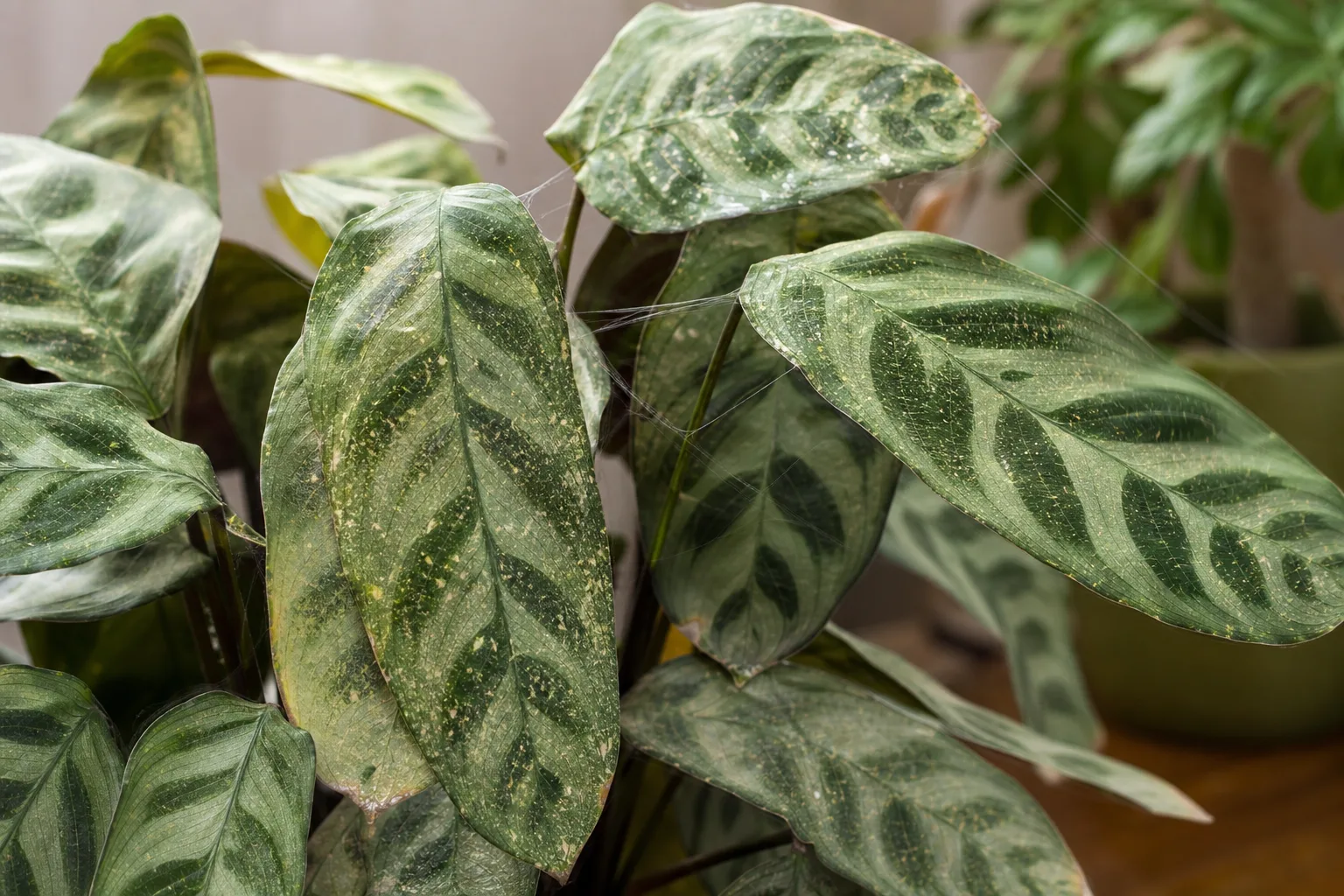
Spider Mites on Ctenanthe: Causes, Checks & Fixes
This guide covers spider mites on Ctenanthe. See also the general Spider Mites guide, watering, and light pages for this plant.
Spider Mites on Ctenanthe: Causes, Checks & Fixes
Quick answer
Spider mites on Ctenanthe are almost always a humidity-and-stress story. This fishbone prayer plant wants consistently high moisture in the air, but indoor heating in winter creates the warm, dry conditions where twospotted spider mites reproduce fastest. The damage shows up early on pale fishbone stripes as pinpoint stippling that looks like dust until you tilt the pot and inspect from below.
First step: isolate the plant and rinse the undersides of every leaf and folded spear with lukewarm water. Mites feed on the lower surface and hide in the nyctinastic joints where Ctenanthe leaves meet at night. A thorough rinse knocks down the population before you decide whether soap or horticultural oil is needed-and it costs nothing except a few minutes at the sink.
Do not spray pesticides on day one without confirming active mites. Low humidity alone can crisp Ctenanthe edges in a pattern that resembles mite bronzing, and overeager chemical treatment can mark delicate patterned foliage. Baseline species context: Ctenanthe overview.
Why Ctenanthe gets spider mites - Marantaceae humidity story
Ctenanthe belongs to the prayer-plant family Marantaceae alongside Calathea, Maranta, and Stromanthe. These plants evolved in humid tropical understories where leaf surfaces stay supple. When your home drops below roughly 50% humidity for weeks-especially near heat vents or during winter-the plant’s thin patterned tissue loses resilience at the same time mites find ideal breeding conditions in dry air.
That combination is the core risk for Ctenanthe specifically. A snake plant in the same dry room may look fine while your fishbone prayer plant develops stippling because marantaceous leaves are thinner and the pale fishbone stripes lack the chlorophyll buffer that solid green tissue provides. Mites pierce individual cells and cause stippling; on C. burle-marxii the damage reads as obvious speckling across silver-green panels within days-often before you notice webbing on top.
Common entry points include new nursery purchases, plants summered outdoors and brought back inside, and mites crawling or drifting from infested neighbors such as palms, fiddle-leaf figs, or other prayer plants on the same shelf. Ctenanthe’s compact crown and nightly leaf folding create humid, sheltered pockets along stems where colonies build unnoticed. Crowded plant groupings reduce airflow around folded leaves and make weekly inspection harder-mites can hide in a spear axil for weeks before webbing appears on the upper surface.
underwatering on Ctenanthe does not cause spider mites directly, but drought-stressed Ctenanthe recovers slowly from feeding damage and may shed older leaves while you fight the pest. Overcorrection matters too: a plant pushed against a sunny window without a humidifier gets light stress plus dry air-a double vulnerability during mite season. The same dry winter air that triggers brown tips and low-humidity stress also favors mite reproduction.
Cultivar size affects inspection and rinse technique. Tabletop C. burle-marxii fishbone plants fit easily under a sink sprayer; rinse the whole clump in two to three minutes. Taller C. oppenheimiana and floor-scale C. lubbersiana need longer shower passes or a damp cloth wiped across burgundy undersides leaf by leaf. All share the same mite vulnerability when humidity drops-only the reach changes.
What spider mite damage looks like on Ctenanthe
Early feeding on fishbone-pattern foliage
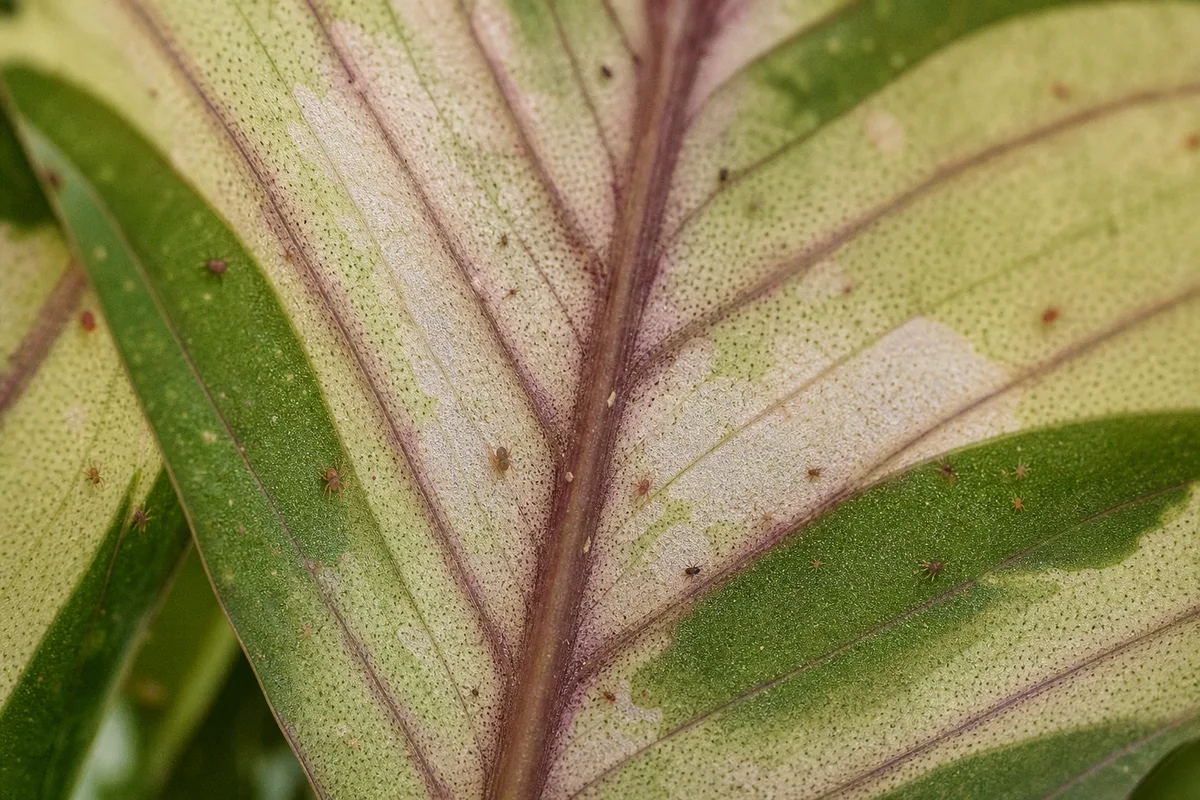
Spider Mites symptoms on Ctenanthe - compare with healthy tissue on the same plant.
- Pinpoint pale or silvery dots scattered across fishbone stripes and pale green panels
- Upper surfaces look dull or slightly gritty before color bronzes
- Newest rolled spears may show stippling at the tips while still folded upright at night
- No webbing yet-easy to confuse with mineral splash, thrips scarring, or dry-air crisp alone
On C. burle-marxii, stippling often appears first on the lighter silver-green zones of the herringbone pattern because chlorophyll loss shows against the pale background faster than on solid green Marantaceae cultivars.
Established infestation in folded spear joints
- Fine silk webbing at petiole bases, between nyctinastic folds, and around spear tips
- Bronzed or yellowed patches on patterned tissue
- Burgundy leaf undersides may hide colonies until populations are large
- Older leaves feel papery and may curl inward at margins
- New spears slow to unfurl or open with distorted, stippled panels
- Tiny moving dots on undersides-barely visible without magnification
Mites congregate in the protected inner folds where leaves meet the stem at night because those pockets hold slightly more humidity than open air but still stay drier than mites prefer outdoors. Inspect when leaves stand upright after dark-that is when hidden axils are most exposed.
Severe damage and when to consider discarding
- Webbing sheets across multiple leaves and stems
- Widespread bronzing with leaf drop starting from the bottom of the clump
- Growth stalls; new spears abort or brown before opening
- Tap tests stay positive after three full treatment cycles
At this stage, saving one severely webbed Ctenanthe may risk repeated outbreaks across Calathea, Maranta, and Stromanthe neighbors on the same humidity tray. A compact fishbone plant is replaceable; a whole prayer-plant shelf reinfestation is not.
How to confirm spider mites vs. thrips, dry air, and mineral residue
Work through these checks before committing to sprays:
- Tap test - Hold white paper under a suspect leaf and tap the stem sharply. Mites fall as tiny specks that crawl on the paper. Pepper-like dust that does not move is not mites.
- Underside inspection - Use a hand lens or phone macro mode on burgundy backs and inside folded spears. Twospotted spider mites are oval, pale green or orange, with two dark spots visible at higher magnification.
- Webbing location - Mite silk is fine and irregular, usually starting at leaf axils and spear bases. Uniform silky threads covering only new growth without moving specks may suggest broad mites instead-confirm with magnification before treating.
- Humidity reading - Measure at canopy height with a hygrometer. Readings below 45% for extended periods support mite-friendly conditions on a humidity-loving plant. The Ctenanthe overview targets 60% and above for cleanest leaf edges in heated homes.
- Pattern vs. care stress - Even brown tip margins from fluoride or low humidity alone do not produce moving dots or webbing. If you see both crisp edges and stippling with mites present, treat the pest first, then adjust humidity and water quality.
- Neighbor check - Inspect Marantaceae plants on the same shelf or windowsill. Mites spread plant to plant before every host looks equally bad. Check mealybugs and aphids on neighbors too-different pests, same crowded-shelf risk.
Symptom lookalike comparison
| What you see | Likely cause | Key differentiator |
|---|---|---|
| Crisp brown tips, no stippling, no webbing | Low humidity or tap-water minerals | No moving dots on tap test; fix humidity and water quality |
| Silvery scrape marks, black fecal specks | Thrips | Insects jump when disturbed; no fine mite webbing in axils |
| White cottony clusters in axils | Mealybugs | Wax smears pink when crushed; not stippling across flat panels |
| Uniform tip browning on older leaves | Mineral or fluoride burn | Symmetric edge pattern; no underside colonies |
| Pale speckling + webbing + crawling tap-test dots | Spider mites | Confirm with magnification and repeat tap tests |
If tap tests and magnification show no mites, webbing, or stippling progression, reconsider whether dry air or mineral burn is the real issue before applying pesticides.
First fix: isolate, rinse undersides, then treat safely
Move the plant away from healthy collection plants and rinse every leaf underside under lukewarm running water or in the shower.
Support the pot so soil does not wash out. Angle leaves so water flows across burgundy backs and into the folded joints where mites hide. For compact C. burle-marxii clumps, a two-to-three-minute shower pass is usually enough. For larger C. lubbersiana, wipe undersides with a soft damp cloth after the initial rinse to reach leaves the spray misses.
Repeat this rinse two to three times in the first week, spacing sessions at least two days apart so foliage dries fully between washes. Let the crown dry before leaves fold for the night-dense Ctenanthe clumps that stay wet in stagnant air can develop fungal spotting unrelated to the mites. Rinse in morning or midday when possible.
This single step is the safest opening move for Ctenanthe because patterned foliage can burn easily under oils or soap applied to a dry, hot leaf in direct sun. Physical removal also reaches mites that webbing would otherwise shield from contact sprays.
After the first thorough rinse, raise humidity near the plant with a humidifier-not just occasional misting, which lifts surface moisture briefly but does not change the dry air mites prefer. Keep your normal watering rhythm; do not soak the roots hoping to compensate for dry air.
Only after two or three rinses and confirmed live mites should you add horticultural oil or insecticidal soap. Patch-test one patterned leaf first and wait 24 hours before treating the whole plant-Marantaceae foliage varies in sensitivity to oils and soaps.
What not to do the same day
Do not spray the whole plant with oil or soap before confirming live mites. Do not move a freshly treated plant into direct sun. Do not repot, fertilize, and treat pests all in the same week on a stressed prayer plant.
Step-by-step recovery
Once isolation and initial rinses are done:
- Apply horticultural oil or insecticidal soap if mites persist after repeated washing. Cover undersides completely, including spear folds. Follow label intervals-typically every five to seven days for at least three cycles to catch newly hatched mites.
- Run a humidifier targeting 60% or higher at canopy level. This supports Ctenanthe recovery and makes the environment less favorable for mite reproduction.
- Prune only heavily webbed leaves that block spray coverage or are mostly bronzed. Cut at the base of the petiole; bag and discard clippings. Do not strip the plant bare-Ctenanthe needs remaining leaves to photosynthesize while new growth returns.
- Treat or inspect neighbors on the same shelf. Mites on one prayer plant often mean hidden colonies on another.
- Avoid systemic insecticides labeled for insects when mites are the target-mites need miticides or contact oils and soaps. Read labels for indoor houseplant use.
- Hold fertilizer until new spears unfurl cleanly for several weeks. Feeding a pest-stressed Ctenanthe pushes soft tissue that mites prefer.
Keep the plant in bright indirect light during recovery-not dark quarantine corners where weakened leaves cannot rebuild, and not direct sun where treated foliage may scorch.
Recovery timeline for Ctenanthe foliage
Expect to see fewer live mites within a few days of consistent rinsing if the infestation was caught early. A full soap or oil course usually takes two to three weeks with label-interval repeats because eggs hatch on a staggered schedule.
Cosmetic stippling on old fishbone panels remains until those leaves age out-often one to two months on a healthy Ctenanthe pushing regular new spears. Judge success by clean unfurling growth, no new webbing, and negative tap tests on weekly checks.
If three treatment cycles plus humidity correction fail to stop new stippling, the population may be too entrenched or reinfesting from nearby plants. At that point, discarding a severely webbed specimen can protect the rest of a collection.
Mistakes to avoid
Do not stop after one rinse or one spray. Mite eggs survive single treatments; incomplete cycles are the main reason infestations return.
Do not spray only the tops of leaves. Mites feed on undersides; top-only coverage wastes product and burns patterned panels in sun without killing pests.
Do not assume high humidity alone cures an active infestation. Humidity helps prevention and recovery but does not replace physical removal and contact treatment when colonies are established.
Do not compost heavily infested clippings near other houseplants. Bag and discard them.
Do not confuse normal nyctinasty-leaves folding upward at night-with mite damage unless stippling or webbing is visible on exposed surfaces.
Do not use insecticides labeled for insects only. Mites are arachnids, not insects, and many common houseplant sprays miss them entirely.
Ctenanthe care cross-check during treatment
While fighting mites, keep baseline care stable:
- Light: Bright indirect light-enough for steady spears, not so intense that treated leaves burn. See light requirements.
- Water: Keep evenly moist per the watering guide-check the top inch before each drink. Use filtered or rainwater to avoid adding mineral stress on already damaged tissue.
- Humidity: 60% or higher near the canopy during treatment and after. Below 40%, expect continued edge crisp and mite pressure even when watering is correct.
- Temperature: Avoid cold drafts and heat vents blowing directly on foliage. NC State recommends 60 to 85°F for Ctenanthe.
- Airflow: Gentle circulation helps leaves dry after rinses; stagnant wet folds in a dense crown invite fungal spotting on smooth patterned leaves-not the fuzzy-leaf water-spot issue some other houseplants face, but real damage on Ctenanthe nonetheless.
Ctenanthe is widely classified as non-toxic to pets, which makes thorough sink rinsing practical in homes with curious cats. Still wipe treated leaves dry and keep soap residues off surfaces pets lick.
How to prevent spider mites on Ctenanthe
Inspect burgundy undersides and folded joints weekly during dry seasons-winter heating, air-conditioned summer rooms, and any period when humidity drops below 50% near the plant. Time inspections for evening hours when nyctinastic folds expose hidden axils.
Quarantine new purchases for at least two weeks before placing them beside Ctenanthe. Mites are easier to treat on one small plant than on a full prayer-plant shelf.
Run a humidifier as standard Ctenanthe care, not only after damage appears. Sustained humidity supports leaf quality and makes reproduction harder for mites.
Rinse foliage monthly in the shower during winter. This knocks down early colonies before webbing forms.
Space plants enough to inspect folded leaves individually. Dense jungle shelves look beautiful but hide pests.
Avoid letting Ctenanthe sit in prolonged drought between waterings. Even though drought does not cause mites, stressed plants recover slowly and may drop leaves during treatment.
When to escalate - collection spread and repeated failure
Escalate quickly when webbing covers most of the clump, new spears brown before opening, or tap tests stay positive after three full treatment cycles. Mites can kill a severely weakened Ctenanthe by removing enough chlorophyll that the plant cannot push new growth.
Discard severely infested plants in sealed bags if saving them would risk repeated outbreaks across Calathea, Maranta, Stromanthe, or other marantaceous neighbors. A tabletop fishbone plant is replaceable; a whole shelf reinfestation is not.
Contact your local cooperative extension office if infestations persist across multiple rooms despite quarantine and repeated treatment-chronic collection-wide mite problems sometimes need professional identification to rule out pesticide-resistant strains or misidentified broad mites.
A few stippled older leaves with no webbing and negative tap tests after one rinse is not urgent-keep monitoring and raise humidity before adding chemicals.
Conclusion
Spider mites on Ctenanthe exploit the gap between what this fishbone prayer plant needs-steady humidity and careful handling-and what many homes provide in dry seasons. Confirm mites with tap tests and underside inspection in nyctinastic folds, isolate and rinse before you spray, repeat treatments through the full hatch cycle, and judge recovery by clean new spears rather than old stippled panels. That path protects Ctenanthe’s patterned foliage without unnecessary chemical stress-and keeps your Marantaceae neighbors safer on the same shelf.
When to use this page vs other Ctenanthe guides
- Ctenanthe watering guide - Use for routine moisture checks before assuming spider mites is the main issue.
- Ctenanthe problems hub - Browse all 17 common issues on this species.
- Low Humidity on Ctenanthe - Different entry point when symptoms overlap with spider mites.
- Curling Leaves on Ctenanthe - Different entry point when symptoms overlap with spider mites.
- Slow Growth on Ctenanthe - Different entry point when symptoms overlap with spider mites.