Yellow Leaves on Croton: Causes, Checks & Fixes
Quick answer
Yellow leaves on croton (Codiaeum variegatum) usually mean relocation shock, watering imbalance, insufficient bright light, cold drafts below about 50°F, or normal aging on the oldest lower leaves-not one simple thirst problem. First step: stop moving the pot, check whether soil is wet or dry at the top half-inch to one inch, and note whether new growth is fading green or uniformly yellowing.
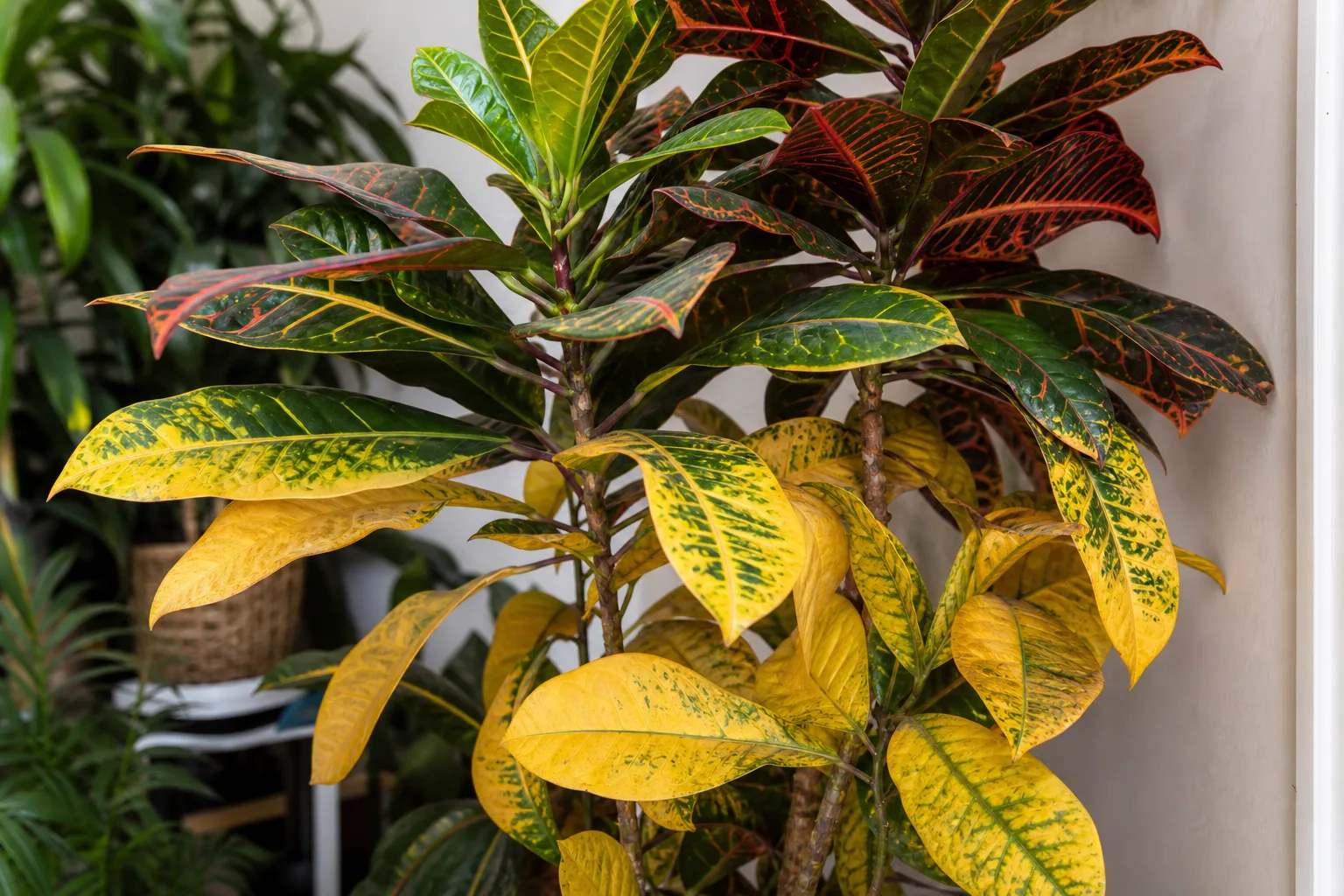
Yellow Leaves on Croton: Causes, Checks & Fixes
This guide covers yellow leaves on Croton. See also the general Yellow Leaves guide, watering, and light pages for this plant.
Yellow Leaves on Croton: Causes, Checks & Fixes
Quick answer
Yellow leaves on croton (Codiaeum variegatum) are a symptom, not one diagnosis. This upright tropical shrub with bold, leathery foliage yellows and drops leaves faster than many common houseplants when light, water, temperature, or placement shift. The leading triggers are relocation shock after a move, overwatering or underwatering, insufficient bright light (color fade before drop), cold exposure below about 50°F, spider mites in dry air, and normal aging on the oldest lower leaves on an otherwise healthy plant.
First step: stop moving the pot, then probe the top half-inch to one inch of mix and note which leaves are affected. Wet soil with widespread lower-leaf yellowing points to root stress; a light pot and dry mix fit drought; mass drop after a nursery purchase usually means shock; green-yellow new growth in a dim room means light-not fertilizer.
Separate harmless bottom-leaf aging from stress patterns before you repot, feed, or relocate again.
What yellow leaves look like on Croton
Croton is a woody, broadleaf evergreen shrub in the spurge family (Euphorbiaceae) with glossy, often variegated leaves on upright stems. Cultivars like Petra and Mammy develop red, orange, and yellow pigment as leaves mature. Yellowing shows up in distinct patterns:
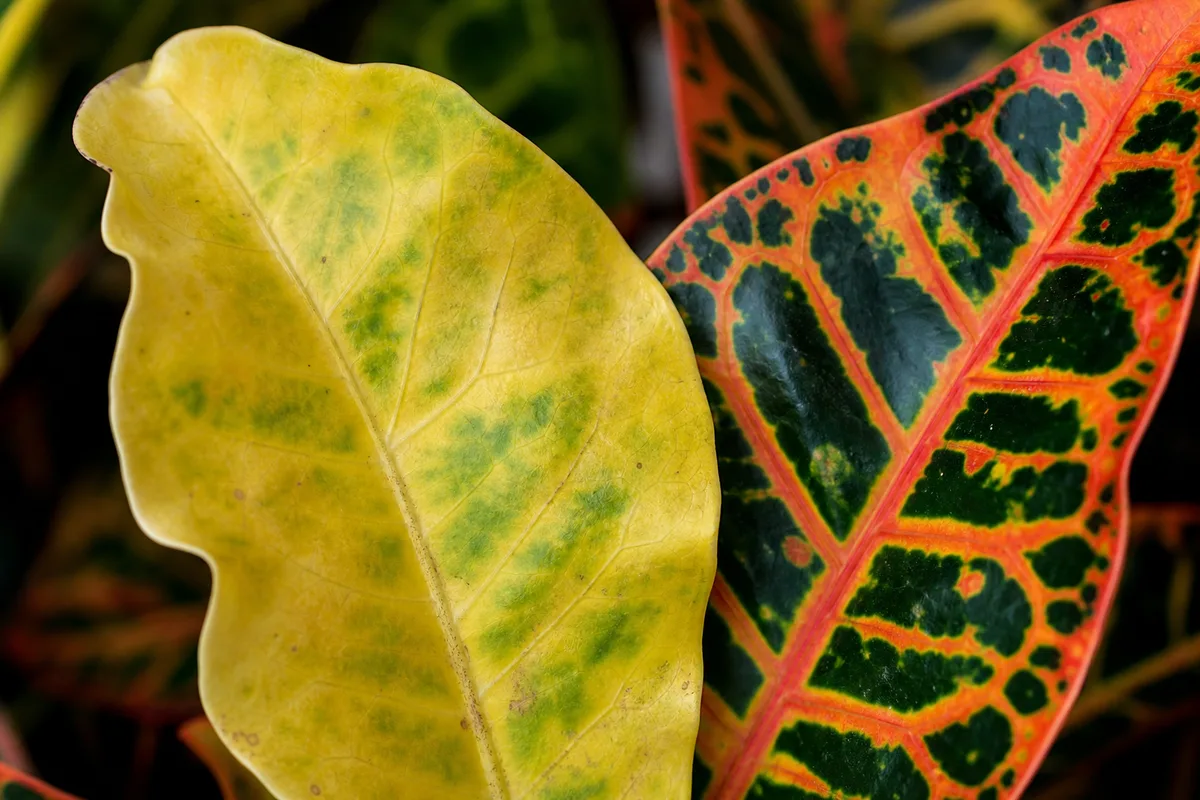
Yellow Leaves symptoms on Croton - compare with healthy tissue on the same plant.
- Relocation shock - Many leaves yellow and drop within days to weeks after bringing a plant home from a nursery, moving rooms, or repotting. Drop often starts on older foliage while stems stay firm. Soil moisture may look normal because the plant is reacting to environmental change, not thirst alone.
- Overwatering and root stress - Lower leaves turn uniform yellow while soil stays wet for days, the pot feels heavy, and leaves may feel limp or dull. Sour-smelling mix or soft stems at the soil line suggest advancing root trouble. See overwatering on croton when wet soil is the story.
- Underwatering - Yellowing pairs with a lightweight pot, dry mix through the top inch, and slight leaf curl or droop before obvious collapse. Thick waxy leaves hide drought longer than thin-leaved species-yellow often appears before dramatic wilt.
- Insufficient bright light (green revert) - New leaves stay green or yellow-green instead of developing bold color; older variegated leaves lose contrast and may yellow before they fall. Internodes stretch and the plant leans toward windows. This overlaps with but differs from uniform stress yellowing-see not enough light on croton for the full light diagnostic.
- Cold drafts and low temperature - Water-soaked or yellow patches followed by drop after cold nights near glass, transport in a cold car, or repeated exposure below about 50°F. Wisconsin Extension notes leaf drop below 50°F, and the RHS lists leaf drop in cold draughts or below 15°C (59°F).
- Spider mite stippling - Fine pale or yellow dots on leaf surfaces with webbing on undersides, often in hot dry winter rooms. Damage can look like yellow patches before leaves crisp. Inspect before assuming watering fault.
- Normal lower-leaf aging - On a terminal-growth shrub like croton, one or two oldest bottom leaves may yellow slowly over months while new variegated growth above stays firm. Low priority if watering, light, and placement are sound. This is not the rosette crown-aging pattern seen on succulents-croton sheds from the bottom of upright stems as it grows upward.
Worry when yellowing hits new center growth, spreads across most of the plant within a week, or pairs with wet sour soil-not when a single old leaf fades over months.
Why Croton gets yellow leaves
Relocation shock is the signature trigger
Croton evolved in stable tropical conditions across Malaysia, the Pacific islands, and northern Australia. Changing environments too quickly can shock the plant and cause leaf drop-the journey from greenhouse to shop to dry apartment is enough. Light intensity, humidity, and temperature all shift at once; the plant sheds foliage to reduce demand while roots catch up.
This is why a croton that looked perfect at the nursery may yellow en masse in week one even when you water carefully. Compensating with extra water on a partially defoliated plant raises root-rot risk.
Overwatering in dim or cool rooms
Croton has moderate water needs-water when the top half-inch to one inch of soil dries. Kept too wet, roots lose oxygen and stop moving water efficiently. Lower leaves yellow first because the root system cannot supply the farthest tissue. Low-light rooms keep mix wet longer, so wet soil plus dim placement is a common combo-yellow leaves with soggy mix need dry-down, not brighter windows alone without adjusting water.
Underwatering and inconsistent rhythm
Croton drops leaves if kept too wet or too dry for extended periods. Drought yellowing often starts on older leaves while the pot feels light and the top inch is crumbly. Owners who see yellow and add water without checking depth sometimes alternate flood and drought-both stress foliage.
Insufficient bright light
Croton needs bright light most of the day, including acclimated direct sun, to hold vivid color. In insufficient light, leaves may lose vibrant colours or drop. New growth stays green; older variegated leaves fade and may yellow before abscission. This is pigment loss and energy budgeting-not the same pattern as sudden shock drop after a move.
Cold temperature and drafts
Croton does best at 60–85°F indoors and suffers leaf drop if temperatures remain below 50°F. Winter window sills, entry doors, and AC vents create microclimates that yellow and drop leaves even when central room temperature looks fine.
Spider mites in dry interiorscape air
NC State Extension notes spider mite susceptibility increases in dry indoor conditions. Stippling lightens leaf tissue before widespread yellowing; webbing on undersides confirms pests, not culture alone.
Normal senescence on lower stems
As croton grows upward from stem tips, the oldest leaves on lower woody stems naturally age out-one or two yellowing over months on an otherwise bushy plant. Remove spent leaves with gloves; milky sap can irritate skin on cut stems.
Lookalike symptoms to rule out
Before repotting or stacking fixes, rule out these common misreads:
| What you see | Likely cause | Quick differentiator |
|---|---|---|
| Mass yellow + drop after purchase or room move | Relocation shock | Recent move; stems firm; soil moisture not extreme |
| Lower yellow + wet heavy pot + sour smell | Overwatering / root stress | Mix damp for days; see root rot if mushy roots |
| Yellow + light pot + dry top inch | Underwatering | Crispy edges possible; perks after thorough soak |
| Green-yellow new leaves + long stems | Low light revert | Dim placement; not uniform overnight yellow |
| Yellow after cold night near glass | Cold damage | Draft history; temperature dip below ~50°F |
| Pale dots + webbing on undersides | Spider mites | Dry air; inspect with magnification |
| One or two bottom leaves over months | Normal aging | New growth clean and colorful |
Wilting plus yellow often means water stress-compare with our wilting guide when leaves droop and yellow together.
How to confirm the cause
Work through this inspection in order:
- Recent history - Did you buy, move, or repot the plant in the last four weeks? Shock is the leading suspect if yes.
- Which leaves yellow - Bottom only over months = aging likely. Many leaves at once = shock, water, cold, or pests. New growth pale green = light.
- Moisture at top half-inch to one inch - Cool and damp = pause watering. Dry and crumbly with light pot = drought. Heavy pot days after watering = slow dry-down or overwatering.
- Light placement - Is the pot more than four feet from a bright window, in a north room, or recently moved from a dim shop? Shadow test at midday: faint fuzzy shadow means too dim for long-term health.
- Temperature and drafts - Nights below 50°F near glass? AC or heat vent blasting foliage? Cold car transport?
- Leaf undersides - Fine stippling, webbing, or sticky residue = spider mites or other pests-not culture alone.
- Root spot-check (if wet soil + spreading yellow) - Gently slide the plant partway out. Firm pale roots support a dry-down fix. Mushy brown roots need trimming before recovery.
Confirmed shock shows recent move history, firm stems, and gradual slowing of drop after stable bright placement. Confirmed overwatering shows wet mix, yellow lower leaves, and possibly soft stems.
First fix for Croton
Stop moving the pot and check soil moisture at the top half-inch to one inch before you water, feed, or repot.
That single step prevents the two most common mistakes-relocating a shocked croton again while it adjusts, and adding water to already wet soil because yellow leaves “look thirsty.”
After the moisture check:
- If soil is wet and the pot is heavy - Let the top half-inch to one inch dry fully before the next watering. Ensure drainage holes are open and saucers stay empty. Do not fertilize. See overwatering if yellowing spreads with sour smell.
- If soil is dry and the pot is light - Water thoroughly with room-temperature water until runoff exits drainage holes; empty the saucer. Resume check-at-knuckle rhythm from the watering guide.
- If you moved the plant recently - Place it in a bright, stable east window or filtered south/west exposure and do not move it again for four to six weeks. Hold consistent watering-not extra water to “help” leaf drop.
- If new growth is green in a dim room - Increase light gradually over 7–14 days per the light guide; do not jump to harsh afternoon sun through hot glass.
- If cold exposure is likely - Move away from uninsulated glass and draft paths; keep temperatures in the 60–85°F range when possible.
Make one primary correction first. Wait two weeks before repotting, fertilizing, or multiple simultaneous experiments unless roots are mushy.
Step-by-step recovery
Match follow-up steps to what you confirmed:
Relocation shock (recent move, firm stems, mass drop slowing):
- Choose a permanent bright spot-east sill or filtered south/west-and leave the plant there.
- Water when the top half-inch to one inch dries; do not keep soil soggy on a defoliated plant.
- Raise humidity with a pebble tray or humidifier if indoor air is very dry, but avoid wet leaves overnight in dim corners.
- Expect some drop for two to four weeks; watch for firm new tips before repotting or feeding.
Overwatering (wet soil, yellow lower leaves):
- Let the top half-inch to one inch dry between waterings.
- Ensure pot drains freely; empty saucers after every watering.
- If roots are mushy, escalate to root-rot recovery-trim dead roots and repot into fresh aerated mix.
Underwatering (dry mix, light pot, slight curl):
- Soak thoroughly once; then resume regular dry-down checks.
- Do not leave standing water in saucers.
- See underwatering on croton if drought keeps recurring.
Low light (green revert, stretch, pale new leaves):
- Move toward brighter exposure in steps over 7–14 days.
- Wipe dust from leaves so light reaches the surface.
- Judge success on the next growth flush with developing color-not old green leaves.
Cold damage:
- Move off cold window sills and away from AC paths.
- Stabilize watering; expect continued drop while the plant adjusts.
- Wait for firm new growth before repotting or fertilizing.
Spider mites (stippling, webbing):
- Shower foliage or wipe undersides; improve humidity without leaving leaves wet overnight.
- Isolate from other plants if infestation is widespread.
- See spider mites on croton if damage spreads despite cultural fixes.
Normal aging (one or two bottom leaves over months):
- Gently remove fully yellow spent leaves; wear gloves because sap irritates skin.
- No other action needed if new growth stays firm and colorful.
Recovery timeline
Fully yellow leaves do not turn green again-they drop or stay pale until removed. Recovery is measured by new growth from stem tips, not old leaf color.
- Relocation shock - Drop often peaks in weeks 1–2, then slows; new variegated leaves may appear in weeks 3–6 if placement and watering stay stable.
- Overwatering correction - Yellowing should stop spreading within two to three weeks after dry-down; new growth stays green if roots are still firm.
- Underwatering - One thorough soak plus stable rhythm often shows clean new leaves within two to three weeks.
- Light improvement - Next flush with shorter internodes and developing pigment may take three to six weeks; older faded leaves rarely regain full color.
- Cold damage - Leaf drop may continue two to four weeks after warmth stabilizes.
- Advanced root rot - Recovery takes longer and may be partial; soft crown or ongoing yellow on new leaves despite dry-down means the plant may not be saveable.
Signs of improvement: new leaves emerge firm with developing color, drop slows, soil dries on a predictable schedule. Signs of worsening: sour smell, soft stems, webbing on undersides, or soil that never dries.
What not to do
Do not keep moving a shocked croton trying to find a perfect spot-each move resets adjustment.
Do not water more because leaves look yellow when soil is already wet at the knuckle depth-that deepens root stress.
Do not fertilize a yellowing, dropping plant to force growth. Salt buildup from overfeeding can yellow foliage; stressed roots cannot use extra nitrogen safely.
Do not repot on day one during shock unless roots are mushy or drainage has failed. Repotting adds stress without fixing relocation or light problems.
Do not exile croton to a dim corner to stop sun-related issues. Croton needs bright exposure; filter harsh rays and acclimate instead.
Do not ignore wet soil while treating for light or humidity. Overwatering and shock overlap-fix what soil moisture confirms first.
Do not remove yellow leaves without gloves. Croton sap from cut stems can irritate skin-wash hands after handling.
How to prevent yellow leaves on Croton
- Stable placement - Choose a bright permanent spot before bringing a new plant home; avoid repeated moves during the first month.
- Bright light with acclimated sun - East window sills or filtered south/west exposure per the light guide; croton is not a low-light species.
- Water on dryness, not calendar - Check the top half-inch to one inch every time; summer may mean every 5–7 days, winter often every 10–14 days.
- Temperature guardrails - Keep above 50°F; protect from cold glass and AC drafts in winter.
- Humidity in heated seasons - Pebble tray or humidifier when dry air drives mite risk and margin stress.
- Inspect undersides weekly in winter - Catch spider mites before stippling spreads.
- Match watering to light - Brighter exposure uses water faster; dim rooms need less frequent watering to avoid chronic wet soil.
When to worry
Treat yellow leaves as urgent when:
- Many leaves yellow within days while soil stays wet and smells sour-inspect roots the same week.
- Stems soften at the soil line or blacken upward-possible advanced rot.
- New crown leaves yellow within days of unfurling despite stable care-root or pest problem likely.
- Fine stippling and webbing spread on undersides with widespread pale patches-mites, not thirst alone.
- The plant collapses despite moist soil-roots may be failing to absorb water.
One or two yellow bottom leaves over months on an otherwise stable Petra or Mammy in good light is usually cosmetic aging-not an emergency.
Croton yellow-leaf cause comparison
| Cause | Leaf pattern | Soil / pot | First action |
|---|---|---|---|
| Relocation shock | Mass yellow + drop after move | Often normal moisture | Stop moving; bright stable spot |
| Overwatering | Lower yellow; limp foliage | Wet, heavy pot | Dry-down; check roots if sour |
| Underwatering | Yellow + curl; older leaves first | Dry, light pot | Thorough soak; stable rhythm |
| Low light | Green-yellow new growth; stretch | May stay wet longer in dim room | Increase light gradually |
| Cold drafts | Yellow after cold nights | Variable | Move off glass; warm stable air |
| Spider mites | Stippled pale patches; webbing | Usually not wet-related | Inspect; shower; improve humidity |
| Normal aging | One–two bottom leaves over months | Healthy rhythm | Remove spent leaves; monitor |
Related Croton guides
- Croton overview - full care context for Codiaeum variegatum
- Croton light needs - bright direct sun, acclimation, color intensity
- Croton watering - soil checks and seasonal rhythm
- Not enough light on croton - green revert deep-dive
- Overwatering on croton - wet-soil yellowing overlap
- Underwatering on croton - drought lookalike
- Root rot on croton - mushy roots escalation
- Wilting on croton - combined wilt and yellow
- Spider mites on croton - stippling and webbing